Showing posts with label Horror. Show all posts

Sunday, 5 July 2020

The Uncanny (1977)


I have watched horror films for over 25 years, and I have had cats all my life. Despite this, I had somehow missed the existence of a Milton Subotsky anthology film starring Peter Cushing as a paranoid writer, who believes felines have a plan to topple mankind as the dominant species on planet Earth.

Cushing is Wilbur Gray, a writer trying to convince his publisher of his conspiracy theory. To illustrate it, he tells three tales. 

The first is set in 1912 London. A wealthy woman changes her will to leave all her money to her cats rather than her wastrel nephew. Said nephew (played by Simon Williams) is also having an affair with her maid. The cats are having none of it.

The second story involves an orphan girl in contemporary Canada. Sent to live with her aunt, uncle and their bratty child, Lucy brings her only friend, a black cat called Wellington. Bratty child hates Wellington, but the cat has the last laugh, thanks to some awful camera trickery.

The third sees Donald Pleasance as 1930s Hollywood star Valentine De'ath. He does away with his wife by "accidentally" having a film set use a real blade in a Pit and the Pendulum scene. De'ath then bullies his producer Pomeroy (John Vernon) into handing over the role to his halfwit girlfriend Edina (Samantha Eggar). Again, the late wife's cats are having none of it.

Don't get me wrong, this is badly written, filmed, and directed. However, the cast alone makes it essential viewing for trash fiends. Peter Cushing made his fair share of stinkers, but I cannot think of any of them where he is anything less compelling, as well as playing it straight no matter how ludicrous the premise. Pleasance had a comparable mix of duds and dandies, but again, he always brought a compelling intensity, and with this film, a campy sense of humour. In addition, there is the always watchable Ray Milland as Cushing's understandably cynical publisher. He is right to be cynical, as the stories only seem to illustrate that the cats are justified in their behaviour.


Sunday, 31 May 2020

The Mummy (1959)


The Mummy comes from that first flush of Hammer studio's late 1950s horror success that also included Dracula and Frankenstein. It has many of the classic elements, such as the stars, the director, the writer, luscious cinematography, rich dramatic score. It has also has some of the problematic elements, that nowadays are fascinating to examine.

The story starts in the 1890s with a team of British archaeologists in Egypt, led by John Banning (Peter Cushing) and his father Stephen (Felix Aylmer). They uncover the sealed tomb of one Princess Ananka, but Stephen inadvertently brings the mummified body of her High Priest Kharis (Christopher Lee) back to life. Years later, back in England, Mehemet Bey (George Pastell), a modern-day worshipper of Ananka unleashes the undead Kharis to take gruesome revenge on the them.

Cushing's role is different to that Frankenstein or Van Helsing. Those are more authoritative people, they have answers, they drive the story. Banning has no knowledge of, or part in the creation of the mummy. He is learning as he goes, which does give the character a chance to develop.

Even covered head to toe in layers of muddy bandages, Lee is still recognisable, through his eyes and stature. His mummy is a relentless killing machine, immune to bullets and knives, a precursor to the Terminator.

Some elements do look dated. In an accurate depiction of the time the film is set in, archaeology is shown as going to a faraway country to loot artifacts and interpret them through the prism of the colonial English.

None of the Egyptian characters are played by Egyptians. Pastell (who is Cypriot born) is suitably slimy as Bey. He says his magic spells in a mix of gibberish and English. With brown skin and a permanent bright red fez, he sticks out and is easy to spot as the bad guy.

There is mileage in the symbolism of the story. At the heart of it is pesky foreigners and their backwards superstitions. By coming "over here" they can be seen as foreign agents invading the country. However, the English characters are all brought down by their arrogance, and English exceptionalism.


Monday, 13 April 2020

The Thing from Another World (1951)


The Thing from Another World is an entertaining mix of Cold War paranoia and Howard Hawks machismo.

The plot is based on "Who Goes There?", a short story by John W. Campbell. A group of scientists and US Air Force crew unearth a frozen flying saucer and its pilot near to their Arctic base. Unfortunately for them, the pilot has thawed out, is on the hunt for blood, and is impervious to their bullets.

There has been some confusion over who directed this film. Christian Nyby is the man on the credits, but. Howard Hawks, whose production company made the film, has often been mentioned as being the real talent behind the lens. Regardless of how true any claim is, there are some Hawks-like tropes, most noticeably in the rapid and overlapping dialogue.

In the original short story, the alien is a shape-shifter, imitating the characters, and causing tension and paranoia. In this version, it becomes a vegetable-based humanoid (memorably described as "an intellectual carrot"), immune to bullets and needing blood to regenerate. But there is still tension in the conflict between scientists and the military. The character of Dr Carrington in particular is shown as, if not an enemy, then at least a threat by wanting to reason with the creature rather than set it on fire. This makes a change from other sci-fi films of the era. Scientists are usually portrayed as the only people with the answers, working with or trying to keep the military in check.


Tuesday, 7 April 2020

Galaxy of Terror (1981)


Galaxy of Terror is a cheap, sleazy and goofy attempt by Roger Corman to cash in on the Sci-fi boom of the era.

The plot sees a spacecraft off to a distant planet to rescue the crew of another ship. But, the mission goes wrong when the rescue ship itself crashes. Then, the crew start to come under attack from what appear to be demons from their own minds.

Any right thinking trash hound will immediately be attracted by the cast. There is Robert "Freddy Krueger" Englund. The captain of the rescue ship is Grace Zabriskie aka Laura Palmer's mom in Twin Peaks. And one of the crew members is Erin Moran, otherwise known as Joanie Cunningham from Happy Days.

The film is often described as an Alien rip off. This hinges on one particularly unpleasant scene of a female crew member being raped by a slimy tentacle creature. The other deaths revolve around hallucinations linked to their subconscious.

Galaxy of Terror feels like it was shot in a weekend. But, there is a good grungy, Dark Star feel to the production design and special effects, partly due to a young James Cameron.

Unfortunately, a jumbled baffling narrative and too many slow dull patches make the film hard work and less fun than it should be.


Sunday, 22 March 2020

Dracula's Daughter (1936)


As a sequel, Dracula's Daughter is overlooked and overshadowed by the Bela Lugosi original. Today it feels like a brave attempt to bring something fresh to the vampire mythology. The pace of the story and editing is snappier than the sometimes sluggish original. It is also loaded with fascinating symbolism and a great performance from Gloria Holden as the title character.

With a quick recap, the plot picks up at the end of the first film. Professor Van Helsing has been arrested (by Yorkshire policemen talking with "gor blimey guvnor" accents) for murder after destroying Count Dracula. He enlists the help of a psychiatrist friend Dr Jeffrey Garth (Otto Kruger) to try and prove his innocence. Meanwhile, Dracula's daughter, Countess Marya Zaleska has stolen and burnt the Count's body hoping to break free of the curse of vampirism. After a chance meeting with Dr Garth, she enlists him in her efforts. But Zaleska seems unable to curb her blood cravings, and takes to kidnapping young girls from the streets of London 

As much as I love the Universal monsters films, they are a boys club. (The obvious other exception is the Bride of Frankenstein, although the time the title character is on screen is minimal). So, to see a strong female protagonist who is the main focus of the film makes a refreshing change. Dracula's daughter has the same seductive power over both men and women as her father. Of course this raises the question, how did she become a vampire? Through her father? Is this child abuse?

This is very much a film of it's time, not least with it's fascination with psychoanalysis. Zaleska tries to enlist the help of Dr. Jeffrey Garth to cure what she thinks is a mental illness. This is a man who believes addicts should simply use their willpower, without examining the underlying causes. When new victims of the vampire appear the initial assumption is that is Dracula. I mean, God forbid that a woman should have the competence and initiative to stalk their own victims. This is, after all, a psychiatrist who spends his spare time shooting birds with his big gun. He also stumbles over tying a tie. Only Janet, his long suffering secretary, can finish him off.


Thursday, 27 February 2020

Dracula (1974)


1974 was a bumper year for vampire films in quantity, if not always quality. Andy Warhol was bring the sleaze and gore in Blood for Dracula. Hammer Studios were looking for new twists, with Captain Kronos, Vampire Hunter and the martial arts cash-in Legend of the Seven Golden Vampires. Meanwhile, David Niven was embarrassing himself in Old Dracula. Elsewhere, Dan Curtis, the producer of legendary Gothic soap opera Dark Shadows brought us a TV take on the tale.

The screenplay is by genre legend Richard Matheson, and the plot hits all the major beats of the source novel. But, like the Hammer and Universal versions, it pares back the sprawling plot and cast of characters. One original element it does introduce is the idea of Dracula being a tragic, lovesick character, doomed to spend eternity pining for a lost love. This is something that Francis Ford Coppola will use twenty years later by in his risible take on the story.

In the title role is Jack Palance, someone who has no problem being evil, menacing, and imposing. In fact he's almost like the Terminator, acting alone, breaking into houses, and refusing to lie down when shot, Palance also brings a secondary layer to the character. His Dracula is someone who is occasionally vulnerable to, and not quite in control of their lusts. This offers a reading of the character as a metaphor for addiction.

Opposing Dracula as his arch rival Dr Van Helsing is Nigel Davenport. He is best known, to me at least, as the cantankerous scientist Hubbs in the apocalyptic classic Phase IV. As Van Helsing he brings the necessary stolid reassurance of the character. But he lacks the eccentricity and energy that someone like Peter Cushing being to the role.

The cinematography makes it look like an episode of Hammer House of Horror. This is not a criticism, as a I am big of fan of this show, but it means it might be an acquired taste. Regardless, it's a pacy, creepy and often overlooked version of a familiar tale.


Tuesday, 11 February 2020

Parasite (2019)


For once the hype is justified and the Oscars got it right. Parasite is a brilliant, unsettling and completely unpredictable work.

Set in modern day Korea, the story revolves around two families, from polar opposite ends of the social spectrum, whose lives intertwine by chance. There is no point saying much else about the plot, as you should watch Parasite with as little prior knowledge as possible.

Director Bong Joon-ho effortlessly switches between gears and genres. He mixes unsettling horror, with black comedy and heartbreaking tragedy, wrong-footing the audience expectations. He backs it with characters that are complex, believable, and very sympathetic, even when this sympathy is challenged.

It is also, I suspect, a richly layered work with plenty of rewards for repeat viewing.


Saturday, 2 November 2019

The Black Sleep (1956)


The Black Sleep is an intriguing and little seen low budget horror film, with a dream cast of genre veterans.

In Victorian England, a brilliant surgeon, Sir Joel Cadman (Basil Rathbone) is trying to find a way to revive his beloved wife from a coma caused by a brain tumor. But, his methods are a little unscrupulous, as Cadman employs a powerful anesthetic from India to induce a death like state in his test subjects. He uses it to snatch a fellow Doctor, Gordon Ramsey, from Death Row, where Ramsey is awaiting execution for a murder he denies carrying out. Cadman wants Ramsay's help, but as Ramsey soon discovers, not all Cadman's previous experiments have been so successful.

Rathbone is on fine form, making Cadman initially seem charming and even sympathetic, but slowly revealing him to be cruel and insane.

His co-stars are not always as lucky. Lon Chaney Jr hams it up as Mungo, a former scientific genius who has been turned into a crazed madman by the good doctor's experiments. But poor Bela Lugosi, in his final filmed role, is left without a word to say. The underwritten character of Cadman's butler feels like it was written to put Lugosi's name on the posters.

Tor Johnson, Lugosi's co-star in the Ed Wood films Plan 9 from Outer Space and Bride of the Monster, has some fun as the sort of lurking bulk of a monster he excelled at.

The highlight comes in the form of John Carradine, playing another of Cadman's victims. Carradine does not hold back, even by his usual standards, as the climax sees the inmates taking over the asylum.


Tuesday, 17 September 2019

The Body Snatcher (1945)


The Body Snatcher is a classic example of a film that has all the ingredients on paper, but which never comes to life.

The screenplay is based on a short story by Robert Louis Stevenson. The film stars no less than Boris Karloff as the title character, John Gray, a shifty cab driver who has a sideline sourcing and delivering dead bodies for top surgeon Wolfe "Toddy" MacFarlane (Henry Daniell, best known as Goebbels parody Garbitsch in Charlie Chaplin's The Great Dictator). Bela Lugosi has a small role as MacFarlane's other cadaver consultant, but the fact that he barely registers should be an alarm bell for the rest of the film.

Producer Val Lewton had previously given us Cat People, The Curse of the Cat People and I Walked with a Zombie. These films, despite their lurid titles, have an unsettling mix of atmosphere and ambiguity. This kept the viewer intrigued and on edge. Director Robert Wise would go on to have an eclectic career, from editing montages for Citizen Kane, to directing everything from low key noir classics like The Set Up to big budget epics like The Sound of Music and Star Trek: The Motion Picture
 
There are some interesting ideas in The Body Snatcher, particularly with regard to class, and how those at MacFarlane's level feel like they can get away with flouting the law. But, largely it is talk, endless talk, with little or nothing left to the imagination of the viewer, the central strength of Lewton's former work. One for the Karloff / Lewton / Lugosi completists only.


Thursday, 12 September 2019

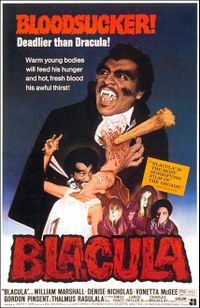
Blacula (1972)


Blacula is a fun and intriguing mash up of Blaxploitation and horror, with a dignified turn from William Marshall as the title character.

Marshall plays an 18th century African prince named Mamuwalde. He wants to bring his kingdom into the modern world, and, for some reason, turns to Count Dracula for help. Unsurprisingly, it does not go well, and instead of opening up global markets, Dracula opens up the veins in Mamuwalde's neck, seals him up in a coffin and leaves his wife Luva to die. Cut to the 1970s, and two interior decorators who are expanding their US property portfolio to include Transylvania. They unwittingly resurrect Mamuwalde after bringing him back to the US, leaving him free to pursue a woman he thinks is the reincarnation of his late wife.

This is cheap but cheesy fun and there has been some thought gone into the script.
 
The original Dracula story had the Van Helsing character to act as the counterpoint to Dracula (and exposition point for the audience). Wisely, Dr. Gordon Thomas (Thalmus Rasulala) plays that role here.

What is especially interesting is that all the main characters are black, and the producers made no attempt to introduce any kind of white saviour character.

The real star is William Marshall whose natural charisma manages to inject some dignity into the part of Mamuwalde, and make him a tragic rather than horrific character.


Sunday, 11 August 2019

A Cat in the Brain (1990)


Lucio Fulci had a long career as a director, one that covered many styles. But he is best remembered for the gore splattered horror films he made from the late 70s onwards. A Cat in the Brain presents itself as a horror version of 8 1/2, a meta reflection on this particular genre, as well as Fulci's career, and his audience.

Fulci plays a fictional version of himself, a director in the middle of shooting his latest gory effort. Not only that but "Fulci" is also convinced he is going mad, sent over the edge by years of making horror films, and that he may be responsible for a series of slayings near his house.

For such an intriguing wacky premise with so much promise, the end result is surprisingly dreary and plodding.

Much of the footage in A Cat in the Brain is culled from half a dozen films Fulci was involved in a year or two previously, although none of them have anything to do with each other.

The mismatched incoherent tone is sometimes the perfect representation of a fractured disintegrating psyche, but often makes the film look cheap and poorly thought out.


Wednesday, 16 January 2019

Death Bed: The Bed That Eats (1977)


Apart from having a damn great title, Death Bed: The Bed That Eats is a baffling but compelling mix of horror, black comedy, inventiveness and incompetence.

For once with an exploitation film, it delivers on that title. There is a plot of some sort, something about a demon in love with a woman who died in the titular bed, and an artist trapped in a painting who, in a voice that disconcertingly sounds like Stephen Fry, taunts the demon while providing a narration of sorts. But the focus is on four set pieces, each labelled with meal related intertitles, where unsuspecting folk wind up on the mattress menu.

At times it reminded me of Hausu, which was released in the same year. But it lacks the relentless breakneck pace of that loopy Japanese classic, going instead for a momentum free druggy torpor, where the characters almost stagger around, disconnected from reality.

Luckily, there's enough going on to stop things getting dull. The premise is loopy enough and director George Barry (in his only attempt at film making) accompanied it by some equally surreal visuals, and a harsh jarring synth soundtrack. Barry doesn't skimp on two other vital ingredients. There is plenty of gore, such as a woman getting garrotted by her own crucifix. There is plenty of weird humour, such as the bed drinking a bottle of Pepto-Bismol after a particularly hard to digest victim. Coupled with some hammy acting, it sometimes feels like a Monty Python sketch.

If you're looking for plot, characters and slick film making, this may not be for you. But, if you like brain stretching freaky chutzpah,
Death Bed: The Bed That Eats is well worth a look.

Saturday, 8 December 2018

The Strange World of Planet X (1958)


An unremarkable low budget British Sci-fi B-movie, The Strange World of Planet X lumbers along through an hour of talky cliched script before bursting into life with some stupid special effects.

In a laboratory in rural England, archetypal mad scientist Dr Laird is carrying out experiments involving ultra-powerful magnetic fields. His American assistant Gilbert Graham (Forrest Tucker) is having some doubts about the work, as are the government backers. After a freak storm hits the country, giant mutant insects appear in the village forest. Are they linked to Laird's laboratory? And who is the mysterious Mr Smith, who seems to know a lot about both Laird's work, and some recent UFO sightings?

The film staggers on for an interminable talky hour, with little in the way of interesting character development or even cheap thrills. It's sustained by the charisma of Tucker, the cringe-worthy sexism of the scientists towards a female colleague (they don't believe she can do "highly skilled work"), and the mysterious Smith character, who, with his interest in dangerous science, turns out to be a rip off from Klaatu in The Day the Earth Stood Still. Oh, and there's a subplot about a tramp who gets turned into a serial killer by the storm, but that soon fizzles out.

After that, the giant insects arrive. Of course, when I say giant insects, I mean normal insects filmed extremely closeup, which is exactly what they look like.

It's worth watching for the cheap laughs at the climax, but it is a hard slog to get there.


Sunday, 4 November 2018

Halloween (2018)


The Halloween film series, just like main antagonist Michael Myers, refuses to stay dead. The eleventh outing has an excellent turn from original star Jamie Lee Curtis but fails to bring much else new or exciting.

Wisely ignoring the sequels (both old and new), the story starts Michael with locked up in an asylum, forty years after the events of the first film. The object of his stalking, Laurie Strode (Curtis) has spent the time suffering PTSD, which has cost her two marriages and the relationship with her daughter. One day she gets the news that she has been dreading - Myers is being transferred to a new facility, giving him the opportunity to escape and finish what he started.

It's always great to see Jamie Lee Curtis in anything, and here she brings a great mix of vulnerability and toughness to her character. The other characters are mostly forgettable, but that is not unusual for the genre. Kudos also to John Carpenter who, with his son Cody and Daniel Davies, has crafted a score that is as discomfiting and driving as his work for the original.

The film is competently made but never answers the question "What's the point of this?". Director David Gordon Green reverently copies many of the shots and tropes of the original, but misses the main thing that made the original work so well. The original’s director John Carpenter stripped nearly everything back to the bare minimum, from the story, to the score, to the fleeting appearances of Myers in tracking shots.

Green takes the opposite approach, overloading the film with themes and topics, (best represented by the two podcasters trying to re-examine Myers story and turn him into an object of fascination) and the inevitable throwbacks to the original film. All this does is remind you how lean and efficient the original was.


Tuesday, 30 October 2018

Mother Riley Meets The Vampire (1952)


One for the Bela Lugosi (or Mother Riley) completists, Mother Riley meets the Vampire is a strange hybrid of English Music Hall and American low budget mad scientist movies.

Arthur Lucan had been playing Mother Riley, an Irish washer woman who gets herself into assorted scrapes and adventures, on stage and screen since the 1930s, but, possibly due to the parochial nature of the character, the films had not really caught on internationally had much success outside of the UK. Enter Bela Lugosi, who had travelled to the UK for a stage version of Dracula that flopped, leaving him penniless and desperately needing money to get back to the US. Producer George Minter must have seen him, even in the twilight of his career, as a big enough name to drum up some business at the American box office.

The sinister Von Housen (Lugosi) has two notable character traits: he is hellbent on seeks dominating the world with an army of 50,000 radar-controlled nuclear-powered robots. He also reckons he's a vampire and has several young women abducted, including one who has a map to a uranium mine that he needs for his robot army. Granted, his army is currently 49,999 short, and to make matters worse, his only functioning robot has been shipped to Mother Riley's store by mistake.

The result is two different film styles that don't really gel together, but it's more entertaining than not. Lugosi seems to be enjoying himself, and, as always, is great fun to watch. Lucan brings a sense of knockabout slapstick and some well delivered occasional salty quips ("May the saints shower you with sailors on shore leave!"), but his constantly shrill delivery means a little goes a long way. Modern audiences may mostly be reminded of comedy character Arthur Atkinson from the Fast Show, with comparable baffling catchphrases and contemporary references.