Horror and Sci-Fi films old and new, weirdo trash, arthouse, forgotten gems, well loved classics, and I'm watching the original Dr Who from the beginning.
Showing posts with label Freud. Show all posts
Sunday, 22 March 2020
Dracula's Daughter (1936)
As a sequel, Dracula's Daughter is overlooked and overshadowed by the Bela Lugosi original. Today it feels like a brave attempt to bring something fresh to the vampire mythology. The pace of the story and editing is snappier than the sometimes sluggish original. It is also loaded with fascinating symbolism and a great performance from Gloria Holden as the title character.
With a quick recap, the plot picks up at the end of the first film. Professor Van Helsing has been arrested (by Yorkshire policemen talking with "gor blimey guvnor" accents) for murder after destroying Count Dracula. He enlists the help of a psychiatrist friend Dr Jeffrey Garth (Otto Kruger) to try and prove his innocence. Meanwhile, Dracula's daughter, Countess Marya Zaleska has stolen and burnt the Count's body hoping to break free of the curse of vampirism. After a chance meeting with Dr Garth, she enlists him in her efforts. But Zaleska seems unable to curb her blood cravings, and takes to kidnapping young girls from the streets of London
As much as I love the Universal monsters films, they are a boys club. (The obvious other exception is the Bride of Frankenstein, although the time the title character is on screen is minimal). So, to see a strong female protagonist who is the main focus of the film makes a refreshing change. Dracula's daughter has the same seductive power over both men and women as her father. Of course this raises the question, how did she become a vampire? Through her father? Is this child abuse?
This is very much a film of it's time, not least with it's fascination with psychoanalysis. Zaleska tries to enlist the help of Dr. Jeffrey Garth to cure what she thinks is a mental illness. This is a man who believes addicts should simply use their willpower, without examining the underlying causes. When new victims of the vampire appear the initial assumption is that is Dracula. I mean, God forbid that a woman should have the competence and initiative to stalk their own victims. This is, after all, a psychiatrist who spends his spare time shooting birds with his big gun. He also stumbles over tying a tie. Only Janet, his long suffering secretary, can finish him off.
Labels:
1936,
Bela Lugosi,
Black and White,
Dracula,
Freud,
Horror,
Universal,
vampires
Thursday, 6 July 2017
Now Voyager (1942)
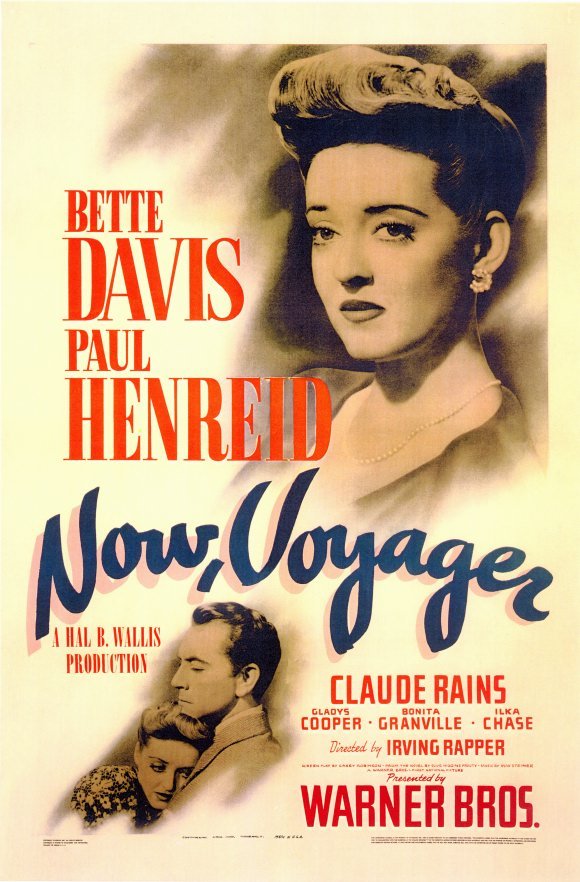
Now Voyager appeared as part of the first wave of Hollywood's brief love affair with psychoanalysis, along with the likes of Hitchcock's Spellbound. This Freudian undertone sets it apart from standard Hollywood romantic melodramas, and the plot of a person forced to repress their true personality by an overbearing family figure seems to have struck a chord with gay film fans, amongst whom it has a fanbase to this day.
Bette Davis plays Boston heiress Charlotte Vale, a neurotic mess, largely due to her domineering mother (Gladys Cooper). After coming under the care of psychiatrist Dr. Jasquith (Claude Rains), Charlotte reinvents herself, going from frumpy introvert to glamorous woman about town. While on a cruise she meets and fall in love with a married man, Jerry (Paul Henreid). How will her mother react to the newly independent Charlotte? And can she ever find happiness with Jerry?
Drama is based around conflict and there is no shortage of that in this film, with Charlotte clashing with her mother, Charlotte's sister clashing with her mother, her mother clashing with Dr Jasquith, and Charlotte clashing with her feelings for Jerry. What makes the drama seem so fresh is the liberal attitude of Jasquith. He is more interested in Charlotte being happy, rather than have her conform to the stuffy morality of her background, or, indeed, of the wider society of the day, something that makes the appeal to the film's gay fanbase obvious. In addition, the script goes against the grain of contemporary romantic films by not going for an obvious path to true love, and seeming to accept that relationships are often complicated and happiness not always conventional.
There is plenty of fun to be had watching Bette Davis playing against type as the monobrowed dowdy Charlotte we see at the beginning of the film, emerging from her chrysalis into the polar opposite, glamorous, adventurous, and fun loving, not giving a damn for the stifling world of upper middle class Boston and the sense of duty and obligation that comes with it.
Film and psychoanalysis are the around the same age, as the Lumiere brothers started screenings of moving pictures in 1895, the same year that Freud published Studies in Hysteria, his first foray into what would become psychoanalysis. If anything it is the depiction of psychoanalysis itself, or at least the Hollywood version of Freud's work that dates Now Voyager. It portrays the mystery of the human psyche as being like a whodunnit, one that can be unravelled with the aid of the right clues, an approach that now seems a little unsophisticated.
Thursday, 7 April 2016
Forbidden Planet (1956)
1950s sci-fi films often feature campy special effects and hostile outsiders from another planet trying to invade this one but Forbidden Planet stands out from the crowd in that it features neither of these things. MGM poured a lot of money into the excellent model work and borrowed a Disney man to work on the animated laser blasts and the famed "Monsters from the ID" and the threat comes not from "out there" but from deep within the mind of man.
In the 23rd Century, a star ship led by Commander John Adams (Leslie Nielsen) is sent to the distant planet of Altair 4 in order to find out what happened to an expedition who landed there 20 years earlier. On arrival the crew are met by the only survivors, Dr Morbius and his daughter Altaira, and their robot servant, Robby. Morbius tells them that his shipmates and their craft were destroyed by a planetary force when they tried to leave. The same force starts to attack Adams and his crew and ship but is it a force which may have a source closer to home than someone would like to admit?
The script for Forbidden Planet is both one of the best and weakest things about the film. The themes explored are serious and intelligent, aimed at adults, not the teenage drive-in crowd of The Blob, and are engaging and thought provoking. But it is also relentlessly talky at times, giving the film an often sluggish paced, something not helped by the slightly flat and stilted performances of the leads.
However, these occasional lapses are more than made up for by the sumptuous visuals, whether it is the spacecraft model work, the huge, imposing and beautifully realised Krell underground cities (structures that completely dwarf their human interlopers), or the eerie and disturbing animated silhouettes of the Id monster, courtesy of Disney’s Joshua Meador, who was loaned to MGM for the film.
The story is not entirely original of course. Forbidden Planet often gets branded as a space opera version of The Tempest, and while that is not strictly true, it does share some similarities with Shakespeare's play. The Tempest centres on Prospero, a magician exiled to an island with his daughter Miranda by his brother Antonio who then steals his title and property. Prospero uses his powers to cause a storm that shipwrecks Antonio, trapping him on the island where he can take his revenge. Morbius is the Prospero character with Altaira as Miranda, and Altair 4 stands in for Prospero's island. After that the comparisons don't really work as Adams and the crew are strangers to Morbius, and he is not driven by revenge, rather a desire to be left alone to carry exploring the planet and the Krell, the now extinct civilisation that lived there previously.
Forbidden Planet works much better if you judge it as a piece of work in its own right, and as a time capsule of the ideas, attitudes and obsessions of the time in which it was made. The first of these obsessions is Freudian psychoanalysis, which by the 1950s had come out of the consulting room and into popular culture, in particular the movies, through the work of directors such as Hitchcock. It is made explicit in Forbidden Planet through talk of "Monsters from the Id". The Id is what Freud thought of as the primitive, instinctive, often illogical aspect of our personality that demands immediate satisfaction, regardless of the consequences. Morbius thinks both he and the Krell have outgrown this, but it soon becomes apparent, particularly when handsome space pilots take a shine to his daughter, that he has not, and the raging torrent in his psyche takes a more literal and deadly form when linked to the highly advanced Krell technology.
Forbidden Planet is also very much of it's time in its look and attitudes. The Flying Saucer that the crew arrive in is another 1950s icon, albeit one here used by mankind rather than little green men. The film has some of the 50s can-do optimism of a country riding high from the post-war euphoria, with a new generation of pioneers, rolling up their sleeves and carving out new worlds. The craft is run like the ships and subs that some of the audience may have served on during the war 10 years earlier, even down to the cook with a taste for bourbon.
Robby the Robot is also a very old fashioned idea of a robot, basically a butler with a deadpan tone of voice. Although a wildly impractical design, he would go to become an iconic figure in further films and TV shows, and here, more importantly, plays an important role, driving the plot forward with his manufacturing capabilities and programmed attitudes towards human life. The deadpan tone also provides some comic relief to the sometimes very serious onscreen talking.
The astonishing, unsettling soundtrack is the work of electronic music pioneers Bebe and Louis Barron. It breaks all the rules of what a soundtrack should be in two big ways. Firstly it is entirely atonal, being composed and performed on oscillators made by the Barrons, and fed through echoes and tape loops. Secondly, by having their work represent everything from the ambient noise of the Krell buildings, the roar of the monsters and the ship’s engines, but also having it underpin key scenes to add to the tension, they blur the lines between diegetic and non-diegetic audio.
Forbidden Planet had a further influence beyond this, leaving an undeniable mark on the whole sci-fi genre. It paved the way for serious, adult sci-fi such as 2001: A Space Odyssey, as well as providing the template for Star Trek. The film and TV show both feature a ship run like a military craft, exploring new worlds and investigating mysteries, but using a scientific approach to explain things. In addition, the human drama in Trek and Forbidden Planet centres around the three main crew members, the First Officer, the ship’s doctor, and the steely, unflappable captain with an eye for the ladies.
Tuesday, 13 May 2014
The Dark Mirror (1946)
The Dark Mirror
is an entertaining melodrama, fusing elements of film noir, psychoanalysis and an
old cinematic trope about good twin vs bad twin. Although the psychology has
dated badly, the film is more than lifted by clever direction, great lead
performances, and some, for the time at least, astonishing special effects
Terry and Ruth
Collins (both played by Olivia de Havilland) are identical twins, one kind and
caring, the other a very disturbed individual. However, both are caught up in
the murder of a doctor after witnesses place one of them with the victim just
before his death. The police agree, but are stumped as to which, so they call
in the help of psychiatrist Doctor Scott Elliott to see if he can shed any
light on them. However, is Elliot putting his own life at risk, by falling in
love?
Although the
events in this film are triggered by crime, director Robert Siodmak favours
mind over murder, with the focus on Elliot delving into the psyche of the
sisters, rather than any police investigation. Olivia de Havilland wisely plays
the pair as having distinctive characteristics, particularly in their attitudes
to men, without being too dissimilar, or too extreme and theatrical.
Her performance
is greatly helped by the extraordinary (for the time at least) optical effects
used to place both twins in the same shot, which, when combined with clever
editing and body doubles, means it is often possible to forget you are watching
the same actress.
She gets able
support from Thomas Mitchell as the baffled police detective, Lt. Stevenson, bringing
the same sort of likeable enthusiasm he gave to the role of Uncle Billy in It's
a Wonderful Life. Lew Ayres is less successful as Dr Elliot, although this may
be down to the character being fundamentally unlikeable, a slightly pompous
know-it-all, whose actions, particularly taking a patient out on a date, can
seem a little unethical.
Siodmak is
considered, in some circles, “the primary architect” of Film Noir, and there are enough elements of Noir, both in style
and character, for it to be counted in that genre. The film is shot with plenty
of stylised light and shade, which helps keep an air of suspense and unease,
the plot revolves around crime, and, of course, if there is a woman who is
aggressive confident, and intelligent, she has to be evil. Siodmak has also
taken the time to put plenty of mirror themes into the imagery and characters,
such as the symmetrical Rorschach inkblots in the opening and end credits, or
the total opposite character pairing of the old-fashioned cop and the
ultra-modern doctor.
What also makes
this film so fascinating is the portrayal of psychoanalysis, something
Hitchcock had started putting into his films with Spellbound, which was
released a year before this. Perhaps it was the hope it seemed to offer in
healing the minds shattered by the traumas of World War Two, but it is shown as
something that can provide, quantifiable, empirical, definitive answers, and
quickly, in the same way a treatment of drugs can for the body. At one point
Elliot subjects the twins to a Rorschach inkblot test, showing them a series of
pictures and noting their answers. He is then seen crosschecking these against
some sort of textbook, before going on to tell Stevenson that from the results
of this alone can he tell for certain that one of the twins is insane. This
kind of thinking looks clunky and simplistic nowadays, although this film was
not the only example. The idea that a psychological test or the uncovering of a
single traumatic event can provide the key to unlocking a mystery would crop up
in other Film Noir movies, throughout Hitchcock’s work, and in the giallo films
that came out of Europe in the 1960s and 70s. This suggests a pattern of
thinking in directors (maybe also in audiences) that, no matter how baffling a
mystery may be, it cannot, under any circumstances, go unsolved.
Subscribe to:
Posts (Atom)