Horror and Sci-Fi films old and new, weirdo trash, arthouse, forgotten gems, well loved classics, and I'm watching the original Dr Who from the beginning.
Showing posts with label Colour. Show all posts
Sunday, 5 July 2020
The Uncanny (1977)
I have watched horror films for over 25 years, and I have had cats all my life. Despite this, I had somehow missed the existence of a Milton Subotsky anthology film starring Peter Cushing as a paranoid writer, who believes felines have a plan to topple mankind as the dominant species on planet Earth.
Cushing is Wilbur Gray, a writer trying to convince his publisher of his conspiracy theory. To illustrate it, he tells three tales.
The first is set in 1912 London. A wealthy woman changes her will to leave all her money to her cats rather than her wastrel nephew. Said nephew (played by Simon Williams) is also having an affair with her maid. The cats are having none of it.
The second story involves an orphan girl in contemporary Canada. Sent to live with her aunt, uncle and their bratty child, Lucy brings her only friend, a black cat called Wellington. Bratty child hates Wellington, but the cat has the last laugh, thanks to some awful camera trickery.
The third sees Donald Pleasance as 1930s Hollywood star Valentine De'ath. He does away with his wife by "accidentally" having a film set use a real blade in a Pit and the Pendulum scene. De'ath then bullies his producer Pomeroy (John Vernon) into handing over the role to his halfwit girlfriend Edina (Samantha Eggar). Again, the late wife's cats are having none of it.
Don't get me wrong, this is badly written, filmed, and directed. However, the cast alone makes it essential viewing for trash fiends. Peter Cushing made his fair share of stinkers, but I cannot think of any of them where he is anything less compelling, as well as playing it straight no matter how ludicrous the premise. Pleasance had a comparable mix of duds and dandies, but again, he always brought a compelling intensity, and with this film, a campy sense of humour. In addition, there is the always watchable Ray Milland as Cushing's understandably cynical publisher. He is right to be cynical, as the stories only seem to illustrate that the cats are justified in their behaviour.
Sunday, 31 May 2020
The Mummy (1959)
The Mummy comes from that first flush of Hammer studio's late 1950s horror success that also included Dracula and Frankenstein. It has many of the classic elements, such as the stars, the director, the writer, luscious cinematography, rich dramatic score. It has also has some of the problematic elements, that nowadays are fascinating to examine.
The story starts in the 1890s with a team of British archaeologists in Egypt, led by John Banning (Peter Cushing) and his father Stephen (Felix Aylmer). They uncover the sealed tomb of one Princess Ananka, but Stephen inadvertently brings the mummified body of her High Priest Kharis (Christopher Lee) back to life. Years later, back in England, Mehemet Bey (George Pastell), a modern-day worshipper of Ananka unleashes the undead Kharis to take gruesome revenge on the them.
Cushing's role is different to that Frankenstein or Van Helsing. Those are more authoritative people, they have answers, they drive the story. Banning has no knowledge of, or part in the creation of the mummy. He is learning as he goes, which does give the character a chance to develop.
Even covered head to toe in layers of muddy bandages, Lee is still recognisable, through his eyes and stature. His mummy is a relentless killing machine, immune to bullets and knives, a precursor to the Terminator.
Some elements do look dated. In an accurate depiction of the time the film is set in, archaeology is shown as going to a faraway country to loot artifacts and interpret them through the prism of the colonial English.
None of the Egyptian characters are played by Egyptians. Pastell (who is Cypriot born) is suitably slimy as Bey. He says his magic spells in a mix of gibberish and English. With brown skin and a permanent bright red fez, he sticks out and is easy to spot as the bad guy.
There is mileage in the symbolism of the story. At the heart of it is pesky foreigners and their backwards superstitions. By coming "over here" they can be seen as foreign agents invading the country. However, the English characters are all brought down by their arrogance, and English exceptionalism.
Labels:
1959,
Christopher Lee,
Colour,
Hammer,
Horror,
Peter Cushing
Wednesday, 13 May 2020
Prophesies of Nostradamus (1974)
The legendary Toho studio in Japan, home of Godzilla, made a name for itself internationally with apocalyptic films that show cities being ravaged and destroyed. In this respect, Prophesies of Nostradamus is no different from that strand of their output. Except that in this case, the monster is.... MANKIND.
The central character is a biologist / paediatrician (it is a bit vague) Ryogen Nishiyama. His family heirloom is a book of prophecies from noted 16th century French crackpot / charlatan Nostradamus, prophecies that Dr Nishiyama starts to see coming true in 1970s Japan.
This film combines two genres that had a brief bloom of popularity in the 1970s, those of eco-horror and apocalyptic disaster. In the West this meant films as diverse as Phase IV, The Late Great Planet Earth and the UK TV show and movie spinoff Doomwatch.
The lead character is a prototype Eco-warrior who preaches against overpopulation. Being a middle-class hypocrite, he of course wants his daughter to have children. He also is a big believer in the bunkum nonsense of Nostradamus, but that does not emerge as a massive driver of the plot, which is surprising, given the film's title.
The first 45 minutes or so are talky but a lot of energy comes from passionate anger of Nishiyama. By an hour in the gross Eco-horror starts. Nishiyama leads a trip to New Guinea to find what happened to a group of scientists. While there his party is attacked by giant bats and leeches. The natives have turned into cannibals, and when one scientist is attacked, he also turns into a cannibal, albeit a rabid one.
Elsewhere the apocalypse ramps up as children are born with amazing physical and mental powers which will prove horribly fatal in later life. In more shocking scenes HIPPIES STOP CARING, as demonstrated in a scene that feels like somebody trying to a Rowan and Martin style montage.
The film builds an air of pessimism and gloom. Riots are replaced with volcanoes, earthquakes, and nuclear apocalypse. By the climax, only a couple of mutants survive. But do not worry - THERE'S A TWIST ENDING.
Recommended for fans of goofy, gross, tasteless oddball cinema.
Labels:
1974,
Apocalypse,
Colour,
Godzilla,
Japan,
Post-Apocalyptic,
Sci-Fi,
Toho
Monday, 9 March 2020
S is for Stanley (2016)
In life Stanley Kubrick threw a wall of secrecy around himself, his family and his creative process. Since his death the myth of Kubrick as an eccentric loner has ebbed away. In it's place we have a picture of a man who loved family, friends, and pets as much as the movies.
S is for Stanley is a puts another piece of the puzzle into place, telling the story of Kubrick's chauffeur, assistant and friend Emilio D’Alessandro. Born in Italy, he moved to the UK, working as a taxi driver in London. One fateful day, he got a call to move a giant phallus to the set of a film called A Clockwork Orange. Kubrick took a shine to him and his driving skills, and thus began a thirty year adventure. Emilio spent his days ferrying around the director, his props, and other aspects of his professional and private life.
I was concerned that this might be a cheap cash-in, someone on the periphery of Kubrick's life, vying for their fifteen minutes. It soon becomes clear that this is not the case. As unlikely as the anecdotes might sound, they are all backed up by photographic and documentary evidence, from the garage full of memories in D’Alessandro's home. The subject could easily have been self aggrandizing but he comes across as humble and sincere.
The running time is brief but it doesn't feel rushed, only focusing on an intense but relatively brief time in the whole of both men's lives.
The seemingly mismatched pair, had some things in common, both immigrants, both family men. It was also the differences between the men that bonded them. D’Alessandro, with his aspirations of being a Formula One driver, had no connections to the film industry. Indeed, he never actually saw one of his Kubrick's films until after his death.
Kubrick was a demanding boss. When a film was in production, he could pile one job after another onto D’Alessandro, who seemed to accept it all with good grace.
It may have been recorded elsewhere, but this was the first time that I had seen details of how frail Kubrick was at the end of his life, relying on oxygen tanks. There is a heartbreaking anecdote of him being too frail to break up a tablet to feed to one of his cats. This was the great director with the fearsome reputation, who had driven the likes of Malcolm McDowell and Shelley Duvall to tears. Now, he was too weak to tend to one of his beloved pets.
This is a must for fans of Kubrick, and for everyone else there is an unlikely but warm and touching story about two unlikely friends.
Tuesday, 11 February 2020
Parasite (2019)
For once the hype is justified and the Oscars got it right. Parasite is a brilliant, unsettling and completely unpredictable work.
Set in modern day Korea, the story revolves around two families, from polar opposite ends of the social spectrum, whose lives intertwine by chance. There is no point saying much else about the plot, as you should watch Parasite with as little prior knowledge as possible.
Director Bong Joon-ho effortlessly switches between gears and genres. He mixes unsettling horror, with black comedy and heartbreaking tragedy, wrong-footing the audience expectations. He backs it with characters that are complex, believable, and very sympathetic, even when this sympathy is challenged.
It is also, I suspect, a richly layered work with plenty of rewards for repeat viewing.
Sunday, 19 January 2020
Wheels of Fire (1985)
Wheels of Fire is a competent action packed Mad Max knock-off, marred only by some dated 80s sexism.
The film is set in a post-apocalyptic (the reasons for this aren't clear, but don't matter) world. A permanently stubbled hero, Trace, spends his days riding around in his turbo boosted, flame throwing Ford Mustang, fighting marauding gangs.
There's a plot involving a commune of people who want to fly to Mars in a homemade rocket, and an evil villain trying to wipe them out. Along the way Trace runs into a dwarf, a girl who has a hawk for a pet, a girl with telepathic powers, and a band of cave dwelling albino cannibals.
But, we're here for the car chases, gun battles and explosions, and Wheels of Fire does not disappoint. Nothing fancy or groundbreaking, but nothing unwatchably awful, just solid trashy entertainment. Plus, you have to admire any film with characters credited as Scum Woman 1 and Scum Woman 2.
Labels:
1985,
action,
cars,
Ciro H Santiago,
Colour,
Mad Max,
Post-Apocalyptic,
Roger Corman
Thursday, 12 September 2019
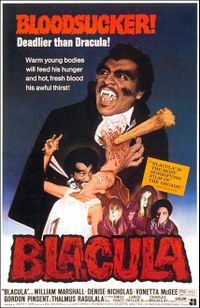
Blacula (1972)
Blacula is a fun and intriguing mash up of Blaxploitation and horror, with a dignified turn from William Marshall as the title character.
Marshall plays an 18th century African prince named Mamuwalde. He wants to bring his kingdom into the modern world, and, for some reason, turns to Count Dracula for help. Unsurprisingly, it does not go well, and instead of opening up global markets, Dracula opens up the veins in Mamuwalde's neck, seals him up in a coffin and leaves his wife Luva to die. Cut to the 1970s, and two interior decorators who are expanding their US property portfolio to include Transylvania. They unwittingly resurrect Mamuwalde after bringing him back to the US, leaving him free to pursue a woman he thinks is the reincarnation of his late wife.
This is cheap but cheesy fun and there has been some thought gone into the script.
The original Dracula story had the Van Helsing character to act as the counterpoint to Dracula (and exposition point for the audience). Wisely, Dr. Gordon Thomas (Thalmus Rasulala) plays that role here.
What is especially interesting is that all the main characters are black, and the producers made no attempt to introduce any kind of white saviour character.
The real star is William Marshall whose natural charisma manages to inject some dignity into the part of Mamuwalde, and make him a tragic rather than horrific character.
Labels:
1972,
AIP,
blaxploitation,
Colour,
Dracula,
Horror,
vampires,
William Marshall
Sunday, 18 August 2019
Bruce Lee against Supermen (1975)
Any film with a title that great is only going to be a disappointment, and in this respect, Bruce Lee against Superman does not disappoint. It's part of an odd and crass sub genre of martial arts films cashing in on Lee's death with a similarly named star and little in the way of talent or story.
There's a half-hearted attempt at a plot, something involving a scientist who has worked out how to make food from petrol, but it feels more like a cheese induced fever dream. Bruce Li, aka Ho Tsung-Tao starts off playing a version of Cato from The Green Hornet, then seems to turn into somebody called Carter, who occasionally wears red pyjamas along with a bearded man who seems to be his boss or something. The Supermen wear black with little napkins for capes. One of them is the leader and the other two fall out with him for some reason.
While there are brief flashes of entertainingly unhinged nuttiness akin to Ed Wood or Ray Dennis Steckler (especially Rat Fink a Boo Boo) the real sin of this movie is to be mostly dull and boring.
Sunday, 11 August 2019
A Cat in the Brain (1990)
Lucio Fulci had a long career as a director, one that covered many styles. But he is best remembered for the gore splattered horror films he made from the late 70s onwards. A Cat in the Brain presents itself as a horror version of 8 1/2, a meta reflection on this particular genre, as well as Fulci's career, and his audience.
Fulci plays a fictional version of himself, a director in the middle of shooting his latest gory effort. Not only that but "Fulci" is also convinced he is going mad, sent over the edge by years of making horror films, and that he may be responsible for a series of slayings near his house.
For such an intriguing wacky premise with so much promise, the end result is surprisingly dreary and plodding.
Much of the footage in A Cat in the Brain is culled from half a dozen films Fulci was involved in a year or two previously, although none of them have anything to do with each other.
The mismatched incoherent tone is sometimes the perfect representation of a fractured disintegrating psyche, but often makes the film look cheap and poorly thought out.
Labels:
1990,
Colour,
Fellini,
films about films,
Horror,
Italian,
Lucio Fulci
Monday, 15 July 2019
Duck You Sucker (1971)
In Revolution-era Mexico, Juan (Rod Steiger) is a bandit with dreams of knocking over the country's biggest bank. When he meets wanted IRA terrorist John (James Coburn), Juan blackmails the Irishman into helping him. But the bank is as empty of money as it is full of political prisoners. After freeing them, Juan finds himself hailed as a revolutionary hero, but that means betrayal and tragedy are around the corner.
Director Sergio Leone kick-started the Spaghetti Western Genre with his ground-breaking 1964 film A Fistful of Dollars, and expanded on the template of amoral heroes, violent gun-play and eerie sun-baked apocalyptic atmosphere with For a Few Dollars More, The Good The Bad and The Ugly, and Once upon a Time in the West.
But, Duck You Sucker (aka A Fistful of Dynamite) feels like a step backwards, lacking some of the elements that made the other films work, particularly Clint Eastwood's Man with No Name character. In the Dollars Trilogy he's a tight lipped stoical man, who sets a tone of ambiguity and understatement. This provides a much needed contrast to the more outre characters. Here, Steiger and Coburn go for the thick cartoon brand of Mexican and Irish accents which soon become grating. Luckily, their natural presence and charisma stop the characters from being unwatchable. Also, the script is heavy handed with too much talk and exposition, while the soft focus flashbacks to John's back story become ludicrous.
Aside from occasional casual misogyny, Duck You Sucker has some more positive, familiar Sergio Leone traits. The Ennio Morricone soundtrack is as quirky, bombastic and haunting as his earlier work with the director. The action sequences, particularly the raid on the bank by Juan and his gang are brilliantly executed. The massacre of a large group of peasants by Mexican government troops is disturbing, and makes a contrast from the dismissive attitude to death often seen in this genre.
Wednesday, 16 January 2019
The Swimmer (1968)
The
Swimmer is both a melancholy look at a man's life that is falling apart and an
unsentimental look at the pitfalls of nostalgia.
Based on
a short story by John Cheever, the plot centres on Ned Merrill (a buff looking
Burt Lancaster), a middle aged ad man who decides to swim his way home via his
neighbour's backyard pools. Both the day and Ned's mood start off bright, but
as each pool brings up people he hasn't seen for a while, and the memories
associated with them things take a dark turn. Gradually we learn more about
Ned, and he learns some painful lessons about himself.
The
script is very talky, but it is dialogue packed with irony and double meaning. Director
Frank Perry (with one uncredited scene helmed by Sydney Pollock) has plenty of
cinematic style with some fast cuts and odd angles. The occasional shift into
soft focus seems to be signifying wistful yearning for the past. But it always
resolves into something downbeat, and there is always something dark behind the
facile grins.
While The
Swimmer starts off in a realistic fashion, the film gradually takes on a more
dreamlike and allegorical quality, enhanced by the stiff detached delivery of
some of the lines. As the disconnect between surface appearances and reality
becomes wider, day turns to evening, sunshine to rain, happiness to sadness.
Death Bed: The Bed That Eats (1977)
Apart from having a damn great title, Death Bed: The Bed That Eats is a baffling but compelling mix of horror, black comedy, inventiveness and incompetence.
For once with an exploitation film, it delivers on that title. There is a plot of some sort, something about a demon in love with a woman who died in the titular bed, and an artist trapped in a painting who, in a voice that disconcertingly sounds like Stephen Fry, taunts the demon while providing a narration of sorts. But the focus is on four set pieces, each labelled with meal related intertitles, where unsuspecting folk wind up on the mattress menu.
At times it reminded me of Hausu, which was released in the same year. But it lacks the relentless breakneck pace of that loopy Japanese classic, going instead for a momentum free druggy torpor, where the characters almost stagger around, disconnected from reality.
Luckily, there's enough going on to stop things getting dull. The premise is loopy enough and director George Barry (in his only attempt at film making) accompanied it by some equally surreal visuals, and a harsh jarring synth soundtrack. Barry doesn't skimp on two other vital ingredients. There is plenty of gore, such as a woman getting garrotted by her own crucifix. There is plenty of weird humour, such as the bed drinking a bottle of Pepto-Bismol after a particularly hard to digest victim. Coupled with some hammy acting, it sometimes feels like a Monty Python sketch.
If you're looking for plot, characters and slick film making, this may not be for you. But, if you like brain stretching freaky chutzpah, Death Bed: The Bed That Eats is well worth a look.
Labels:
1977,
Colour,
exploitation,
Horror,
independent,
Monty Python
Sunday, 4 November 2018
Halloween (2018)
The Halloween film series, just like main antagonist Michael
Myers, refuses to stay dead. The eleventh outing has an excellent turn from
original star Jamie Lee Curtis but fails to bring much else new or exciting.
Wisely ignoring the sequels (both old and new), the story
starts Michael with locked up in an asylum, forty years after the events of the
first film. The object of his stalking, Laurie Strode (Curtis) has spent the
time suffering PTSD, which has cost her two marriages and the relationship with
her daughter. One day she gets the news that she has been dreading - Myers is
being transferred to a new facility, giving him the opportunity to escape and
finish what he started.
It's always great to see Jamie Lee Curtis in anything, and
here she brings a great mix of vulnerability and toughness to her character.
The other characters are mostly forgettable, but that is not unusual for the
genre. Kudos also to John Carpenter who, with his son Cody and Daniel Davies,
has crafted a score that is as discomfiting and driving as his work for the
original.
The film is competently made but never answers the question
"What's the point of this?". Director David Gordon Green reverently
copies many of the shots and tropes of the original, but misses the main thing
that made the original work so well. The original’s director John Carpenter
stripped nearly everything back to the bare minimum, from the story, to the
score, to the fleeting appearances of Myers in tracking shots.
Green takes the opposite approach, overloading the film with
themes and topics, (best represented by the two podcasters trying to re-examine
Myers story and turn him into an object of fascination) and the inevitable
throwbacks to the original film. All this does is remind you how lean and
efficient the original was.
Subscribe to:
Posts (Atom)