Showing posts with label Christopher Lee. Show all posts

Sunday, 31 May 2020

The Mummy (1959)


The Mummy comes from that first flush of Hammer studio's late 1950s horror success that also included Dracula and Frankenstein. It has many of the classic elements, such as the stars, the director, the writer, luscious cinematography, rich dramatic score. It has also has some of the problematic elements, that nowadays are fascinating to examine.

The story starts in the 1890s with a team of British archaeologists in Egypt, led by John Banning (Peter Cushing) and his father Stephen (Felix Aylmer). They uncover the sealed tomb of one Princess Ananka, but Stephen inadvertently brings the mummified body of her High Priest Kharis (Christopher Lee) back to life. Years later, back in England, Mehemet Bey (George Pastell), a modern-day worshipper of Ananka unleashes the undead Kharis to take gruesome revenge on the them.

Cushing's role is different to that Frankenstein or Van Helsing. Those are more authoritative people, they have answers, they drive the story. Banning has no knowledge of, or part in the creation of the mummy. He is learning as he goes, which does give the character a chance to develop.

Even covered head to toe in layers of muddy bandages, Lee is still recognisable, through his eyes and stature. His mummy is a relentless killing machine, immune to bullets and knives, a precursor to the Terminator.

Some elements do look dated. In an accurate depiction of the time the film is set in, archaeology is shown as going to a faraway country to loot artifacts and interpret them through the prism of the colonial English.

None of the Egyptian characters are played by Egyptians. Pastell (who is Cypriot born) is suitably slimy as Bey. He says his magic spells in a mix of gibberish and English. With brown skin and a permanent bright red fez, he sticks out and is easy to spot as the bad guy.

There is mileage in the symbolism of the story. At the heart of it is pesky foreigners and their backwards superstitions. By coming "over here" they can be seen as foreign agents invading the country. However, the English characters are all brought down by their arrogance, and English exceptionalism.


Tuesday, 12 September 2017

The Hound of the Baskervilles (1959)


An energetic and atmospheric take on the Sherlock Holmes tale, the Hammer Studios version of The Hound of the Baskervilles works as both an exciting detective story and an atmospheric Gothic chiller.

Although some changes are made to the source material, the basic plot remains the same, with Holmes (Peter Cushing) and Watson (Andre Morell) called on to investigate the mythical supernatural beast that has been haunting and killing members of the Baskerville family for hundreds of years. After his uncle Charles Baskerville is found dead, nephew Henry, the last of the line, finds himself left with the family estate – but does this have an unwanted extra, namely, the fatal family curse?

Cushing makes an excellent Holmes, a keen and energetic man with a razor-sharp brain and tongue to match, while Morell plays Watson closer to the literary version of the character, the heart to Holmes' brain, rather than the affable duffer that Nigel Bruce went for in the Basil Rathbone era films. Christopher Lee acquits himself well, playing a good guy for a change, but with enough charisma and haughty aristocratic manner to make Sir Henry convincing.  The script rattles along at a good pace, and the changes from the novel merely help make the story pacey and visual without dumbing it down.

What really makes this a unique take on the story is the way director Terence Fisher seamlessly blends Holmes and his world into that of Hammer Horror. The Baskerville house could just as easily be the Frankenstein residence, and the lush colours, bold music, and spooky atmosphere could be right out of any of their genuinely more supernatural efforts.


Friday, 8 September 2017

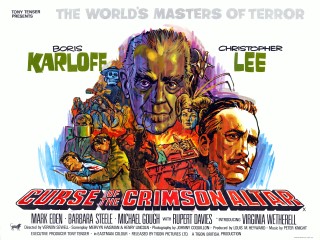
The Curse of the Crimson Altar (1968)


A garish mix of occult themed horror and groovy Sixties British psychedelia, The Curse of the Crimson Altar is not scary, but the colourful energy and supporting cast of Barbara Steele, Christopher Lee and Boris Karloff make it worth a look.

Antiques dealer Robert Manning (Mark Eden) is searching for his missing brother, last seen at Craxted Lodge a remote manor in the English countryside. The manor's owner, Morely (Lee) claims never to have heard of him, but nevertheless invites Manning to stay while the hunt continues. While there, manning starts to suffer vivid nightmares involving a sinister witchcraft cult headed by a mysterious woman (Steele). Is there a link between the dreams and to Manning's quests? And what are the real motives of occult expert Professor Marsh (Karloff)?

The plot is a little more confused than that synopsis makes it sound but the oily charm of Lee and the sinister menace of a cadaverous looking Karloff, coupled with the crazy sleazy dreams of rituals involving a green body painted Steele and a man wearing nothing but a leather apron and a helmet of antlers more than make up for any slow points.


Thursday, 24 November 2016

The Curse of Frankenstein (1957)


The Curse of Frankenstein is the film that launched Hammer Horror on to the world, and there is a deliberate attempt to distance this film from both the Mary Shelley book and James Whale's iconic Universal version and create something unique. There are no pursuits to the North Pole, no fairy-tale castles, and no hunchback assistants, but the basic premise of the precociously talented scientist obsessed with creating a fully formed human being, and then being forced to deal with the consequences of achieving this remains intact.

Jimmy Sangster's script makes Victor Frankenstein the focus of the story but makes no attempt to portray him in a sympathetic light. This is a man who does not think in terms of good and evil, only in terms of getting his work done, and as a scientist who has no concept of the consequences of his actions. Peter Cushing brings a mix of charm, coldness, and nervous energy, to the role, creating a character who is determined, dangerous and unpredictable. While courting his cousin Elizabeth he carries on an affair with his maid, and when the latter finds she is pregnant, it is fascinating to watch the difference in his attitude to creating life in the laboratory and creating life with a human being.

Christopher Lee gives a similarly distinctive performance as the Monster. When he is discovered chained to a wall by his creator, his first instinct is to cover his face, still showing traces of vanity and humanity. The end result is a complex creature who is both a mindless killer, and a slightly pathetic pawn of somebody else's ambitions.

With two such dominating characters (and actors), it is difficult for the supporting cast to get a look in. Hazel Court does her best with the underwritten part of Elizabeth, but Frankenstein's increasingly moral and self-righteous mentor Paul Krempe (Robert Urquhart) is just irritating.

When placed in the context of the Hammer Horror story, what amazes in retrospect is how fully formed the style seems already, with so many of the tropes, such as the colour, the gore, the actors, the urgent, dramatic music, and the Gothic European settings already in place.


The Curse Of Frankenstein / Original Theatrical... by AndersEben

Saturday, 12 December 2015

The Man with the Golden Gun (1974)

James Bond is one of the most enduring characters in cinema and undoubtedly one aspect of the longevity is the producer’s willingness and ability to keep the films relevant to contemporary audiences and tastes. The Man with the Golden Gun is an example of this, reflecting the tastes and attitudes of the target audience and popular culture of the time. Along the way however it needlessly complicates the story, wastes potentially one of the greatest Bond villains of all time, and relies too much on cringe-worthy comedy and weak supporting characters.

The hunter has become the hunted as Bond becomes the target of Scaramanga, a mysterious assassin, who charges one million dollars per job and always uses gold bullets on his targets. Scaramanga is also linked to the death of a scientist working on the "Solex Agitator", a powerful solar cell. How is this linked to the price on Bond's head – and will 007 live long enough find out?

Although the 70s Bond films were still using the original novels as source material, this was increasingly confined to the title, and basic plot, and The Man with the Golden Gun is no exception.  Producers Albert Broccoli and Harry Saltzman moved the action from the Jamaican setting of the book to the Far East, which, as Enter the Dragon had been released the previous year, allows the film to incorporate elements from the Kung Fu movies which were all the rage. This was neither the first or last time this sort of cash in would happen as Live and Let Die and Moonraker came out within a short time of Shaft and Star Wars respectively, and incorporated many of the tropes of those films as well as playing to the public hunger for them.  However in The Man with the Golden Gun, rather than incorporated, these elements feel clumsily shoehorned in, leading to scenes that are baffling and insulting to the intelligence (why does Hip, Bond's man in Hong Kong, bring his teenage nieces on a mission? So they can beat up bad guys. Because they're Kung Fu experts).

The race and gender depictions are very much also of the time, with the Asians presented as both mysterious and exotic, or simply there to serve the British.  Women come off just as badly, although this is not unusual for Bond films. They range from the helpless and doomed Andrea (played by Maud Adams), who, in a jarring break from Moore's wisecracking smoothie portrayal, gets several smacks round the face from Bond as he tries to get information from her. At the other end of the spectrum we have helpless and stupid in the form of fellow British agent Mary Goodnight (Britt Ekland), a character who might have worked as a comedy relief dizzy blonde, but here is someone so stupid, incompetent and grating, that it actually insults the intelligence of the audience.

The goofy broad humour reaches a low point with the character of Sheriff J.W. Pepper, the two dimensional Southern Sheriff who had previously appeared in Live and Let Die. Bizarrely, and completely improbably (even in the improbable world of James Bond films) he is on holiday in Thailand, sat in a car at a showroom at precisely the moment Bond requisitions a vehicle for a chase. To make us believe that an overtly racist character like Pepper would holiday in Thailand is too much, never mind the idea that he would visit a car dealer at the same time

This leads to the most famous scene in the film, the corkscrew car bridge jump, and spectacular though this is, it, like the Sheriff, the Kung Fighting and the Solex Agitator, it adds nothing to the story telling and could have been left out without compromising the plot, or could have been inserted just as arbitrarily into any other film.

This is the crux of the problem with The Man with the Golden Gun, the simple initial premise of two men hunting each other needlessly complicated by these elements. The best Bond films, such as From Russia with Love take a simple plot with clear goals and make everything that happens, a clear and logical part of that. A duel between Bond and a worthy adversary should have been such a premise, and even if this takes in multiple locations and characters, they can all serve this. Sadly and unforgivably, the filmmakers (given this is a franchise, it is perhaps not always clear how much of the final product is down to producers, writers or directors) waste what could have been one of the greatest and most unique Bond villains of all time.

Christopher Lee rose to fame playing Dracula as a suave, charismatic, but ruthless and overtly sexual predator, qualities he brings to Scaramanga and, arguably, qualities that somewhat define the character of Bond. Certainly he is every bit as suave, charming, dangerous as Bond, almost like a mirror image of him, and while he does have a lair, gadgets and, in Nick Nack, played by Herve Villechaize, a sidekick (the 6ft 5 Lee  and Villechaize make a great odd couple, like Kramer and Mickey Abbott in Seinfeld), his focus on assassination and personal enrichment put him in a different league to Blofeld and SPECTRE.


Thursday, 30 October 2014

Dracula (1958)

It is always good to go back to an old film favourite and find something new, and a recent viewing of the Hammer Studios 1958 take on Dracula provided just such an opportunity.

Made nearly 30 years after Tod Browning's equally ground-breaking,iconic and financially successful Universal version starring Bela Lugosi, director Terence Fisher crafts something just as distinctive and unique, helped both by a first rate cast and a punchy script by Jimmy Sangster, one that never forgets that the audience wants to be entertained. Sangster takes the basic premise from the Bram Stoker novel but tinkers with the story quite significantly, stripping the plot to the bare essentials, moving the action from England to Germany, changing some characters (Jonathan Harker is upgraded to Van Helsing’s undercover sidekick, and is fully aware of the Count’s night-time activities), and playing down or eliminating others, such as Dr Seward. 

The main theme of Good v Evil is left in place, along with the absolutist, black and white definitions of each, and this film taps into many of the tropes associated with vampires and Hammer films, such as the gloomy castles, frightened villagers and lush Gothic ambience. However, despite the changes from the source material, the underlying themes are still in place too, and as any media studies student knows, vampires are about two things - addiction and sex. The former is undisguised, with the vampires depicted as slaves to their craving for blood, and Van Helsing explicitly comparing it to narcotic dependence.

Sex is there too, in an overt rather than explicit manner. The main source of the sex is the Count himself, with Christopher Lee lighting up the screen as six feet five inches of charm, testosterone and magnetism. Of course, if you go with the "neck biting as intercourse" theory, he is not only seducing other men's wives, but other men too, (in the climax between Van Helsing and Dracula, after their initial skirmish, look quickly and you can see Van Helsing checking his neck to make sure he hasn’t been penetrated by the Count). This imagery gives a queasy undertone to the sight of Harker’s fiancée Lucy, turned into a vampire by Dracula, trying to abduct her niece and seduce her brother,.

The lurid sexual tone is backed by an equally violent one, albeit tamer than we see nowadays, with lashings of very red blood, and a new slightly extended gruesome sight of Dracula disintegrating, thanks to some recently rescued footage taken from a previously lost Japanese version of the film.

The other thing that I had not properly appreciated is the energy, intensity and swashbuckling demeanour of Peter Cushing. His version of Van Helsing is a world away from the elderly, more academic characterisation by Edward Van Sloan in the Browning film, and the final battle between him and the Count could almost have come right out of an Errol Flynn film.


Thursday, 27 March 2014

The Devil Rides Out (1968)


Although not a big commercial success on its release, The Devil Rides Out is one of the best horror films produced by the Hammer studio. This is despite it being in many ways the antithesis of everything that Hammer was supposed to represent, in that there were no gloomy castles or other Gothic trappings, no vampires or other such monsters, and Christopher Lee was playing the good guy. The reactionary undertones of the source material remain intact, something quite fascinating to consider, given the year in which the film was released.

In 1920s England, the Duc de Richleau (Christopher Lee) is concerned that Simon Aron (Patrick Mower), the son of a late friend has been brainwashed by a satanic cult. The leader of the cult, Mocata, (Charles Gray) wants to induct Simon and his friend Tanith Carlisle into a satanic baptism - and he has some powerful allies, including the Angel of Death and the Devil himself

The punchy well-structured script by Richard Matheson sticks to the plot of the original Dennis Wheatley novel. We are plunged straight into the action from the beginning, and there is barely a wasted line or scene as the action drives relentlessly forward, through manor houses, countryside car chases, and frenzied Black Magic rituals. The 1920s setting also means that in many respects it does not look dated – although the effects do

Unsurprisingly, the main star of the film is Lee, who manages to be an almost mirror image of the villains he is perhaps more well known for. His Richleau is every inch the aristocratic charmer that his Dracula is, but this is now mixed with elements of Van Helsing, particularly the arcane knowledge, which he can handily explain to the audience, and the traditional Christian moral view. When Richleau is admonishing Simon at the beginning, he sounds like a concerned parent horrified at what their children are getting into. It is not too much of a stretch of the imagination to picture a real life parent in 1968 similarly horrified at their offspring and their long hair and interest in the occult, something that would be crystallised in the mainstream with the release the following year of the hit single Age of Aquarius.

There is often a reactionary or Puritan streak underpinning the horror genre, such as in the sight of sexually active teens being knifed by masked killers. This is often paired with situations that show or imply a pro-Christian message, such as the crucifix dispatching the vampire, or the Roman Catholic exorcism rituals succeeding where medicine and science fails.

On the surface, The Devil Rides Out is no exception, with the crosses, the depiction of Satanists as evil, (with no real discussion as to why), and the subtext of the Christian (and in this case, sexually and emotionally repressed) way of life is good, while the Satanic (and, again, as represented in the film, uninhibited) life is bad. There is a small hint of irony in this, given that a film could not have been made without the rise of more permissive attitudes in cinema goers, and perhaps this is the key as to why there is no heavy handed lecturing in the film, which would have turned audiences off. Instead, the two sides are presented as no more than opposing forces for dramatic purposes for us to cheer or boo as appropriate.


Saturday, 8 February 2014

Captain Horatio Hornblower R.N. (1951)


The swashbuckler is a film genre almost as old as cinema, and while not one of the best examples, Captain Horatio Hornblower RN is still an entertaining film. A meandering and occasionally sluggish script is compensated for with great special effects, exciting battle sequences, lush Technicolor, and an endearing performance from Gregory Peck as the stern but fair title character. It is also easy to see the influence of Hornblower on one famous sci-fi saga.

Combining elements of three of C S Foresters Hornblower novels, the plot sees the Captain, his ship and crew on a secret mission to Central America during the Napoleonic wars at the turn of the 19th century. Hornblower find himself battling not just the Kings enemies, who change according to the whims of politics, but tragedies at home, and the unwelcome appearance of a woman on his ship

By using three books, seemingly unconnected, it does mean the plot often lacks a single driving force, with the main focus being on the character of Hornblower himself, who comes across as a man of integrity and intelligence, a stoical man who always does his duty, but certainly not a martinet, or a macho show off. However, his stiff upper lip becomes a barrier, meaning we never really get inside the mind of Hornblower.

Director Raoul Walsh usually made more contemporary, and more land based films, which might explain why it never feels like he gets totally to grips with the genre and the setting. However, when the action does kick off it is first rate, with exciting battle sequences, backed up with excellent special effects, a stirring musical score from Robert Farnon and lovely rich looking Technicolor.

Gregory Peck plays Hornblower with a relatively understated authority, rather than the brash machismo of someone like Errol Flynn, and his charisma help keep your attention through the slower parts of the film. The main stand out in the supporting cast is James Robertson Justice as Quist, the seaman who helps Hornblower escape capture by the French. Although better known to me as the demanding surgeon Sir Lancelot Spratt in the "Doctor" films with Dirk Bogarde, he certainly brings a more down-to-earth quality to the character of Quist, and would go on to head out to sea with Peck in Moby Dick and The Guns of Navarone. Also, look fast for a cameo from a young and just about recognisable Christopher Lee, as a Spanish naval captain.

As a footnote, I had not realised the extent of the influence of Hornblower on the creation of Star Trek. The basic premise of a ship, its captain and crew, far from home, being plunged into dramatic situations (often with a military or diplomatic background) is easily transposed into outer space. While Kirk is perhaps more macho (and more of a ladies man) than Hornblower, both are bold, decisive men of action, and both have loyal first officers, and, in this film at least, cantankerous ship’s doctors.


Friday, 12 October 2012

From the Archives: Dr. Terror's House of Horrors (1965)


Dr. Terror's House of Horrors was the first in a series of anthology films from the Amicus studio, and the one that launched them for a time to the same dizzying heights, at least at the box office, as their arch rival Hammer. But it is a film that prove Hitchcock's maxim about a film needing three things: a good script, a good script and a good script, as the poor quality of the writing is the factor that stops this from becoming a masterpiece.

Read the full review at Classic-Horror.com