Horror and Sci-Fi films old and new, weirdo trash, arthouse, forgotten gems, well loved classics, and I'm watching the original Dr Who from the beginning.
The legendary Toho studio in Japan, home of Godzilla, made a name for itself internationally with apocalyptic films that show cities being ravaged and destroyed. In this respect, Prophesies of Nostradamus is no different from that strand of their output. Except that in this case, the monster is.... MANKIND.
The central character is a biologist / paediatrician (it is a bit vague) Ryogen Nishiyama. His family heirloom is a book of prophecies from noted 16th century French crackpot / charlatan Nostradamus, prophecies that Dr Nishiyama starts to see coming true in 1970s Japan.
This film combines two genres that had a brief bloom of popularity in the 1970s, those of eco-horror and apocalyptic disaster. In the West this meant films as diverse as Phase IV, The Late Great Planet Earth and the UK TV show and movie spinoff Doomwatch.
The lead character is a prototype Eco-warrior who preaches against overpopulation. Being a middle-class hypocrite, he of course wants his daughter to have children. He also is a big believer in the bunkum nonsense of Nostradamus, but that does not emerge as a massive driver of the plot, which is surprising, given the film's title.
The first 45 minutes or so are talky but a lot of energy comes from passionate anger of Nishiyama. By an hour in the gross Eco-horror starts. Nishiyama leads a trip to New Guinea to find what happened to a group of scientists. While there his party is attacked by giant bats and leeches. The natives have turned into cannibals, and when one scientist is attacked, he also turns into a cannibal, albeit a rabid one.
Elsewhere the apocalypse ramps up as children are born with amazing physical and mental powers which will prove horribly fatal in later life. In more shocking scenes HIPPIES STOP CARING, as demonstrated in a scene that feels like somebody trying to a Rowan and Martin style montage.
The film builds an air of pessimism and gloom. Riots are replaced with volcanoes, earthquakes, and nuclear apocalypse. By the climax, only a couple of mutants survive. But do not worry - THERE'S A TWIST ENDING.
Recommended for fans of goofy, gross, tasteless oddball cinema.
1974 was a bumper year for vampire films in quantity, if not always quality. Andy Warhol was bring the sleaze and gore in Blood for Dracula. Hammer Studios were looking for new twists, with Captain Kronos, Vampire Hunter and the martial arts cash-in Legend of the Seven Golden Vampires. Meanwhile, David Niven was embarrassing himself in Old Dracula. Elsewhere, Dan Curtis, the producer of legendary Gothic soap opera Dark Shadows brought us a TV take on the tale.
The screenplay is by genre legend Richard Matheson, and the plot hits all the major beats of the source novel. But, like the Hammer and Universal versions, it pares back the sprawling plot and cast of characters. One original element it does introduce is the idea of Dracula being a tragic, lovesick character, doomed to spend eternity pining for a lost love. This is something that Francis Ford Coppola will use twenty years later by in his risible take on the story.
In the title role is Jack Palance, someone who has no problem being evil, menacing, and imposing. In fact he's almost like the Terminator, acting alone, breaking into houses, and refusing to lie down when shot, Palance also brings a secondary layer to the character. His Dracula is someone who is occasionally vulnerable to, and not quite in control of their lusts. This offers a reading of the character as a metaphor for addiction.
Opposing Dracula as his arch rival Dr Van Helsing is Nigel Davenport. He is best known, to me at least, as the cantankerous scientist Hubbs in the apocalyptic classic Phase IV. As Van Helsing he brings the necessary stolid reassurance of the character. But he lacks the eccentricity and energy that someone like Peter Cushing being to the role.
The cinematography makes it look like an episode of Hammer House of Horror. This is not a criticism, as a I am big of fan of this show, but it means it might be an acquired taste. Regardless, it's a pacy, creepy and often overlooked version of a familiar tale.
Made to commemorate fifty years of MGM, That’s Entertainment is a nostalgic trip through the history of the studio's contribution to the genre that made them. It features the contemporary presence of several bona fide stars of the day, such as Frank Sinatra, James Stewart, Bing Crosby and Debbie Reynolds, all waxing lyrical about their experiences with the dances, songs and fellow artists, and clips from over sixty MGM films from the 1920s (starting with the first MGM musical, The Broadway Melody of 1929, the first film to feature the song Singin’ in the Rain) to the 1950s. Fascinatingly, when viewed together, the deluge of clips reveals some interesting things.
Firstly is the contrast between the sleek, extravagant sets in films such as The Band Wagon and Good News and the rather sad, dilapidated state of the MGM lot as it was by the 70s, on the verge of demolition. This certainly emphasises the gulf between the two eras, and increases the feeling of nostalgia. This is something that could well have been felt at the time of release, with the United States mired in the Watergate Scandal, and is tacitly acknowledged in the strapline on the poster (“Boy, do we need it now”).
Secondly, while we are used to seeing the likes of Gene Kelly, Fred Astaire, Ginger Rogers, and Eleanor Powell in musicals, the ubiquity of the genre during the 30s and 40s meant that all of MGM’s talent were expected to be able to sing and dance, and the sight of James Stewart and Cary Grant giving it their best is wonderfully surprising.
Thirdly is the gradual evolution of cinematic style, from simply pointing a static camera at performers on a stage, to two distinctive directing techniques. On one hand is the style made famous by directors such as Stanley Donen in the likes of Singin' in the Rain, where the emphasis is very much on individual performers, with long unbroken takes as the camera glides up and down in their wake. The polar opposite of this is the Busby Berkeley style, of grand, often surreal spectacle, with scores of performers moving in sync amid lavish sets, or in the case of Small Town Girl, Anne Miller dancing through a sea of disembodied arms holding musical instruments.
One thing that all of the clips have in common is an energy and exuberance, which means That's Entertainment is never dull viewing. It works as a primer for those new to the genre and trip through memory lane for existing fans.
James Bond is one of the most enduring characters in cinema and undoubtedly one aspect of the longevity is the producer’s willingness and ability to keep the films relevant to contemporary audiences and tastes. The Man with the Golden Gun is an example of this, reflecting the tastes and attitudes of the target audience and popular culture of the time. Along the way however it needlessly complicates the story, wastes potentially one of the greatest Bond villains of all time, and relies too much on cringe-worthy comedy and weak supporting characters.
The hunter has become the hunted as Bond becomes the target of Scaramanga, a mysterious assassin, who charges one million dollars per job and always uses gold bullets on his targets. Scaramanga is also linked to the death of a scientist working on the "Solex Agitator", a powerful solar cell. How is this linked to the price on Bond's head – and will 007 live long enough find out?
Although the 70s Bond films were still using the original novels as source material, this was increasingly confined to the title, and basic plot, and The Man with the Golden Gun is no exception. Producers Albert Broccoli and Harry Saltzman moved the action from the Jamaican setting of the book to the Far East, which, as Enter the Dragon had been released the previous year, allows the film to incorporate elements from the Kung Fu movies which were all the rage. This was neither the first or last time this sort of cash in would happen as Live and Let Die and Moonraker came out within a short time of Shaft and Star Wars respectively, and incorporated many of the tropes of those films as well as playing to the public hunger for them. However in The Man with the Golden Gun, rather than incorporated, these elements feel clumsily shoehorned in, leading to scenes that are baffling and insulting to the intelligence (why does Hip, Bond's man in Hong Kong, bring his teenage nieces on a mission? So they can beat up bad guys. Because they're Kung Fu experts).
The race and gender depictions are very much also of the time, with the Asians presented as both mysterious and exotic, or simply there to serve the British. Women come off just as badly, although this is not unusual for Bond films. They range from the helpless and doomed Andrea (played by Maud Adams), who, in a jarring break from Moore's wisecracking smoothie portrayal, gets several smacks round the face from Bond as he tries to get information from her. At the other end of the spectrum we have helpless and stupid in the form of fellow British agent Mary Goodnight (Britt Ekland), a character who might have worked as a comedy relief dizzy blonde, but here is someone so stupid, incompetent and grating, that it actually insults the intelligence of the audience.
The goofy broad humour reaches a low point with the character of Sheriff J.W. Pepper, the two dimensional Southern Sheriff who had previously appeared in Live and Let Die. Bizarrely, and completely improbably (even in the improbable world of James Bond films) he is on holiday in Thailand, sat in a car at a showroom at precisely the moment Bond requisitions a vehicle for a chase. To make us believe that an overtly racist character like Pepper would holiday in Thailand is too much, never mind the idea that he would visit a car dealer at the same time
This leads to the most famous scene in the film, the corkscrew car bridge jump, and spectacular though this is, it, like the Sheriff, the Kung Fighting and the Solex Agitator, it adds nothing to the story telling and could have been left out without compromising the plot, or could have been inserted just as arbitrarily into any other film.
This is the crux of the problem with The Man with the Golden Gun, the simple initial premise of two men hunting each other needlessly complicated by these elements. The best Bond films, such as From Russia with Love take a simple plot with clear goals and make everything that happens, a clear and logical part of that. A duel between Bond and a worthy adversary should have been such a premise, and even if this takes in multiple locations and characters, they can all serve this. Sadly and unforgivably, the filmmakers (given this is a franchise, it is perhaps not always clear how much of the final product is down to producers, writers or directors) waste what could have been one of the greatest and most unique Bond villains of all time.
Christopher Lee rose to fame playing Dracula as a suave, charismatic, but ruthless and overtly sexual predator, qualities he brings to Scaramanga and, arguably, qualities that somewhat define the character of Bond. Certainly he is every bit as suave, charming, dangerous as Bond, almost like a mirror image of him, and while he does have a lair, gadgets and, in Nick Nack, played by Herve Villechaize, a sidekick (the 6ft 5 Lee and Villechaize make a great odd couple, like Kramer and Mickey Abbott in Seinfeld), his focus on assassination and personal enrichment put him in a different league to Blofeld and SPECTRE.
How could a film that stars Cliff
Richard as a merchant banker in 1970s Birmingham, a former Dr Who companion as
his love interest, has a plot that revolves around a burger that represents the
city, and features random shots of people machine-gunning televisions fail?
Sadly, Take Me High is nowhere near as interesting as that synopsis may make it
appear, a musical drama with no drama and boring, forgettable music.
Cliff plays
Tim Matthews, a high flying, (he keeps a half bottle of champagne in the glove
box of his Mini Clubman) go-getter in the world of international finance. All
set for a promotion and transfer to New York, he is instead sent to Birmingham
to turn the screws on a failing restaurant and the owner, Sarah Jones (played
by Deborah Watling, perhaps best known for playing Victoria Waterfield, one of
the assistants of the second Dr Who, Patrick Troughton). However once there, he
finds himself helping relaunch the business as a glamorous burger bar, with the
Brum Burger - a product designed to sum up the city in meat form - but also
finds himself falling in love with Sarah.
Sadly, Cliff
is utterly unconvincing as a smarmy charmless banker, although he gets no help
from the script, which has no believable character development, and little in
the way of dramatic tension. The musical numbers do actually serve as the
internal monologue of Matthews, expressing what is going on in his head,
although they are boring and undistinguished.
Deborah
Watling makes the character of Sarah Jones likeable and sympathetic and the ever-reliable
George Cole does his best as the hard-bitten socialist politician Bert Jackson.
However, again, poor scripting makes them both largely dull characters,
especially the underwritten part of Jackson, too much even for Cole's talents
to breathe life into
The only
beacon of interest character-wise is Hugh Griffith as Sir Harry Cunningham, the
socialist hating millionaire, who seems to own most of Birmingham. We are first
introduced to him at a dinner party, raging at a TV interview with Jackson,
before picking up a machine gun and urging his guests join him in blowing the
set to pieces. His all too brief and infrequent scenes are so entertainingly
bizarre and surreal that they breathe some much-needed life into proceedings,
even if those scenes are so jarringly off-the-wall.
The other
star of the show is Birmingham itself, and credit to the director David Askey
for actually shooting on location, rather than go for the stock footage option.
Much is made of the famed canals of the city, fascinating for somebody like me who
used to live around that way, perhaps less so for anyone who did not. It
certainly does not capture the feel of the people of the city, showing little
of the racial and cultural diversity present even 40 years ago, and without the
recognisable locations, could actually have been set anywhere outside of
London.
As a side
note, the Brum burger itself is remarkably prescient, being handmade, and using
all locally sourced ingredients, something that every Gastro pub in the country
seems to offer nowadays.
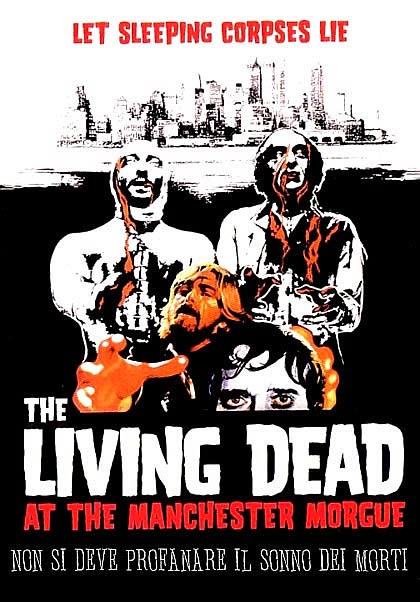
The Living Dead at Manchester Morgue may have
a Spanish director and largely Italian cast and crew, but the settings and
wonderfully creepy atmosphere put it closer to English horror films and TV
shows of the same time. In addition, buried in the slightly schlocky script are
some interesting themes about the abuse of power and abuse of the environment.
George (Ray Lovelock) is taking a break
from his Manchester antique shop to meet up with friends in the scenic beauty
of the Lake District. When Edna (Christina Galbo) accidentally trashes his
motorbike, she offers to drive him to his destination. After getting lost,
George comes across a remote farm where government scientists are trying a new
form of pest control, using ultrasonic radiation, while a lumbering mad man who
emerges from a river attacks Edna. Are the two things connected? Moreover, as
more and more residents of the local churchyard rise to attack them, can George
and Edna get to safety and stop the source of the zombies?
The story is in the realm of George Romero
zombie films, with its non-supernatural premise and contemporary setting, as
well as scenes of people being stalked in a cemetery and barricaded inside a
building. However, unlike Romero's zombie films, Grau makes the reason the dead
are coming back to life a central part of the story and the search for the
cause of the zombies, and the efforts to get that cause shut down do provide a
good “McGuffin”, making for a slightly more coherent and plot heavy film than
others of the era. However, this is unnecessarily muddied by throwing in
further plot points in order to bring in to get the requisite gore. We are told
that the ultrasonic machine excites primitive nervous systems, hence the dead
come back to life and attack anything that moves, but about half way through
the film, they start to eat the flesh and organs of their victims. Then we get
an unsatisfactory explanation about the zombies using the blood of the living
to bring others to life for some unspecified reason. There are also some
baffling lapses in logic at times (how does the fire in the church put itself
out? If the ultrasonic radiation has a range of 1 mile, why are the scientists
pointing a machine at a small spot on the ground?)
The main characters a little one
dimensional, as is often the case in these sorts of films, and George's “Gor
Blimey” accent soon gets a bit grating, while Edna seems to serve little
purpose other than screaming and being rescued. The police sergeant also seems
both clichéd, with his gruff and loud manner, Irish accent and trench coat, and
wildly out of place in the Lake District. Of more interest, are her sister,
Katie and Katie's husband Martin, with dark hints at the relationship they
have, a junkie being exploited and abused by a manipulative pervert. While it
might have been worth developing that story further, it may have proved to be
too much of a distraction from the core plotline.
However, these minor niggles are more than
made up for by the films strengths, such as the excellent gory make up, with
some nice details such as stitches on the chest of one walking corpse. This film first came to my attention as part
of the British Government's notorious "video nasty" list, and while
it does not skimp on the gore, the real success comes from the creepy
atmospherics. Director Jorge Grau shows genuine talent and imagination in
places, with some prowling, restless camerawork, giving a palpable sense of
unease at times. Setting the film not only in England, but, just as
importantly, far outside of London is a stroke of genius. The hills and valleys
of the countryside, along with tropes such as the 1970s haircuts, the cheap
looking ultrasonic machine, the pseudoscientific dialogue and white antiseptic
hospital make me think of British sci-fi and horror such as Dr Who, Quatermass,
Hammer House of Horror, and Doomwatch. Sound design plays a large part in this
sense of unease, with throbbing bleeping machine sounds throughout.
Despite some, at times, slightly silly plot
elements, Living Dead at Manchester Morgue has some interesting and intelligent
things going on thematically. I would not pretend for one minute that this film
is a preachy “message” film, but it was made not long after the rise of Greenpeace
and Friends of the Earth, so may have been the case of exploitation filmmakers
responding to what their audience would be seeing in the news. Nevertheless, the
environmental undertones are there within the opening credits montage, and as
George heads out of the city, we see industrial wasteland, dead wildlife, power
stations belching smoke into the sky, and a population who already look like
dead-eyed zombies.
Beyond that, rather than go for a
straightforward "progressive v reactionary" subtext, the scenario
presented is more complex. On the one hand, we have the aggressive and
high-handed side of science and on the other we have a reactionary almost
fascistic section of society, as represented by the police sergeant with his
disgust at "long hair and faggot clothes" and "permissive
rot", and his wish that the police could have "a free hand". The
former causes the problem through arrogance, the latter fails to solve it
through a blinkered and bigoted worldview, and caught in the middle, is George,
who, despite his hippy appearance, is seemingly not engaged with subversive
political or social activity. He carries pagan antiques that the police assume
are for satanic rituals, but are in fact purely for business. Nobody in
authority listens so nothing is learnt and the, perhaps unlikely, combination
of progressive and reactionary thinking actually prevents the problem being
solved.
Taking pity on
Turkish cinemagoers in the 1970s that wanted to see William Friedkins's The
Exorcist, but were unable, due to the unavailability of any prints, some
enterprising producers dashed off a largely identical work to fill the gap. Unfortunately,
Seytan dilutes the elements that make the original work, while adding little
new, leaving an end product that is not horrifying, thought provoking,
disgusting, or even that much fun to watch certainly compared to other rip-offs
from that country.
The filmmakers stick rigidly to the plot and characters of the original, giving
us not just a scene-for-scene remake, but in places shot-for-shot and
word-for-word (and note for note, as Tubular Bells crops up several times,
albeit wonky and badly dubbed). However, as 99.8% of the Turkish population identifies as Muslim
it is perhaps not surprising that the major change is that the Catholic imagery
and rituals have been removed and replaced largely, although not entirely, with
Islamic equivalents.
However, the one major change to one of the lead characters comes from removing
not replacing the religious element. In The Exorcist, Father Damian Karrass is
both a psychiatrist and a priest, losing his faith and wracked with guilt over
his inability to do anything to help his mother and her deteriorating health.
In Seytan, the Karrass character, Tugrul Bilge, although also guilt ridden over
his senile mother (a lifetime of poorly paid academia, rather than a lucrative
career in medicine, has left him unable to afford decent health care) is a
completely secular person, and without the spiritual crisis, he just comes
across as a bit of a loser.
The other major change is that most of the obscene and blasphemous language and
imagery has also been removed or altered (the infamous scene with the crucifix
is replaced with one involving some sort of Devil shaped knife). This strips
out another layer of interest from the source material, where the foul-mouthed
demon contrasted with the quiet dignity of the priest.
Beyond the changes, the main problem is that is simply not as well made as the
original. It was churned out in a cheap and hurried fashion and it shows, with
the flat cinematography lacking the atmospheric touches of The Exorcist. The
acting is melodramatic, hammy, scenery chewing stuff, with some, presumably,
unintended comedy, such as the scene where the Doctor is hit in the groin being
reminiscent of a Benny Hill sketch.
The terrible
special effects do not help either, although it is hard to pick a low point
with so many to choose. There is the papier-mâché demon, or the bouncing bed,
where it is blatantly obvious that it is a group of people underneath the bed
pushing it up and down. There are the scenes where the girl is supposed to be
having electro shock therapy, which consists of what appear to be mini jack
hammers pounding into either side of her skull while she gurns, mugs and rolls
her eyes. There is also their take on the 180-degree head spin too, but in
fairness, that looked pretty silly in the original, and the one here is not
much worse.
These provide
some cheap laughs, and much needed sparks of energy, but are too few and far between to save
Seytan from being a largely grim and dull watch.