Showing posts with label British. Show all posts

Tuesday, 30 October 2018

Mother Riley Meets The Vampire (1952)


One for the Bela Lugosi (or Mother Riley) completists, Mother Riley meets the Vampire is a strange hybrid of English Music Hall and American low budget mad scientist movies.

Arthur Lucan had been playing Mother Riley, an Irish washer woman who gets herself into assorted scrapes and adventures, on stage and screen since the 1930s, but, possibly due to the parochial nature of the character, the films had not really caught on internationally had much success outside of the UK. Enter Bela Lugosi, who had travelled to the UK for a stage version of Dracula that flopped, leaving him penniless and desperately needing money to get back to the US. Producer George Minter must have seen him, even in the twilight of his career, as a big enough name to drum up some business at the American box office.

The sinister Von Housen (Lugosi) has two notable character traits: he is hellbent on seeks dominating the world with an army of 50,000 radar-controlled nuclear-powered robots. He also reckons he's a vampire and has several young women abducted, including one who has a map to a uranium mine that he needs for his robot army. Granted, his army is currently 49,999 short, and to make matters worse, his only functioning robot has been shipped to Mother Riley's store by mistake.

The result is two different film styles that don't really gel together, but it's more entertaining than not. Lugosi seems to be enjoying himself, and, as always, is great fun to watch. Lucan brings a sense of knockabout slapstick and some well delivered occasional salty quips ("May the saints shower you with sailors on shore leave!"), but his constantly shrill delivery means a little goes a long way. Modern audiences may mostly be reminded of comedy character Arthur Atkinson from the Fast Show, with comparable baffling catchphrases and contemporary references.


Wednesday, 5 September 2018

Juggernaut (1936)


I will sit through anything with Boris Karloff in at least once, but with some films, once is more than enough.

Set in the CĂ´te d’Azure, Juggernaut sees him playing a doctor, desperate for funds to complete experiment into cure a form of paralysis who gets caught up in a plot by a scheming heiress to murder her husband.

Despite Karloff playing a murderous scientist, Juggernaut is not a horror film, but a crime melodrama, and not a very good one at that. The story isn't always clear, the script is overly talky, the acting poor (even Karloff) and the film itself is badly directed, with poorly framed shots sometimes held for several minutes.

It's also a completely misleading title, covering a dreary affair with no momentum that fizzles out long before the end.


Tuesday, 4 September 2018

The Monkey's Paw (1948)


The Monkey's Paw
, the famous tale of being careful what you wish for has been adapted many times and in many mediums. This low budget adaption sticks to the basic premise of the supernatural short story by author W. W. Jacobs, with an elderly couple wanting to use a magical wish granting monkey paw to undo a recent tragedy.

For the most part the film is slow, creaky, woodenly acted and indifferently shot and edited, making the running time feel a lot longer than it is. 

However, it comes to life in the last ten minutes, and as the story moves towards an inexorable conclusion, the atmosphere becomes creepy and the plight of the couple genuinely tragic.


Monday, 27 August 2018

That Riviera Touch (1966)


A pleasant if unremarkable comedy, That Riviera Touch was the second of three attempts by Morecambe and Wise to make it as big screen stars in the 1960s.

The pair play a couple of London traffic wardens, forced to take an impromptu holiday in the south of France after Eric nearly gives the Queen a parking ticket. Once there, they become unwittingly involved in a jewel theft caper when the robber decides to use them to smuggle some stolen cargo out of the country. Along there's a sinister villa, disappearing bodies and a beautiful girl for Eric and Ernie to fight over.

The main problem with That Riviera Touch is that it doesn't feel like a Morecambe and Wise vehicle. If anything, it feels more like an Abbott and Costello film, with Eric as the bumbling, prat-falling, wisecracking Lou Costello and Eric as the smooth lady chasing straight man Bud Abbott. This is noticeably different to their TV personas, where Eric is more self-assured and quick-witted, and Ernie is the bumbler.

Nevertheless, the pair do the best with what they are given and breath some much needed life into the script. It's no classic, but there's enough entertaining silliness to make it worth a look, especially for fans of the duo.


Saturday, 14 April 2018

Are You Being Served? (1977)

Part of the 70s trend for TV sitcoms getting big screen adaptions, Are You Being Served? is a particularly joyless example of the genre.

The Grace Brothers department store is closed for refurbishment, so the staff are sent on a paid holiday to the Spanish resort of Costa Plonka. A misplaced note leads to misunderstandings and the whole thing ends with the hotel being overrun by revolutionary terrorists (the film was made during the transition to democracy era in Spain, after the death of Franco)

The script is based on a stage play and it shows, with nearly the whole film taking place on two locations, the department store and a very obviously studio bound hotel. Nearly thirty interminable minutes is spent at the former, with nothing but corny gags, chatter about the holiday, and a surprise appearance by Derek Griffiths as a wealthy sheik (surprising, not least because all we've heard so far is people saying the store is closed). Things don't improve when we get to Spain with seemingly endless strained farce and more corny gags, only relieved by the novelty of seeing Andrew Sachs playing a Spaniard working in a hotel (although at least this time he's running it).

The characters are one dimensional and cartoonish, and not that interesting, being reduced to the standard seventies sex obsessed sitcom archetypes. The only one who makes any impact is menswear assistant Mr Humphries, and while his mincing camp demeanour may seem dated in the 21st century, his unapologetic refusal to be anything other than himself, especially when telling tales of his social life, is actually quite charming.

Sadly, he is not enough to carry the whole film. On the surface, with the same writers and cast, it has all the ingredients of the TV show, but that is not the case. Apart from a sorely needed laughter track to indicate the arrival of a joke, much of the comedy on the small screen came from the interactions and tensions between the staff and the customers. Here, with only themselves to squabble amongst, the results are painfully unfunny.


Friday, 10 November 2017

Carry On Cabby (1963)


The first few Carry On films are largely variations on a theme, with well-meaning bumblers wreaking havoc in a variety of jobs. Carry on Cabby keeps the work based setting, but cuts back on the bumbling to concentrate on the battle of the sexes.

Charlie Hawkins (Sid James) runs a highly successful cab firm, and the cab firm runs his life, much to the chagrin of his neglected other half Peggy (Hattie Jacques). To teach Charlie a lesson, Peggy clandestinely starts her own business, Glamcabs, employing only sexy young women as drivers. As Glamcabs starts to poach Charlie's business, he resorts to sabotage.

This may look like a case of women getting the upper hand, but, of course, this is a Carry On film, so for the women to fight back they have to use sexist methods, and the drivers are picked purely on their looks and legs.

The script is more story driven than later films in the series, favouring a tone that is warm and innocent rather than the knowing smut that would follow. There is a focus on relationships, and subtle little characterisations, such as Charlie helping out ex-army people, a code he sticks to loyally even if it means employing a hopelessly clumsy halfwit like Pintpot (Charles Hawtrey)

The end result is a film played straight and realistically by an excellent cast, and one more grounded in reality, and less cartoonish than the series would become.

Friday, 8 September 2017

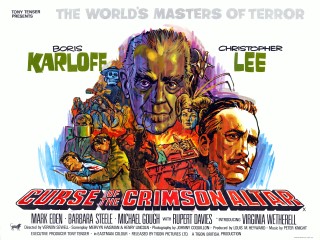
The Curse of the Crimson Altar (1968)


A garish mix of occult themed horror and groovy Sixties British psychedelia, The Curse of the Crimson Altar is not scary, but the colourful energy and supporting cast of Barbara Steele, Christopher Lee and Boris Karloff make it worth a look.

Antiques dealer Robert Manning (Mark Eden) is searching for his missing brother, last seen at Craxted Lodge a remote manor in the English countryside. The manor's owner, Morely (Lee) claims never to have heard of him, but nevertheless invites Manning to stay while the hunt continues. While there, manning starts to suffer vivid nightmares involving a sinister witchcraft cult headed by a mysterious woman (Steele). Is there a link between the dreams and to Manning's quests? And what are the real motives of occult expert Professor Marsh (Karloff)?

The plot is a little more confused than that synopsis makes it sound but the oily charm of Lee and the sinister menace of a cadaverous looking Karloff, coupled with the crazy sleazy dreams of rituals involving a green body painted Steele and a man wearing nothing but a leather apron and a helmet of antlers more than make up for any slow points.


Thursday, 31 August 2017

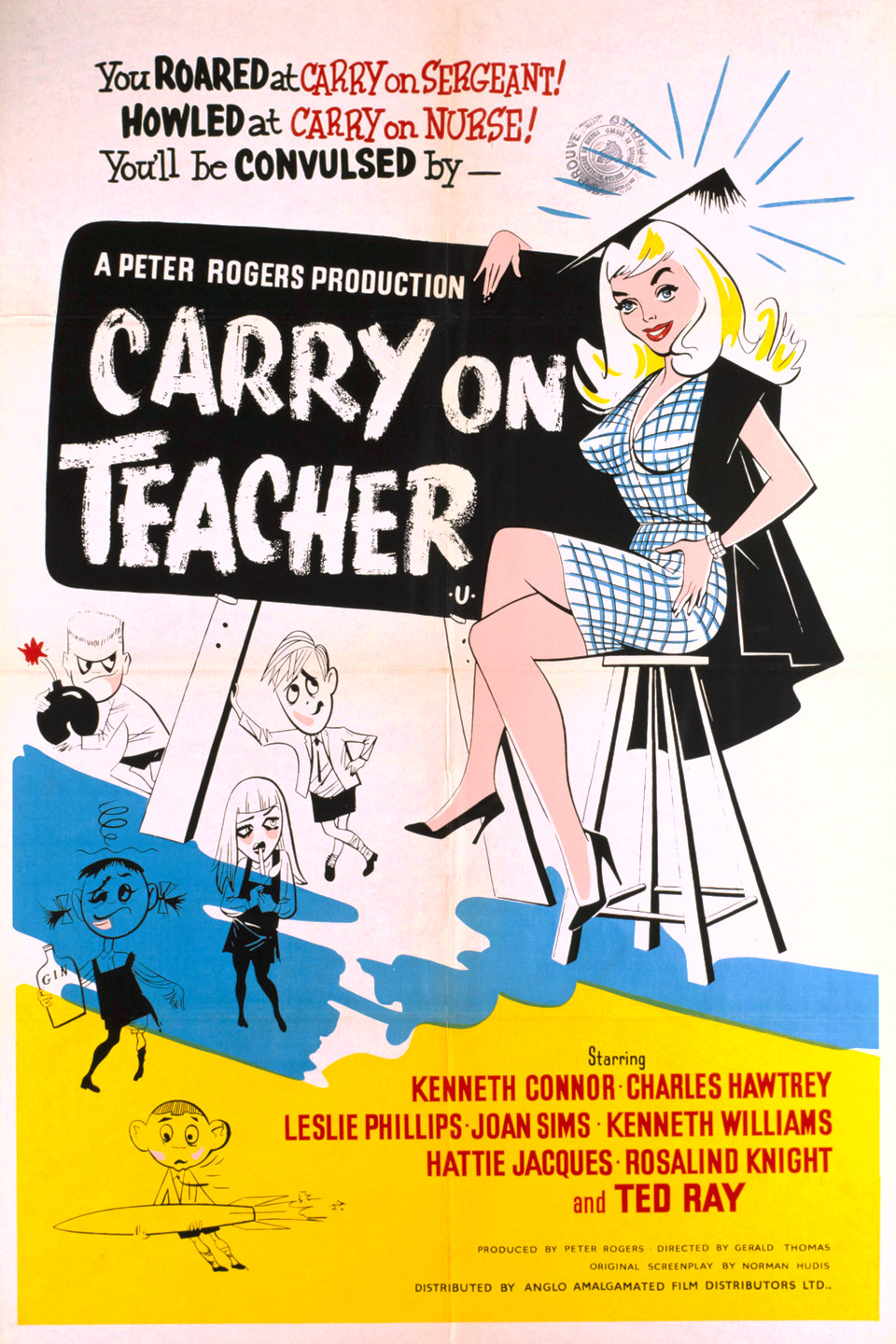
Carry On Teacher (1959)


Being only the third in the series, Carry On Teacher lacks a few of the elements associated with the films, but we can already see a rough blueprint of how they will develop.

William Wakefield (played by Ted Ray, in his only Carry On film) is the Headmaster of Maudlin Street Secondary Modern School. His hopes of getting a job at a shiny new school rest entirely on the results of a visit by Government Inspector Miss Wheeler, and noted child psychiatrist Alistair Grigg (Leslie Phillips). However, the pupils don't want Wakefield to leave, and plot to sabotage the inspection by any means necessary.

Several actors would go on to be Carry On regulars and here seem to be rehearsing the roles they would play on a more regular basis, with Kenneth Connor as an affable duffer, Charles Hawtrey as a camp neurotic, and Joan Sims as Sarah Allcock, the object of male desire. The exception is Kenneth Williams, playing straight as Edwin Milton, the English teacher, very different from the leering grotesque persona of the later films. (Look also for a very young Richard O'Sullivan, of later Man About the House fame)

Being a Carry On film, some of the script revolves around sex, particularly Grigg chasing after Allcock, and the innuendo in her name does not go unnoticed. However, this is rather tame and anodyne, lacking the bawdy energy that the likes of Sid James would bring into later films of the series.

In fact, the world of Carry On Teacher is an uncomplicated, sometimes sentimental one, but modern viewers might find one aspect jarring. Corporal punishment is a recurring theme, particularly the reluctance of Wakefield to administer it, and is a reminder of a time when British school children faced the possibility of physical punishment from their teachers.

Thursday, 17 August 2017

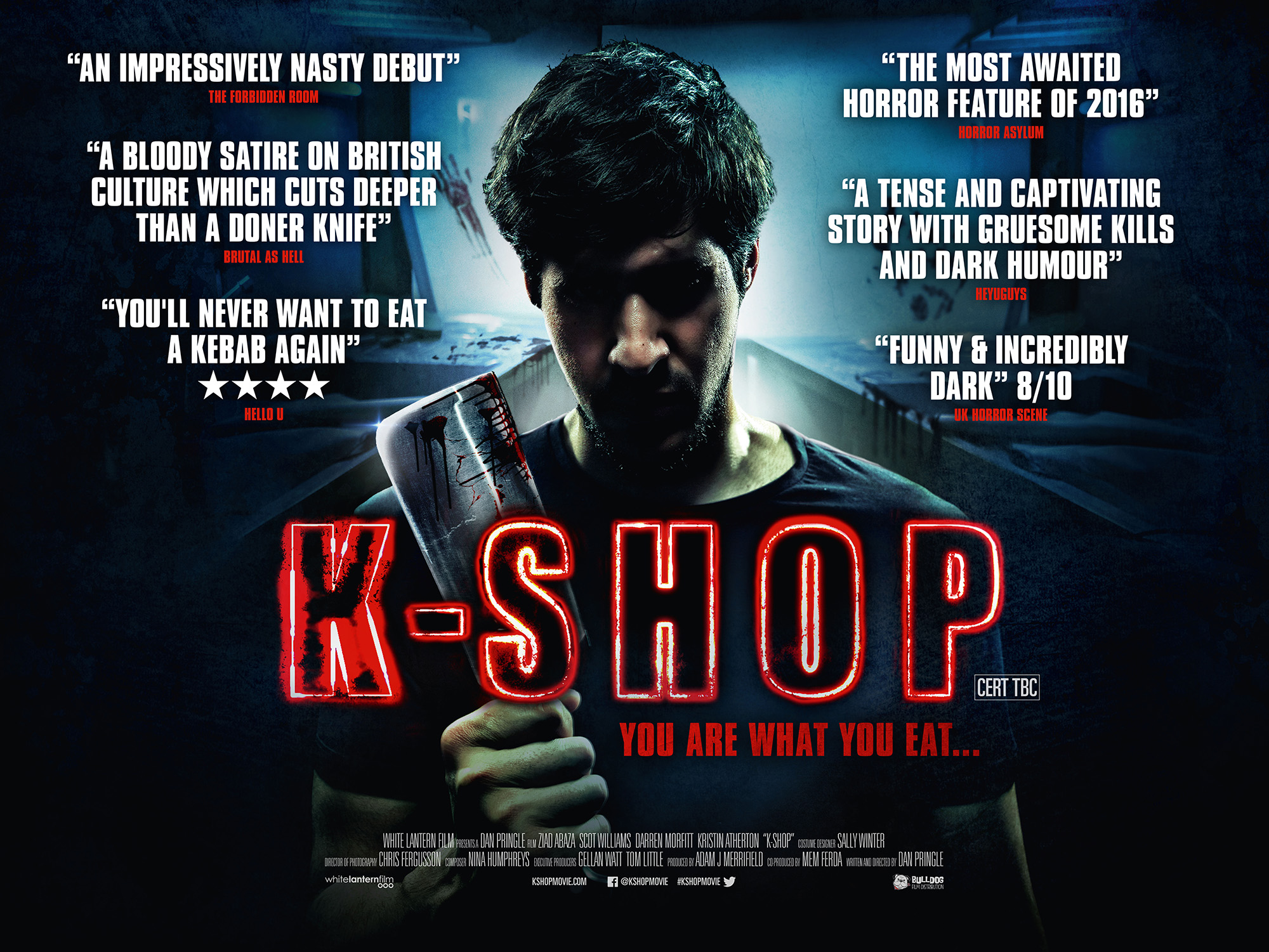
K-Shop (2016)


A modern take on the Sweeney Todd story, K-Shop has some good ideas but these get buried in a script that fails to make the main character convincing.

Salah (Ziad Abaza) is a Turkish-British student, about to graduate with a politics degree. With nothing left to do but fine tune his dissertation, he comes to help his ailing father Zaki (Nayef Rashed) who runs a late-night kebab place in an English seaside town. He is horrified at the way the drunks abuse Zaki, abuse that turns tragic when Zaki dies at the hands of one of them, leaving Salah in charge of the shop. From there, he launches a one-man vigilante operation against his customers, and, being a businessman, finds a way to dispose of the evidence and cut down on his overheads.

The film certainly paints a bleak view of England, a land of binge drinking, vomiting, fancy dress stag nights, and sinister nightclub owning reality TV stars. The biggest influence, consciously or not, seems to be the Death Wish series and their subsequent rip-offs, where the filmmakers are not subtle about telling us about whom we should be cheering for and who we should be booing. The characterisation for the latter doesn't really go beyond being us being shown somebody saying something awful, such as call centre workers boasting about ripping off elderly vulnerable customers, or a drunk man helping himself to food and referring to Zaki as Saddam, and the character arc of Salah going from bookish student to cold blooded killer is not believable in the slightest.

Nevertheless the anger of Salah, coupled with a dark sense of humour and some outré gore compensate enough to make the film worth a watch for the misanthropic.