Showing posts with label Boris Karloff. Show all posts

Tuesday, 17 September 2019

The Body Snatcher (1945)


The Body Snatcher is a classic example of a film that has all the ingredients on paper, but which never comes to life.

The screenplay is based on a short story by Robert Louis Stevenson. The film stars no less than Boris Karloff as the title character, John Gray, a shifty cab driver who has a sideline sourcing and delivering dead bodies for top surgeon Wolfe "Toddy" MacFarlane (Henry Daniell, best known as Goebbels parody Garbitsch in Charlie Chaplin's The Great Dictator). Bela Lugosi has a small role as MacFarlane's other cadaver consultant, but the fact that he barely registers should be an alarm bell for the rest of the film.

Producer Val Lewton had previously given us Cat People, The Curse of the Cat People and I Walked with a Zombie. These films, despite their lurid titles, have an unsettling mix of atmosphere and ambiguity. This kept the viewer intrigued and on edge. Director Robert Wise would go on to have an eclectic career, from editing montages for Citizen Kane, to directing everything from low key noir classics like The Set Up to big budget epics like The Sound of Music and Star Trek: The Motion Picture
 
There are some interesting ideas in The Body Snatcher, particularly with regard to class, and how those at MacFarlane's level feel like they can get away with flouting the law. But, largely it is talk, endless talk, with little or nothing left to the imagination of the viewer, the central strength of Lewton's former work. One for the Karloff / Lewton / Lugosi completists only.


Wednesday, 5 September 2018

Juggernaut (1936)


I will sit through anything with Boris Karloff in at least once, but with some films, once is more than enough.

Set in the Côte d’Azure, Juggernaut sees him playing a doctor, desperate for funds to complete experiment into cure a form of paralysis who gets caught up in a plot by a scheming heiress to murder her husband.

Despite Karloff playing a murderous scientist, Juggernaut is not a horror film, but a crime melodrama, and not a very good one at that. The story isn't always clear, the script is overly talky, the acting poor (even Karloff) and the film itself is badly directed, with poorly framed shots sometimes held for several minutes.

It's also a completely misleading title, covering a dreary affair with no momentum that fizzles out long before the end.


Friday, 8 September 2017

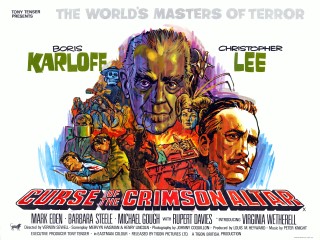
The Curse of the Crimson Altar (1968)


A garish mix of occult themed horror and groovy Sixties British psychedelia, The Curse of the Crimson Altar is not scary, but the colourful energy and supporting cast of Barbara Steele, Christopher Lee and Boris Karloff make it worth a look.

Antiques dealer Robert Manning (Mark Eden) is searching for his missing brother, last seen at Craxted Lodge a remote manor in the English countryside. The manor's owner, Morely (Lee) claims never to have heard of him, but nevertheless invites Manning to stay while the hunt continues. While there, manning starts to suffer vivid nightmares involving a sinister witchcraft cult headed by a mysterious woman (Steele). Is there a link between the dreams and to Manning's quests? And what are the real motives of occult expert Professor Marsh (Karloff)?

The plot is a little more confused than that synopsis makes it sound but the oily charm of Lee and the sinister menace of a cadaverous looking Karloff, coupled with the crazy sleazy dreams of rituals involving a green body painted Steele and a man wearing nothing but a leather apron and a helmet of antlers more than make up for any slow points.


Monday, 10 October 2016

The Sorcerers (1967)


The life and career of Michael Reeves was tragically cut short at the age of 25 by an accidental drugs overdose, and while much of the focus of his career is on the brilliant Witchfinder General, it would be shame if The Sorcerers was overlooked. Although made cheaply and quickly, it has a creepy, decadent atmosphere, a fascinating premise and a sympathetic and dignified turn from Boris Karloff.

He plays Professor Marcus Monserrat, an ageing hypnotherapist who has a bizarre new contraption that lets him and his wife Estelle enter and control the mind of anyone they can persuade to undergo his treatment. Not only that but they get to live vicariously through them, experiencing the sights, sounds and sensations that the subject does, the subject in question being Mike (Ian Ogilvy), a jaded party animal in Swinging Sixties London. But the scientific quest of the Professor starts to take a back seat as Estelle starts to want more and more thrills - including murder.

Reeves was, despite his youth and inexperience, gifted at using limited time and resources. He also made good choices both in casting and direction. With the former, he clearly realised the artistic and commercial potential of having a charismatic horror film icon in the lead role, and Karloff brings a humanity and sympathy to the character of Monserrat, who grows increasingly appalled as his creation spirals out of control. This trick would be repeated by Reeves with Vincent Price in Witchfinder General. He also gives the film a gritty, and at times, brutal feel, and doesn't skimp on the blood and violence. The photography is sharp with a documentary feel which does not paint a flattering picture of the groovy young swingers and their world.

The premise is ludicrous but Reeves quite rightly does not focus on how the machine works, but rather on the consequences of having this sort of power. This is in turn leads to a number of possible readings of the film. On one hand it can be seen as a morality tale of how absolute power corrupts absolutely, or alternatively, a metaphor for cinema itself, how we the audience vicariously live through the characters on screen.


The Sorcerers (1967) Trailer from picturepalacemovieposters.com from PICTURE PALACE MOVIE POSTERS on Vimeo.

Wednesday, 4 November 2015

The Secret Life of Walter Mitty (1947)


Very loosely based on the classic James Thurber short story, The Secret Life of Walter Mitty is a fun little romp, with a refreshingly dark and unsentimental side that makes it stand apart from other comedies of the era.

Danny Kaye plays the title character, a young man working at a New York publishing company, somebody with no greater life plans than getting to the end of the day without falling foul of his bullying boss, insufferably bossy mother, and immature and irritating fiancé. The only escape for poor Mitty is his own private fantasyland, where, whether as a brilliant surgeon, a dashing fighter pilot, or a sure shot cowboy, he is always the hero. However, fantasy and reality start to merge when, back in the real world, a beautiful woman drags Mitty into a plot involving stolen jewels – a beautiful woman who happens to look exactly like a woman from his dreams.

The film works best during the fantasy sequences, with the production design in the individual dreams both detailed and surreal (and in the hospital sequence, weird, almost like Cronenberg's Dead Ringers). Director Norman McLeod plays up this visual element more than in some of his previous work with the likes of the Marx Brothers and W.C. Fields, where the emphasis was more on surreal sight gags and word play.

There is also no attempt to gloss over how grim much of Mitty's life is, being undervalued at work and home, henpecked and demeaned by the men and women in his life. Things get genuinely dark too, when those around him convince Mitty that his active imagination is in fact a serious mental illness, and send him to see a shrink, played by, of all people, Boris Karloff. Again, credit to McLeod for balancing the light and dark of the film, ultimately making Mitty a sympathetic rather than just pathetic character.