Horror and Sci-Fi films old and new, weirdo trash, arthouse, forgotten gems, well loved classics, and I'm watching the original Dr Who from the beginning.
The
Swimmer is both a melancholy look at a man's life that is falling apart and an
unsentimental look at the pitfalls of nostalgia.
Based on
a short story by John Cheever, the plot centres on Ned Merrill (a buff looking
Burt Lancaster), a middle aged ad man who decides to swim his way home via his
neighbour's backyard pools. Both the day and Ned's mood start off bright, but
as each pool brings up people he hasn't seen for a while, and the memories
associated with them things take a dark turn. Gradually we learn more about
Ned, and he learns some painful lessons about himself.
The
script is very talky, but it is dialogue packed with irony and double meaning. Director
Frank Perry (with one uncredited scene helmed by Sydney Pollock) has plenty of
cinematic style with some fast cuts and odd angles. The occasional shift into
soft focus seems to be signifying wistful yearning for the past. But it always
resolves into something downbeat, and there is always something dark behind the
facile grins.
While The
Swimmer starts off in a realistic fashion, the film gradually takes on a more
dreamlike and allegorical quality, enhanced by the stiff detached delivery of
some of the lines. As the disconnect between surface appearances and reality
becomes wider, day turns to evening, sunshine to rain, happiness to sadness.
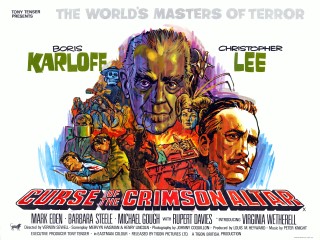
A garish mix of occult themed horror and groovy Sixties British psychedelia, The Curse of the Crimson Altar is not scary, but the colourful energy and supporting cast of Barbara Steele, Christopher Lee and Boris Karloff make it worth a look.
Antiques dealer Robert Manning (Mark Eden) is searching for his missing brother, last seen at Craxted Lodge a remote manor in the English countryside. The manor's owner, Morely (Lee) claims never to have heard of him, but nevertheless invites Manning to stay while the hunt continues. While there, manning starts to suffer vivid nightmares involving a sinister witchcraft cult headed by a mysterious woman (Steele). Is there a link between the dreams and to Manning's quests? And what are the real motives of occult expert Professor Marsh (Karloff)?
The plot is a little more confused than that synopsis makes it sound but the oily charm of Lee and the sinister menace of a cadaverous looking Karloff, coupled with the crazy sleazy dreams of rituals involving a green body painted Steele and a man wearing nothing but a leather apron and a helmet of antlers more than make up for any slow points.
Bullitt is well known for the astonishing car chase, rightly hailed as one of the best in cinema history, but there is more to this film than just one sequence. As well an action film and detective story, Bullitt is a character study of one man and how his survival tactics for dealing with the harsh realities of his job may have cost him his humanity.
Frank Bullitt (Steve McQueen) is a San Francisco cop who gets the job of being bodyguard to Johnny Ross, a mafia witness, due to testify at a high-profile hearing organised by publicity-hungry politician Walter Chalmers (Robert Vaughn). Unfortunately for him, said witness gets gunned down and later dies in hospital. While Chalmers is determined to make Bullitt pay, the detective starts to see that there is much more to this case than meets the eye.
Steve McQueen was one of those actors who were best playing a variation on their public persona, and Bullitt is no exception. Here he is cool, unflappable, and utterly unintimidated by anyone, from Senator to crook. But he is also something of an anomaly, unable to fit in with anybody else's world, whether it's the power obsessed world of Chalmers, the buttoned-down world of his colleagues and superiors, or the sensitive arty world of his artist girlfriend. Instead, he has become emotionally disconnected, hardened and oblivious to the violent messy reality of his daily life. This is a survival tool, but one that may have cost him his soul. McQueen is in the vast majority of scenes, but his charisma is such that he never becomes boring to watch, and the focus on his character makes Bullitt more than just the standard clichéd maverick cop.
Obviously, that makes it difficult for the cast to make an impression, but Robert Vaughn acquits himself admirably as the oily, seemingly unstoppable Chalmers, switching from friendly to menacing in the blink of an eye, and the opposite of Bullitt in every respect, as perfectly summed up in Bullitt's famous retort, "You work your side of the street, and I'll work mine".
The chase itself is of course the highlight of the action, breathtakingly filmed with plenty of shots inside the cars, which help put the viewer right into the heart of the action. But it is the editing, which won Frank P Keller an Oscar, that makes it a classic. The actual filming took place over a five-week period, which Keller flawlessly distils to an adrenalin filled ten minutes.
Bullitt was the first American film for English director Peter Yates, and here he deftly blends detached stylish cool with fast paced editing, and gritty (and at times gory) documentary style realism. When combined with the quality script and riveting performances from the leads, the result is an exciting and unforgettable classic that rewards repeated viewings.
Although not a
big commercial success on its release, The Devil Rides Out is one of the best
horror films produced by the Hammer studio. This is despite it being in many
ways the antithesis of everything that Hammer was supposed to represent, in
that there were no gloomy castles or other Gothic trappings, no vampires or
other such monsters, and Christopher Lee was playing the good guy. The
reactionary undertones of the source material remain intact, something quite
fascinating to consider, given the year in which the film was released.
In 1920s England,
the Duc de Richleau (Christopher Lee) is concerned that Simon Aron (Patrick
Mower), the son of a late friend has been brainwashed by a satanic cult. The
leader of the cult, Mocata, (Charles Gray) wants to induct Simon and his friend
Tanith Carlisle into a satanic baptism - and he has some powerful allies,
including the Angel of Death and the Devil himself
The punchy
well-structured script by Richard Matheson sticks to the plot of the original
Dennis Wheatley novel. We are plunged straight into the action from the
beginning, and there is barely a wasted line or scene as the action drives
relentlessly forward, through manor houses, countryside car chases, and
frenzied Black Magic rituals. The 1920s setting also means that in many
respects it does not look dated – although the effects do
Unsurprisingly,
the main star of the film is Lee, who manages to be an almost mirror image of
the villains he is perhaps more well known for. His Richleau is every inch the
aristocratic charmer that his Dracula is, but this is now mixed with elements
of Van Helsing, particularly the arcane knowledge, which he can handily explain
to the audience, and the traditional Christian moral view. When Richleau is
admonishing Simon at the beginning, he sounds like a concerned parent horrified
at what their children are getting into. It is not too much of a stretch of the
imagination to picture a real life parent in 1968 similarly horrified at their
offspring and their long hair and interest in the occult, something that would
be crystallised in the mainstream with the release the following year of the
hit single Age of Aquarius.
There is often a
reactionary or Puritan streak underpinning the horror genre, such as in the
sight of sexually active teens being knifed by masked killers. This is often
paired with situations that show or imply a pro-Christian message, such as the
crucifix dispatching the vampire, or the Roman Catholic exorcism rituals
succeeding where medicine and science fails.
On the surface,
The Devil Rides Out is no exception, with the crosses, the depiction of
Satanists as evil, (with no real discussion as to why), and the subtext of the
Christian (and in this case, sexually and emotionally repressed) way of life is
good, while the Satanic (and, again, as represented in the film, uninhibited)
life is bad. There is a small hint of irony in this, given that a film could
not have been made without the rise of more permissive attitudes in cinema goers, and perhaps this is the key as to why there is no heavy handed
lecturing in the film, which would have turned audiences off. Instead, the two
sides are presented as no more than opposing forces for dramatic purposes for
us to cheer or boo as appropriate.
If You Meet Sartana Pray for Your Death, is a competent, enjoyable, but highly derivative Spaghetti Western.
Gianni Garko plays the title character, pretty much a clone of Clint Eastwood's Man with no Name from his work with Sergio Leone, complete with a face full of stubble and a cool, indifferent attitude towards his adversaries.
The plot is also reminiscent of Leone's "A Fistful of Dollars" with Sartana playing two rival gangs off against each other to get his hands on a box of stolen gold, and as well as borrowing for story ideas and characters, director Gianfranco Parolini also lifts many of Leone's visual ideas, in particular, juxtaposing extreme close-ups with lengthy long shots.
However, none of this ever tops it's source material, lacking Leone's knack for over-the-top grandeur and sadism, and it fails to create something new from the basic Spaghetti Western blueprint, such as the grimy weirdness of Sergio Corbucci's "Django".
Even Klaus Kinski, although charismatic as ever in his role as a hired killer, fails to completely light up the screen, coming across as a little restrained and not as much fun to watch as normal.