Horror and Sci-Fi films old and new, weirdo trash, arthouse, forgotten gems, well loved classics, and I'm watching the original Dr Who from the beginning.
Showing posts with label Sci-Fi. Show all posts
Monday, 22 June 2020
Dr Who #8: Planet of Giants
A TARDIS malfunction leaves the ship and crew back on Earth but shrunk to miniature size. The Doctor, Susan, Ian, and Barbara are thrust into a conspiracy involving a murder, a shady businessman and a deadly pesticide that could threaten all life on the planet. (The "genius" inventor of this only seemed to realise once it was ready for production)
Like The Edge of Destruction, this starts off with a suitably gripping "what the hell" moment as the TARDIS doors open before the ship has landed. What follows is a pacey murder mystery fused with elements of Gulliver's Travels and fears of a looming eco-disaster.
Considering the non-existent budget, the production design is excellent, especially the models of the giant laboratory, the ant eggs, and the fly that attacks Barbara.
The reason for the shrinking of the TARDIS is explained away with some technobabble and is not really the focus of the plot.
As Barbara becomes infected by the DN6 pesticide, the race is on to get her back to the safety of the TARDIS. The ending does feel rushed. Initially a four-part serial, the last two episodes were edited together into one. While this does bring the pace up, for one thing, it is never properly explained how Barbara gets better.
Interestingly, this is one of the only times that the main cast have no direct interaction with the supporting characters.
Wednesday, 13 May 2020
Prophesies of Nostradamus (1974)
The legendary Toho studio in Japan, home of Godzilla, made a name for itself internationally with apocalyptic films that show cities being ravaged and destroyed. In this respect, Prophesies of Nostradamus is no different from that strand of their output. Except that in this case, the monster is.... MANKIND.
The central character is a biologist / paediatrician (it is a bit vague) Ryogen Nishiyama. His family heirloom is a book of prophecies from noted 16th century French crackpot / charlatan Nostradamus, prophecies that Dr Nishiyama starts to see coming true in 1970s Japan.
This film combines two genres that had a brief bloom of popularity in the 1970s, those of eco-horror and apocalyptic disaster. In the West this meant films as diverse as Phase IV, The Late Great Planet Earth and the UK TV show and movie spinoff Doomwatch.
The lead character is a prototype Eco-warrior who preaches against overpopulation. Being a middle-class hypocrite, he of course wants his daughter to have children. He also is a big believer in the bunkum nonsense of Nostradamus, but that does not emerge as a massive driver of the plot, which is surprising, given the film's title.
The first 45 minutes or so are talky but a lot of energy comes from passionate anger of Nishiyama. By an hour in the gross Eco-horror starts. Nishiyama leads a trip to New Guinea to find what happened to a group of scientists. While there his party is attacked by giant bats and leeches. The natives have turned into cannibals, and when one scientist is attacked, he also turns into a cannibal, albeit a rabid one.
Elsewhere the apocalypse ramps up as children are born with amazing physical and mental powers which will prove horribly fatal in later life. In more shocking scenes HIPPIES STOP CARING, as demonstrated in a scene that feels like somebody trying to a Rowan and Martin style montage.
The film builds an air of pessimism and gloom. Riots are replaced with volcanoes, earthquakes, and nuclear apocalypse. By the climax, only a couple of mutants survive. But do not worry - THERE'S A TWIST ENDING.
Recommended for fans of goofy, gross, tasteless oddball cinema.
Labels:
1974,
Apocalypse,
Colour,
Godzilla,
Japan,
Post-Apocalyptic,
Sci-Fi,
Toho
Tuesday, 12 May 2020
Doctor Who #6: The Aztecs
The second surviving historical rather than sci-fi story has some excellent suspense, some terrible acting, and some interesting character development.
The TARDIS lands in 15th century Mexico and Barbara is instantly mistaken for the reincarnation of a high priest. Along with Ian, Susan, and The Doctor she quickly sees two sides of Aztec culture: a thirst for knowledge and thirst for blood, in the form of human sacrifice. Barbara wants to put a stop to the latter, but the Doctor has other ideas.
At its worst The Aztecs is like a pantomime, with obviously painted on cardboard sets, badly choreographed fight scenes and a "he's behind you" villain in the gurning High Priest of Sacrifice, Tlotoxl (familiar face character actor John Ringham).
The drama itself is well constructed though. The "why don't they just take off" problem is solved by trapping the TARDIS in a tomb, and out of reach. And both Ian and Barbara have close calls with death. Susan seems to disappear for a couple of episodes. As with William Hartnell in the Keys of Marinus, she took a two-week holiday so was written out of the script.
Most interesting is the continuing development of the character of the Doctor. After his rather passive start to the series, letting Ian take charge, he is now much more proactive. He reprimands both Ian and Barbara against interfering in history when they both want to turn the Aztecs away from bloodshed. He also ends up in a cheeky flirtation with and accidental engagement to a woman, Cameca. It pays off, as Cameca comes through with some vital knowledge at a key time.
Tuesday, 28 April 2020
Doctor Who #5 The Keys of Marinus
The fourth story, Marco Polo, is missing in its entirety so it is straight onto the fifth. Writer Terry Nation makes a return after his triumph with the Daleks. It is a disjointed but enjoyable affair, even if the patchwork nature of the story is both a blessing and a curse.
The TARDIS arrive on a small island on the planet Marinus. The Doctor, his granddaughter Susan, and her former teachers Ian and Barbara meet Arbitan. He is the keeper of the Conscience of Marinus, a computer designed to keep law and order across the entire planet. It is under attack by humanoid beings called the Voord, who want to control the conscience. As a security device, the Conscience requires five keys. By blocking their access to the TARDIS, Arbitan forces the Doctor and his friends to go and look for them.
The first episode sets up an intriguing mystery. Creepy beings in diving suits and spiked helmets prowl around, while the cast disappear one by one. It feels like an Agatha Christie story.
After a quick bit of exposition, the story is up and away. A quest is set up, giving us one key per episode. The question of "why don't you just leave?" is also settled by having an invisible force field thrown around the TARDIS.
There is a mix of the established story format (they are separated from the TARDIS) with a new one (different worlds in each episode). This gives us a new world to explore each time, which means that while there is always something fresh, there is no chance to explore or develop the worlds or characters we meet. Which is a shame, as there are some interesting ideas here. I liked the decadent, Roman style planet. This is a place where life is devoted to leisure and people can have anything they want. Barbara can see that there is something sinister going on under the surface. There is a creepy atmosphere to that episode, with POV camera shots, and brains with eye stalks in a jar giving it the feel of a horror film.
Later episodes are not as successful. One that sees everybody trapped in a mountainous region of the planet has a bewildering array of characters jammed into twenty minutes. The Doctor disappears for two of these episodes without a decent on-screen explanation. Off screen, there was no great drama, William Hartnell took a fortnight's holiday.
We also see them land in the middle of a classic locked room mystery. This turns into a courtroom drama, with Ian accused of murder.
The character development is a mixed bag, highlighting the problem that having too many companions poses to the story format. The Doctor continues to be more assertive despite being absent for two thirds of the story. Ian is still an unlikely but willing action man. Barbara also takes a more proactive role. This leaves poor Susan who just seems to scream and scream again. I am starting to understand Carole Anne Ford's frustrations with the role.
Monday, 27 April 2020
Doctor Who #3 - The Edge of Destruction
The Edge of Destruction is a two part story, conjured up at the last minute due to an episode shortfall. It is an unsettling, claustrophobic tale that also provides important character development.
The story sees the TARDIS seeming taken over by an alien force. The Doctor, his granddaughter Susan, and her teachers Ian Chesterton and Barbara Wright start acting strangely and even turn on each other.
The main character in this is the TARDIS itself. By presenting the ship as an enigmatic, seemingly conscious entity make the epsiodes feel like a haunted house story. It's definitely unsettling to see characters at each others throats. In particular the sight of Susan trying to attack people with a pair of Scissors, or the Doctor drugging Ian and Barbara after he suspects them of sabotage.
Compared to The Daleks there is less action, which means that the Doctor can take a bigger role. We also start to see a thaw in his icy character at the end. He even apologises to the others for not trusting them. This sees an end to the adversarial relationships the character enjoyed, and the start of them working together as a team.
Monday, 13 April 2020
The Giant Claw (1957)
Standard issue 1950s Sci-fi, with little to recommend beyond the hilariously goofy godawful puppet used for the titular character.
The plot is about a giant bird attacking cities around the world. There's no point trying to describe it, so I'll just show you a picture:
As usual with this genre, there is far too much talking and padding out the running time with stock footage. There's some gobbledygook about antimatter to explain the creature, but trying to understand it is a waste of time.
There is a doom laden apocalyptic tone at the end as the bird smashes up New York, but by then it's too little too late.
Doctor Who #2 - The Daleks
The Daleks is as important and ground-breaking as the previous serial An Unearthly Child. It also has some of the same issues with pacing.
The story starts with the Doctor, his granddaughter Susan, and their two fellow travellers Ian Chesterton and Barbara Wright landing the TARDIS in a petrified jungle. From there, they get caught up in a war between the Daleks, unseen creatures encased in distinctive mechanical shells and the Thals, an Aryan-like race of humanoids.
This incarnation of the Doctor has yet to settle down into the proactive heroic do-gooder we know and love. In the Daleks he sabotages the TARDIS to force everyone to explore the Dalek city. Ian remarks that the Doctor "has a knack for getting himself into trouble". Of course, that means it's not himself, but also his companions, two of whom are there against their will. Of course, if he had not, the Thals would have been eliminated by the Daleks. The Doctor remains a passive character in this story, with Ian leading the attempts to escape from the Daleks, and the later attack on their city.
There is some silly and frustrating padding, such as the scene with a Food making machine, and the pace of the story is at times glacial. It also soon becomes clear that too much inter-Dalek dialogue is grating and unlistenable. And why are the female Thals dressed like they're trying to be Playboy bunnies?
These minor quibbles aside, it is still a fantastic story. There is tension and a weird creepy atmosphere that runs throughout. The script has some undertones of racial intolerance and Nazis that would be explored further in later stories.
It's also fascinating to two things about both the Doctor and the Daleks. Firstly, at this stage, neither are encumbered by their own mythology. Secondly, how both have a very analogue 1960s version of advanced technology, with everything working from dials and printouts. And of course, the MacGuffin for the story is the mercury filled fluid link that, without which, the TARDIS is rendered completely immobile.
The Thing from Another World (1951)
The Thing from Another World is an entertaining mix of Cold War paranoia and Howard Hawks machismo.
The plot is based on "Who Goes There?", a short story by John W. Campbell. A group of scientists and US Air Force crew unearth a frozen flying saucer and its pilot near to their Arctic base. Unfortunately for them, the pilot has thawed out, is on the hunt for blood, and is impervious to their bullets.
There has been some confusion over who directed this film. Christian Nyby is the man on the credits, but. Howard Hawks, whose production company made the film, has often been mentioned as being the real talent behind the lens. Regardless of how true any claim is, there are some Hawks-like tropes, most noticeably in the rapid and overlapping dialogue.
In the original short story, the alien is a shape-shifter, imitating the characters, and causing tension and paranoia. In this version, it becomes a vegetable-based humanoid (memorably described as "an intellectual carrot"), immune to bullets and needing blood to regenerate. But there is still tension in the conflict between scientists and the military. The character of Dr Carrington in particular is shown as, if not an enemy, then at least a threat by wanting to reason with the creature rather than set it on fire. This makes a change from other sci-fi films of the era. Scientists are usually portrayed as the only people with the answers, working with or trying to keep the military in check.
Sunday, 12 April 2020
It Came From Beneath The Sea (1955)
Alternating between grinding boredom and thrilling monster packed action, It Came from Beneath the Sea is worth the slog for the special effects genius of Ray Harryhausen.
A start-of-the-art submarine goes out of action in mysterious circumstances. Fishing boats disappear in Japan and Siberia. The evidence starts to point to a massive creature, disturbed from it's deep sea slumber by atomic testing. Can it be stopped before it destroys San Francisco?
There is far too much talking, whether is exposition, or typical 1950s sexist leering. There's a subplot of a relationship between the submarine commander Pete Mathews (Kenneth Tobey, largely reprising his turn in The Thing From Outer Space) and the lead scientist Professor Lesley Joyce. According to her colleague, Joyce is one of those new breed of women "who feel they're just as smart and courageous as men".
But these quibbles are soon forgotten once the creature itself appears. Harryhausen shows his usual attention to detail and fluidity of movement. His creations are as lifelike as the humans on screen.
Tuesday, 7 April 2020
Galaxy of Terror (1981)
Galaxy of Terror is a cheap, sleazy and goofy attempt by Roger Corman to cash in on the Sci-fi boom of the era.
The plot sees a spacecraft off to a distant planet to rescue the crew of another ship. But, the mission goes wrong when the rescue ship itself crashes. Then, the crew start to come under attack from what appear to be demons from their own minds.
Any right thinking trash hound will immediately be attracted by the cast. There is Robert "Freddy Krueger" Englund. The captain of the rescue ship is Grace Zabriskie aka Laura Palmer's mom in Twin Peaks. And one of the crew members is Erin Moran, otherwise known as Joanie Cunningham from Happy Days.
The film is often described as an Alien rip off. This hinges on one particularly unpleasant scene of a female crew member being raped by a slimy tentacle creature. The other deaths revolve around hallucinations linked to their subconscious.
Galaxy of Terror feels like it was shot in a weekend. But, there is a good grungy, Dark Star feel to the production design and special effects, partly due to a young James Cameron.
Unfortunately, a jumbled baffling narrative and too many slow dull patches make the film hard work and less fun than it should be.
Labels:
1981,
Aliens,
Horror,
James Cameron,
Roger Corman,
Sci-Fi
Monday, 6 April 2020
Doctor Who #1 - An Unearthly Child
An Unearthly Child is essential viewing for anyone interested in Dr Who, even if it is something of a Curate's Egg. Barbara Wright and Ian Chesterton are two school teachers in early 1960s London. They share the same gifted but bizarre pupil, Susan Foreman. They decide to team up to confront her mysterious guardian, known only as the Doctor, who seemingly lives in a junkyard, inside a Police Box.
The first episode is brilliant, and establishes the main characters quickly. Especially interesting is the title character. As the show is yet to get bogged down with its own mythology, the Doctor we see here is a genuine enigma. He has unclear motives and an abrasive streak in his character.
The story sets the template for a type of story that will recur throughout the show, even into the modern era. The Doctor and crew get separated from the TARDIS, and battle to fight their way back. In this case it is against hostile factions of a Stone Age tribe who have lost the power to make fire. This means, whatever else is going on, the stakes can be raised a certain amount, and solves the "why don't you simply take off again" problem. But, in An Unearthly Child there is very little else, and could have lost one of the four episodes to tighten the pace. There is plenty of creepy ambience, and the climax in the Cave of Skulls is far more gruesome than I would have expected for a children's show of that era.
The Doctor actually takes a back seat as the story progresses, with Ian being the proactive character who shows the cave people how to make fire again. This is a show that is, finding it's feet, but the basic elements are there. Oh, and for anyone who thinks the show is only nowadays a bastion of bleeding heart liberalism, at one point Ian and Barbara try to teach the cave dwellers about democracy and compassion with the phrase "a tyrant is not as strong as the whole tribe acting collectively".
Sunday, 26 May 2019
Behemoth the Sea Monster (1959)
Cheap and cheerful, Behemoth the Sea Monster borrows from the American giant monster films of the 1950s, especially director Eugène Lourié's earlier influential classic The Beast from 20,000 Fathoms. It's worth a look for the novelty of the London setting, the appearance of Hammer Horror regular André Morell, and the final FX work by King Kong legend Willis O'Brien.
American scientist Steve Karnes (Gene Evans) is giving a speech to British scientists about marine life and the dangers by nuclear testing. Later, he learns of thousands of lifeless fish washed ashore on the Cornish coast and the death of a fisherman from radiation burns. Teaming up with Professor James Bickford (Morell) to investigate, the pair find a passenger ship destroyed, with the loss of all on board, while tests show the dead fish were full of radioactive contamination. Karnes begins to suspect the creature the fisherman described seeing is a beast mutated by nuclear testing, with a desire to come back to London.
In the first ten minutes we get all the tropes you expect from this genre. 1) A conference of scientists with ominous warnings. 2) A bureaucrat who dismisses said warnings. 3) A pretty girl, and a hunky love interest. 4) somebody having a deadly encounter with something, linked to the opening scene, and shot from the point of view of the something. 5) The dying man muttering portentous semi coherent warnings with his dying breath. Following this comes lots of padding, occasional exposition, further deaths and possible monster sightings. Finally, the full reveal of the monster and a trail of destruction. In this respect, Behemoth the Sea Monster is no different, but it is still entertaining for the most part. There is some hokey Dr Who level rubber glove puppet special FX, some atmospheric scenes in Cornwall, and the always watchable Morell.
In fairness, the stop motion monster in the final scenes is not too bad considering the low budget, and this was the final credited work of Willis O'Brien. While he did not invent the technique, he refined and brought it to popular attention through King Kong, inspiring the likes of Ray Harryhausen.
Lourie would go on to give the monster smashing up London in the more colourful and fun Gorgo. This took the action from destroying anonymous docks and houses, to smashing London landmarks like Tower Bridge.
Sunday, 20 January 2019
Robot Monster (1953)
Robot Monster is a rite-of-passage for anyone with an interest in 50's B-Movies and has long been staple of those Worst Films Ever lists that were all the rage in the 80s and 90s.
Ro-Man, an Alien Robot that in no way bears a striking resemblance to a man wearing a gorilla suit and a diving helmet, is on a mission to destroy all human life on Earth with his Calcinator death ray. He is achingly close to getting the job done, except for half a dozen humans that stubbornly remain alive; a scientist, his wife, their two daughters, his young son Johnny and his assistant, who have all somehow developed an immunity to the death ray. As if that's not bad enough for poor Ro-Man, he has developed an illogical attraction to Alice, the eldest daughter.
It's true that the film contains much that is easy to sneer at. The story makes little sense, the acting is wooden, the Death Ray seems to be a bubble machine with a TV antenna, and the four day shooting schedule is reflected in a few fluffed lines.
But, one thing you could never call it is dull. The sheer insanity and invention coupled with a total lack of any irony or self-awareness gives Robot Monster a delirious energy sorely lacking from other examples of this genre, or their modern-day equivalents such as the Sharknado franchise. Special mention goes to the generous use of stock footage for spacecraft and ruined cities from the likes of Rocketship X-M, Lost Continent, Flight to Mars and Captive Women. Oh, and dinosaurs from One Million B.C., because Ro-Man can also unleash giant lizards on the earth or something.
Despite the recycled special effects, the score is completely original and by no less a Hollywood luminary than Elmer Bernstein. A few years before his classics such as The Man with the Golden Arm and The Magnificent Seven, Bernstein was still a jobbing composer, and had, according to him, been side-lined in some areas of Hollywood due to his left-wing politics. His score for Robot Monster is a mix of bombastic and discord and sounds like it should belong in a much better film.
There is also a Shaggy dog story twist ending (SPOILER ALERT), which actually makes the whole baffling premise work. It turns out the whole thing has been a nightmare in the mind of little Johnny, which explains the incoherent and childish feel to the plot.
Friday, 28 December 2018
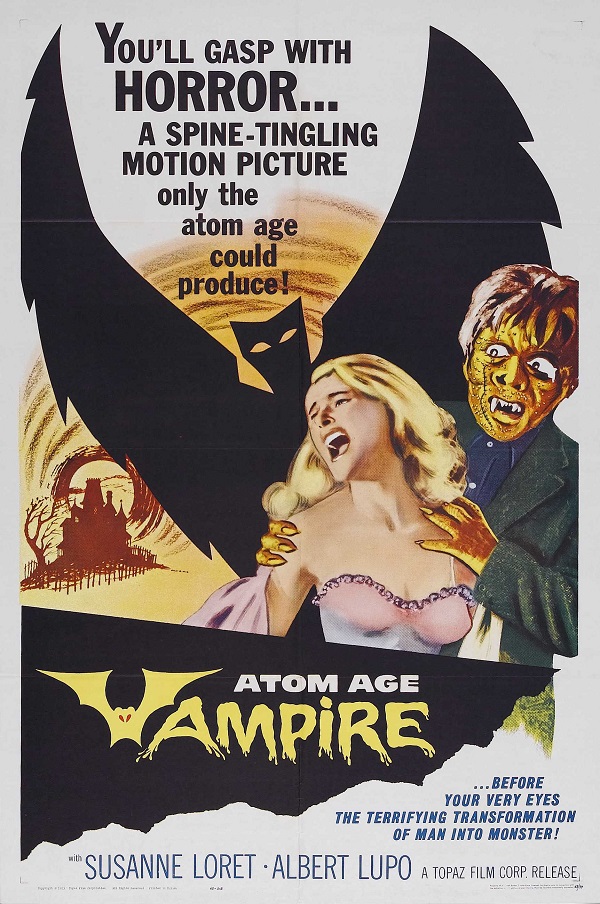
Atom Age Vampire (1960)
The title Atom Age Vampire is only 50% correct, as atoms and radiation play a big part in the plot, but there is no sign of a vampire.
The plot borrows from both the mad surgeon part of Eyes Without a Face and man / monster elements of Dr Jekyll and Mr Hyde. After a car accident leaves stripper Jeanette Moreneau (Susanne Loret) horribly scarred, a brilliant scientist Professor Alberto Levin (Albert Lupo) falls in love with her. Levin has created a treatment that uses radiation to restore her beauty, but to preserve it he must use glands taken from murdered women, for some reason. He can also only murder said women after taking a potion that turns him into a hideous monster, for some reason.
It's a mixed bag, with the flat lifeless direction draining any genuine horror or tension from scene after scene. But, the photography is surprisingly imaginative, with a use of shadows that gives the film a gloomy, creepy look.
The premise is a little confused, but the over the top twists and turns, coupled with low budget effects and make up (especially Levin's werewolf-like alter-ego) means enough trashy campy fun to make Atom Age Vampire worth a look.
Sunday, 9 December 2018
The Day Time Ended (1979)
Not only does the title The Day Time Ended bear no relation to the events on screen, the events themselves often bear no relation to the other events in the film.
The plot, as far as I discern, sees a family moving into their new solar-powered home in the middles of the desert. The bad news is their house in right in the centre of some sort of time vortex. Beyond that, God only knows. Close Encounters of the Third Kind is clearly a big influence that the filmmakers were trying to cash in on, with cute kids, time travel, inexplicable events and alien abductions. The script feels like somebody wrote down every sci-fi trope they could think of, put them into a hat and drew them out one by one, regardless of how much sense they made.
In the right hands - or even the wrong hands - this sort of approach can work, with a delirious energy meaning never a dull moment for the viewer. Director John "Bud" Cardos had previously made some low budget exploitation gems such as nature-on-the-rampage classic Kingdom of the Spiders, but he can't make this mess come to life. The special effects are cheap and cheesy, especially the stop-motion aliens, and at least provide a distraction from the wooden human characters.
The finale is left open-ended and if anything feels like this is a pilot for a TV show that, thankfully, never went anywhere.
Saturday, 8 December 2018
The Strange World of Planet X (1958)
An unremarkable low budget British Sci-fi B-movie, The Strange World of Planet X lumbers along through an hour of talky cliched script before bursting into life with some stupid special effects.
In a laboratory in rural England, archetypal mad scientist Dr Laird is carrying out experiments involving ultra-powerful magnetic fields. His American assistant Gilbert Graham (Forrest Tucker) is having some doubts about the work, as are the government backers. After a freak storm hits the country, giant mutant insects appear in the village forest. Are they linked to Laird's laboratory? And who is the mysterious Mr Smith, who seems to know a lot about both Laird's work, and some recent UFO sightings?
The film staggers on for an interminable talky hour, with little in the way of interesting character development or even cheap thrills. It's sustained by the charisma of Tucker, the cringe-worthy sexism of the scientists towards a female colleague (they don't believe she can do "highly skilled work"), and the mysterious Smith character, who, with his interest in dangerous science, turns out to be a rip off from Klaatu in The Day the Earth Stood Still. Oh, and there's a subplot about a tramp who gets turned into a serial killer by the storm, but that soon fizzles out.
After that, the giant insects arrive. Of course, when I say giant insects, I mean normal insects filmed extremely closeup, which is exactly what they look like.
It's worth watching for the cheap laughs at the climax, but it is a hard slog to get there.
Saturday, 3 February 2018
Invaders from Mars (1986)
Noisy, shrill and charmless, this pointless Cannon Films funded remake of the 1950s paranoid classic is everything the original wasn't.
The plot follows the original, with young David Gardner seeing an alien spacecraft land in a quarry behind his house. When his normally warm and loving dad goes to investigate he returns cold and emotionless. As this behaviour starts to spread, taking in David's mother, teachers and fellow townspeople, his only ally is the school nurse, Linda Magnuson. Can they persuade the Marines to help them stop a Martian invasion?
The original may have had bargain basement effects and obvious padding to the running time, but it also had a bleak mood and the feverish quality of a child's nightmare, which, in this context, makes the ping pong ball eye aliens and rushed plotting work. This version has a big budget (much of which went on the impressive special effects), and a knowing, ironic tone, with portentous dialogue, telegraphed scenes of tension and several scenes played for laughs, but little else beyond this.
The plot follows the original, with young David Gardner seeing an alien spacecraft land in a quarry behind his house. When his normally warm and loving dad goes to investigate he returns cold and emotionless. As this behaviour starts to spread, taking in David's mother, teachers and fellow townspeople, his only ally is the school nurse, Linda Magnuson. Can they persuade the Marines to help them stop a Martian invasion?
The original may have had bargain basement effects and obvious padding to the running time, but it also had a bleak mood and the feverish quality of a child's nightmare, which, in this context, makes the ping pong ball eye aliens and rushed plotting work. This version has a big budget (much of which went on the impressive special effects), and a knowing, ironic tone, with portentous dialogue, telegraphed scenes of tension and several scenes played for laughs, but little else beyond this.
Tuesday, 15 August 2017
Shin Godzilla (2016)
Godzilla is arguably Japan's most internationally well-known cinematic icon, and Shin Godzilla (aka Godzilla Resurgence) is an attempt to bring him into a 21st century world of mobile phones and CGI. The film is certainly entertaining, but suffers from odd pacing and a lack of the title character for long stretches.
The plot largely follows the standard template for a Godzilla film, particularly the 1954 original, starting with mysterious scenes of death and destruction, which are eventually linked to the title character, followed by his increasingly devastating rampages and futile attempts by the military to stop him. There are some modern updates as this time, rather than American nuclear testing it is dumped nuclear waste that brings the beast to life, and, of course, when the public see Godzilla for the first time, they all reach for their phones to start filming him.
The original is a fascinating study of national identity in post-World War Two Japan. Shin Godzilla retains this more serious tone, but brings it up to date with the scenes of destruction and the bureaucratic impotence of the national government recalling the recent real-life horrors of Fukushima, although, endless scenes of inter-governmental bickering do not always make for scintillating viewing. The pacing feels inconsistent with a gripping and thrill packed opening 30 minutes followed by a stodgy, talky and hour or so, which is also largely monster free, while Godzilla recharges his nuclear batteries.
Purists may also balk at the amount of CGI used, with the traditional man in a rubber suit replaced by a man in a motion-capture suit, and some of the scenes of destruction look a little more slick and digital than the traditional miniature model sets.
Nevertheless, it's always good to see Godzilla back on the big screen, and when the mayhem and destruction happens it's easy to forget the flaws and focus on what is so good about these sorts of films.
Friday, 23 June 2017
Gonks Go Beat (1965)
Knocked out cheaply and quickly to cash in the youth culture and music of the day, Gonks Go Beat is by turn astonishing, excruciating and deathly dull.
In the not too distant future, Earth is split into two opposing factions, Hip, hairy, and cool Beat Land versus neat, tidy, crooner loving Ballad Isle. Every year they have a musical competition to decide who is best, with the judge being the subtly named Mr. A&R (Frank Thornton). Meanwhile the galactic overlords who rule over everything have for some reason decided to put an end to the squabbling, so send their worst agent, the ever bungling Wilco Roger (Kenneth Connor) to sort the situation out and bring the two sides together.
Having first about this many years ago, I was hoping for an unhinged lost classic, with a rip roaring sixties soundtrack, shoddy sets, a baffling plot, and genuine talents such as Connor, Thornton and Terry Scott degrading themselves, but the reality is a curate's egg. The songs play like promo videos, and music wise, Beat Land wins hands down, with the likes of Lulu, the Graham Bond Organisation (with Jack Bruce and Ginger Baker), leaving Ballad Isle with some insipid, coma inducing tripe.
The story is baffling, the characters unengaging, and the comedy is painful to watch, and having seen some of the things Connor and Scott appeared in, I know they can make the corniest of gags work, but this is beyond even their talents.
I was hoping for a British version of Plan 9 From Outer Space, at least in terms of jaw dropping weirdness, but it lacks the truly deranged vision and energy of Ed Wood's work, and what should be a brain rotting piece of fun soon becomes a slog. If you're a fan of 60s Beat / Blues music, it is worth a watch, but it has little to recommend for anyone else.
Labels:
1965,
Beatlemania,
British,
Colour,
Comedy,
Ed Wood,
Kenneth Connor,
musical,
Sci-Fi,
Terry Scott
Monday, 12 June 2017
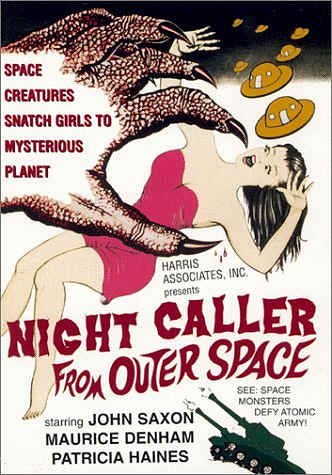
The Night Caller (1965)
After a meteorite crashes into the English countryside, scientist Jack Costain (John Saxon) and his team set out to investigate. They discover it is actually an alien device from one of Jupiter's moons used to transfer matter to Earth. But what is the connection between the visitor from outer space, a mystery man placing ads in the back pages of bikini magazines and the disappearance of anyone who answers them.
At times this feels like two different films thrown together lurching between Quatermass style extra terrestrial mystery and sleazy Soho-based whodunnit. What should have been either a creepy atmospheric chiller or a campy piece of fun is sunk by the script, which is both confusing and relentlessly talky, and the finished product is teeth-grindingly dull.
John Saxon does his best, heroically managing to sustain an English accent for the duration, and there is some fun to be had watching for cameos from Warren Mitchell as a father of a missing girl, Aubrey Morris as a squalid bookstore owner, and Ballard Berkeley, best known as the Major in Fawlty Towers.
Labels:
1965,
Aliens,
Black and White,
British,
Horror,
John Saxon,
Quatermass,
Sci-Fi
Subscribe to:
Posts (Atom)