Horror and Sci-Fi films old and new, weirdo trash, arthouse, forgotten gems, well loved classics, and I'm watching the original Dr Who from the beginning.
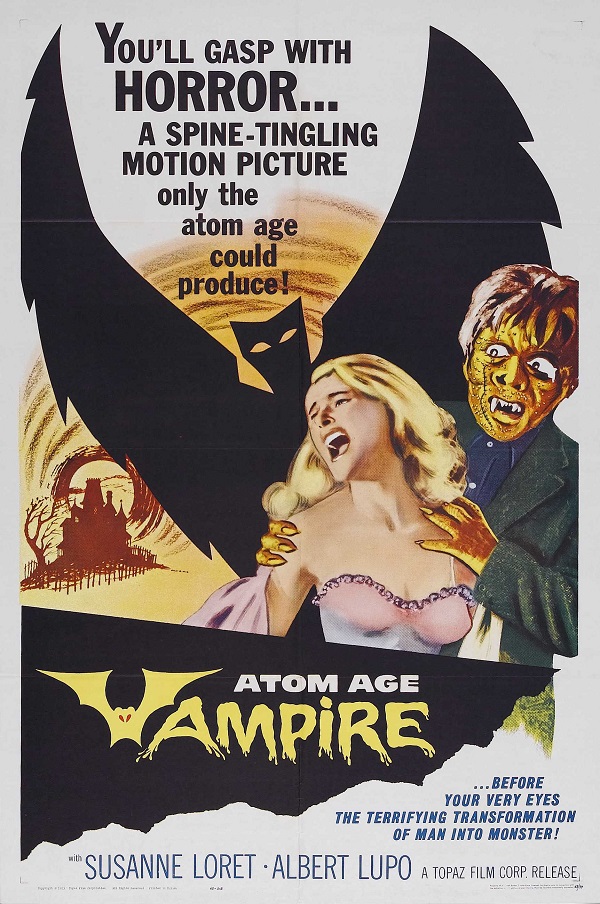
The title Atom Age Vampire is only 50% correct, as atoms and radiation play a big part in the plot, but there is no sign of a vampire.
The plot borrows from both the mad surgeon part of Eyes Without a Face and man / monster elements of Dr Jekyll and Mr Hyde. After a car accident leaves stripper Jeanette Moreneau (Susanne Loret) horribly scarred, a brilliant scientist Professor Alberto Levin (Albert Lupo) falls in love with her. Levin has created a treatment that uses radiation to restore her beauty, but to preserve it he must use glands taken from murdered women, for some reason. He can also only murder said women after taking a potion that turns him into a hideous monster, for some reason.
It's a mixed bag, with the flat lifeless direction draining any genuine horror or tension from scene after scene. But, the photography is surprisingly imaginative, with a use of shadows that gives the film a gloomy, creepy look.
The premise is a little confused, but the over the top twists and turns, coupled with low budget effects and make up (especially Levin's werewolf-like alter-ego) means enough trashy campy fun to make Atom Age Vampire worth a look.
Excision is an intriguing and disturbing mix of teen angst, suburban tension, and Cronenberg style body horror. Pauline (Annalynne McCord) is a teenage outcast, obsessed with surgery and losing her virginity, a combination that leads to some erotic and gory dreams. The interest in medicine is not entirely morbid, as Pauline wants to cure her younger sister Grace, who has cystic fibrosis. This is an excellent, assured debut from writer/director Richard Bates, Jr, who keeps the pace restrained and the gore unhinged. Some scenes are reminiscent of David Lynch, with the juxtaposition of suburban banality and gross disturbing imagery. Pauline is a great character, a mix of unashamed assertiveness and manipulation, and an disturbing innocence. There's an first-class supporting cast with Traci Lords as Pauline's uptight religious mother, locked in a permanent power struggle with her wayward daughter and cameos from Malcolm McDowell and John Waters as Pauline's maths teacher and priest respectively.
Hammer Horror is perhaps mostly closely associated with the Dracula and Frankenstein films, but the studio first explored the horror genre with The Quatermass Xperiment. Although somewhat hampered by the odd choice of leading man, director Val Guest gives both a tense, fast moving adaption of the hit BBC TV serial (the “Xperiment” was presumably changed by Hammer to sell it as an "X" rated film), while keeping the themes of the original intact. The film can also be counted as a very early example of the subgenre known as Body Horror.
Professor Bernard Quatermass, the head of the British Rocket Group, has just sent the country’s first manned rocket into space. However, disaster strikes as all contact with the three crew members is lost, and the rocket crashes back to earth. Two of the crew have disappeared, and the one remaining survivor, Victor Carroon, is in shock, unable to speak, only mouth the words “Help me”. While in hospital, Caroon starts to undergo horrifying changes, and finds he needs to absorb living things in order to survive. Quatermass soon realises that Caroon, or whatever it is that he has become, will not stop growing, and the next stage of his transformation will threaten the entire planet.
Like many low budget European films, The Quatermass Xperiment was given a Hollywood star whose career had hit a lull, brought in for cheap to help sell the film to the American market. This leaves The Quatermass Xperiment with it's only serious flaw, Irish born Brian Donlevy, who had made a name for himself playing tough guys and gangsters, particularly in groundbreaking examples of Film Noir such as Kiss of Death and The Big Combo. Given this background, it is perhaps not surprising that he seems a little bit out of place in an English Sci-Fi movie. That said, while he lacks credibility playing a man of science, his tough guy persona gives the movie Quatermass a headstrong decisiveness and a refusal to be bullied or brushed aside. This Quatermass is a leader, a man of action, coupled with an almost reckless arrogance, a character that is tough to like, not least because he seems unwilling to take responsibility for the consequences of his actions, but who is always unpredictable and interesting.
Far more sympathetic is Richard Wordsworth as the tragic surviving astronaut Carroon. The character stays mute throughout so the anger and despair we see him go through as he loses control of his mind and body is portrayed largely through facial expressions and inarticulate grunts, something that puts him in the same realm as the Boris Karloff’s heartrending take on Frankenstein’s monster. There is also a more overt echo of this, whether it is a conscious one or not, in the scene where Carroon encounters a small girl out playing by herself. Although there is a different outcome here, both scenes are symbolic of the monster's struggle with their intrinsic humanity, and like Frankenstein's monster, Carroon's anguish is not self inflicted, being the victim of a scientists, albeit well meaning, plans gone wrong. This sort of approach would come to be termed Body Horror, and explored many years later by the likes of David Cronenberg, with films such as Shivers, Rabid, and his reworking of The Fly.
The Quatermass Xperiment was the first attempt at a sci-fi / horror film by director Val Guest. He would go on to helm other genre classics such as this film's sequel, Quatermass 2, and The Day The Earth Caught Fire (as well as a long and eclectic career taking in everything from thrillers, comedies and numerous TV shows). If there is a common thread to his approach with these three films, it is to keep the fantastic story rooted in reality, helped by an unflashy, almost documentary approach to shooting scenes, as well as frequent use of actual locations rather than studio backdrops. The screenplay (co-written by Guest, based on Nigel Kneale's original TV scripts) also shows the effects of the events on ordinary people as much as the scientists, military men and government officials.
The film is also fascinating when placed into a historical context, being released at a time when Britain was still wrestling with the mix of World War Two euphoria, Cold War feelings of potential apocalyptic doom, and the realisation that with the collapse of the British Empire, the country was no longer the global colossus that it had been. This was coupled with the clash of the old and new, that Quatermass with his relentless charge to the future and insistence on blasting rockets into outer space represents the latter half of. This insistence is not dulled by the events of the film however, and in the final scenes, we see Quatermass walking off alone into the distance, followed, without any dramatic music, by the final shot of another rocket being launched. Progress, it seems, will not be stopped.
Best
remembered for the iconic scene of an exploding head, courtesy
of make up legend Dick Smith, Scanners
has a fascinating
central idea but is hampered by a wooden
lead actor and a plodding, sometimes
messy script which fails to make the
characters as interesting as the premise.
Scanners
are people with extraordinary X-Men style psychic powers, able to
join with, read and control the minds of others, with sometimes
terrible side effects, such as in the previously described head
explosion. One of them, Daryl Revok (Michael Ironside) has clearly
let that power go to his head as he is hell-bent on world domination
using Scanners loyal to him. The mysterious Dr Paul Ruth (Patrick
McGoohan) wants to stop him, using both the
resources of his employers, the shady ConSec Corporation, and one
Scanner, Cameron Vale (Stephen Lack) who has not fallen under the
spell of Revok. But as the bodies pile up, so do the questions, as
nobody seems to be who they say they are.
Cronenberg
made Scanners during
the first phase of his career, a phase that also included Shivers,
Rabid, and
The Brood, and
out of this astonishing, disturbing
and bloody body of work, Scanners is
easily the weakest. At this stage of his career as a filmmaker,
Cronenberg had never been one for involving human drama, preferring
to use his characters primarily as a means to explore themes and
ideas. In this respect Scanners is
no different, but what those other films all had was a little
something extra.
With
Shivers and
Rabid it
is a lurid energy, betraying their
exploitation film roots. The Brood had
a human interest story, and for all the blood and perverse scenes
still feels like a heartfelt and personal work. Scanners
has none of these, and after the
initial shock of the exploding head, Cronenberg moves away from the
unique sexually charged body horror of his other earlier work towards
a more conventional sci-fi / spy genre, crossover film, with evil
scientists, car chases and guns. Disappointingly,
the exploding head does not occur
again, and,
coupled
with some clunky scenes of expositional dialogue, and
an odd departure of one main character, it rather leaves the
impression that not all the kinks and loose ends in the script had
been ironed out before filming commenced. Perhaps the most notable
missing element, certainly one I found surprising for a Cronenberg
film, is sex, both in terms of sexual chemistry between the leads and
any kind of sexual desire in any of the characters.
The
other big liability is the actor in the main role, and while Stephen
Lack may have surprising
large blue eyes that
make
for a memorable face, here his delivery is stiff and wooden,
sometimes to the point of sucking the life out of a scene. Scanners
does
have two aces in the cast, Patrick McGoohan and Michael Ironside.
McGoohan
brings gravitas and believability
to the character of Dr Ruth, while
Ironside gives Revok a charismatic unpredictable
menace.
Smith's
excellent make up skills make a comeback in the explosive finale
between Vale and Revok, and also worth a mention is Howard Shore's
score,
a mix of dramatic sweeping strings and cold eerie synths that blend
seamlessly with the images on the screen.
Bleak, unsettling
and relentlessly paranoid, Invasion of
the Body Snatchers takes the premise of the source material, both film and
short story, and gives it a gloomy, post-Watergate spin. The end result is a
paean to all the things that make us human, and why we should never let those
things go.
Donald
Sutherland plays Matthew Bennell, a San Francisco public health inspector, who
has his curiosity piqued when a colleague, Elizabeth Driscoll tells him that
her husband has changed, almost overnight into a cold, distant man. Bennell's
psychiatrist friend David Kibner (Leonard Nimoy) tells him that several of his
patients are starting to think that their husbands or wives are not who they
seem to be. Just when Bennell is thinking he may have caught up in some kind of
mass hysteria - two of his friends, Jack and Nancy Bellicec, find a partly
formed corpse, part of an alien plot to replace the world’s population with
emotionless clones.
Right from the
start, director Phillip Kaufman draws us into an off-kilter world of mistrust
and suspicion, mixing shots of normal life and slightly odd things and
occurrences (a telephone cord, a priest on a swing, a man playing banjo) and
seemingly imbuing them all with meaning – a classic trait of the paranoid.
Cleverly, by moving the setting of the story from a small town to a big city,
the idea of people behaving in a cold uncaring manner seems plausible and
easier to dismiss as the consequences of “city living”.
However,
despite the nationwide and global scale of the invaders plans, the script never
loses sight of the human drama and the plight of the individual. Kaufman wisely
chooses to balance the weirdness with characterisation, and he is helped by a
first rate cast. Sutherland, eschewing any movie star trappings or mannerisms,
is believable and sympathetic as the rational everyman, trying to make sense of
the increasingly bewildering and unsettling situations.
The score it is
the only cinematic effort by jazz musician (and psychiatrist) Denny Zeitlin
iseclectic, switching between ominous,
sometimes discordant, orchestral cues, dark rumbling synth lines, and quieter,
more reflective small jazz band pieces,
The special
effects work is excellent, gooey and unpleasant, predating Cronenberg’s films The Brood and The Fly, or John Carpenter’s The
Thing, linking the film to the sub-genre of Body horror.
One thing that
this remake does not have that the original did is a clear political subtext.
Instead the focus is more on emotions, feelings, the things that make us human,
something that makes the final iconic scene as devastating as it is disturbing
Sharing the same mentality (and hailing
from the same part of the world) as early Peter Jackson films like Bad Taste
and Brain Dead, Body Melt has some good ideas, but is derailed by an unfocussed
script. What is left is good looking, and sporadically extreme and gory, but
ultimately, slightly too dull to be a classic.
Residents in the quiet suburban Australian
street of Pebbles Court have started getting free vitamin pills in the mail,
pills designed to make them into the ultimate healthy human. Unfortunately they
also seem to have unexpected side effects such as hallucinations and grotesque
mutations. With the bodies piling up, can police find the source - and does it
have anything to do with the kindly local doctor with a mysterious past?
Body Melt is the brainchild of director
Phillip Brophy and he certainly gives the film a strong, consistent visual
style, particularly in the scenes set in Pebbles court, with the houses and
people alike shown in bright, almost nauseatingly lurid colours, reminiscent of
films like Parents or Blue Velvet.
However, as co-writer and composer, he also
has to shoulder some of the blame for the film's two major shortcomings, the rambling
script, and weak soundtrack. After a great opening that sets up plenty of
intrigue around the premise (as well as giving us a car crash victim with
tentacles crawling out of his neck wounds) things soon taper off, and the
energy dissipates as the script cuts between the different characters from the
street, in long and sometimes seemingly pointless scenes. The credits say the
script is based on a series of short stories by Brophy, and that might go some
way to explaining why none of the plot lines really gel together,
The tinny electronic soundtrack is also
largely down to Brophy, and adds nothing to the power or mood of any of the
scenes, as well as being monotonous enough to quickly become tiresome.
Thankfully, there is still enough to enjoy making
it worth a look. The comic book feel of the film invites some fun overacting,
and the cast are more than up to the challenge. Best of the bunch is Ian Smith
as the town doctor, and British viewers may remember him as Harold Bishop from
the Aussie TV soap Neighbours.
Although some of the ideas, such as mutant
cannibals and melting bodies, are obvious nods to films such as Street Trash,
or The Texas Chainsaw Massacre, placing them in new contexts such as housing
estates or the Australian outback gives them a fresh feel that avoids them
feeling stolen.
There are some wholly original touches too,
such as the musclebound hunks that make up the staff of the Health farm, and
all speak with squeaky high-pitched voices, and the scene involving a pregnant
woman and her husband being attacked by a mutant placenta is, unsurprisingly,
done in wonderfully poor taste, and injects some much needed, and all too rare
energy into the film.
The feature
length debut from writer/director Brandon Cronenberg, Antiviral is a cold,
creepy mix of satire and body horror, set in a world where people do not just
want to get under the skin of celebrities, they want to get the celebrities under
their skin.
Caleb Landry Jones plays Syd March, a worker at a clinic that takes live
viruses from ill celebrities and sells them to obsessed fans. He also has a
lucrative sideline selling pirate samples, smuggling them out in his own body.
When Syd becomes infected with a disease that kills super star Hannah Geist, he
must solve the mystery surrounding her death before he succumbs next.
Brandon Cronenberg is theson of "body horror" pioneer David, so comparisons are inevitable and perhaps unavoidable,
but given the subject matter and the execution, these would arise anyway, no
matter who was behind the camera. Some of the tropes, such as the morally
dubious corporation, body modification, and the lone man getting into a
situation way out of his depth, will be familiar from earlier films of
Cronenberg Sr., such as Videodrome and Shivers (as well as from the writings of
William Burroughs, a big influence on David). In addition, like those films,
the story moves at a slow, deliberate pace, with the emphasis is on the exploration
of ideas rather than characters, or heavy handed moralising.
However, Antiviral is by no means a slavish copy of any of these, with a style
and contemporary look of its own, which contrasts with the grungy feel and
slightly lurid, exploitation movie trappings of a film like Shivers. The sleek
white offices of the Lucas Clinic, with smiling receptionists and plasma screen
TVs pumping out a constant information dense stream of news, feel like the
headquarters of any large corporation anywhere in the world today, while the
recognisable contemporary urban landscapes help root the more outrageous ideas
in reality.
There are also
some recurring motifs in the camerawork, especially the handheld, over the
shoulder shot, which crops up repeatedly, and made me think of a paparazzi
stalking it’s prey.
The piracy
storyline gives the film a very contemporary feel, but also with an outrageous
twist, that sees the pirated cells used by a delicatessen to create the
ultimate in celebrity tie-in merchandise. Special mention must also go to the
soundtrack by E.C. Woodley, a mix of glacial cold glacial strings and throbbing
synths.
The lack of sympathetic, fully rounded characters and the detached,
intellectual approach to the subject matter will mean Antiviral is not for everyone, but it is a
fascinating debut, and leaves me intrigued as to where Cronenberg will go next
with his career.