Horror and Sci-Fi films old and new, weirdo trash, arthouse, forgotten gems, well loved classics, and I'm watching the original Dr Who from the beginning.
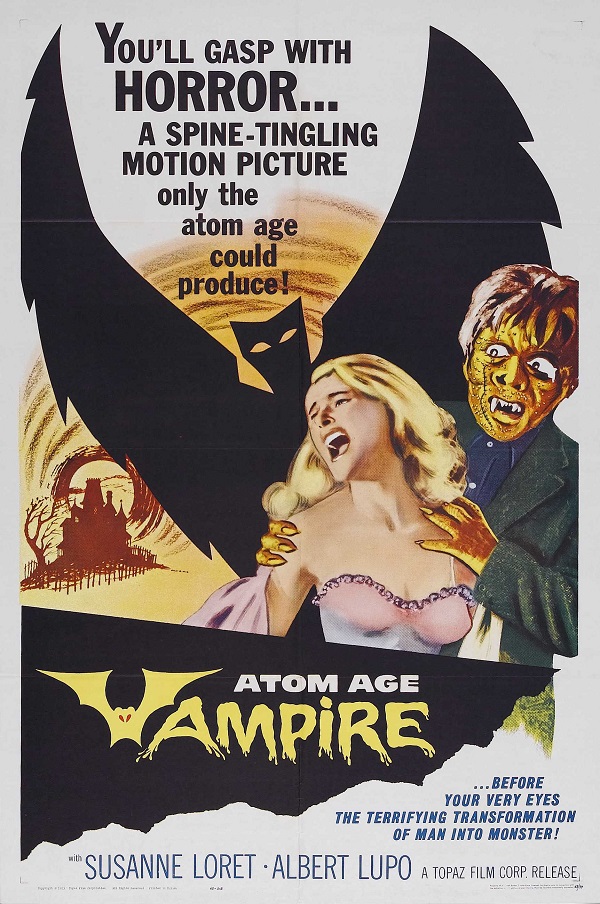
The title Atom Age Vampire is only 50% correct, as atoms and radiation play a big part in the plot, but there is no sign of a vampire.
The plot borrows from both the mad surgeon part of Eyes Without a Face and man / monster elements of Dr Jekyll and Mr Hyde. After a car accident leaves stripper Jeanette Moreneau (Susanne Loret) horribly scarred, a brilliant scientist Professor Alberto Levin (Albert Lupo) falls in love with her. Levin has created a treatment that uses radiation to restore her beauty, but to preserve it he must use glands taken from murdered women, for some reason. He can also only murder said women after taking a potion that turns him into a hideous monster, for some reason.
It's a mixed bag, with the flat lifeless direction draining any genuine horror or tension from scene after scene. But, the photography is surprisingly imaginative, with a use of shadows that gives the film a gloomy, creepy look.
The premise is a little confused, but the over the top twists and turns, coupled with low budget effects and make up (especially Levin's werewolf-like alter-ego) means enough trashy campy fun to make Atom Age Vampire worth a look.
The Hand has a grisly premise and a seedy atmosphere but the film loses its way with a talky confused script, uninteresting characters, and poor acting.
Starting in 1940s Burma, the story sees three captured British soldiers being interrogated by the Japanese. When two of them each have a hand chopped off, the third agrees to talk. Cut to 1960s London and a policeman makes a gruesome discovery - a tramp who is missing a hand - is there a link back to the events in the Far East?
The majority of the film is taken up with the police investigation involving Inspector Munyard and his sidekick Sergeant Foster, two solid, characterless, permanently smoking detectives. The investigation mostly consists of the two of them talking, going to places, talking some more, and then smoking, which does not make for gripping cinema. It is not helped by the poorly written script, which feels like a great central premise that nobody knew how to write a pay-off for. The fractured, hard to follow storyline feels like certain key expositional scenes were either not written, not filmed, or cut out.
Having said that there is, for the time it was released, occasional brutal (if off screen) violence, and some surprisingly coarse language. The Hand also has a rather pleasing ambience of Trad Jazz, fog and Brylcream, so if those things appeal, come for the story, stay for the atmosphere.
With the source material and once-in-a-lifetime cast that it has The Lost World should have been a sure fire piece of schlocky entertainment, but the end product is spoiled by a poor script and unbelievably bad special effects. Professor George Challenger (Claude Rains) is leading an expedition back to the Amazonian basin where he claims he previously discovered living dinosaurs. Accompanying him this time is renowned hunter Lord John Roxton (Michael Rennie, star of The Day the Earth Stood Still), sceptical scientist Professor Summerlee, and a reporter, Ed Malone (David Hedison). As Malone's News Agency employers are picking up some of the costs, his boss's daughter Jennifer Holmes (Jill St. John) also gets to tag along, along with her brother and her pet poodle, and the gang is completed by the stereotyped, hot blooded and mysterious Latin American helicopter pilot Manuel and his stereotyped greedy and cowardly sidekick Costa. Along the way they battle such dangers as gibberish spouting native tribesmen (definitely not white people in loincloths and brown make up), man eating dinosaurs (definitely not lizards with horns glued on) and falling molten rocks (definitely not painted bits of polystyrene). The most obvious problem is the aforementioned effects, not in the slightest bit convincing, and surprising to see in a big Hollywood production. However, this might have been forgivable if the plodding, laborious script, laced with childish humour and grating melodrama had been of a better quality, and the characters more than cardboard cutouts. The stars make it just about enjoyable, with Rains in particular being a major asset, bringing the same likeable energy that gave to the character of Captain Renault in Casablanca, even with a paunch and a curly sandy coloured fright wig that makes him unrecognisable from the suave slime ball of that film.
Sometimes
the most disturbing films are not those that are obviously shocking but those
that slowly creep under your skin and Plein
Soleil (aka Purple Noon) is a classic example of this. The first on-screen
appearance of Patricia Highsmith’s supremely cold-hearted villain Tom Ripley,
director René Clément brilliantly mixes elements of Hitchcock with a decidedly
French New Wave approach, and Alain Delon gives a charismatic, star-making
performance as Ripley.
Based
on Highsmith’s novel “The Talented Ripley” (filmed again in 1999 with Matt
Damon as Ripley), the plot sees Tom Ripley in Italy, living it up on a boat
with his wealthy friend, Philippe Greenleaf (Maurice Ronet). Greenleaf’s father
has employed Ripley to persuade his son to return to the US. However, Greenleaf
Jr., ensconced on a boat, travelling the Italian coast with his girlfriend
Marge, has no such plans – and Ripley may have more sinister intentions than
Philippe realises.
The
relationship between Ripley and Greenleaf drives the first part of the story,
but even that is never entirely straightforward. Ripley starts as a clumsy,
slightly dim, subservient "little brother" to Greenleaf, going along
with his behaviour, as Greenleaf throws his father's money away like confetti. Eventually the whole film starts to revolve
purely around Ripley, and he remains a fascinating, enigmatic character
throughout. His motives are ambiguous, never as simply explainable as, for
example, greed, envy, coveting Marge or even the need to "possess" or
become Greenleaf, even though they may be all or none of those things.
Alain
Delon is magnetic, looking a mixture of baby faced innocence and ridiculously
handsome movie star. He is completely convincing as Ripley, and the switch in
dynamic and behaviour, from charmer to amoral psychopath is creepy and
chilling.
Plein Soleil has a number
parallels with the work of Alfred Hitchcock. Most obviously is the fact that
Hitch made a big screen version of another Highsmith novel, Strangers on a Train. There are other
thematic similarities to the work of Hitchcock, such as murder, loss of
identity, and relationships.
However,
in some ways, in this film at least, Clement is the opposite of Hitchcock. He
employs a number of techniques that are synonymous with the French New Wave of
filmmaking, particularly the way the film is grounded very much in real life.
Therefore, instead of filming the sequences on Greenleaf’s ship in a studio
with an obviously projected backdrop, they are filmed out at sea, with a
handheld camera, on an actual boat. This makes the actual scenes of them
struggling to regain control of the ship in choppy waters, especially when
being thrown overboard, seemingly in the middle of nowhere, almost unbearably
tense, as there are clearly no special effects or stuntmen in use here.
The
only real disappointment is the ending, which deviates from the novel. It feels
like a needless concession to morality and jars noticeably with the amoral tone
of the rest of the film. Nevertheless, there is still an air of ambiguity to
the conclusion, and given the situations, Ripley has previously extricated
himself from, maybe things are not as clear-cut as they might appear.