Horror and Sci-Fi films old and new, weirdo trash, arthouse, forgotten gems, well loved classics, and I'm watching the original Dr Who from the beginning.
A TARDIS malfunction leaves the ship and crew back on Earth but shrunk to miniature size. The Doctor, Susan, Ian, and Barbara are thrust into a conspiracy involving a murder, a shady businessman and a deadly pesticide that could threaten all life on the planet. (The "genius" inventor of this only seemed to realise once it was ready for production) Like The Edge of Destruction, this starts off with a suitably gripping "what the hell" moment as the TARDIS doors open before the ship has landed. What follows is a pacey murder mystery fused with elements of Gulliver's Travels and fears of a looming eco-disaster. Considering the non-existent budget, the production design is excellent, especially the models of the giant laboratory, the ant eggs, and the fly that attacks Barbara. The reason for the shrinking of the TARDIS is explained away with some technobabble and is not really the focus of the plot. As Barbara becomes infected by the DN6 pesticide, the race is on to get her back to the safety of the TARDIS. The ending does feel rushed. Initially a four-part serial, the last two episodes were edited together into one. While this does bring the pace up, for one thing, it is never properly explained how Barbara gets better. Interestingly, this is one of the only times that the main cast have no direct interaction with the supporting characters.
The Thing from Another World is an entertaining mix of Cold War paranoia and Howard Hawks machismo.
The plot is based on "Who Goes There?", a short story by John W. Campbell. A group of scientists and US Air Force crew unearth a frozen flying saucer and its pilot near to their Arctic base. Unfortunately for them, the pilot has thawed out, is on the hunt for blood, and is impervious to their bullets.
There has been some confusion over who directed this film. Christian Nyby is the man on the credits, but. Howard Hawks, whose production company made the film, has often been mentioned as being the real talent behind the lens. Regardless of how true any claim is, there are some Hawks-like tropes, most noticeably in the rapid and overlapping dialogue.
In the original short story, the alien is a shape-shifter, imitating the characters, and causing tension and paranoia. In this version, it becomes a vegetable-based humanoid (memorably described as "an intellectual carrot"), immune to bullets and needing blood to regenerate. But there is still tension in the conflict between scientists and the military. The character of Dr Carrington in particular is shown as, if not an enemy, then at least a threat by wanting to reason with the creature rather than set it on fire. This makes a change from other sci-fi films of the era. Scientists are usually portrayed as the only people with the answers, working with or trying to keep the military in check.
The Black Sleep is an intriguing and little seen low budget horror film, with a dream cast of genre veterans.
In Victorian England, a brilliant surgeon, Sir Joel Cadman (Basil Rathbone) is trying to find a way to revive his beloved wife from a coma caused by a brain tumor. But, his methods are a little unscrupulous, as Cadman employs a powerful anesthetic from India to induce a death like state in his test subjects. He uses it to snatch a fellow Doctor, Gordon Ramsey, from Death Row, where Ramsey is awaiting execution for a murder he denies carrying out. Cadman wants Ramsay's help, but as Ramsey soon discovers, not all Cadman's previous experiments have been so successful.
Rathbone is on fine form, making Cadman initially seem charming and even sympathetic, but slowly revealing him to be cruel and insane.
His co-stars are not always as lucky. Lon Chaney Jr hams it up as Mungo, a former scientific genius who has been turned into a crazed madman by the good doctor's experiments. But poor Bela Lugosi, in his final filmed role, is left without a word to say. The underwritten character of Cadman's butler feels like it was written to put Lugosi's name on the posters.
The highlight comes in the form of John Carradine, playing another of Cadman's victims. Carradine does not hold back, even by his usual standards, as the climax sees the inmates taking over the asylum.
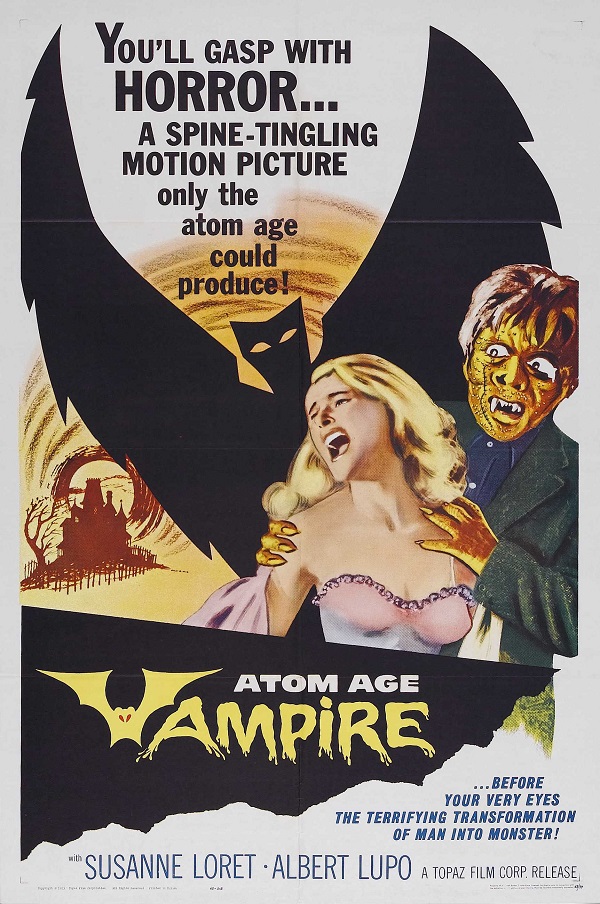
The title Atom Age Vampire is only 50% correct, as atoms and radiation play a big part in the plot, but there is no sign of a vampire.
The plot borrows from both the mad surgeon part of Eyes Without a Face and man / monster elements of Dr Jekyll and Mr Hyde. After a car accident leaves stripper Jeanette Moreneau (Susanne Loret) horribly scarred, a brilliant scientist Professor Alberto Levin (Albert Lupo) falls in love with her. Levin has created a treatment that uses radiation to restore her beauty, but to preserve it he must use glands taken from murdered women, for some reason. He can also only murder said women after taking a potion that turns him into a hideous monster, for some reason.
It's a mixed bag, with the flat lifeless direction draining any genuine horror or tension from scene after scene. But, the photography is surprisingly imaginative, with a use of shadows that gives the film a gloomy, creepy look.
The premise is a little confused, but the over the top twists and turns, coupled with low budget effects and make up (especially Levin's werewolf-like alter-ego) means enough trashy campy fun to make Atom Age Vampire worth a look.
An unremarkable low budget British Sci-fi B-movie, The Strange World of Planet X lumbers along through an hour of talky cliched script before bursting into life with some stupid special effects.
In a laboratory in rural England, archetypal mad scientist Dr Laird is carrying out experiments involving ultra-powerful magnetic fields. His American assistant Gilbert Graham (Forrest Tucker) is having some doubts about the work, as are the government backers. After a freak storm hits the country, giant mutant insects appear in the village forest. Are they linked to Laird's laboratory? And who is the mysterious Mr Smith, who seems to know a lot about both Laird's work, and some recent UFO sightings?
The film staggers on for an interminable talky hour, with little in the way of interesting character development or even cheap thrills. It's sustained by the charisma of Tucker, the cringe-worthy sexism of the scientists towards a female colleague (they don't believe she can do "highly skilled work"), and the mysterious Smith character, who, with his interest in dangerous science, turns out to be a rip off from Klaatu in The Day the Earth Stood Still. Oh, and there's a subplot about a tramp who gets turned into a serial killer by the storm, but that soon fizzles out.
After that, the giant insects arrive. Of course, when I say giant insects, I mean normal insects filmed extremely closeup, which is exactly what they look like.
It's worth watching for the cheap laughs at the climax, but it is a hard slog to get there.
For many people, Plan 9 From Outer Space is the gateway drug to the world of bad movies, and it was certainly the case for me. Writer/Director Ed Wood Jr can be accused of many things in terms of deficiencies of plot, characterisation and special effects, but there is no way you can call his work boring. While on a routine flight airline pilot Jeff Trent (Gregory Walcott) and his co-pilot Danny are surprised by a bright light and loud sound, and are shocked to see a flying saucer. The saucer lands at a cemetery, where a number of suspicious deaths have taken place. It turns out aliens are hiding out there, carrying out their fiendish plan to take over the world: reanimating the dead, otherwise known as Plan 9 From Outer Space. The basic elements of the story, mad scientists, atomic power, alien invasions, zombies (albeit the pre-Romero, non contagious, non-flesheating kind) are not unfamiliar in the genre films of the time. In the hands of another film-maker, what could have resulted is the sort of pleasant but forgettable film that so many others were churning out at that time. Thankfully the job was turned over to Ed Wood, a man whose enthusiasm for movies was only matched by his enthusiasm for vodka. This meant that his scripts were bursting with ideas, and while he was not always the best at shaping these into a coherent whole, they have an anarchic energy and anything-can-happen atmosphere, coupled with dialogue that veers between the drearily banal and the outrageously surreal.
There are so many other points of interest along the way, from the health and safety loving police sergeant who insists on punctuating every line of dialogue by pointing at things with his gun, the Styrofoam Gravestones, the outrageously camp chief alien, and the heroic disregard for continuity, especially in terms of what time of day it is. The star of the film, Bela Lugosi died a few days into shooting, the sort of event that would have crushed a lesser man than Ed Wood. Instead, he simply carried on, getting his wife's chiropractor to play the Lugosi role with his cape over his face so that we can't see the difference, even though he is at least a foot taller than Lugosi. When I first saw this, back in the early 1990s the consensus was that this was something silly and terrible, something to be sneered at. Nowadays, I feel nothing but admiration for Wood. Granted his film-making skills are not up there with the best, but his enthusiasm and tenacity shines through in the movies, The surfeit of ideas means the film never gets dull and stands up to repeat viewings.
Island of Terror is a fast paced, imaginative and at times, wonderfully cheesy slice of British sci-fi horror, straddling the twin sub genres of "science run amok" and "trapped on a remote British island". Despite the presence of director Terence Fisher and star Peter Cushing, it is not a Hammer film, and feels if anything like a precursor 1970s era Dr Who.
On a remote island the police constable makes a grisly find - the corpse of a local farmer, but without a single bone in his body. The local doctor is stumped, so travels to the mainland to seek help from top London pathologist Dr. Brian Stanley (Peter Cushing) and bone disease expert Dr. David West. Back on the island they find more boneless bodies - and a mysterious lab where a scientist was working on a cure for cancer. Has this got some link to the strange creatures responsible for the horrifying deaths? But with all transport and communication to the island cut off, will any of them make it off alive?
Island of Terror was very obviously knocked out cheaply and quickly, but the film-makers respond to it with typical British Gusto. Firstly, by cheerfully ignoring the ridiculous rubber monsters causing the terror, and secondly by focussing more on the script. Being trapped in a place is a classic horror trope, and the script does set up, albeit through portentous dialogue, plenty of reasons why they can not get away. The writers are also not afraid to throw in twists and shocks, and bump off important and likeable characters. Granted some of the attitudes have not dated well. Toni Merrill, Dr West's girlfriend exists purely, as the daughter of a wealthy man with a helicopter, to give the men quick transport back to the island. After that she spends most of her time screaming and needing to be rescued. The slightly patronising attitudes of the London lot to the island folk looks a little cringeworthy too, especially when it was big city slicker scientists that started the whole crisis in the first place.
Some of the special effects, such as the boneless corpses or an dismembering a hand are surprisingly gruesome and shocking for a 1960s film. Others, particularly the creatures themselves, are just awful. They look like rubber shells stuffed with noodles, and coupled with the weird squeaky electronic noises they make, could come straight out of 1970s Dr Who. Cushing, as usual, plays it admirably straight, and brings some dignity to these scenes.
In fact, with some minor tweaks, the whole thing could play as a 70s Dr Who story, with Jon Pertwee in the Cushing role, and similar ideas of science gone bad and threatening the world were explored in stories of that era, such as The Green Death and The Seeds of Doom. Plus, there is a perpetually screaming woman who always needs to be rescued.
The film finishes on a speech defending the scientist whose work caused all the problems, a sort of, "okay, it went bad, but at least he meant well". This is quickly followed by a twist ending along the lines of "at least it's not happening anywhere else", followed by a cut to a lab in Japan, where.... well, I'm sure you can guess.
1950s sci-fi films often feature campy special effects and hostile outsiders from another planet trying to invade this one but Forbidden Planet stands out from the crowd in that it features neither of these things. MGM poured a lot of money into the excellent model work and borrowed a Disney man to work on the animated laser blasts and the famed "Monsters from the ID" and the threat comes not from "out there" but from deep within the mind of man.
In the 23rd Century, a star ship led by Commander John Adams (Leslie Nielsen) is sent to the distant planet of Altair 4 in order to find out what happened to an expedition who landed there 20 years earlier. On arrival the crew are met by the only survivors, Dr Morbius and his daughter Altaira, and their robot servant, Robby. Morbius tells them that his shipmates and their craft were destroyed by a planetary force when they tried to leave. The same force starts to attack Adams and his crew and ship but is it a force which may have a source closer to home than someone would like to admit?
The script for Forbidden Planet is both one of the best and weakest things about the film. The themes explored are serious and intelligent, aimed at adults, not the teenage drive-in crowd of The Blob, and are engaging and thought provoking. But it is also relentlessly talky at times, giving the film an often sluggish paced, something not helped by the slightly flat and stilted performances of the leads.
However, these occasional lapses are more than made up for by the sumptuous visuals, whether it is the spacecraft model work, the huge, imposing and beautifully realised Krell underground cities (structures that completely dwarf their human interlopers), or the eerie and disturbing animated silhouettes of the Id monster, courtesy of Disney’s Joshua Meador, who was loaned to MGM for the film.
The story is not entirely original of course. Forbidden Planet often gets branded as a space opera version of The Tempest, and while that is not strictly true, it does share some similarities with Shakespeare's play. The Tempest centres on Prospero, a magician exiled to an island with his daughter Miranda by his brother Antonio who then steals his title and property. Prospero uses his powers to cause a storm that shipwrecks Antonio, trapping him on the island where he can take his revenge. Morbius is the Prospero character with Altaira as Miranda, and Altair 4 stands in for Prospero's island. After that the comparisons don't really work as Adams and the crew are strangers to Morbius, and he is not driven by revenge, rather a desire to be left alone to carry exploring the planet and the Krell, the now extinct civilisation that lived there previously.
Forbidden Planet works much better if you judge it as a piece of work in its own right, and as a time capsule of the ideas, attitudes and obsessions of the time in which it was made. The first of these obsessions is Freudian psychoanalysis, which by the 1950s had come out of the consulting room and into popular culture, in particular the movies, through the work of directors such as Hitchcock. It is made explicit in Forbidden Planet through talk of "Monsters from the Id". The Id is what Freud thought of as the primitive, instinctive, often illogical aspect of our personality that demands immediate satisfaction, regardless of the consequences. Morbius thinks both he and the Krell have outgrown this, but it soon becomes apparent, particularly when handsome space pilots take a shine to his daughter, that he has not, and the raging torrent in his psyche takes a more literal and deadly form when linked to the highly advanced Krell technology.
Forbidden Planet is also very much of it's time in its look and attitudes. The Flying Saucer that the crew arrive in is another 1950s icon, albeit one here used by mankind rather than little green men. The film has some of the 50s can-do optimism of a country riding high from the post-war euphoria, with a new generation of pioneers, rolling up their sleeves and carving out new worlds. The craft is run like the ships and subs that some of the audience may have served on during the war 10 years earlier, even down to the cook with a taste for bourbon.
Robby the Robot is also a very old fashioned idea of a robot, basically a butler with a deadpan tone of voice. Although a wildly impractical design, he would go to become an iconic figure in further films and TV shows, and here, more importantly, plays an important role, driving the plot forward with his manufacturing capabilities and programmed attitudes towards human life. The deadpan tone also provides some comic relief to the sometimes very serious onscreen talking.
The astonishing, unsettling soundtrack is the work of electronic music pioneers Bebe and Louis Barron. It breaks all the rules of what a soundtrack should be in two big ways. Firstly it is entirely atonal, being composed and performed on oscillators made by the Barrons, and fed through echoes and tape loops. Secondly, by having their work represent everything from the ambient noise of the Krell buildings, the roar of the monsters and the ship’s engines, but also having it underpin key scenes to add to the tension, they blur the lines between diegetic and non-diegetic audio.
Forbidden Planet had a further influence beyond this, leaving an undeniable mark on the whole sci-fi genre. It paved the way for serious, adult sci-fi such as 2001: A Space Odyssey, as well as providing the template for Star Trek. The film and TV show both feature a ship run like a military craft, exploring new worlds and investigating mysteries, but using a scientific approach to explain things. In addition, the human drama in Trek and Forbidden Planet centres around the three main crew members, the First Officer, the ship’s doctor, and the steely, unflappable captain with an eye for the ladies.
An affable, sometimes crazy piece of sci-fi action, Eliminators makes the best of a low budget, as well as having a storyline that predates the likes of Robocop and Universal Soldier.
Elderly billionaire recluse Abbott Reeves (Roy Dotrice) has been a busy boy, keeping himself alive with skin grafts, and transfusions, as well as perfecting his time travel matter transfer device, and turning the body of a pilot pulled from crashed plane wreckage in Mexico into a half-human, half-robot "Mandroid" (Patrick Reynolds) in order to send him to and from Ancient Rome. When Reeves orders his assistant Dr. Takada to dismantle Mandroid, Takada refuses, and is killed as he and Mandroid escape. Mandroid teams up with Takada's colleague Colonel Nora Hunter (Denise Crosby of Star Trek TNG and Pet Semetary), Takada's Ninja son Kuji (Conan Lee of Gymakta fame) and mercenary Harry Fontana (Andrew Prine) to take out Reeves. As they get closer to their target, they realise Reeves isn't just time travelling in order to collect antiques - his plans could alter the history and fate of the whole world.
For the most part, the story zips by at a great pace, keeping the twists and turns coming, as long as you don’t stop to think too hard about some of them, peppering them with plenty of gun fights and chases. The star of the show is Mandroid, who has some pretty nifty interchangeable weapons, not to mention his “mobile unit”, a mini tank which he detaches his legs to climb into. The action is not too grim or gory, making the film fine for teenage viewers, and I did wonder at one point whether anyone had planned a toy line based on the characters.
With Mandroid being, by his nature, pretty stern and emotionless, it’s left to Hunter and Fontana to maintain the human interest, and during the riverboat scenes, while they are no Hepburn and Bogart, they keep the lulls in the action going with their bickering. Lee does his best with a limited role, but his character is brought in at just the right moment to give the story a lift and an extra dimension.
The final twist in the tale seems to come from nowhere, and provoked a laugh out loud response from the audience I saw the film with, but in the schlocky, good natured context of this film, it works.
A mix of mad villain sci-fi film and urban cop thriller, Light Blast is a gloriously cheesy slice of entertainment.
Dr Yuri Sobada, a crazed scientist, has created a laser weapon that can melt people on contact (especially sexy teens getting naked in a disused railway carriage) when fired at large digital clocks, and is now holding the city of San Francisco to ransom, for the sum of $10 million dollars. Inspector Ron Warren, played by no less than Erik Estrada, is the maverick cop sent to stop him, using his own renegade methods to get results, with firing guns and chasing take precedence over questioning suspects and filling in paperwork.
Like so many Italian genre and exploitation films of the 70s and 80s, Light Blast feels like a producer had a good idea, then maybe he (or another producer) had another, then another, until finally the poor scriptwriter is tasked with sewing the disparate elements into a screenplay. With a story revolving around a cop hunting a madman terrorising San Francisco, the main influence is obviously Dirty Harry. Like Inspector Callahan, Warren has a penchant for shooting first and asking questions later, if there’s anything left of the suspect to question, as well as his own unique technique of ending hostage situations. Callahan likes to drive a squad car through a shop window, while Warren employs a plate of chicken, a tight fitting pair of underpants and a surprisingly concealed firearm. The mad scientist is a movie staple but it’s interesting to see it matched with the cop thriller. The producer must have also had a soft spot for Raiders of the Lost Ark, or at least the melting face special effects of the climax (Temple of Doom had been released the previous year, so perhaps it was fresh in their minds), as a similar, albeit cheaper attempt crops up here.
Like so many of his contemporaries in the Italian film industry, Enzo G. Castellari helmed a dizzying number of films from all genres. Here he handles the different elements perfectly competently, especially the car chases, shot with a street level, in-your-face feel. It’s a low budget film, and it’s hard to imagine them having the cash to get permission to shut down the highways in a busy city, so I wonder if there was some guerrilla filmmaking going on.
Castellari also knows not to over stay his welcome, and wraps the whole thing up in a tight 90 minutes. There aren’t many lulls, and when they do crop up, they are the perfect opportunity to run to the fridge and get another beer, the perfect accompaniment to this goofy, highly entertaining piece of fun.
The Ghost of Frankenstein is an intriguing film, which can be loved or not depending on the perspective from which is viewed. While a fast paced, entertaining B-movie on its own, it also shows how far the Universal Horror franchise had moved from its origins, in terms of both character and execution.
Set after the events of Son of Frankenstein, the previous film in the franchise (with a town meeting providing some handy flashback and plot info), the film starts with an angry mob blowing up Castle Frankenstein to finally draw a line under the Doctor's experiments, and those of his son. However, this (somehow) actually has the effect of freeing Frankenstein's monster (Lon Chaney Jr) from the sulphur pits that were trapping him. Frankenstein's assistant Ygor (Bela Lugosi) has also, miraculously, survived and the two flee to the nearby town of Vasaria, where a second, previously unmentioned Frankenstein son lives. He is also a Doctor, working with his assistant Dr Bohmer (Lionel Attwill) on a method for transplanting brains. Seeing an opportunity to test his theories, Frankenstein arranges to replace the damaged brain of the monster with a healthy one – but Ygor and Bohmer have other ideas.
It is hard to criticise The Ghost of Frankenstein for being what it is – a fast moving, atmospheric, hokey piece of entertainment, with all the tropes we associate with the genre, such as monsters, scientists, laboratories, lightning and angry mobs. Despite a fairly high amount of expositional dialogue, the script races through the storyline, and at 67 minutes long, the film does not out stay its welcome.
The star of the show is definitely Lugosi, reprising his role from Son of Frankenstein, giving a playful performance that is great fun to watch. Less successful is Lon Chaney JR taking on the role of the monster, as he lacks the pathos that Boris Karloff brought to the role and the and self-awareness, leaving a creature who is no longer a tragic monster, but simply a monster. Sir Cedric Hardwicke plays Frankenstein as less manic and intense than his predecessors but still gives the character some dignity, while Lionel Attwill is underused, but still makes the most of his scenes, always at his best playing a slimy, power hungry villain.
The direction, by Erle C. Kenton, is competent if unimaginative (apart from a few interesting height perspective shots involving the monster and a little girl), and is certainly no match for the ground-breaking work James Whale did with Frankenstein and Bride of Frankenstein, or the arch humour of those films. However, in fairness to Kenton, his budget was clearly no match either, and he still manages to produce some good model effects with Castle Frankenstein, as well as a laboratory full of gadgets, bubbling beakers and fizzing electrical coils.
One interesting new development from the previous films is the role of the lynch mob and the audience feeling towards this. Whereas it was possible to empathise with the Karloff monster when being hounded by a torch and pitchfork wielding crowd, the Chaney version is less sympathetic, so when a child is threatened and villagers killed by him, the anger and fright felt is more understandable than from those just lashing out at something that they do not understand.
Ultimately, your enjoyment of The Ghost of Frankenstein may depend on the context that you watch it in. Within the cycle of Universal Horror, particularly the Frankenstein series, it can be seen a sad comedown from the glory days of the Whale films. However, watched on its own terms it is still great fun, and a breezy slice of monsters, mobs, and mad scientists.