Horror and Sci-Fi films old and new, weirdo trash, arthouse, forgotten gems, well loved classics, and I'm watching the original Dr Who from the beginning.
The third of seven films Bob Hope and Bing Crosby made together during the 40s and 50s, Road to Morocco is pure entertainment that feels fresh and funny today.
The plot is never too important in these sorts of things, acting as a way of dumping the pair in the middle of nowhere so that they can wisecrack their way back home. In this case, the pair are shipwrecked after Hope blows up the vessel they were stowing away on, before drifting into Morocco.
Of course, being 1940s Hollywood, this is the 1940s Hollywood version of Morocco. Everybody is white and speaks either heavily accented English or gibberish. But, the series was always intended as a spoof of the hit film genres of the day, so it feels more like a parody of those tropes rather than a celebration.
The non stop wisecracking from Hope is broken up with an occasional musical interlude from Crosby, and Dorothy Lamour provides the love interest. There is also a charming and refreshing sense of self awareness. Hope regularly breaks the fourth wall to talk to the audience or complain about Crosby sabotaging his Oscar hopes. Even a Camel stops to comment on how this is the screwiest picture he's was ever been in.
Taking the master detective out of Victorian London into World War Two, Sherlock Holmes and the Secret Weapon has little in common with anything penned by Conan Doyle, but it is a hokey, entertaining spy thriller.
Holmes (Basil Rathbone) is up against his old nemesis Professor Moriarty (Lionel Attwill who had played Dr Mortimer in the earlier Rathbone version of The Hound of the Baskervilles), with both on the trail of a missing scientist and his invention, a revolutionary bomb sight that could change the course of the war.
The screenplay take it's cue from the Conan Doyle short story The Adventure of the Dancing Men, but there is little left of the original, beyond the plot device of an alphabet substitution code. The character of Holmes is a world away from the dispassionate Victorian gentleman, only taking cases that tickled his intellectual fancy. Here is a paid up patriotic Brit, doing his bit against the Nazis. As such there are no baffling, impossible murder mysteries to solve, just standard spy stuff like disguises and code breaking. Nevertheless, Rathbone brings the sort of energy and focus needed for the part, and Nigel Bruce as Watson is dimwitted but so charming and affable it is impossible not to like him.
In keeping with the secret agent feel of the film, Lionel Atwill plays Moriarty like a James Bond villain, and even has a secret lair with trapdoors and an entrance hidden by a moving bookcase.
The propaganda is kept to a minimum for most of the film, with the war being the McGuffin to drive a standard espionage plot. It only takes over in the closing minutes, with Holmes gazing wistfully into the distance reciting the "Fortress built by nature" speech from Richard II.
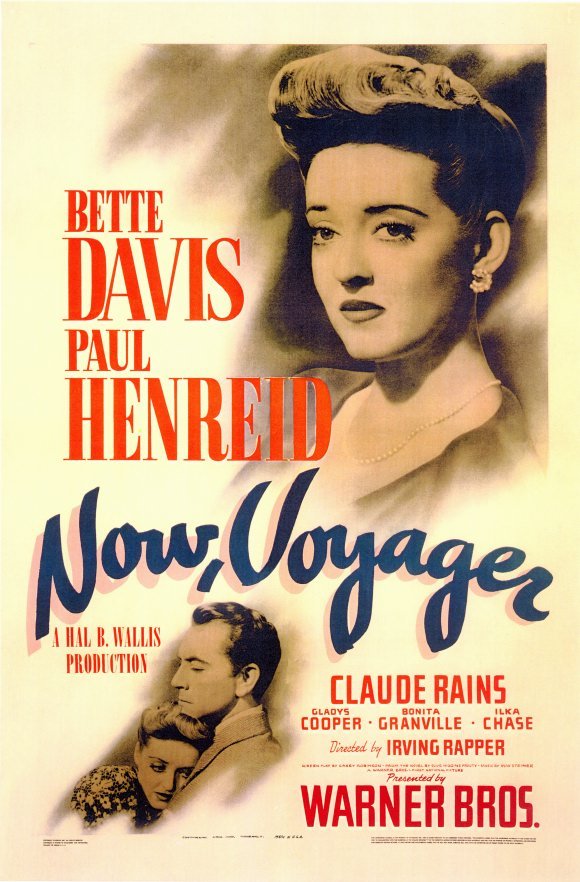
Now Voyager appeared as part of the first wave of Hollywood's brief love affair with psychoanalysis, along with the likes of Hitchcock's Spellbound. This Freudian undertone sets it apart from standard Hollywood romantic melodramas, and the plot of a person forced to repress their true personality by an overbearing family figure seems to have struck a chord with gay film fans, amongst whom it has a fanbase to this day.
Bette Davis plays Boston heiress Charlotte Vale, a neurotic mess, largely due to her domineering mother (Gladys Cooper). After coming under the care of psychiatrist Dr. Jasquith (Claude Rains), Charlotte reinvents herself, going from frumpy introvert to glamorous woman about town. While on a cruise she meets and fall in love with a married man, Jerry (Paul Henreid). How will her mother react to the newly independent Charlotte? And can she ever find happiness with Jerry?
Drama is based around conflict and there is no shortage of that in this film, with Charlotte clashing with her mother, Charlotte's sister clashing with her mother, her mother clashing with Dr Jasquith, and Charlotte clashing with her feelings for Jerry. What makes the drama seem so fresh is the liberal attitude of Jasquith. He is more interested in Charlotte being happy, rather than have her conform to the stuffy morality of her background, or, indeed, of the wider society of the day, something that makes the appeal to the film's gay fanbase obvious. In addition, the script goes against the grain of contemporary romantic films by not going for an obvious path to true love, and seeming to accept that relationships are often complicated and happiness not always conventional.
There is plenty of fun to be had watching Bette Davis playing against type as the monobrowed dowdy Charlotte we see at the beginning of the film, emerging from her chrysalis into the polar opposite, glamorous, adventurous, and fun loving, not giving a damn for the stifling world of upper middle class Boston and the sense of duty and obligation that comes with it.
Film and psychoanalysis are the around the same age, as the Lumiere brothers started screenings of moving pictures in 1895, the same year that Freud published Studies in Hysteria, his first foray into what would become psychoanalysis. If anything it is the depiction of psychoanalysis itself, or at least the Hollywood version of Freud's work that dates Now Voyager. It portrays the mystery of the human psyche as being like a whodunnit, one that can be unravelled with the aid of the right clues, an approach that now seems a little unsophisticated.
The Ghost of Frankenstein is an intriguing film, which can be loved or not depending on the perspective from which is viewed. While a fast paced, entertaining B-movie on its own, it also shows how far the Universal Horror franchise had moved from its origins, in terms of both character and execution.
Set after the events of Son of Frankenstein, the previous film in the franchise (with a town meeting providing some handy flashback and plot info), the film starts with an angry mob blowing up Castle Frankenstein to finally draw a line under the Doctor's experiments, and those of his son. However, this (somehow) actually has the effect of freeing Frankenstein's monster (Lon Chaney Jr) from the sulphur pits that were trapping him. Frankenstein's assistant Ygor (Bela Lugosi) has also, miraculously, survived and the two flee to the nearby town of Vasaria, where a second, previously unmentioned Frankenstein son lives. He is also a Doctor, working with his assistant Dr Bohmer (Lionel Attwill) on a method for transplanting brains. Seeing an opportunity to test his theories, Frankenstein arranges to replace the damaged brain of the monster with a healthy one – but Ygor and Bohmer have other ideas.
It is hard to criticise The Ghost of Frankenstein for being what it is – a fast moving, atmospheric, hokey piece of entertainment, with all the tropes we associate with the genre, such as monsters, scientists, laboratories, lightning and angry mobs. Despite a fairly high amount of expositional dialogue, the script races through the storyline, and at 67 minutes long, the film does not out stay its welcome.
The star of the show is definitely Lugosi, reprising his role from Son of Frankenstein, giving a playful performance that is great fun to watch. Less successful is Lon Chaney JR taking on the role of the monster, as he lacks the pathos that Boris Karloff brought to the role and the and self-awareness, leaving a creature who is no longer a tragic monster, but simply a monster. Sir Cedric Hardwicke plays Frankenstein as less manic and intense than his predecessors but still gives the character some dignity, while Lionel Attwill is underused, but still makes the most of his scenes, always at his best playing a slimy, power hungry villain.
The direction, by Erle C. Kenton, is competent if unimaginative (apart from a few interesting height perspective shots involving the monster and a little girl), and is certainly no match for the ground-breaking work James Whale did with Frankenstein and Bride of Frankenstein, or the arch humour of those films. However, in fairness to Kenton, his budget was clearly no match either, and he still manages to produce some good model effects with Castle Frankenstein, as well as a laboratory full of gadgets, bubbling beakers and fizzing electrical coils.
One interesting new development from the previous films is the role of the lynch mob and the audience feeling towards this. Whereas it was possible to empathise with the Karloff monster when being hounded by a torch and pitchfork wielding crowd, the Chaney version is less sympathetic, so when a child is threatened and villagers killed by him, the anger and fright felt is more understandable than from those just lashing out at something that they do not understand.
Ultimately, your enjoyment of The Ghost of Frankenstein may depend on the context that you watch it in. Within the cycle of Universal Horror, particularly the Frankenstein series, it can be seen a sad comedown from the glory days of the Whale films. However, watched on its own terms it is still great fun, and a breezy slice of monsters, mobs, and mad scientists.
After more than 70 years, Casablanca is still a firm part of
popular culture, with the images, songs, and misquoted dialogue possibly
known by more people than have actually seen the film. For me, after 20
years and countless viewings, it’s something that still intrigues and
delights me as much as the first time. What on the surface may appear to
be standard Hollywood melodrama, mixed with war-time propaganda,
actually has some ambiguities in character and plot, and a far from
happy ending.