Showing posts with label Comedy. Show all posts

Monday, 11 May 2020

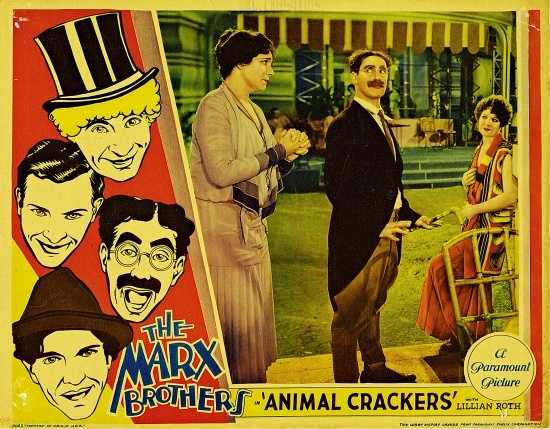
Animal Crackers (1930)


A straightforward adaptation of their hit stage play of the same name, Animal Crackers is flatly filmed but propelled along by the manic energy of the stars.


The slim plot revolves around society matron Mrs Rittenhouse (played by regular Marx brother foil Margaret Dumont) holding a lavish party to celebrate the return of Captain Spaulding (Groucho) and his secretary Horatio Jameson (Zeppo) from his latest jaunt to Africa. The Professor (Harpo) and Signor Emanuel Ravelli (Chico) have been hired to provide musical entertainment but spend most of the time wreaking havoc. There is a side plot involving Rittenhouse's daughter, her boyfriend, and a valuable work of art, but who cares?


Like many films of that era, the direction is a little flat with the camera barely moving. Luckily, the stars are on top form, with a mix of one liners and superb physical comedy, all shot through with surreal anarchy. Even Zeppo manages to keep pace, especially in a classic scene with Spaulding dictating a letter in gibberish legalese.


The film also gives us two songs that would go on to define Groucho. "Hooray for Captain Spaulding" became the theme of Groucho's radio and TV game show You Bet Your Life. "Hello I must be Going" was the opening number of his famous Carnegie Hall concert in 1972


There also a few topical jokes from the time that are fascinating to read about nowadays. The controversial Eugene O'Neill play Strange Interlude was still in the news in 1930. It sees characters regularly stopping what they are doing to give soliloquies to the audience. At several points Groucho spoofs this by turning to the camera and intoning a nonsense monologue in a deep sombre voice.


In addition, the character of Captain Spaulding shares a name with a real-life person, a US Army captain arrested for selling cocaine to movie stars of the day.


Sunday, 2 February 2020

Road to Morocco (1942)


The third of seven films Bob Hope and Bing Crosby made together during the 40s and 50s, Road to Morocco is pure entertainment that feels fresh and funny today.

The plot is never too important in these sorts of things, acting as a way of dumping the pair in the middle of nowhere so that they can wisecrack their way back home. In this case, the pair are shipwrecked after Hope blows up the vessel they were stowing away on, before drifting into Morocco.

Of course, being 1940s Hollywood, this is the 1940s Hollywood version of Morocco. Everybody is white and speaks either heavily accented English or gibberish. But, the series was always intended as a spoof of the hit film genres of the day, so it feels more like a parody of those tropes rather than a celebration.

The non stop wisecracking from Hope is broken up with an occasional musical interlude from Crosby, and Dorothy Lamour provides the love interest. There is also a charming and refreshing sense of self awareness. Hope regularly breaks the fourth wall to talk to the audience or complain about Crosby sabotaging his Oscar hopes. Even a Camel stops to comment on how this is the screwiest picture he's was ever been in.

Tuesday, 29 October 2019

Dolemite Is My Name (2019)


It's a testament to the charm of
Eddie Murphy that he makes the lead character of Dolemite Is My Name warm and sympathetic, despite that person's crude and sexist comedy. Along with a strong supporting cast, a lush period production design, and a well-structured script, this makes for a thoroughly entertaining film.

Murphy plays Rudy Ray Moore, a real life nightclub comic whose act was an early form of rapping. Wanting to break into the movies, he used his own money and a group of friends and volunteers to make outrageous cult Blaxploitation comedy Dolemite.

Moore offstage is often shown as a world away from his onstage persona, particularly through the character of Lady Reed. After meeting her in a bar following a show and hearing about her life of single motherhood, Moore encourages Reed to get on stage and tell her stories. When she becomes part of his show, she is always treated as an equal. Murphy effortlessly switches between the brash showman, and warm human being who understands and empathises with those who going through tough times. There are references to Moore's childhood, particularly an abusive stepfather who told him he would never amount to anything, but this is never turned into a simplistic single driving force behind Moore's ambition.

I know nothing about the real life Moore, and as it's a biopic I assume some liberties are taken with events and people. But, as a drama it's well constructed, taking time to establish the characters and their goals, and giving them plenty of obstacles to overcome along the way. 

One of the best scenes is Ray and his friends sitting in a packed cinema watching Jack Lemmon and Walter Matthau in The Front Page. They are baffled at how the white folks in the audience are falling about laughing at something they find unfunny. Looking behind him, Moore becomes transfixed on the light from the projector, until it becomes like a divine luminance from above, giving him an epiphany about the next stage of his career. 

Dolemite Is My Name made me think of two other films about filmmaking. Firstly, Ed Wood, Tim Burton's biopic about the cult 50s director. Like Moore, Wood is always optimistic, and will not take no for an answer. Both believe a person can reinvent themselves through sheer force of will.

The other is Sullivan’s Travels, Preston Sturges 1941 comedy. In it, John Sullivan, is a filmmaker who wants to leave behind the world of "mere" entertainment and make highbrow, socially conscious films. Eventually Sullivan has a change of heart and comes to the conclusion that "... there's a lot to be said for making people laugh". My Name is Dolemite has a similar conflict, through the character of Jerry Jones. The writer of the Dolemite screenplay, he wants to make a gritty thriller showing the realities of urban black life. Moore's instincts are towards entertainment, giving the audience a laugh and a few hours relief from their daily lives.


Friday, 28 December 2018

County Hospital (1932)


It's standard in the world of Laurel and Hardy that no good deed goes unpunished. In County Hospital, Olly is recovering from a broken leg, and Stan's attempts to cheer him up with a visit only make things worse. While it never really comes to life like one of their classics, it's certainly enjoyable and funny.

While it's wrong to say all Laurel and Hardy films are the same, the routines often follow many of the same structures. In this case, Stan means well, causes a problem, tries to fix it, and makes everything much worse. So, what starts as a spilled jug of water ends up with a doctor clinging for dear life out of a window and Olly being evicted from his hospital bed with his trousers and dignity in shreds. All because Stan came to visit as he "had nothing better to do."

After Stan sits on a hypodermic needle full of tranquiliser, his attempts to drive Olly home take a dizzying and surreal turn. The back projection of swerving traffic is completely unbelievable but is perhaps indicative of the state of Stan's head. Needless to say, it does not end well for the car.


Monday, 3 December 2018

Heavens Above (1963)


Heavens Above is the high point of the several collaborations between  Peter Sellers and the British film making duo of Roy and John Boulting. The film takes on two most sacred of cows, organised religion and Christian beliefs (particularly how they work in the real world), with a brilliant, straight performance by Sellers, undermined by a ridiculous and unnecessary climax.

Sellers plays John Smallwood, a good hearted but naive prison chaplain, assigned as vicar to a small and prosperous English country town after a clerical error.

Smallwood's brand of Christianity runs on charity and forgiveness, the polar opposite of his congregation, who are outraged when he takes on a black man as his churchwarden, lets a gypsy family live in the vicarage, and talks the local landowner Lady Despard into giving free food for the church to distribute to the locals.

The cinematic legacy of Peter Sellers rests on his comic creations such as Inspector Clouseau and Dr Strangelove, but with Smallwood he gives us a character who is both vulnerable and believable, even resisting the urge to make his Brummie accent comically broad.

The writing, directing and producing team of Roy and John Boulting had worked with Sellers on the industrial relations satire I'm Alright Jack, where they mocked both the power-crazed unions and the greedy boardrooms. Here they take a similar approach, laying into the hypocritical church leaders and their congregation, but also Smallwood's guileless and easily exploited Christianity, and his betrayal by both his bosses and the people he tried to help is heart breaking.

Then, from out of nowhere, the story takes an unexpected diversion, abandoning village life to focus on a frightened astronaut and a new job for Smallwood. The comedy becomes broad and wacky, the polar opposite of everything we've seen up to then.  Jarring and pointless, this switch nearly derails the rest of the film.


Tuesday, 30 October 2018

Mother Riley Meets The Vampire (1952)


One for the Bela Lugosi (or Mother Riley) completists, Mother Riley meets the Vampire is a strange hybrid of English Music Hall and American low budget mad scientist movies.

Arthur Lucan had been playing Mother Riley, an Irish washer woman who gets herself into assorted scrapes and adventures, on stage and screen since the 1930s, but, possibly due to the parochial nature of the character, the films had not really caught on internationally had much success outside of the UK. Enter Bela Lugosi, who had travelled to the UK for a stage version of Dracula that flopped, leaving him penniless and desperately needing money to get back to the US. Producer George Minter must have seen him, even in the twilight of his career, as a big enough name to drum up some business at the American box office.

The sinister Von Housen (Lugosi) has two notable character traits: he is hellbent on seeks dominating the world with an army of 50,000 radar-controlled nuclear-powered robots. He also reckons he's a vampire and has several young women abducted, including one who has a map to a uranium mine that he needs for his robot army. Granted, his army is currently 49,999 short, and to make matters worse, his only functioning robot has been shipped to Mother Riley's store by mistake.

The result is two different film styles that don't really gel together, but it's more entertaining than not. Lugosi seems to be enjoying himself, and, as always, is great fun to watch. Lucan brings a sense of knockabout slapstick and some well delivered occasional salty quips ("May the saints shower you with sailors on shore leave!"), but his constantly shrill delivery means a little goes a long way. Modern audiences may mostly be reminded of comedy character Arthur Atkinson from the Fast Show, with comparable baffling catchphrases and contemporary references.


Monday, 27 August 2018

That Riviera Touch (1966)


A pleasant if unremarkable comedy, That Riviera Touch was the second of three attempts by Morecambe and Wise to make it as big screen stars in the 1960s.

The pair play a couple of London traffic wardens, forced to take an impromptu holiday in the south of France after Eric nearly gives the Queen a parking ticket. Once there, they become unwittingly involved in a jewel theft caper when the robber decides to use them to smuggle some stolen cargo out of the country. Along there's a sinister villa, disappearing bodies and a beautiful girl for Eric and Ernie to fight over.

The main problem with That Riviera Touch is that it doesn't feel like a Morecambe and Wise vehicle. If anything, it feels more like an Abbott and Costello film, with Eric as the bumbling, prat-falling, wisecracking Lou Costello and Eric as the smooth lady chasing straight man Bud Abbott. This is noticeably different to their TV personas, where Eric is more self-assured and quick-witted, and Ernie is the bumbler.

Nevertheless, the pair do the best with what they are given and breath some much needed life into the script. It's no classic, but there's enough entertaining silliness to make it worth a look, especially for fans of the duo.


Sunday, 22 July 2018

Drunken Wu Tang (1984)


Relentlessly kinetic, largely incomprehensible, and great fun, Drunken Wu Tang feels like fifty different films edited together at random.

There is a plot buried in there somewhere, something about a lecherous old drunk Kung-Fu master trying to find an adolescent boy who is a virgin (or "Cherry Boy") for a religious ceremony, probably best not to dwell too much on it.

Instead, focus on the insane stream-of-consciousness that assaults your senses for ninety-odd minutes, with the drunk Kung-Fu master tearing around on a buck toothed Go-Kart, the same actor in drag playing the "Cherry Boy's" pipe smoking Grandmother, and the infamous Watermelon monster, a giant black ball with big red lips, sharp teeth and a nipple fetish


The tone is relentlessly shrill and the comedy very broad indeed, but this is not a film where the entertainment comes from sneering at the incompetence behind the camera. The well choreographed fight scenes and breakneck speed editing sets belie any such claims. So many shots involve people leaping into or out of the frame, which help underlie the feeling of perpetual motion, even if you have no idea where this is leading. Don't go in looking for plot, characters or logic, instead just enjoy the energy and adrenaline rush of a truly original piece of unhinged cinema.