Horror and Sci-Fi films old and new, weirdo trash, arthouse, forgotten gems, well loved classics, and I'm watching the original Dr Who from the beginning.
A pleasant if unremarkable comedy, That Riviera Touch was the second of three attempts by Morecambe and Wise to make it as big screen stars in the 1960s.
The pair play a couple of London traffic wardens, forced to take an impromptu holiday in the south of France after Eric nearly gives the Queen a parking ticket. Once there, they become unwittingly involved in a jewel theft caper when the robber decides to use them to smuggle some stolen cargo out of the country. Along there's a sinister villa, disappearing bodies and a beautiful girl for Eric and Ernie to fight over.
The main problem with That Riviera Touch is that it doesn't feel like a Morecambe and Wise vehicle. If anything, it feels more like an Abbott and Costello film, with Eric as the bumbling, prat-falling, wisecracking Lou Costello and Eric as the smooth lady chasing straight man Bud Abbott. This is noticeably different to their TV personas, where Eric is more self-assured and quick-witted, and Ernie is the bumbler.
Nevertheless, the pair do the best with what they are given and breath some much needed life into the script. It's no classic, but there's enough entertaining silliness to make it worth a look, especially for fans of the duo.
Despite being fifty years old, Django remains a brutal and disconcerting entry in the spaghetti western sub-genre.
Across a bleak muddy landscape, a lone figure in a Union Army uniform drags a coffin behind him. The man is Django, a former soldier with a secret from his past and a secret in his coffin. These secrets will soon drag him into the paths of a prostitute named Maria, a racist confederate ex-soldier and his hood wearing henchmen, and an excitable gang of Mexican revolutionaries.
All Westerns are slightly surreal and somewhat stylised, especially with the excess or lack of blood, given the amount of bullets fired, but Spaghetti Westerns, the uniquely European appropriation of a uniquely American genre are even more so. Whereas the US versions may celebrate or explore both the light and dark sides of the modern history of the country, the continental equivalents are shorn of that cultural context, and seem to take place in a strange alien world, but the world of Django goes a step further.
The bleak, isolated muddy town looks like a post-apocalyptic war zone, a place where human life has lost all value, where unlucky men are used as sporting prey, the unlucky women used for pleasure, and the "lucky" women get to feel like "real" women and be loved by a man.
The script is offbeat, unpredictable, and shocking. Plot wise, barely more than half an hour and the big twist about the contents of the coffin is revealed, turning the focus of the story elsewhere, with the links between Django and the other characters becoming apparent.
Clearly modelled on the two criminal sides of A Fistful of Dollars, the two gangs in Django are both equally despicable, but director Sergio Corbucci takes things a disturbing step further. The confederate gang dress in in red Ku Klux Klan style hoods, and treat their Mexican prisoners like animals, to be hunted for sport.
Django himself is no angel, repaying the hospitality of Nathaniel the saloon owner by shooting up the bar to demonstrate a weapon to the Mexicans, then later cajoling Nathaniel into driving him to a massacre. It's a testament to Franco Nero that he can make a character like that likeable enough to keep us rooting for him.
What makes Django so compelling is the extremity of so many of the elements, even by the standards of the Spaghetti Western. The dialogue veers between the cringingly cheesy (“I felt like I was a real woman. Someone to protect, and to be loved), and the portentous (“His time hasn't come yet”). The violence is still shocking today, the tone being set in the opening scene of Maria being mercilessly whipped by the Mexicans, after which we get everything from an ear that gets cut off and fed to its owner, to the comical, almost sexual pleasure General Rodríguez takes from watching Django having his hands crushed. Not surprisingly the film suffered with the censors, especially in the UK, with the BBFC refusing a certificate for the film until 1993.
There are also two things in Django that are surprising for this sort of film. Firstly is a modicum of character development. As the end theme music swells, Django walks off into the distance, but in the foreground we see that he has left his gun behind, which throughout the film has been the main way for Django to define himself as a man. Secondly, as he walks off, he has Maria with him, signifying another change in how he defines himself, this time with the love of a good woman. Both of these thing point to a changed man, and a happy ending of sorts, for an audacious and forgettable classic.
Island of Terror is a fast paced, imaginative and at times, wonderfully cheesy slice of British sci-fi horror, straddling the twin sub genres of "science run amok" and "trapped on a remote British island". Despite the presence of director Terence Fisher and star Peter Cushing, it is not a Hammer film, and feels if anything like a precursor 1970s era Dr Who.
On a remote island the police constable makes a grisly find - the corpse of a local farmer, but without a single bone in his body. The local doctor is stumped, so travels to the mainland to seek help from top London pathologist Dr. Brian Stanley (Peter Cushing) and bone disease expert Dr. David West. Back on the island they find more boneless bodies - and a mysterious lab where a scientist was working on a cure for cancer. Has this got some link to the strange creatures responsible for the horrifying deaths? But with all transport and communication to the island cut off, will any of them make it off alive?
Island of Terror was very obviously knocked out cheaply and quickly, but the film-makers respond to it with typical British Gusto. Firstly, by cheerfully ignoring the ridiculous rubber monsters causing the terror, and secondly by focussing more on the script. Being trapped in a place is a classic horror trope, and the script does set up, albeit through portentous dialogue, plenty of reasons why they can not get away. The writers are also not afraid to throw in twists and shocks, and bump off important and likeable characters. Granted some of the attitudes have not dated well. Toni Merrill, Dr West's girlfriend exists purely, as the daughter of a wealthy man with a helicopter, to give the men quick transport back to the island. After that she spends most of her time screaming and needing to be rescued. The slightly patronising attitudes of the London lot to the island folk looks a little cringeworthy too, especially when it was big city slicker scientists that started the whole crisis in the first place.
Some of the special effects, such as the boneless corpses or an dismembering a hand are surprisingly gruesome and shocking for a 1960s film. Others, particularly the creatures themselves, are just awful. They look like rubber shells stuffed with noodles, and coupled with the weird squeaky electronic noises they make, could come straight out of 1970s Dr Who. Cushing, as usual, plays it admirably straight, and brings some dignity to these scenes.
In fact, with some minor tweaks, the whole thing could play as a 70s Dr Who story, with Jon Pertwee in the Cushing role, and similar ideas of science gone bad and threatening the world were explored in stories of that era, such as The Green Death and The Seeds of Doom. Plus, there is a perpetually screaming woman who always needs to be rescued.
The film finishes on a speech defending the scientist whose work caused all the problems, a sort of, "okay, it went bad, but at least he meant well". This is quickly followed by a twist ending along the lines of "at least it's not happening anywhere else", followed by a cut to a lab in Japan, where.... well, I'm sure you can guess.
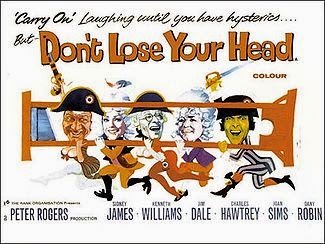
The 13th in the venerable series of British comedy films, Carry On Don't Lose Your Head is an often funny but also often unremarkable effort, with good performances undermined by a few slow spots and a script that runs out of steam before the end. Set in the time of the French Revolution, the plot spoofs the famous story of the Scarlet Pimpernel, with jaded layabout English noblemen, Sir Rodney Ffing (pronounced "Effing") and Lord Darcy Pue (Sid James and Jim Dale respectively), leading double lives saving French aristocrats from beheading at the guillotine, always leaving behind the mocking sign of the The Black Fingernail. But soon they find themselves crossing swords with head revolutionary Citizen Camembert (Kenneth Williams) and his sidekick, Citizen Bidet (Peter Butterworth), two Frenchmen who are so desperate to track down the Fingernail they are even prepared to travel to England. Carry On films are never noted for their extravagant budgets and lavish sets, but this one looks great, with fancy costumes and country houses helping to recreate the tropes of the swashbuckling genre, in the same way that the previous film in the series, Carry On Screaming, did with Gothic horror. Script wise, we get the usual wince inducing puns, and running jokes, this time based around lapses into schoolboy level French, and Sir Rodney’s surname. The other gags come thick and fast, and some do not work (there is a talking to camera sketch that goes on too long), but others hit the mark and the cast are more than capable of breathing life into the few other dry spells. Sometimes the story takes second place to a more sketch based approach, and there are caricatures rather than characters, with some broad acting to match, perfectly in keeping with the pantomime feel of the film. Almost stealing the show is Charles Hawtrey as sex-crazed aristocrat Duc de Pommfrit, one of those saved at the last minute from Madam Guillotine ("Your grace, there's an urgent letter for you!" "Oh, drop it in the basket, I'll read it later"). Sadly things run out of steam in the climactic sword fight which is not played for as many laughs as it should be and goes on too long. There are also a few swipes at England, with gags about strikes and unions, not surprising given that it was released in the same year that saw a walkout by the National Union of Seamen lead to Harold Wilson’s government declaring a state of emergency.
A raucous but affectionate spoof of Hammer and Universal horror films, Carry On Screaming is one of the funniest and best crafted of the long running British comedy series. Despite lacking some of the regular faces commonly associated with Carry On Films, their replacements more than rise to the occasion, and are joined by a few regulars, a script that doesn't abandon story for corny gags and an eye for detail in the production design.
The plot sees two Edwardian London policemen, Sergeant Sidney Bung (Harry H. Corbett of Steptoe and Son fame) and Constable Slobotham (Peter Butterworth) investigating the disappearance of several young women in a local wood. Could the disappearances have anything to with sinister scientist Dr Watt (Kenneth Williams), who has a lab full of mysterious equipment – and a lucrative sideline selling female mannequins to local department stores?
This is the twelfth entry in the series, so by now many of the tropes had been established, both the with characters (the henpecked lech Sid James, his harridan wife, his dopey sidekick, and an object of his lust and the script (innuendos, puns, and broad slapstick). There is no actual Sid James the actor, so the Sid James character is represented by Corbett, and he gives Bung a stoutness and sympathy that you might not have got from James the actor. Most of the back and forth banter between him and Butterworth feels like two men doing a music hall routine, but they know to milk the lines for laughs.
In the world of Carry On the usual object of the lust of Sid James is Barbara Windsor, but here it is the stunning Fenella Fielding, in a low cut red dress, the epitome of saucy goth beauty, her subtly naughty style making a good contrast to the histrionics of Kenneth Williams. Sadly Joan Sims, is rather wasted in the role of nagging wife Emily Bung, given little to do other than verbally and physically attack Sidney.
Aside from the people, Carry on Screaming, often looks and sounds as good as the films it is spoofing. It has the lush eerie score, cob web strewn haunted houses, and portentous dialogue. What is also noticeable and unexpected, at least for a Carry On film, is that it is often, if not scary, then at least creepy, with weird and almost unpleasant undertones that crop up from time to time. Williams actually makes Watt feel, at times, genuinely salacious and unsavoury, with a hint of incestous flirting in the banter between him and Valeria.


.jpg)