Showing posts with label Charles Hawtrey. Show all posts

Friday, 10 November 2017

Carry On Cabby (1963)


The first few Carry On films are largely variations on a theme, with well-meaning bumblers wreaking havoc in a variety of jobs. Carry on Cabby keeps the work based setting, but cuts back on the bumbling to concentrate on the battle of the sexes.

Charlie Hawkins (Sid James) runs a highly successful cab firm, and the cab firm runs his life, much to the chagrin of his neglected other half Peggy (Hattie Jacques). To teach Charlie a lesson, Peggy clandestinely starts her own business, Glamcabs, employing only sexy young women as drivers. As Glamcabs starts to poach Charlie's business, he resorts to sabotage.

This may look like a case of women getting the upper hand, but, of course, this is a Carry On film, so for the women to fight back they have to use sexist methods, and the drivers are picked purely on their looks and legs.

The script is more story driven than later films in the series, favouring a tone that is warm and innocent rather than the knowing smut that would follow. There is a focus on relationships, and subtle little characterisations, such as Charlie helping out ex-army people, a code he sticks to loyally even if it means employing a hopelessly clumsy halfwit like Pintpot (Charles Hawtrey)

The end result is a film played straight and realistically by an excellent cast, and one more grounded in reality, and less cartoonish than the series would become.

Thursday, 31 August 2017

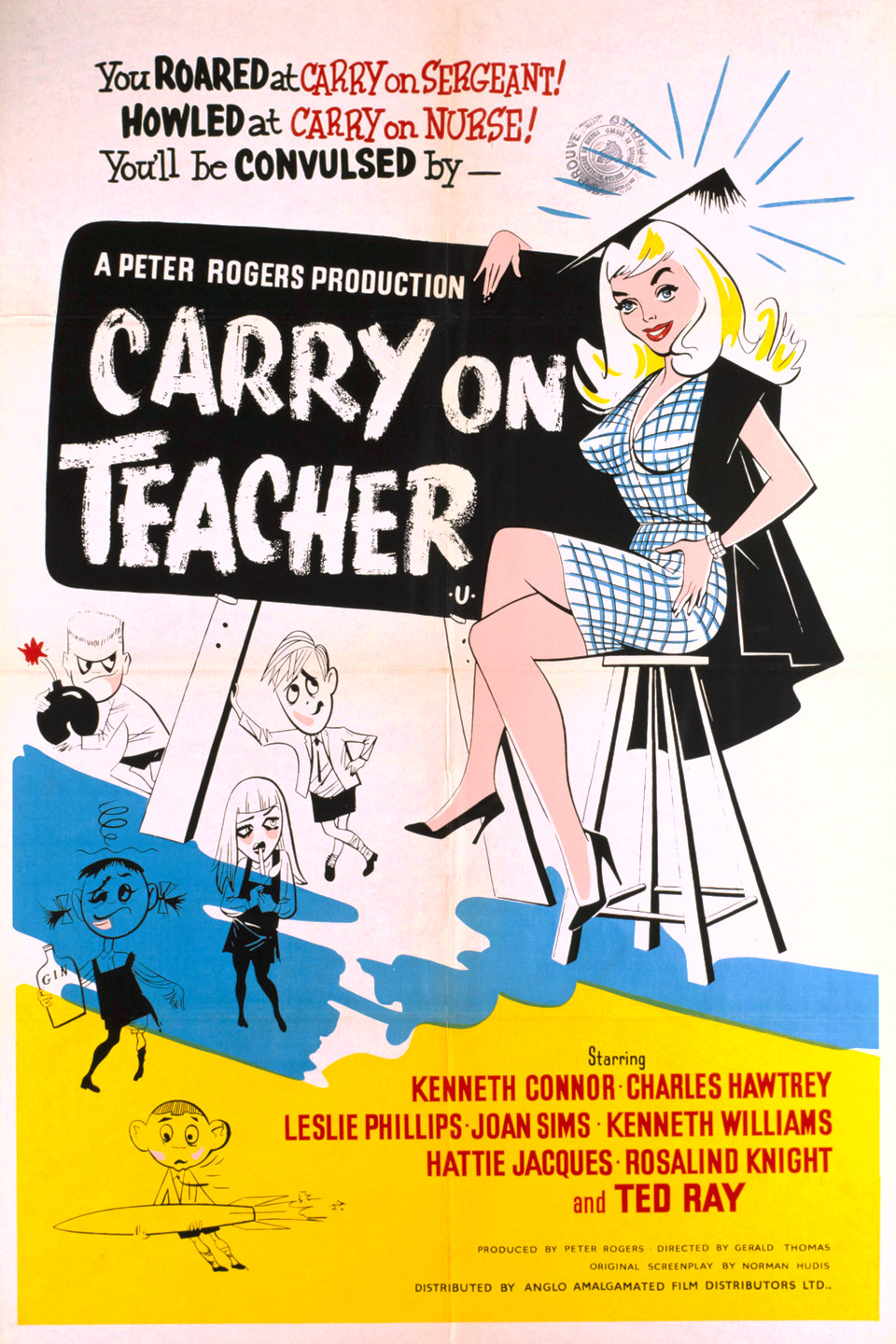
Carry On Teacher (1959)


Being only the third in the series, Carry On Teacher lacks a few of the elements associated with the films, but we can already see a rough blueprint of how they will develop.

William Wakefield (played by Ted Ray, in his only Carry On film) is the Headmaster of Maudlin Street Secondary Modern School. His hopes of getting a job at a shiny new school rest entirely on the results of a visit by Government Inspector Miss Wheeler, and noted child psychiatrist Alistair Grigg (Leslie Phillips). However, the pupils don't want Wakefield to leave, and plot to sabotage the inspection by any means necessary.

Several actors would go on to be Carry On regulars and here seem to be rehearsing the roles they would play on a more regular basis, with Kenneth Connor as an affable duffer, Charles Hawtrey as a camp neurotic, and Joan Sims as Sarah Allcock, the object of male desire. The exception is Kenneth Williams, playing straight as Edwin Milton, the English teacher, very different from the leering grotesque persona of the later films. (Look also for a very young Richard O'Sullivan, of later Man About the House fame)

Being a Carry On film, some of the script revolves around sex, particularly Grigg chasing after Allcock, and the innuendo in her name does not go unnoticed. However, this is rather tame and anodyne, lacking the bawdy energy that the likes of Sid James would bring into later films of the series.

In fact, the world of Carry On Teacher is an uncomplicated, sometimes sentimental one, but modern viewers might find one aspect jarring. Corporal punishment is a recurring theme, particularly the reluctance of Wakefield to administer it, and is a reminder of a time when British school children faced the possibility of physical punishment from their teachers.

Wednesday, 18 March 2015

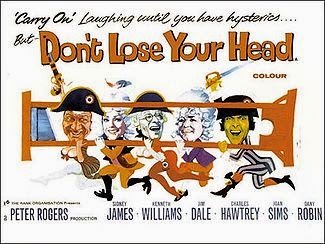
Carry On Don't Lose Your Head (1966)


The 13th in the venerable series of British comedy films, Carry On Don't Lose Your Head is an often funny but also often unremarkable effort, with good performances undermined by a few slow spots and a script that runs out of steam before the end.

Set in the time of the French Revolution, the plot spoofs the famous story of the Scarlet Pimpernel, with jaded layabout English noblemen, Sir Rodney Ffing (pronounced "Effing") and Lord Darcy Pue (Sid James and Jim Dale respectively), leading double lives saving French aristocrats from beheading at the guillotine, always leaving behind the mocking sign of the The Black Fingernail. But soon they find themselves crossing swords with head revolutionary Citizen Camembert (Kenneth Williams) and his sidekick, Citizen Bidet (Peter Butterworth), two Frenchmen who are so desperate to track down the Fingernail they are even prepared to travel to England.

Carry On films are never noted for their extravagant budgets and lavish sets, but this one looks great, with fancy costumes and country houses helping to recreate the tropes of the swashbuckling genre, in the same way that the previous film in the series, Carry On Screaming, did with Gothic horror.

Script wise, we get the usual wince inducing puns, and running jokes, this time based around lapses into schoolboy level French, and Sir Rodney’s surname. The other gags come thick and fast, and some do not work (there is a talking to camera sketch that goes on too long), but others hit the mark and the cast are more than capable of breathing life into the few other dry spells. 

Sometimes the story takes second place to a more sketch based approach, and there are caricatures rather than characters, with some broad acting to match, perfectly in keeping with the pantomime feel of the film. Almost stealing the show is Charles Hawtrey as sex-crazed aristocrat Duc de Pommfrit, one of those saved at the last minute from Madam Guillotine ("Your grace, there's an urgent letter for you!" "Oh, drop it in the basket, I'll read it later"). Sadly things run out of steam in the climactic sword fight which is not played for as many laughs as it should be and goes on too long.

There are also a few swipes at England, with gags about strikes and unions, not surprising given that it was released in the same year that saw a walkout by the National Union of Seamen lead to Harold Wilson’s government declaring a state of emergency.


Tuesday, 30 December 2014

Carry On Screaming (1966)


A raucous but affectionate spoof of Hammer and Universal horror films, Carry On Screaming is one of the funniest and best crafted of the long running British comedy series. Despite lacking some of the regular faces commonly associated with Carry On Films, their replacements more than rise to the occasion, and are joined by a few regulars, a script that doesn't abandon story for corny gags and an eye for detail in the production design.

The plot sees two Edwardian London policemen, Sergeant Sidney Bung (Harry H. Corbett of Steptoe and Son fame) and Constable Slobotham (Peter Butterworth) investigating the disappearance of several young women in a local wood. Could the disappearances have anything to with sinister scientist Dr Watt (Kenneth Williams), who has a lab full of mysterious equipment – and a lucrative sideline selling female mannequins to local department stores?

This is the twelfth entry in the series, so by now many of the tropes had been established, both the with characters (the henpecked lech Sid James, his harridan wife, his dopey sidekick, and an object of his lust and the script (innuendos, puns, and broad slapstick). There is no actual Sid James the actor, so the Sid James character is represented by Corbett, and he gives Bung a stoutness and sympathy that you might not have got from James the actor. Most of the back and forth banter between him and Butterworth feels like two men doing a music hall routine, but they know to milk the lines for laughs.

In the world of Carry On the usual object of the lust of Sid James is Barbara Windsor, but here it is the stunning Fenella Fielding, in a low cut red dress, the epitome of saucy goth beauty, her subtly naughty style making a good contrast to the histrionics of Kenneth Williams. Sadly Joan Sims, is rather wasted in the role of nagging wife Emily Bung, given little to do other than verbally and physically attack Sidney.

Aside from the people, Carry on Screaming, often looks and sounds as good as the films it is spoofing. It has the lush eerie score, cob web strewn haunted houses, and portentous dialogue. What is also noticeable and unexpected, at least for a Carry On film, is that it is often, if not scary, then at least creepy, with weird and almost unpleasant undertones that crop up from time to time. Williams actually makes Watt feel, at times, genuinely salacious and  unsavoury, with a hint of incestous flirting in the banter between him and Valeria.