Showing posts with label Swashbuckling. Show all posts

Tuesday, 4 August 2015

The Master of Ballantrae (1953)


The Master of Ballentrae is a highly enjoyable example of the kind of old-fashioned swashbuckler film they simply do not make any more. It is also significant in that it is the penultimate swashbuckler of Errol Flynn's career, the man who made his name, as well as the success of the genre, with the classics like The Adventures of Robin Hood and Captain Blood. Although starting to look a little long in the tooth, Flynn still crackles with plenty of the charisma, energy and sex appeal he had done twenty years previously.

The story is loosely based on the Robert Louis Stevenson novel of the same name. In 18th Century Scotland, the Jacobite Rebellion is underway, with Bonnie Prince Charlie and his forces trying to reclaim the British throne from George II. Two brothers decide to take opposite sides in the war, in order to preserve the family fortune, whatever the outcome. Jamie Durie (played by Flynn) a hellraising scoundrel, with a string of women (in addition to his fiancĂ©) and a string of gambling debts goes to fight for the rebellion, while his brother Henry, the pious, honest one, stays at home pretending to champion the English cause. When one of Jamie's spurned lovers betrays him to the Redcoats, he mistakenly thinks Henry is the culprit, and finds himself fleeing for his life, getting caught up in all manner of adventures involving slaves, pirates, an unscheduled trip to the West Indies, a Spanish Galleon full of gold, and a lovable rogue Irishman, Colonel Francis Burke (Roger Livesey). Will Jamie ever return to his homeland – and will he ever be convinced that it was not his brother who betrayed him?

Swashbuckling films are one of those genres where you expect certain tropes and The Master of Ballentrae does not disappoint, with sword fights a plenty, ships, colourful villains, treachery and betrayal. If there is a criticism to be made in terms of the genre, it is that this film provides little that we have not seen before. However, taken on its own merits, this is great entertainment, with Flynn belying his age and failing health to fling himself into the action scenes. The story rarely drags, with the goal of Jamie's quest to get back to Scotland constantly driving him on.

The Scotland in question is of course very much a Hollywood version of the country, with lush green hills, humble peasant folk, villainous Englishmen, and Scottish accents that sound like Groundskeeper Willie from The Simpsons. Wisely, Flynn does not attempt the Scots brogue, sticking instead to his familiar smooth tones. Livesey provides the perfect sidekick for him, giving his character as big a lust for life (and whiskey and women) as Jamie, and as much charm, but without ever overshadowing him. Anthony Steel as Henry is a little stiff and bland, but this is entirely in keeping with the character, a man the total opposite of Jamie.

The other big asset for the film is the rich and vivid cinematography by the legendary Jack Cardiff, who had previously shot the likes of The Red Shoes and The African Queen. The location filming, done around Cornwall, Scotland and Sicily, really brings the countryside to life, with the vivid colours as intoxicating and enjoyable as the star and the on-screen action.


Wednesday, 6 May 2015

Sword of Sherwood Forest (1961)


A lesser-known entry in the Hammer studios back catalogue, Sword of Sherwood Forest is a slight and only sporadically entertaining take on the Robin Hood legend. The plot sees the Sheriff of Nottingham (Peter Cushing) trying to get control of the estate of a nobleman who has been killed fight in the Crusades. When the Archbishop of Canterbury intervenes, the Sheriff plots to have him assassinated. Meanwhile Robin finds himself falling for the mysterious Marion - despite her links to the Sheriff.

Unfortunately, the story is part of the problem, not being substantial enough to sustain a whole film, instead feeling more suited to an episode of the Robin Hood TV show of which Green was the star. Green himself is another part of the problem, seeming a little long in the tooth, lacking the exuberant energy of Errol Flynn.

Thankfully his co-stars pick up some of the slack, with Peter Cushing oily but charismatic as the evil Sheriff and Niall MacGinnis (who played the creepy Julian Karswell in Night of the Demon) as a fun and funny Friar Tuck. Look fast for Desmond “Q” Llewelyn and a virtually unrecognizable Oliver Reed, although as the former has no lines and the latter is dubbed, neither of them make much of an impact

The other asset the film has is legendary Hammer director Terence Fisher who makes the most of the beautiful Irish countryside locations and ensures the sword fights and horse chases are fast and exciting, even if the script is not. Sword of Sherwood Forest was not the only time Hammer adapted a TV show, but unlike with the other examples such as the Quatermass series, here they failed to develop it into something cinematic.


Wednesday, 18 March 2015

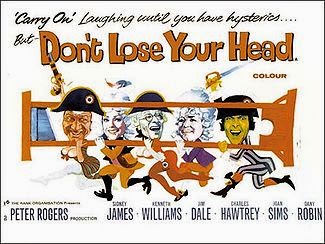
Carry On Don't Lose Your Head (1966)


The 13th in the venerable series of British comedy films, Carry On Don't Lose Your Head is an often funny but also often unremarkable effort, with good performances undermined by a few slow spots and a script that runs out of steam before the end.

Set in the time of the French Revolution, the plot spoofs the famous story of the Scarlet Pimpernel, with jaded layabout English noblemen, Sir Rodney Ffing (pronounced "Effing") and Lord Darcy Pue (Sid James and Jim Dale respectively), leading double lives saving French aristocrats from beheading at the guillotine, always leaving behind the mocking sign of the The Black Fingernail. But soon they find themselves crossing swords with head revolutionary Citizen Camembert (Kenneth Williams) and his sidekick, Citizen Bidet (Peter Butterworth), two Frenchmen who are so desperate to track down the Fingernail they are even prepared to travel to England.

Carry On films are never noted for their extravagant budgets and lavish sets, but this one looks great, with fancy costumes and country houses helping to recreate the tropes of the swashbuckling genre, in the same way that the previous film in the series, Carry On Screaming, did with Gothic horror.

Script wise, we get the usual wince inducing puns, and running jokes, this time based around lapses into schoolboy level French, and Sir Rodney’s surname. The other gags come thick and fast, and some do not work (there is a talking to camera sketch that goes on too long), but others hit the mark and the cast are more than capable of breathing life into the few other dry spells. 

Sometimes the story takes second place to a more sketch based approach, and there are caricatures rather than characters, with some broad acting to match, perfectly in keeping with the pantomime feel of the film. Almost stealing the show is Charles Hawtrey as sex-crazed aristocrat Duc de Pommfrit, one of those saved at the last minute from Madam Guillotine ("Your grace, there's an urgent letter for you!" "Oh, drop it in the basket, I'll read it later"). Sadly things run out of steam in the climactic sword fight which is not played for as many laughs as it should be and goes on too long.

There are also a few swipes at England, with gags about strikes and unions, not surprising given that it was released in the same year that saw a walkout by the National Union of Seamen lead to Harold Wilson’s government declaring a state of emergency.


Tuesday, 30 December 2014

The Adventures of Robin Hood (1938)


A thrilling piece of escapist entertainment, The Adventures of Robin Hood has a fast paced script, lush score, stunning Technicolor and a great cast led by a star in the role he seems born to play. It is also a film that exists in it's own world, free from the irony and subtexts that would inevitably come with a version of the story made at any point after 1938.

In 12th century England, with King Richard held captive in a foreign land, his brother Prince John (Claude Rains) seizes power and, along with his Norman cronies such as Sir Guy of Gisbourne (Basil Rathbone), begins oppressing the Saxon population. However, one man leads the fightback, Robin Hood (Errol Flynn), a Saxon knight, stripped of his land and wealth, who heads a guerilla army, hiding out in Sherwood Forest, robbing the rich to give to the poor.

This is very much Flynn's show, and his indefatigable swagger and energy mean the audience never get bored. The swagger is still there even when he is not sword-fighting or swinging from vines, as he delivers rousing speeches mocking John and Gisbourne like a music hall comedian delivering a routine.

His natural charisma helps sell the unbelievable situations, such as the Jesus-like way he persuades total strangers to drop everything and start following him. The whole premise is unbelievable in any kind of realistic sense, so your enjoyment will depend entirely on your ability to buy into the completely artificial world of Sherwood Forest, with the endless sunshine, well laundered and utterly impractical costumes, and people swinging from the sort of vines not normally seen in European woodland.

The co-stars are uniformly excellent, with Reins and Rathbone making a great contrasting double act, one short, squat and bullying, the other tall, athletic and a physical match for the hero. However, both are definitely bad guys, and very easy to boo at.

The well structured script clips along at a breathless pace, quickly establishing the characters, then breaking up into episodes that give them all things to do, culminating in a perilous rescue of the damsel in distress, Maid Marian (Olivia de Havilland). Despite the numerous fight scenes involving arrows, swords and a trail of bad guy corpses, the end product is sanitised of any blood, although the descriptions of the torture of Saxon peasants are disconcertingly quite gory.

While it might not be swimming in blood The Adventures of Robin Hood is certainly swimming in colour, and looks fantastic, with the astonishingly
vivid Technicolor cinematography becoming almost overwhelming at times, and certainly helping to lend a fantastic, hyper-real feeling to the film.

It does not just look wonderful, but also sounds wonderful as well, thanks to Erich Korngold’s brilliant and groundbreaking music. Korngold was arguably one of the architects of the modern film score with his use of different recurring themes and motifs for different characters, as well as often explicitly tying the music to the action on screen, ideas that seem so obvious nowadays, but in the 1930s had not then been this fully explored in Hollywood.

If The Adventures of Robin Hood had been made a few years later than it was, it would be tempting to see it as a rousing piece of wartime propaganda, with heroes, villains, and talk of freeing oppressed people and different races (Norman and Saxon) uniting together. However, it was released in May 1938, and while Hitler was spreading fear and turmoil across Europe, it's hard to picture many people in Hollywood, or in the movie going public thinking too much of war. It is still very much a product of it's time, an innocence, on screen at least, that it is hard to imagine today. It is also hard to imagine Hollywood producing a hero so committed to forced redistribution of wealth in the post-war, McCarthy era, and I can not deny being surprised at a Hollywood hero so committed to the re-establishment of the monarchy.

The film has a happy ending, of course, but one thought remains though, one that I have never been able to resist thinking after seeing happy endings. Robin Hood makes his goal very explicit throughout the film, that of of wanting to see Prince John removed and King Richard restored to the throne. However, the fun he has making that happen, even in the face of extreme peril and threats to his life, mean that now his wish has come true, life in Sherwood Forest is simply not going to be so exciting any more.


Saturday, 8 February 2014

Captain Horatio Hornblower R.N. (1951)


The swashbuckler is a film genre almost as old as cinema, and while not one of the best examples, Captain Horatio Hornblower RN is still an entertaining film. A meandering and occasionally sluggish script is compensated for with great special effects, exciting battle sequences, lush Technicolor, and an endearing performance from Gregory Peck as the stern but fair title character. It is also easy to see the influence of Hornblower on one famous sci-fi saga.

Combining elements of three of C S Foresters Hornblower novels, the plot sees the Captain, his ship and crew on a secret mission to Central America during the Napoleonic wars at the turn of the 19th century. Hornblower find himself battling not just the Kings enemies, who change according to the whims of politics, but tragedies at home, and the unwelcome appearance of a woman on his ship

By using three books, seemingly unconnected, it does mean the plot often lacks a single driving force, with the main focus being on the character of Hornblower himself, who comes across as a man of integrity and intelligence, a stoical man who always does his duty, but certainly not a martinet, or a macho show off. However, his stiff upper lip becomes a barrier, meaning we never really get inside the mind of Hornblower.

Director Raoul Walsh usually made more contemporary, and more land based films, which might explain why it never feels like he gets totally to grips with the genre and the setting. However, when the action does kick off it is first rate, with exciting battle sequences, backed up with excellent special effects, a stirring musical score from Robert Farnon and lovely rich looking Technicolor.

Gregory Peck plays Hornblower with a relatively understated authority, rather than the brash machismo of someone like Errol Flynn, and his charisma help keep your attention through the slower parts of the film. The main stand out in the supporting cast is James Robertson Justice as Quist, the seaman who helps Hornblower escape capture by the French. Although better known to me as the demanding surgeon Sir Lancelot Spratt in the "Doctor" films with Dirk Bogarde, he certainly brings a more down-to-earth quality to the character of Quist, and would go on to head out to sea with Peck in Moby Dick and The Guns of Navarone. Also, look fast for a cameo from a young and just about recognisable Christopher Lee, as a Spanish naval captain.

As a footnote, I had not realised the extent of the influence of Hornblower on the creation of Star Trek. The basic premise of a ship, its captain and crew, far from home, being plunged into dramatic situations (often with a military or diplomatic background) is easily transposed into outer space. While Kirk is perhaps more macho (and more of a ladies man) than Hornblower, both are bold, decisive men of action, and both have loyal first officers, and, in this film at least, cantankerous ship’s doctors.