Showing posts with label 1959. Show all posts

Sunday, 31 May 2020

The Mummy (1959)


The Mummy comes from that first flush of Hammer studio's late 1950s horror success that also included Dracula and Frankenstein. It has many of the classic elements, such as the stars, the director, the writer, luscious cinematography, rich dramatic score. It has also has some of the problematic elements, that nowadays are fascinating to examine.

The story starts in the 1890s with a team of British archaeologists in Egypt, led by John Banning (Peter Cushing) and his father Stephen (Felix Aylmer). They uncover the sealed tomb of one Princess Ananka, but Stephen inadvertently brings the mummified body of her High Priest Kharis (Christopher Lee) back to life. Years later, back in England, Mehemet Bey (George Pastell), a modern-day worshipper of Ananka unleashes the undead Kharis to take gruesome revenge on the them.

Cushing's role is different to that Frankenstein or Van Helsing. Those are more authoritative people, they have answers, they drive the story. Banning has no knowledge of, or part in the creation of the mummy. He is learning as he goes, which does give the character a chance to develop.

Even covered head to toe in layers of muddy bandages, Lee is still recognisable, through his eyes and stature. His mummy is a relentless killing machine, immune to bullets and knives, a precursor to the Terminator.

Some elements do look dated. In an accurate depiction of the time the film is set in, archaeology is shown as going to a faraway country to loot artifacts and interpret them through the prism of the colonial English.

None of the Egyptian characters are played by Egyptians. Pastell (who is Cypriot born) is suitably slimy as Bey. He says his magic spells in a mix of gibberish and English. With brown skin and a permanent bright red fez, he sticks out and is easy to spot as the bad guy.

There is mileage in the symbolism of the story. At the heart of it is pesky foreigners and their backwards superstitions. By coming "over here" they can be seen as foreign agents invading the country. However, the English characters are all brought down by their arrogance, and English exceptionalism.


Sunday, 26 May 2019

Behemoth the Sea Monster (1959)


Cheap and cheerful, Behemoth the Sea Monster borrows from the American giant monster films of the 1950s, especially director Eugène Lourié's earlier influential classic The Beast from 20,000 Fathoms. It's worth a look for the novelty of the London setting, the appearance of Hammer Horror regular André Morell, and the final FX work by King Kong legend Willis O'Brien.

American scientist Steve Karnes (Gene Evans) is giving a speech to British scientists about marine life and the dangers by nuclear testing. Later, he learns of thousands of lifeless fish washed ashore on the Cornish coast and the death of a fisherman from radiation burns. Teaming up with Professor James Bickford (Morell) to investigate, the pair find a passenger ship destroyed, with the loss of all on board, while tests show the dead fish were full of radioactive contamination. Karnes begins to suspect the creature the fisherman described seeing is a beast mutated by nuclear testing, with a desire to come back to London.

In the first ten minutes we get all the tropes you expect from this genre. 1) A conference of scientists with ominous warnings. 2) A bureaucrat who dismisses said warnings. 3) A pretty girl, and a hunky love interest. 4) somebody having a deadly encounter with something, linked to the opening scene, and shot from the point of view of the something. 5) The dying man muttering portentous semi coherent warnings with his dying breath. Following this comes lots of padding, occasional exposition, further deaths and possible monster sightings. Finally, the full reveal of the monster and a trail of destruction. In this respect, Behemoth the Sea Monster is no different, but it is still entertaining for the most part. There is some hokey Dr Who level rubber glove puppet special FX, some atmospheric scenes in Cornwall, and the always watchable Morell.

In fairness, the stop motion monster in the final scenes is not too bad considering the low budget, and this was the final credited work of Willis O'Brien. While he did not invent the technique, he refined and brought it to popular attention through King Kong, inspiring the likes of Ray Harryhausen.

Lourie would go on to give the monster smashing up London in the more colourful and fun Gorgo. This took the action from destroying anonymous docks and houses, to smashing London landmarks like Tower Bridge.


Tuesday, 12 September 2017

The Hound of the Baskervilles (1959)


An energetic and atmospheric take on the Sherlock Holmes tale, the Hammer Studios version of The Hound of the Baskervilles works as both an exciting detective story and an atmospheric Gothic chiller.

Although some changes are made to the source material, the basic plot remains the same, with Holmes (Peter Cushing) and Watson (Andre Morell) called on to investigate the mythical supernatural beast that has been haunting and killing members of the Baskerville family for hundreds of years. After his uncle Charles Baskerville is found dead, nephew Henry, the last of the line, finds himself left with the family estate – but does this have an unwanted extra, namely, the fatal family curse?

Cushing makes an excellent Holmes, a keen and energetic man with a razor-sharp brain and tongue to match, while Morell plays Watson closer to the literary version of the character, the heart to Holmes' brain, rather than the affable duffer that Nigel Bruce went for in the Basil Rathbone era films. Christopher Lee acquits himself well, playing a good guy for a change, but with enough charisma and haughty aristocratic manner to make Sir Henry convincing.  The script rattles along at a good pace, and the changes from the novel merely help make the story pacey and visual without dumbing it down.

What really makes this a unique take on the story is the way director Terence Fisher seamlessly blends Holmes and his world into that of Hammer Horror. The Baskerville house could just as easily be the Frankenstein residence, and the lush colours, bold music, and spooky atmosphere could be right out of any of their genuinely more supernatural efforts.


Thursday, 31 August 2017

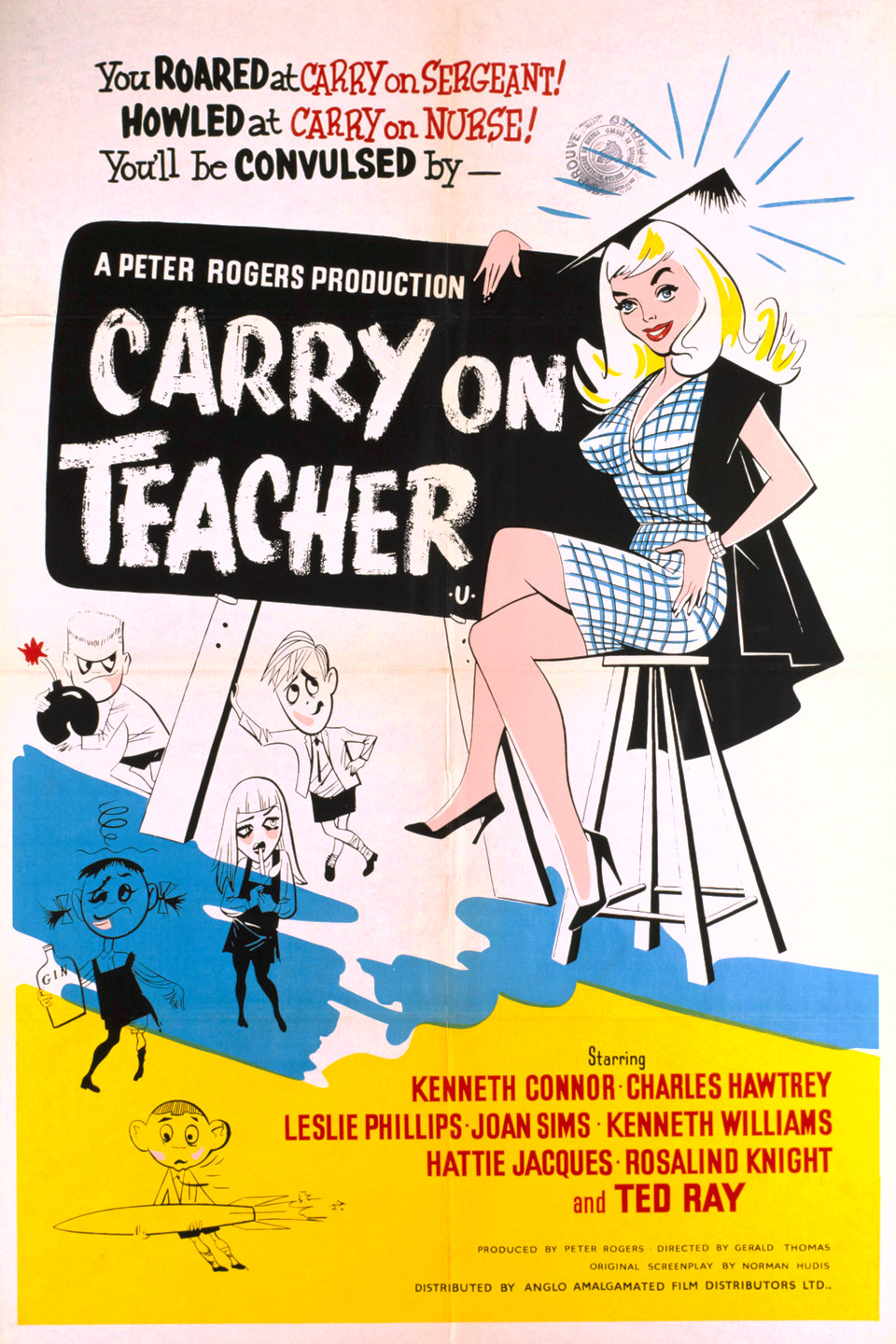
Carry On Teacher (1959)


Being only the third in the series, Carry On Teacher lacks a few of the elements associated with the films, but we can already see a rough blueprint of how they will develop.

William Wakefield (played by Ted Ray, in his only Carry On film) is the Headmaster of Maudlin Street Secondary Modern School. His hopes of getting a job at a shiny new school rest entirely on the results of a visit by Government Inspector Miss Wheeler, and noted child psychiatrist Alistair Grigg (Leslie Phillips). However, the pupils don't want Wakefield to leave, and plot to sabotage the inspection by any means necessary.

Several actors would go on to be Carry On regulars and here seem to be rehearsing the roles they would play on a more regular basis, with Kenneth Connor as an affable duffer, Charles Hawtrey as a camp neurotic, and Joan Sims as Sarah Allcock, the object of male desire. The exception is Kenneth Williams, playing straight as Edwin Milton, the English teacher, very different from the leering grotesque persona of the later films. (Look also for a very young Richard O'Sullivan, of later Man About the House fame)

Being a Carry On film, some of the script revolves around sex, particularly Grigg chasing after Allcock, and the innuendo in her name does not go unnoticed. However, this is rather tame and anodyne, lacking the bawdy energy that the likes of Sid James would bring into later films of the series.

In fact, the world of Carry On Teacher is an uncomplicated, sometimes sentimental one, but modern viewers might find one aspect jarring. Corporal punishment is a recurring theme, particularly the reluctance of Wakefield to administer it, and is a reminder of a time when British school children faced the possibility of physical punishment from their teachers.

Monday, 30 May 2016

Plan 9 from Outer Space (1959)


For many people, Plan 9 From Outer Space is the gateway drug to the world of bad movies, and it was certainly the case for me. Writer/Director Ed Wood Jr can be accused of many things in terms of deficiencies of plot, characterisation and special effects, but there is no way you can call his work boring.

While on a routine flight airline pilot Jeff Trent (Gregory Walcott) and his co-pilot Danny are surprised by a bright light and loud sound, and are shocked to see a flying saucer. The saucer lands at a cemetery, where a number of suspicious deaths have taken place. It turns out aliens are hiding out there, carrying out their fiendish plan to take over the world: reanimating the dead, otherwise known as Plan 9 From Outer Space.

The basic elements of the story, mad scientists, atomic power, alien invasions, zombies (albeit the pre-Romero, non contagious, non-flesheating kind) are not unfamiliar in the genre films of the time. In the hands of another film-maker, what could have resulted is the sort of pleasant but forgettable film that so many others were churning out at that time. Thankfully the job was turned over to Ed Wood, a man whose enthusiasm for movies was only matched by his enthusiasm for vodka. This meant that his scripts were bursting with ideas, and while he was not always the best at shaping these into a coherent whole, they have an anarchic energy and anything-can-happen atmosphere, coupled with dialogue that veers between the drearily banal and the outrageously surreal.


There are so many other points of interest along the way, from the health and safety loving police sergeant who insists on punctuating every line of dialogue by pointing at things with his gun, the Styrofoam Gravestones, the outrageously camp chief alien, and the heroic disregard for continuity, especially in terms of what time of day it is.

The star of the film, Bela Lugosi died a few days into shooting, the sort of event that would have crushed a lesser man than Ed Wood. Instead, he simply carried on, getting his wife's chiropractor to play the Lugosi role with his cape over his face so that we can't see the difference, even though he is at least a foot taller than Lugosi.

When I first saw this, back in the early 1990s the consensus was that this was something silly and terrible, something to be sneered at. Nowadays, I feel nothing but admiration for Wood. Granted his film-making skills are not up there with the best, but his enthusiasm and tenacity shines through in the movies, The surfeit of ideas means the film never gets dull and stands up to repeat viewings.