Showing posts with label Aliens. Show all posts

Monday, 13 April 2020

The Thing from Another World (1951)


The Thing from Another World is an entertaining mix of Cold War paranoia and Howard Hawks machismo.

The plot is based on "Who Goes There?", a short story by John W. Campbell. A group of scientists and US Air Force crew unearth a frozen flying saucer and its pilot near to their Arctic base. Unfortunately for them, the pilot has thawed out, is on the hunt for blood, and is impervious to their bullets.

There has been some confusion over who directed this film. Christian Nyby is the man on the credits, but. Howard Hawks, whose production company made the film, has often been mentioned as being the real talent behind the lens. Regardless of how true any claim is, there are some Hawks-like tropes, most noticeably in the rapid and overlapping dialogue.

In the original short story, the alien is a shape-shifter, imitating the characters, and causing tension and paranoia. In this version, it becomes a vegetable-based humanoid (memorably described as "an intellectual carrot"), immune to bullets and needing blood to regenerate. But there is still tension in the conflict between scientists and the military. The character of Dr Carrington in particular is shown as, if not an enemy, then at least a threat by wanting to reason with the creature rather than set it on fire. This makes a change from other sci-fi films of the era. Scientists are usually portrayed as the only people with the answers, working with or trying to keep the military in check.


Tuesday, 7 April 2020

Galaxy of Terror (1981)


Galaxy of Terror is a cheap, sleazy and goofy attempt by Roger Corman to cash in on the Sci-fi boom of the era.

The plot sees a spacecraft off to a distant planet to rescue the crew of another ship. But, the mission goes wrong when the rescue ship itself crashes. Then, the crew start to come under attack from what appear to be demons from their own minds.

Any right thinking trash hound will immediately be attracted by the cast. There is Robert "Freddy Krueger" Englund. The captain of the rescue ship is Grace Zabriskie aka Laura Palmer's mom in Twin Peaks. And one of the crew members is Erin Moran, otherwise known as Joanie Cunningham from Happy Days.

The film is often described as an Alien rip off. This hinges on one particularly unpleasant scene of a female crew member being raped by a slimy tentacle creature. The other deaths revolve around hallucinations linked to their subconscious.

Galaxy of Terror feels like it was shot in a weekend. But, there is a good grungy, Dark Star feel to the production design and special effects, partly due to a young James Cameron.

Unfortunately, a jumbled baffling narrative and too many slow dull patches make the film hard work and less fun than it should be.


Sunday, 20 January 2019

Robot Monster (1953)


Robot Monster is a rite-of-passage for anyone with an interest in 50's B-Movies and has long been staple of those Worst Films Ever lists that were all the rage in the 80s and 90s.

Ro-Man, an Alien Robot that in no way bears a striking resemblance to a man wearing a gorilla suit and a diving helmet, is on a mission to destroy all human life on Earth with his Calcinator death ray. He is achingly close to getting the job done, except for half a dozen humans that stubbornly remain alive; a scientist, his wife, their two daughters, his young son Johnny and his assistant, who have all somehow developed an immunity to the death ray. As if that's not bad enough for poor Ro-Man, he has developed an illogical attraction to Alice, the eldest daughter.

It's true that the film contains much that is easy to sneer at. The story makes little sense, the acting is wooden, the Death Ray seems to be a bubble machine with a TV antenna, and the four day shooting schedule is reflected in a few fluffed lines.

But, one thing you could never call it is dull. The sheer insanity and invention coupled with a total lack of any irony or self-awareness gives Robot Monster a delirious energy sorely lacking from other examples of this genre, or their modern-day equivalents such as the Sharknado franchise. Special mention goes to the generous use of stock footage for spacecraft and ruined cities from the likes of Rocketship X-M, Lost Continent, Flight to Mars and Captive Women. Oh, and dinosaurs from One Million B.C., because Ro-Man can also unleash giant lizards on the earth or something.

Despite the recycled special effects, the score is completely original and by no less a Hollywood luminary than Elmer Bernstein. A few years before his classics such as The Man with the Golden Arm and The Magnificent Seven, Bernstein was still a jobbing composer, and had, according to him, been side-lined in some areas of Hollywood due to his left-wing politics. His score for Robot Monster is a mix of bombastic and discord and sounds like it should belong in a much better film.

There is also a Shaggy dog story twist ending (SPOILER ALERT), which actually makes the whole baffling premise work. It turns out the whole thing has been a nightmare in the mind of little Johnny, which explains the incoherent and childish feel to the plot.


Saturday, 24 November 2018

Shocking Dark (1989)


An astonishing piece of work, even by the standards of 70s/80s Italian ripoff cinema, and a must see for schlock fans, Shocking Dark (AKA Alienators, AKA Terminator 2(!), AKA Death in Venice 2: The Deathening) pilfers from not one but two classics of James Cameron's filmography.

After a vaguely described apocalyptic apocalyptic event (something to do with mutant seaweed sucking the oxygen out of the water - not sure how this affects humans, but never mind) Venice is an abandoned, desolate shell, with a few survivors hiding in secure facilities deep underground. They're not alone though, as a gruesome mutant is roaming the city’s maze of tunnels. A team of soldiers, the Mega Force, go to dispatch it, along with civilian scientist Dr Sara Drumbull and Samuel Fuller (!), a representative of a company called the Tubular Corporation, who is as muscle-bound as he is mysterious.

Throw in a cyborg with half of his face torn off and already you can see some similarities with the work of Cameron. Italian exploitation cinema has a long and noble history of helping itself to ideas and plots from genre hits and writer Claudio Fragasso (the man who brought us the legendary Troll 2) and director Bruno Mattei (Hell of the Living Dead, Rats: Night of Terror), don't merely take the vibe or plotline of Terminator and Aliens, but lift whole scenes and lines of dialogue, shoehorning them in regardless of relevancy or coherence.

The few original elements make no more sense. Venice has been ruined so that property and art prices would (somehow) rocket in value. By the time a plot twist involving a time machine turns up, your brain has been pummelled into submission and will accept anything.


Saturday, 3 February 2018

Invaders from Mars (1986)

Noisy, shrill and charmless, this pointless Cannon Films funded remake of the 1950s paranoid classic is everything the original wasn't.

The plot follows the original, with young David Gardner seeing an alien spacecraft land in a quarry behind his house. When his normally warm and loving dad goes to investigate he returns cold and emotionless. As this behaviour starts to spread, taking in David's mother, teachers and fellow townspeople, his only ally is the school nurse, Linda Magnuson. Can they persuade the Marines to help them stop a Martian invasion?

The original may have had bargain basement effects and obvious padding to the running time, but it also had a bleak mood and the feverish quality of a child's nightmare, which, in this context, makes the ping pong ball eye aliens and rushed plotting work. This version has a big budget (much of which went on the impressive special effects), and a knowing, ironic tone, with portentous dialogue, telegraphed scenes of tension and several scenes played for laughs, but little else beyond this.


Monday, 12 June 2017

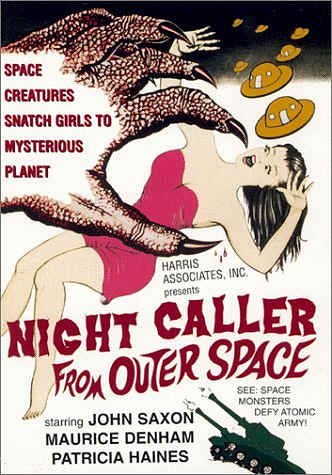
The Night Caller (1965)


After a meteorite crashes into the English countryside, scientist Jack Costain (John Saxon) and his team set out to investigate. They discover it is actually an alien device from one of Jupiter's moons used to transfer matter to Earth. But what is the connection between the visitor from outer space, a mystery man placing ads in the back pages of bikini magazines and the disappearance of anyone who answers them.

At times this feels like two different films thrown together lurching between Quatermass style extra terrestrial mystery and sleazy Soho-based whodunnit. What should have been either a creepy atmospheric chiller or a campy piece of fun is sunk by the script, which is both confusing and relentlessly talky, and the finished product is teeth-grindingly dull.

John Saxon does his best, heroically managing to sustain an English accent for the duration, and there is some fun to be had watching for cameos from Warren Mitchell as a father of a missing girl, Aubrey Morris as a squalid bookstore owner, and Ballard Berkeley, best known as the Major in Fawlty Towers.


Wednesday, 7 December 2016

Arrival (2016)


Arrival (2016)

Mankind's first encounter with extra-terrestrial life has long been a fascination of sci-fi filmmakers, with the emphasis often on the effect this has both on individuals and the planet as a whole. Arrival does have these elements but the emphasis is as much on the process of communication itself, and despite having a fascinating premise, and some good performances, the script flounders with a disappointing payoff.

When gigantic spaceships touch down in a dozen locations around the world.  Linguistics professor Louise Banks (Amy Adams) is called in by the US government to discover a way to communicate with them. But with panic on the streets, and nations on the verge of war, will she find a way before the aliens turn sinister - or before humanity destroys itself?

Adams does her best with the clunky dialogue that sounds deeper than it is ("We are so bound by time. By its order.”), managing to create some sympathy and emotional depth with her character. Forest Whitaker also does good work as Colonel Weber, the middle man between the scientists, the politicians, and the more gung-ho elements of the military.

The CGI is a mixed bag, with the huge spacecraft flawlessly blended into the Montana countryside setting, making it even more disconcerting. However, too much of what we see of the alien creatures feels like, well, it was created in a computer, which, granted, is the problem I have with most CGI.

However, the real problems lie with the script. Some of the plot twists rely on the highly unlikely, such as soldiers having unfettered internet in a locked down high security military base.  The underlying theme of a planet whose population is about to tear each other apart because of a failure to communicate is interesting and drives much of the tension, giving a ticking clock countdown to the work of Professor Banks. But the Deus Ex Machina pay off to this feels lazy, as if the writers have scripted themselves into a corner.

In addition, too much of the script is talky, resorting to the cliché of boffins standing around pointing at whiteboards, a pitfall perhaps of trying to explore the concept of language in a visual medium.


Monday, 30 May 2016

Plan 9 from Outer Space (1959)


For many people, Plan 9 From Outer Space is the gateway drug to the world of bad movies, and it was certainly the case for me. Writer/Director Ed Wood Jr can be accused of many things in terms of deficiencies of plot, characterisation and special effects, but there is no way you can call his work boring.

While on a routine flight airline pilot Jeff Trent (Gregory Walcott) and his co-pilot Danny are surprised by a bright light and loud sound, and are shocked to see a flying saucer. The saucer lands at a cemetery, where a number of suspicious deaths have taken place. It turns out aliens are hiding out there, carrying out their fiendish plan to take over the world: reanimating the dead, otherwise known as Plan 9 From Outer Space.

The basic elements of the story, mad scientists, atomic power, alien invasions, zombies (albeit the pre-Romero, non contagious, non-flesheating kind) are not unfamiliar in the genre films of the time. In the hands of another film-maker, what could have resulted is the sort of pleasant but forgettable film that so many others were churning out at that time. Thankfully the job was turned over to Ed Wood, a man whose enthusiasm for movies was only matched by his enthusiasm for vodka. This meant that his scripts were bursting with ideas, and while he was not always the best at shaping these into a coherent whole, they have an anarchic energy and anything-can-happen atmosphere, coupled with dialogue that veers between the drearily banal and the outrageously surreal.


There are so many other points of interest along the way, from the health and safety loving police sergeant who insists on punctuating every line of dialogue by pointing at things with his gun, the Styrofoam Gravestones, the outrageously camp chief alien, and the heroic disregard for continuity, especially in terms of what time of day it is.

The star of the film, Bela Lugosi died a few days into shooting, the sort of event that would have crushed a lesser man than Ed Wood. Instead, he simply carried on, getting his wife's chiropractor to play the Lugosi role with his cape over his face so that we can't see the difference, even though he is at least a foot taller than Lugosi.

When I first saw this, back in the early 1990s the consensus was that this was something silly and terrible, something to be sneered at. Nowadays, I feel nothing but admiration for Wood. Granted his film-making skills are not up there with the best, but his enthusiasm and tenacity shines through in the movies, The surfeit of ideas means the film never gets dull and stands up to repeat viewings. 

Monday, 10 September 2012

God Told Me To (1976)


In New York City, a sniper opens fire on a dozen innocent victims; a police officer at the St Patrick's Day Parade guns down both members of the public and his colleagues; and in an apartment, a man calmly tells officers how he murdered his wife and young children. The thing that links all of these events is that each one of the perpetrators claims, "God told me to do it". With a premise like that what could possibly go wrong? Well, unfortunately, plenty, with writer/director Larry Cohen suffering an inability to develop a great idea into a fully fleshed out story.

"God Told Me To" was released in 1976, when the book "Chariot of the Gods?" was all the rage, and author Erich von Daniken theorising that many of the religious beliefs and ancient technological advances on planet Earth may have extra-terrestrial origins. Cohen throws plenty of similar ideas into the mixture, as he tries to link UFO abductions, virgin births, mind control, biblical sacrifice, and messianic androgynous aliens, but fails to tie them up into a completely coherent whole.


Given that the murders and their investigation are initially introduced as the factor driving the plot of the film, it is baffling how they are eventually forgotten about, and the reasons behind them never adequately explained. Vague allusions are made to the Biblical story of Abraham being asked to sacrifice his son Isaac, and a possible link to the modern day God (or in this case, what appears to be some sort of malevolent extra-terrestrial being that his followers mistake for God) testing his followers by asking them to do terrible things. However, this does not really work in the context of the film, as, according to the book of Genesis, God also intervened at the last minute to save Isaac, and Abraham did not subsequently kill himself.


A couple of the individual scenes are memorable, with the St Patrick’s Day Parade shot with lots of shaky handheld camera work, giving a chaotic feel that mirrors the panic of the crowd. By contrast the interview with the man who has gunned down his family (an act we never actually see) is all the more creepy for the low key approach taken, as he coolly describes what happened, and justifies it with a beatific look on his face and a blissful tone to his voice.
However, these scenes, along with the other elements of the story, such as the mysterious long haired man and his seemingly virgin mother, are presented as though they are pieces of a puzzle that will ultimately add up to an answer, however obtuse, bizarre or vague, something which frustratingly never happens. Instead of resolving plot strands, Cohen opts instead for adding more and more, which does mean the constant flow of off-the-wall ideas and situations just about sustains interest until the end - just do not expect to have worked out what any of it was ultimately about or may have been trying to say.