Horror and Sci-Fi films old and new, weirdo trash, arthouse, forgotten gems, well loved classics, and I'm watching the original Dr Who from the beginning.
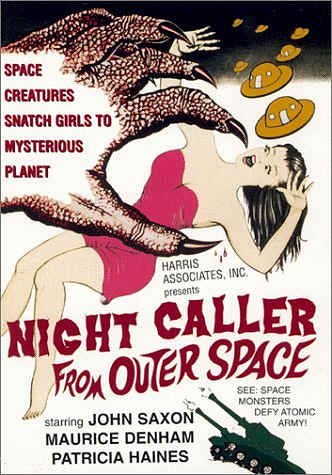
After a meteorite crashes into the English countryside, scientist Jack Costain (John Saxon) and his team set out to investigate. They discover it is actually an alien device from one of Jupiter's moons used to transfer matter to Earth. But what is the connection between the visitor from outer space, a mystery man placing ads in the back pages of bikini magazines and the disappearance of anyone who answers them.
At times this feels like two different films thrown together lurching between Quatermass style extra terrestrial mystery and sleazy Soho-based whodunnit. What should have been either a creepy atmospheric chiller or a campy piece of fun is sunk by the script, which is both confusing and relentlessly talky, and the finished product is teeth-grindingly dull.
John Saxon does his best, heroically managing to sustain an English accent for the duration, and there is some fun to be had watching for cameos from Warren Mitchell as a father of a missing girl, Aubrey Morris as a squalid bookstore owner, and Ballard Berkeley, best known as the Major in Fawlty Towers.
Although it might be tempting to lump Cannibal Apocalypse in with similar gut munching genre films from the 70s and 80s it is both different from and much more entertaining than many of these. Director Antonio Margheriti keeps the action moving but also focusses as much on character as on grue, John Saxon creates a sympathetic lead, and the premise has some surprising symbolism about post traumatic stress disorder. A platoon of US soldiers lands in a Vietnamese village on a search and rescue mission led by Captain Norman Hopper (John Saxon). Hopper finds two POWs trapped in a pit, munching on the flesh of a villager, and as he reaches out to rescue them, one (the distractingly named Charles Bukowski, played by genre legend John Morghen) bites him. Cut to a few years later, back in the US and Bukowski is released from a psychiatric hospital, but he still has a taste for human flesh, a craving caused by a virus contracted in Vietnam. Hopper starts to realise that Bukowski may have passed the virus on to him - and to anyone else that he can get his teeth into. Margheriti does not skimp on the gore, such as the football sized hole that a shotgun blast leaves in somebody's guts, and it will not be too much of a suprise to hear that this film made the British Government's infamous Video Nasty list in the 1980s. Nevrtheless, Cannibal Apocalypse has several elements that lift the film above the more grim, cheerless and tiresome horror efforts that were also being made at the time. Firstly the script is both straightforward and fast moving, and gives John Saxon the opportunity to build a likeable and sympathetic leading character, an every-man thrust into a bizarre situation that gradually slips out of his control. The polar opposite of Hopper is his former comrade-in-arms Bukowski. He is brilliantly played by Morghen, an actor who seems here as in the likes of Cannibal Ferox and House on the Edge of the Park, to be typecast as some of the most grubby and unwholesome characters in cinema history. The most fascinating part of the film is the symbolism of the virus that causes them to turn to flesheating. Unlike the zombies or cannibals of other contemporary horror films, these characters do not become mindless killers, but, although slaves to their new appetites, remain seemingly sentient, more like high functioning addicts. Another interpretation stems from where the characters originally contracted the virus, their wartime experiences. This, like Post-traumatic stress disorder, is something that they bring back to civilian life, and, like PTSD, can sit dormant for years, but if untreated, eventually begins to have a detrimental effect on the veterans, as well as their families and friends, and, eventually, their fellow citizens. One accusation that could be placed at both Vietnam and Cannibal genre films is racism. The North American or European protagonists are, even if cruel and degenerate, still the "normal" people that the audience relate to, and the Vietnamese / Cannibals are savage, exotic, mysterious and "foreign", even if the action takes place for in their own country. Cannibal Apocalypse overcomes these by placing most of the action in urban America, and making the Americans the cannibals. The flesheating is never implied to be a part of Vietnamese culture, just something that the war has driven the Americans to acting out. Of course there are some of the usual things present in low budget exploitation filmmaking, such as clunky dialogue, underwritten supporting characters and badly matched stock footage, but none of this detracts from a distinctive, and unsettling slice of 80s horror.
Sometimes, extreme circumstances require
extreme responses, and they do not come much more extreme than those used by
the hero of Napoli Violenta, an
action packed Italian crime flick, or “Poliziotteschi” from the 70s. What the
film lacks in subtlety, characterisation or morality, it more than makes up for
with outrageous violence, a protagonist who seems at times to be as unhinged as
the villains, and some audacious directorial touches.
No nonsense cop Inspector Betti (played by genre favourite Maurizio Merli) is
transferred to Naples, and immediately sets about confronting crime and
corruption in his own two fisted manner. Soon his violent tactics are making as
many enemies in the police as in the criminal underworld - will it be just a
matter of time before one side puts him out of action?
The Italian exploitation film business in the 70s and 80s usually followed a
standard approach, no matter what the genre. Enterprising producers would spot
a Hollywood hit, appropriate some of the stylistic and thematic elements, (and
often shift the action from America to Italy), hire a competent journeyman
director, willing to turn his hand to anything, and make something cheap and
quick to cash in. In this case, Umberto Lenzi was behind the camera, a man who
had already made Westerns, Comic Book adaptations, Giallo, Sword-and-Sandal,
and Spy films, and would later achieve a degree of notoriety when Cannibal Ferox turned up on the British
Governments “Video Nasty” list in the 1980s.
Napoli Violenta clearly has its roots in the Dirty Harry series of films, with a violent, unflappable,
borderline psychotic anti-hero (not five minutes in and he is beating up a car
thief), as much at war with his superiors as with the criminals. The script
juggles several plot strands, with protection rackets, thieves, a crafty bank
robber and the mob all vying for attention, meaning there is rarely a dull
moment. Betti is a man defined by his actions, the sort of guy who will shoot
first, hit second, and maybe ask questions later, if the suspect is still
alive. He is occasionally given to moments of regret - when one crook fatally
impales himself on a spike, Betti certainly looks regretful - regretful that he
did not do the job himself. The lurid violence is could perhaps be seen as a
forerunner of Lenzi’s later efforts in the horror genre, but here it is more lively
and “comic book” in tone, and certainly less grim and depressing than the likes
of Cannibal Ferox.
With his big hair, big moustache and macho
attitude, Betti is the epitome of 1970s masculinity, and while the character is
a little one dimensional, Merli has more than enough charisma, even with the
ropey dubbing, to hold your attention. The ever-reliable John Saxon makes the
most of his small role, but the rest of the cast are competent without being
memorable, meaning that apart from Merli and Saxon, it is the outrageous action
and violence that gives the film life and energy.
One aspect that sets Napoli
Violenta apart from many others of the same era and genre is the occasionally
inspired directorial flourishes, most notably during the chase sequences. I get
the impression that rather than spend a lot of time and money on the correct
paperwork, Lenzi, like Betti, just decided to take whatever action is necessary
to achieve a result. So, as motorcycles race through the streets of Naples, we
follow the action on the bikes via hand-held cameras, watching what looks like
real people dive for cover, making for heart stopping viewing, and giving a
feel of genuine guerrilla film making.
The picture painted of Naples is that of a dense, chaotic and vicious city,
where the creed is kill or be killed, and anyone showing weakness is doomed.
This is something that Inspector Betti understands, as do his superiors, and
the police chief is happy to ignore what Betti gets up to, if it gets results.
By making the champion of law and order a violent man with no regard for due
process of law, a vigilante with badge, the director skirts close to almost
celebrating an authoritarian outlook. This is not something that is really
sustained throughout the film through any other references or symbolism
however, and it should be remembered that this film came out during the height
of a period known as The Years of Lead, a time where politically motivated
violence, kidnappings and assassinations were rife. However, none of the crime
in this film is political, so perhaps it is more a case of giving contemporary
audiences clearly defined roles of hero and villain, and providing them with
the escapism of seeing an incorruptible John Wayne style hero prevail.