Horror and Sci-Fi films old and new, weirdo trash, arthouse, forgotten gems, well loved classics, and I'm watching the original Dr Who from the beginning.
Apart from having a damn great title, Death Bed: The Bed That Eats is a baffling but compelling mix of horror, black comedy, inventiveness and incompetence.
For once with an exploitation film, it delivers on that title. There is a plot of some sort, something about a demon in love with a woman who died in the titular bed, and an artist trapped in a painting who, in a voice that disconcertingly sounds like Stephen Fry, taunts the demon while providing a narration of sorts. But the focus is on four set pieces, each labelled with meal related intertitles, where unsuspecting folk wind up on the mattress menu.
At times it reminded me of Hausu, which was released in the same year. But it lacks the relentless breakneck pace of that loopy Japanese classic, going instead for a momentum free druggy torpor, where the characters almost stagger around, disconnected from reality.
Luckily, there's enough going on to stop things getting dull. The premise is loopy enough and director George Barry (in his only attempt at film making) accompanied it by some equally surreal visuals, and a harsh jarring synth soundtrack. Barry doesn't skimp on two other vital ingredients. There is plenty of gore, such as a woman getting garrotted by her own crucifix. There is plenty of weird humour, such as the bed drinking a bottle of Pepto-Bismol after a particularly hard to digest victim. Coupled with some hammy acting, it sometimes feels like a Monty Python sketch.
If you're looking for plot, characters and slick film making, this may not be for you. But, if you like brain stretching freaky chutzpah, Death Bed: The Bed That Eats is well worth a look.
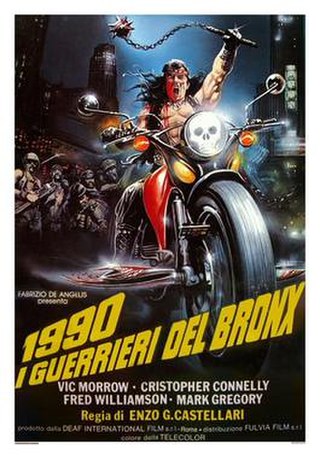
What it lacks in originality and coherence, 1990: The Bronx Warriors more than makes up for in energy, glorious cheese, and a pulsing soundtrack.
Like many of the film's contemporaries, there is much in common with other successful genre films, in this case Mad Max 2, The Warriors and especially Escape From New York.
The year is 1990 and the US government has given up trying to police the Bronx, instead sealing the area off and leaving it to the gangs and criminals still there. Meanwhile, Anne, the teenage heiress to a giant arms manufacturing corporation is having some moral questions about her upcoming inheritance, so she runs away to the Bronx to join a biker gang. But the Corporation isn't about to let her go that easily, so enter ruthless, psychopathic mercenary Hammer (played by Vic Morrow), who has orders to get her back by any means necessary.
Although the premise and characters may sound like a none too subtle imitation of Escape from New York, it is not quite as straightforward as that. Carpenter's film paints Snake Pliskin as an anti-authoritarian nihilist, while Hammer is simply a gun for hire, who, by the end, turns into a pantomime villain. Genre stalwarts Fred Williamson and Christopher Connelly (The Atlantis Interceptors) take on the Isaac Hayes and Ernest Borgnine roles as Ogre the gangster and Hot Dog the cabby, the former being more of a Robin Hood figure than an outright villain. Meanwhile the biker gangs are actually the easiest to cheer for, coming across as the little Davids taking on the Goliath that is the Corporation.
Some clever shooting and editing helps cover up the limited resources available to the filmmakers, and there are some nice goofy touches such as the supposedly menacing gang on roller skates (no match for guys on bikes) or the drum solo on the soundtrack that, as the camera pulls back reveals an actual drummer playing away in the middle of some wasteland for reasons best known to himself.
The script has a few head scratching moments but also an energy that stops it from ever getting dull. Essential trash viewing.
Sometimes, extreme circumstances require
extreme responses, and they do not come much more extreme than those used by
the hero of Napoli Violenta, an
action packed Italian crime flick, or “Poliziotteschi” from the 70s. What the
film lacks in subtlety, characterisation or morality, it more than makes up for
with outrageous violence, a protagonist who seems at times to be as unhinged as
the villains, and some audacious directorial touches.
No nonsense cop Inspector Betti (played by genre favourite Maurizio Merli) is
transferred to Naples, and immediately sets about confronting crime and
corruption in his own two fisted manner. Soon his violent tactics are making as
many enemies in the police as in the criminal underworld - will it be just a
matter of time before one side puts him out of action?
The Italian exploitation film business in the 70s and 80s usually followed a
standard approach, no matter what the genre. Enterprising producers would spot
a Hollywood hit, appropriate some of the stylistic and thematic elements, (and
often shift the action from America to Italy), hire a competent journeyman
director, willing to turn his hand to anything, and make something cheap and
quick to cash in. In this case, Umberto Lenzi was behind the camera, a man who
had already made Westerns, Comic Book adaptations, Giallo, Sword-and-Sandal,
and Spy films, and would later achieve a degree of notoriety when Cannibal Ferox turned up on the British
Governments “Video Nasty” list in the 1980s.
Napoli Violenta clearly has its roots in the Dirty Harry series of films, with a violent, unflappable,
borderline psychotic anti-hero (not five minutes in and he is beating up a car
thief), as much at war with his superiors as with the criminals. The script
juggles several plot strands, with protection rackets, thieves, a crafty bank
robber and the mob all vying for attention, meaning there is rarely a dull
moment. Betti is a man defined by his actions, the sort of guy who will shoot
first, hit second, and maybe ask questions later, if the suspect is still
alive. He is occasionally given to moments of regret - when one crook fatally
impales himself on a spike, Betti certainly looks regretful - regretful that he
did not do the job himself. The lurid violence is could perhaps be seen as a
forerunner of Lenzi’s later efforts in the horror genre, but here it is more lively
and “comic book” in tone, and certainly less grim and depressing than the likes
of Cannibal Ferox.
With his big hair, big moustache and macho
attitude, Betti is the epitome of 1970s masculinity, and while the character is
a little one dimensional, Merli has more than enough charisma, even with the
ropey dubbing, to hold your attention. The ever-reliable John Saxon makes the
most of his small role, but the rest of the cast are competent without being
memorable, meaning that apart from Merli and Saxon, it is the outrageous action
and violence that gives the film life and energy.
One aspect that sets Napoli
Violenta apart from many others of the same era and genre is the occasionally
inspired directorial flourishes, most notably during the chase sequences. I get
the impression that rather than spend a lot of time and money on the correct
paperwork, Lenzi, like Betti, just decided to take whatever action is necessary
to achieve a result. So, as motorcycles race through the streets of Naples, we
follow the action on the bikes via hand-held cameras, watching what looks like
real people dive for cover, making for heart stopping viewing, and giving a
feel of genuine guerrilla film making.
The picture painted of Naples is that of a dense, chaotic and vicious city,
where the creed is kill or be killed, and anyone showing weakness is doomed.
This is something that Inspector Betti understands, as do his superiors, and
the police chief is happy to ignore what Betti gets up to, if it gets results.
By making the champion of law and order a violent man with no regard for due
process of law, a vigilante with badge, the director skirts close to almost
celebrating an authoritarian outlook. This is not something that is really
sustained throughout the film through any other references or symbolism
however, and it should be remembered that this film came out during the height
of a period known as The Years of Lead, a time where politically motivated
violence, kidnappings and assassinations were rife. However, none of the crime
in this film is political, so perhaps it is more a case of giving contemporary
audiences clearly defined roles of hero and villain, and providing them with
the escapism of seeing an incorruptible John Wayne style hero prevail.