Horror and Sci-Fi films old and new, weirdo trash, arthouse, forgotten gems, well loved classics, and I'm watching the original Dr Who from the beginning.
The Halloween film series, just like main antagonist Michael
Myers, refuses to stay dead. The eleventh outing has an excellent turn from
original star Jamie Lee Curtis but fails to bring much else new or exciting.
Wisely ignoring the sequels (both old and new), the story
starts Michael with locked up in an asylum, forty years after the events of the
first film. The object of his stalking, Laurie Strode (Curtis) has spent the
time suffering PTSD, which has cost her two marriages and the relationship with
her daughter. One day she gets the news that she has been dreading - Myers is
being transferred to a new facility, giving him the opportunity to escape and
finish what he started.
It's always great to see Jamie Lee Curtis in anything, and
here she brings a great mix of vulnerability and toughness to her character.
The other characters are mostly forgettable, but that is not unusual for the
genre. Kudos also to John Carpenter who, with his son Cody and Daniel Davies,
has crafted a score that is as discomfiting and driving as his work for the
original.
The film is competently made but never answers the question
"What's the point of this?". Director David Gordon Green reverently
copies many of the shots and tropes of the original, but misses the main thing
that made the original work so well. The original’s director John Carpenter
stripped nearly everything back to the bare minimum, from the story, to the
score, to the fleeting appearances of Myers in tracking shots.
Green takes the opposite approach, overloading the film with
themes and topics, (best represented by the two podcasters trying to re-examine
Myers story and turn him into an object of fascination) and the inevitable
throwbacks to the original film. All this does is remind you how lean and
efficient the original was.
Horror and satire seem to make for a potent mix and Get Out is the latest entry in this sub-genre, joining the likes of The Stepford Wives and They Live. With genuine scares and a relevant social message, the film is a pitch perfect mix of excruciating satire and nerve shredding horror
Chris Washington (a star-making turn from British actor Daniel Kaluuya) is a young black man getting ready to visit the family of his white girlfriend, Rose Armitage at the upmarket country estate where they live. But no matter how friendly and welcoming everyone is, there is no denying something weird is going on. Why do the family's black housekeeper and grounds keeper, Walter and Georgina, seem so passive and mindless? What is going on with Mrs Armitage's hypnosis techniques? And why is one of the Armitage's guests warning Chris to "Get Out"?
This is a remarkably assured début from writer director Jordan Peele, who manages to get the balance between shocks and satire right, so that one does not overwhelm the other, and makes the shocks and satire genuinely shocking and funny respectively. The script is a master-class in discipline and structure, with hardly a wasted scene or line, clever set-ups that all pay off, and some great lines ("I would have voted for Obama a third time if I could"). Peele also throws in plenty of horror tropes that genre fans will instantly recognise, but does not rely on them to plug gaps in the story.
The cast is also uniformly excellent, led by Daniel Kaluuya as Chris, trying to retain his cool and dignity in the face of increasingly weird and uncomfortable events. As the Armitage parents, Catherine Keener and Bradley Whitford combine a welcoming charm with an unnerving forcefulness and underlying menace, and Caleb Landry Jones is memorably obnoxious as Rose's brother Jeremy.
Race is always in the news, but recent events have made this film feel even more relevant. However, what makes Get Out so different and successful is the unexpected way the topic is tackled. There are some scenes of Chris falling foul of authority figures, but the main focus of this theme is elsewhere. Equally hurtful is the patronising privileged condescension from the white liberals at the Armitage house. Despite their friendly attempts to ingratiate themselves, for them, black people are judged purely in terms of how useful they are.
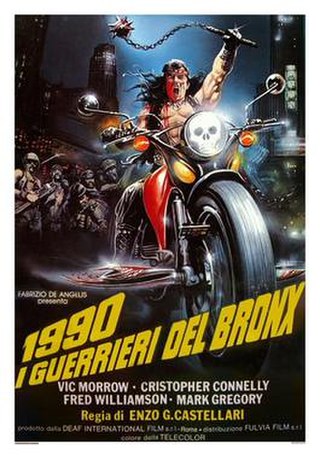
What it lacks in originality and coherence, 1990: The Bronx Warriors more than makes up for in energy, glorious cheese, and a pulsing soundtrack.
Like many of the film's contemporaries, there is much in common with other successful genre films, in this case Mad Max 2, The Warriors and especially Escape From New York.
The year is 1990 and the US government has given up trying to police the Bronx, instead sealing the area off and leaving it to the gangs and criminals still there. Meanwhile, Anne, the teenage heiress to a giant arms manufacturing corporation is having some moral questions about her upcoming inheritance, so she runs away to the Bronx to join a biker gang. But the Corporation isn't about to let her go that easily, so enter ruthless, psychopathic mercenary Hammer (played by Vic Morrow), who has orders to get her back by any means necessary.
Although the premise and characters may sound like a none too subtle imitation of Escape from New York, it is not quite as straightforward as that. Carpenter's film paints Snake Pliskin as an anti-authoritarian nihilist, while Hammer is simply a gun for hire, who, by the end, turns into a pantomime villain. Genre stalwarts Fred Williamson and Christopher Connelly (The Atlantis Interceptors) take on the Isaac Hayes and Ernest Borgnine roles as Ogre the gangster and Hot Dog the cabby, the former being more of a Robin Hood figure than an outright villain. Meanwhile the biker gangs are actually the easiest to cheer for, coming across as the little Davids taking on the Goliath that is the Corporation.
Some clever shooting and editing helps cover up the limited resources available to the filmmakers, and there are some nice goofy touches such as the supposedly menacing gang on roller skates (no match for guys on bikes) or the drum solo on the soundtrack that, as the camera pulls back reveals an actual drummer playing away in the middle of some wasteland for reasons best known to himself.
The script has a few head scratching moments but also an energy that stops it from ever getting dull. Essential trash viewing.
The eighth in a once seemingly interminable franchise, Halloween: Resurrection tries to bring a contemporary feel to things with a plot about web-cams and reality TV. However, the whole thing is as tired and grating as any of the sequels and rip-offs that came in the wake of the original Halloween.
Set three years after the previous film, Halloween H20 (which, if you missed, we are brought up to speed on with some exposition dialogue and flashbacks), the film starts with Laurie Strode in a mental hospital after decapitating a man she thought was her brother, Michael Myers, the knife wielding masked killer of six of the previous seven Halloween films. However, once again, he lives to slash another day, and tracks Laurie down before finally fulfilling his life ambition and bumping her off. Still, it means the studio can put Jamie Lee Curtis on the poster, and no doubt, she was well paid for an afternoon’s work.
Therefore, after just 15 minutes, Myers is suffering something of an existential crisis, pondering what to do now he has no raison d'etre. Fortunately, for him at least, the second part of the film kicks in, with the answer to his prayers coming in the form of a group of teenagers who have agreed to spend Halloween night in the Myers childhood home. The rooms are all fitted with web-cams, and the people fitted with head cams, as part of an internet reality show created by new media moguls Freddie Harris (Busta Rhymes) and Nora Winston (Tyra Banks). It is the web aspect, rather than the reality TV element that looks most dated now, as a cinematic style, it was old hat even on the film's release, a few years after The Blair Witch Project (the other pop culture reference point being video games, with one killing framed to look like the distinctive point-of-view of Doom) In terms of the genre, the standard rules apply, so rather than fully formed characters, we get tropes, such as the too-cool-for-school Janeane Garofolo type, her blond bimbo friend, the wacky nerd, the wannabe rock god and the black guy who cooks, while, thanks to the killings being broadcast over the internet, a group of dopey teens at a Halloween party get to provide a Greek chorus, and anyone who finds themselves in adult situations involving sex or drugs is doomed.
The style is loud, slick, flashy gory, and the longer the film goes on, the harder it becomes not to compare it with the relatively restrained, creepy, ambiguous and well-constructed freshness of the original, made nearly 25 years earlier. Here, the filmmakers seem to have little to offer other than a topical cash-in, and the increasingly confusing and boring mythology of the franchise. If it did not have the latter, it may have fallen through the cracks to be soon forgotten, although perhaps it might have had more of a chance as a standalone affair. At one point in their encounter, Laurie tells Michael “You have failed because I am not afraid of you”, and I cannot think of a better summing up of this film.
Being threatened in a supposedly safe place is a classic and effective horror trope, and one that, being set largely in a hospital, Halloween 2 exploits as well as its predecessor did with the domestic setting. However, while capably shot, directed and acted, the script, (written, like the first, by John Carpenter and Deborah Hill) is something of a let down. By showing too much of the killer and his back-story, we lose the ambiguity that gave the previous effort an unsettling depth beyond the surface shocks.
Continuing directly after the events of the first film, the murderous Michael Myers is still on the loose in the city of Haddonfield, despite being shot six times by his psychiatrist -turned-nemesis Dr Loomis (Donald Pleasance). Myers heads to the hospital where one of his targets, Laurie Strode (Jamie Lee Curtis) has been taken, and we now find that there is a reason why he is after her - a chilling reason, of which both Laurie and Dr Loomis are completely unaware.
As mentioned, compared to the first film, Halloween 2 sees Myers take a more central part of the story, both in terms of his increased screen time, and some revelations about his past. This, however, is a mistake, as showing more of him diminishes his mystery and power, while the confusing back-story, with hints of links to the supernatural and ancient pagan rituals, feels poorly and barely thought out. It eventually becomes something of an irritating distraction, and the big shocking twist, the reason Michael Myers is stalking Laurie, ultimately feels shoehorned in, as another afterthought.
Ironically, some of the best and most effective elements are those that feature Myers in the background or do not feature him at all. By about half way through the film, jittery townsfolk are seeing his shape everywhere, and a lynch mob (another classic horror trope) is trying to smash up his old family home. Here, we realise, once again, how much more effective a monster Michael Myers is, when we do not see him, only the consequences of his actions.
For example, in one of the best scenes in the film, a nurse runs to the hospital car park to try and get away, only to find the tyres on her car slashed. As she looks around, she sees another car with slashed tyres, then another, and another, and with mounting horror, she realises that every single vehicle in the car park has been sabotaged. What kind of person could do this? Someone unhinged or somebody supernatural? It is this sort of behaviour, bewildering, almost impossible to believe, and largely unseen that works best, and would be spoilt by having too much explanation.
The other significant change is how much more explicitly violent this film is compared to the first. This, presumably, was done for commercial reasons, with the flood of slasher films released in the three years between Halloween 1 and 2, continually upping the gore ante, and, more importantly, the audiences lapping this up. This is not a criticism of cinema violence itself, as that is often the whole point of the slasher genre, to entertain (or offend, depending on your viewpoint), with ever more elaborate and imaginative killings. However, when everyone is doing that, it is the one who is not who stands out, and in that respect, Halloween 2 remains merely a part of the crowd.
However, in other respects Halloween 2 does stand out from other slasher films of the time. For all the flaws and half thought out ideas in the script, it does try to something different and a bit more complex, by having two story arcs, that of Laurie and Loomis, run separately throughout, only bringing them together at the end. In addition, director Rick Rosenthal does take time to set up some of the characters and situations, which stops it becoming a conveyor belt of killings.
Halloween 2 also invites some interesting thoughts on two subjects that inevitably crop up in Horror – sex and death. Firstly, although it might on the surface look like one of the inevitable slasher movie clichés, I was fascinated by how slowly Myers stalks Laurie through the hospital corridors. Granted, she is heavily sedated for a lot of the film, which stops her from running very quickly, but other times she could get away easily. Why does he not walk any faster? In that respect, Myers becomes, like the zombies in George Romero films, a symbol of death and our own mortality – slow but inevitable, no matter how fast you run.
Secondly, a frequent criticism levelled at slasher films is misogyny, and while there may be a debate to be had about other films, particularly the linking of female, often teenage, sexuality and violent death, there is little of that in Halloween 2. Admittedly, the main female character is largely passive and has to be rescued by men, but there is a crucial difference between this film and Halloween, or, indeed, its many imitators.
In the original, where his motives are more ambiguous, and all of the victims are teenagers who engage in drug use or premarital sex, it is possible to see Myers as some sort of force of Puritan vengeance, punishing people for their sins. However, here, there is no suggestion of a sexual agenda to either the killings, or the stalking of Laurie Strode.
Conversely, however, it does mean that Halloween 2 lacks some of the sense of danger, and even the uncomfortably perverse streak that other slashers have. Watching these films does not automatically make you a misogynist, and they can raise, sometimes uncomfortable, questions about the attitudes of the characters, the film-makers, and perhaps ultimately you, the viewer.
Lacking these sorts of extreme elements, what is left with Halloween 2 is a competent, workmanlike slasher film that, aside from the unique elements of the franchise, has little to heavily distinguish it from the scores of others in the genre.
Reviewing sequels can pose a problem - should the film be looked at as a standalone piece, or as part of a series? Thankfully, Halloween 3 largely solves this particular problem by ignoring any of the Michael Myers mythology of the previous two (or subsequent seven) entries in the franchise, and what we are left with is a flawed but still interesting film. The delirious tone and subject matter make it feel at times like a modern day suburban fairy tale, and it mixes an X-Files/Kolchak type story with an uncompromisingly cruel streak that touches on an uncomfortable taboo.
When one of his patients is murdered in hospital, Dr Daniel Challis, played by Tom Atkins (Maniac Cop, Night of the Creeps) teams up with the dead man's daughter to investigate. Their search takes them to the mysterious Silver Shamrock toy factory in California, owned by Conal Cochran, played by Dan O'Herlihy (Robocop), a place that also has links to an incessant toy commercial, a sinister child-based pagan ritual, and a certain day of the year.
After Halloween 2, which followed on directly from the events of the first film, John Carpenter expressed an interest in turning the franchise into an annual event, releasing a different film every October 31st, each unrelated beyond the Halloween moniker. This is the first, and, thanks to disappointing box office results, only result of this experiment.
The main criticism that can be levelled at Halloween 3 is the script, which feels messy, and badly constructed. We get some intriguing situations and plot twists, such as a murderer calmly getting into a car and setting himself on fire, but because the main premise of the factory owner's evil scheme feels half thought through, the big revelation at the end is a baffling, and slightly silly let down.
The first draft of the screenplay was written by Quatermass creator Nigel Kneale, but, according to him, was heavily reworked. It certainly lacks the sharp internal logic of the Quatermass stories, where baffling and intriguing premises are set up but clearly explained by the end, and the whole thing feels a lot goofier than anything Kneale ever put his name to. For example, I can see a Stonehenge-type plot element being in the original (Kneale, in the final Quatermass TV serial three years earlier had explored similar themes) but the idea that one of the stones could be transported from Wiltshire to California without anyone noticing is just ridiculous. At the very least, a writer of the calibre of Kneale might have been able to exploit the potential in the storyline to satirise the commercialisation of the Halloween holiday or the small businessman being squeezed out by a big industrial corporation, opportunities overlooked here.
On the plus side, Atkins is great, and completely believable in his role as the macho, hard drinking Dr Challis. He pulls off the same trick he managed in Maniac Cop, that of keeping a straight face in bizarre situations, and bringing a bit of gravitas to some rather silly lines. The rest of the acting is a little more broad, especially the townsfolk and their "oirish" accents. This eventually starts to grate, but is in keeping with the over the top, EC Comics feel of the film. Aside from Challis, there is no real characterisation as such, with people existing largely as elements that provide us with some mystery or exposition before they are bumped off. There is the plenty of portentous dialogue and scenes, so of course, anyone as garrulous and well liked as Cochran MUST be evil.
The oft-repeated Silver Shamrock TV commercial is as catchy as it is irritating but its daily countdown to Halloween takes on more sinister significance as the movie progresses, and provides a deadline that helps crank up the tension. I also could not help but chuckle that a film that centres on an evil corporation using television to destroy the nation's youth was released in the same year that MTV went on the air.
There is no shortage of blood and gore, which puts it closer in tone to the second Halloween film than the original. However, instead of the grim but realistic violence of that first sequel, we get a slightly more fantastic over-the-top approach, with sights such as bugs and snakes pouring out of a skull that has cracked open, and the emphasis here is on the gruesome rather than the suspenseful.
There are some in-jokes for cinema buffs too, some of which work better than others. Repeated TV adverts in the film for the original Halloween, are jarring and distracting, if for no other reason than it reminds us how good the original is. I could do without the "Landis Pet Store" too, with Carpenter presumably following on from Escape from New York, where two minor characters were named Cronenberg and Romero. A more subtle gag is naming the town Santa Mira, the same as in the original Invasion of the Body Snatchers, which also has a small town doctor trying to convince people of a deadly and fantastic threat, and which also has an ambiguous ending.
Not totally successful, mostly due to the script deficiencies, but carried mostly by another great turn by Atkins, and some imaginative twists and turns, and kudos to the filmmakers for at least trying something different.
Halloween 3 was not a smash at the box office, leading to the switch back to the Michael Myers storyline for part 4 onwards. One possible reason for the failure is the lack of Myers, but another thought occurs. The premise is half thought out, but the half that is thought out touches on something of a taboo, that of child murder, and mass child murder at that. Horror films often revolve around murder, and while there is room for debate on some of the issues, such as gender, that arise from this, the murders are usually of adults or, at the youngest, teenagers. If the films do involve children, the norm is for them to be Omen-style evil protagonists. Child murder, or at least the threat of it, is a theme that crops up in literature, particularly Fairy Tales, and even the Bible, but it is tough to think of a great number of films that deal with it, certainly not on the scale proposed by Cochran, almost as if child murder is a taboo that even the most "daring" filmmaker seems reluctant to break.