Showing posts with label 1982. Show all posts

Tuesday, 28 February 2017

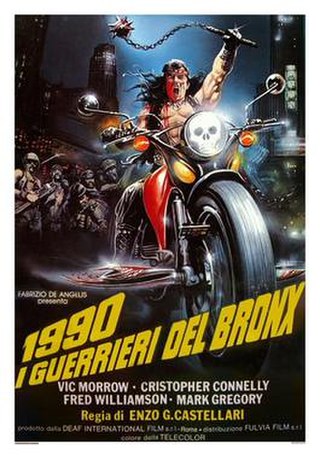
1990: The Bronx Warriors (1982)


What it lacks in originality and coherence, 1990: The Bronx Warriors more than makes up for in energy, glorious cheese, and a pulsing soundtrack.

Like many of the film's contemporaries, there is much in common with other successful genre films, in this case Mad Max 2, The Warriors and especially Escape From New York.

The year is 1990 and the US government has given up trying to police the Bronx, instead sealing the area off and leaving it to the gangs and criminals still there. Meanwhile, Anne, the teenage heiress to a giant arms manufacturing corporation is having some moral questions about her upcoming inheritance, so she runs away to the Bronx to join a biker gang. But the Corporation isn't about to let her go that easily, so enter ruthless, psychopathic mercenary Hammer (played by Vic Morrow), who has orders to get her back by any means necessary.

Although the premise and characters may sound like a none too subtle imitation of Escape from New York, it is not quite as straightforward as that. Carpenter's film paints Snake Pliskin as an anti-authoritarian nihilist, while Hammer is simply a gun for hire, who, by the end, turns into a pantomime villain. Genre stalwarts Fred Williamson and Christopher Connelly (The Atlantis Interceptors) take on the Isaac Hayes and Ernest Borgnine roles as Ogre the gangster and Hot Dog the cabby, the former being more of a Robin Hood figure than an outright villain. Meanwhile the biker gangs are actually the easiest to cheer for, coming across as the little Davids taking on the Goliath that is the Corporation.

Some clever shooting and editing helps cover up the limited resources available to the filmmakers, and there are some nice goofy touches such as the supposedly menacing gang on roller skates (no match for guys on bikes) or the drum solo on the soundtrack that, as the camera pulls back reveals an actual drummer playing away in the middle of some wasteland for reasons best known to himself.

The script has a few head scratching moments but also an energy that stops it from ever getting dull. Essential trash viewing.


1990 The Bronx Warriors b-movie CHEESE 1984 VHS... by uros-mrkonjic

Wednesday, 2 September 2015

Death Wish II (1982)


Despite my hopes of some trashy amoral action packed fun, Death Wish II is a joyless test of the viewer's patience. The star (Charles Bronson) and director (Michael Winner) can do better, certainly in the context of the vigilante genre, as shown in the first film of the franchise.


In the first Death Wish, Paul Kersey (Bronson) hunted down the scummiest scum of New York City, following the murder of his wife and rape of his daughter Carol. Now, several years later, he is working as an architect in Los Angeles, and living with Carol and new girlfriend Geri Nichols (Jill Ireland). After chasing down a gang who stole his wallet, Kersey finds himself followed back to his apartment by his attackers. The gang proceed to beat him unconscious, rape his Mexican housekeeper and kidnap his daughter, who falls to her death trying to escape. For Kersey, that leaves only one course of action - pick up his gun and hunt them down, one scumbag at a time.


The original Death Wish was a slickly made piece of emotional manipulation, which at least kept the viewer interested and tried to provide some justification for Kersey's actions. Here, nobody seems that bothered about putting that much thought into the script, or the direction (making violence boring is an art, but not one to be admired)


The real surprise and disappointment is the star of the film. Bronson, while never in the slightest bit convincing as an architect, is one of the great movie tough guys, with genuine screen presence and charisma, at his best when exuding an impassive and implacable sense of purpose and menace. Here he just looks stiff and dull, a robot going through the motions.


By having the gang made up of scum of different ethnic backgrounds, Winner does go some way to offsetting charges of racism, but there is no getting away from the unpleasant treatment of women. They only exist to be abused by men or to provide reasons for the men to act, although this is not an unusual situation for this genre.


Tuesday, 11 August 2015

First Blood (1982)

First Blood is a good example of how action films should be made. It has a sympathetic lead character, played by a star who is very believable in the role, a talented director, and, perhaps most importantly, a well-structured script. While it is neither overtly a “pro” or “anti” war film, First Blood does have some interesting symbolism in the story that relates to that subject matter.

John Rambo (Sylvester Stallone) is an ex-Green Beret Vietnam veteran, drifting around the US, trying to track down his remaining comrades. A stop in the town of Hope sees him thrown in jail on a vagrancy charge and tortured by the Sheriff's deputies. However, Rambo decides to fight back – but can one man succeed against the town's entire police department, the state police, and the National Guard?

First Blood has a number of assets that raise it above the normal standard for action exploitation films. The script, co-written by Stallone, has its fair share of absurdities and logic lapses, (Rambo's physique looks like he spends his life in the gym not on the road, and a fall from a great height onto jagged rocks leaves him just a few scratches). However, this is not unusual in films where the emphasis is often more on spectacle, and if you simply must have a film with no plot holes or unlikelihood, then maybe action is not the genre for you. What First Blood does have is a tight and well thought out story structure with clear goals for the hero, progression, and sufficient pace to gloss over the absurdities. We learn enough about Rambo, his past and his present to understand and empathise with him before the action kicks in, and when it does, it is relentless, as Rambo breaks free from his captors and turns the tables, taking the fight to them. He is on the enemy's territory, but they are the ones who seem overwhelmed by their environment.

The villains are easy to boo, being the archetypal gun toting small town cops. The two exceptions to this are the fresh faced kid cop Mitch, played by a very young David Caruso and the sheriff, played by Brian Denehhy. The former is torn between wanting to please his peers and be part of the crowd, but also knowing that their behaviour towards Rambo is wrong, and not having the confidence or power to stop it. The latter is not a bad person, (the torture takes place without his knowledge), but instead is somebody who has let their ego and stubbornness lead them into a situation that spirals out of their control.

Aside from the script, the other big asset is the star himself, who switches gears from quiet mumbling to white hot unstoppable physical rage in a completely convincing manner, so that we are caught up in the moment, and overlook some of the more implausible scenarios. The only ally Rambo can turn to is his former commanding officer, Colonel Trautman, played by Richard Crenna, who brings a presence and depth to what could have been a two dimensional grizzled warrior soldier. When faced with his protégé breaking down and sobbing, he looks convincingly uneasy with having to confront the consequences of the sort of dehumanising warrior building that is his life and work. Trautman is a man who can face the worst wartime situations, but cannot handle another man's emotions, and this is conveyed in an understated manner by Crenna, an underrated actor.

Director Ted Kotcheff has had a wildly eclectic career, ranging from episodes of the BBC TV Play for Today series, to the truly disturbing Australian outback exploitation classic Wake in Fright. His talent with cast and camera also goes some way to raising this above a standard action thriller. Kotcheff throws in some almost Expressionist touches, especially out in the woods where the overwhelming landscape and angry flashes of lightning make the scenery almost feel like a character in itself, a foe nearly as hostile as Rambo.

The Vietnam War film is as distinctive a genre as any in modern cinema and the war veteran unable to adjust to civilian life is a similarly distinctive sub-genre within this. If First Blood does have a message, it is that perhaps Governments should take better care of the men and women they send to fight their wars for them. There is certainly no discussion of the rights and wrongs of the Vietnam conflict, politically or morally, and while Rambo resents the anti-war protestors who greeted his return home and called him a “baby killer”, he does not seem to have thought of it as anything more than following orders and doing the job he was trained for.

First Blood is a film steeped in the history and myth of the Vietnam War and as the real life Vietnam veteran William Adams said the war "...is no longer a definite event so much as it is a collective and mobile script in which we continue to scrawl, erase, and rewrite our conflicting and changing view of ourselves."

Whether intentional or not, there are parallels between the events on screen and those of the war that forms the backdrop to them, or, indeed of many wars throughout history. The Sheriff is the one whose poor judgement and bad luck arguably drive Rambo to his violent vengeance. However, others are the ones that pay a price for Teasle's decisions and actions, whether it is his "troops", the deputies who come back maimed or in body bags or the civilians who have to flee for their lives as the town goes up in flames, watching their homes and businesses destroyed.


Tuesday, 29 July 2014

Butcher Baker Nightmare Maker (1982)


The British Government Video Nasties list is as eclectic and perplexing in its make up today as it was 30 years ago. While there are some undisputed and famous classics (Evil Dead, Tenebrae) and some bona fide stinkers (Don't Go Near the Park, Cannibal Terror), there are also some flawed and fascinating gems, such as Butcher Baker Nightmare Maker (aka Nightmare Maker, Night Warning, The Evil Protégé). Despite the flat made-for-TV look, the oppressive atmosphere, transgressive subject matter and flashes of violence make for compulsive viewing

Orphaned as a boy, high school basketball star Billy Lynch (Jimmy McNichol) has been raised by his aunt Cheryl (Susan Tyrell). When Cheryl kills a TV repairman who spurns her advances, bigoted police detective Joe Carlson (Bo Svenson), tries to frame Billy, convinced that the killing was the result of a homosexual love triangle involving Billy's basketball coach. However, Aunt Cheryl has been growing increasingly enamoured with Billy - and she is not going to let him go without a fight.

This is a real stand out both from the Video Nasties list and the slasher film genre more generally. Even though it has some of the ingredients of the latter (knives, blood and teenagers), it also has elements of a teenage coming-of-age story, and hints of Southern Gothic Melodrama. With a few tweaks to the script, toning down the violence and making the sexual subject matter less explicit, you could almost imagine Joan Crawford and Montgomery Clift starring in a version of this story, and certainly Whatever Happened to Baby Jane? and Crawford’s performance in that has to be one of the influences.

Rather than suspense or cheap shocks, the focus here is more on the characters. Genre favourite Svenson plays Detective Carlson as an obnoxious, pig headed, testosterone filled tower of hate, while Tyrell gives a performance so unhinged and disturbing that it is sometimes easy to forget that you are watching a performance.

Against this Billy is always going make a bit less of an impression as a character, but interestingly the script focusses more on the torment that he goes through, both from his harassment at the hands of the law, and harassment at the hands of his aunt, as well as the normal pressures of teenage life.

Butcher Baker Nightmare Maker is also unusual for the genre in the fact that it explores rather than exploits the issue of teenage homosexuality. Granted this is more based around Billy being wrongly thought of as gay, but the bigotry Carlson represents is chilling enough, and anyone who has any experience of growing up in the slightest bit different from the norm in a small town will identify with Billy and his situation.

Director William Asher had a day job making TV shows such as Bewitched, and The Dukes of Hazzard, and it unfortunately shows in the direction that is a bit flat and pedestrian. That said he does create a suitably oppressive gloomy atmosphere that matches the oppressive small town life.

Despite being a lot less gory than other horror films of the time, Butcher Baker Nightmare Maker still ended up labelled a Video Nasty. I can only assume the government looked at the subject matter not the film in this case, but perhaps at least the notoriety has saved it from total obscurity, as it is an unsettling piece of work and well worth a look.


Thursday, 11 April 2013

Halloween 3: Season of the Witch (1982)


Reviewing sequels can pose a problem - should the film be looked at as a standalone piece, or as part of a series? Thankfully, Halloween 3 largely solves this particular problem by ignoring any of the Michael Myers mythology of the previous two (or subsequent seven) entries in the franchise, and what we are left with is a flawed but still interesting film. The delirious tone and subject matter make it feel at times like a modern day suburban fairy tale, and it mixes an X-Files/Kolchak type story with an uncompromisingly cruel streak that touches on an uncomfortable taboo.

When one of his patients is murdered in hospital, Dr Daniel Challis, played by Tom Atkins (Maniac Cop, Night of the Creeps) teams up with the dead man's daughter to investigate. Their search takes them to the mysterious Silver Shamrock toy factory in California, owned by Conal Cochran, played by Dan O'Herlihy (Robocop), a place that also has links to an incessant toy commercial, a sinister child-based pagan ritual, and a certain day of the year.

After Halloween 2, which followed on directly from the events of the first film, John Carpenter expressed an interest in turning the franchise into an annual event, releasing a different film every October 31st, each unrelated beyond the Halloween moniker. This is the first, and, thanks to disappointing box office results, only result of this experiment.

The main criticism that can be levelled at Halloween 3 is the script, which feels messy, and badly constructed. We get some intriguing situations and plot twists, such as a murderer calmly getting into a car and setting himself on fire, but because the main premise of the factory owner's evil scheme feels half thought through, the big revelation at the end is a baffling, and slightly silly let down.

The first draft of the screenplay was written by Quatermass creator Nigel Kneale, but, according to him, was heavily reworked. It certainly lacks the sharp internal logic of the Quatermass stories, where baffling and intriguing premises are set up but clearly explained by the end, and the whole thing feels a lot goofier than anything Kneale ever put his name to. For example, I can see a Stonehenge-type plot element being in the original (Kneale, in the final Quatermass TV serial three years earlier had explored similar themes) but the idea that one of the stones could be transported from Wiltshire to California without anyone noticing is just ridiculous. At the very least, a writer of the calibre of Kneale might have been able to exploit the potential in the storyline to satirise the commercialisation of the Halloween holiday or the small businessman being squeezed out by a big industrial corporation, opportunities overlooked here.

On the plus side, Atkins is great, and completely believable in his role as the macho, hard drinking Dr Challis. He pulls off the same trick he managed in Maniac Cop, that of keeping a straight face in bizarre situations, and bringing a bit of gravitas to some rather silly lines. The rest of the acting is a little more broad, especially the townsfolk and their "oirish" accents. This eventually starts to grate, but is in keeping with the over the top, EC Comics feel of the film. Aside from Challis, there is no real characterisation as such, with people existing largely as elements that provide us with some mystery or exposition before they are bumped off. There is the plenty of portentous dialogue and scenes, so of course, anyone as garrulous and well liked as Cochran MUST be evil.

The oft-repeated Silver Shamrock TV commercial is as catchy as it is irritating but its daily countdown to Halloween takes on more sinister significance as the movie progresses, and provides a deadline that helps crank up the tension. I also could not help but chuckle that a film that centres on an evil corporation using television to destroy the nation's youth was released in the same year that MTV went on the air.

There is no shortage of blood and gore, which puts it closer in tone to the second Halloween film than the original. However, instead of the grim but realistic violence of that first sequel, we get a slightly more fantastic over-the-top approach, with sights such as bugs and snakes pouring out of a skull that has cracked open, and the emphasis here is on the gruesome rather than the suspenseful.

There are some in-jokes for cinema buffs too, some of which work better than others. Repeated TV adverts in the film for the original Halloween, are jarring and distracting, if for no other reason than it reminds us how good the original is. I could do without the "Landis Pet Store" too, with Carpenter presumably following on from Escape from New York, where two minor characters were named Cronenberg and Romero. A more subtle gag is naming the town Santa Mira, the same as in the original Invasion of the Body Snatchers, which also has a small town doctor trying to convince people of a deadly and fantastic threat, and which also has an ambiguous ending.

Not totally successful, mostly due to the script deficiencies, but carried mostly by another great turn by Atkins, and some imaginative twists and turns, and kudos to the filmmakers for at least trying something different.

Halloween 3 was not a smash at the box office, leading to the switch back to the Michael Myers storyline for part 4 onwards. One possible reason for the failure is the lack of Myers, but another thought occurs. The premise is half thought out, but the half that is thought out touches on something of a taboo, that of child murder, and mass child murder at that. Horror films often revolve around murder, and while there is room for debate on some of the issues, such as gender, that arise from this, the murders are usually of adults or, at the youngest, teenagers. If the films do involve children, the norm is for them to be Omen-style evil protagonists. Child murder, or at least the threat of it, is a theme that crops up in literature, particularly Fairy Tales, and even the Bible, but it is tough to think of a great number of films that deal with it, certainly not on the scale proposed by Cochran, almost as if child murder is a taboo that even the most "daring" filmmaker seems reluctant to break.