Horror and Sci-Fi films old and new, weirdo trash, arthouse, forgotten gems, well loved classics, and I'm watching the original Dr Who from the beginning.
Showing posts with label Video Nasty. Show all posts
Friday, 12 August 2016
The Green Inferno (2015)
The Green Inferno harks back to the Italian cannibal films of the 1970s but lacks the truly disturbing edge of the likes of Cannibal Holocaust, as well as their grimy underground feel. In addition the misjudged tone and annoying characters blunt any satirical edge.
Justine (Lorenza Izzo) is a college student and daughter of a UN lawyer. After going to a lecture on female genital mutilation, and meeting hunky rabble-rouser Alejandro, she agrees to sign up his protest trip to take a gang of do-gooders to halt a logging company and their paramilitary security in the Amazon rainforest. It looks like their protest is a success, but after their plane crashes on the return trip, the protesters soon realise that the people they are trying to save would rather have them for dinner.
To his credit, Roth has made a mostly well-structured film in terms of plot, and there are also some brilliant set pieces, not least the plane crash, which is every bit as stomach churning as any gut munching scene.
While the most of the characters exist in order to be bumped off, Roth takes time introduce some tension in the group, particularly through Justine, who finds to her disgust that the crusaders are happy to put her life at risk without asking, banking on her daddy's reputation to avoid her getting killed.
The film also brings the cannibal genre into the twenty first century. For a start, the idea of Westerners flying into a foreign country uninvited with good aims, only to have the natives turn on them still seems topical. The narcissistic campaigners seem as obsessed with getting their work noticed on the internet or planning their next tattoo as with any good they are doing. However Roth seems to lack any ideas as to where to go beyond this, and the constant sneering at the mostly unlikeable characters becomes tiresome, not helped by misjudged scenes about drugs and diarrhoea.
The lush photography is wonderful and is a throwback to more highbrow 70s films such as Herzog's Aguirre, Wrath of God. The cannibals, while portrayed by a real South American tribe, are never shown to be more than obviously outrageous caricatures so I found it hard to get as offended I might have done if I thought Roth was trying to portray anything realistic. But for all the nods to more lowbrow Grindhouse cinema of the same decade like this, The Green Inferno lacks two important elements from these films.
Firstly is unsimulated animal cruelty, something that makes the likes of Cannibal Holocaust uncomfortable viewing even in these jaded times. Incidentally, it is something that Holocaust director Ruggero Deodato seems to regret, having recently completed a special cut of the film that eliminates nearly all of the animal footage, while keeping, it should be noted, nearly all of the human cruelty. Similarly, the focus in The Green Inferno is on the grim and gory fates that befall the cast.
The second hinges on the viewing experience itself. I watched The Green Inferno on a plasma screen TV from a DVD I had bought in a supermarket. I first saw Cannibal Holocaust on a grimy, wonky, third generation dubbed VHS (on a double bill with Cannibal Ferox), borrowed from someone at school who had bought it from an ad in the back of a horror movie mag, with the sound turned down so my parents wouldn’t hear it. Every aspect of this reinforced the feeling that I was watching something truly underground and transgressive, (which also distracted from the problems with the film). Without being able to capture these elements The Green Inferno becomes ultimately, just another horror film.
Eli Roth's The Green Inferno - Official Trailer by FanReviews
Labels:
2015,
Cannibal Holocaust,
Cannibalism,
Colour,
Eli Roth,
Horror,
jungle,
Video Nasty
Friday, 23 October 2015
Cannibal Apocalypse (1980)
Although it might be tempting to lump Cannibal Apocalypse in with similar gut munching genre films from the 70s and 80s it is both different from and much more entertaining than many of these. Director Antonio Margheriti keeps the action moving but also focusses as much on character as on grue, John Saxon creates a sympathetic lead, and the premise has some surprising symbolism about post traumatic stress disorder.
A platoon of US soldiers lands in a Vietnamese village on a search and rescue mission led by Captain Norman Hopper (John Saxon). Hopper finds two POWs trapped in a pit, munching on the flesh of a villager, and as he reaches out to rescue them, one (the distractingly named Charles Bukowski, played by genre legend John Morghen) bites him. Cut to a few years later, back in the US and Bukowski is released from a psychiatric hospital, but he still has a taste for human flesh, a craving caused by a virus contracted in Vietnam. Hopper starts to realise that Bukowski may have passed the virus on to him - and to anyone else that he can get his teeth into.
Margheriti does not skimp on the gore, such as the football sized hole that a shotgun blast leaves in somebody's guts, and it will not be too much of a suprise to hear that this film made the British Government's infamous Video Nasty list in the 1980s. Nevrtheless, Cannibal Apocalypse has several elements that lift the film above the more grim, cheerless and tiresome horror efforts that were also being made at the time.
Firstly the script is both straightforward and fast moving, and gives John Saxon the opportunity to build a likeable and sympathetic leading character, an every-man thrust into a bizarre situation that gradually slips out of his control.
The polar opposite of Hopper is his former comrade-in-arms Bukowski. He is brilliantly played by Morghen, an actor who seems here as in the likes of Cannibal Ferox and House on the Edge of the Park, to be typecast as some of the most grubby and unwholesome characters in cinema history.
The most fascinating part of the film is the symbolism of the virus that causes them to turn to flesheating. Unlike the zombies or cannibals of other contemporary horror films, these characters do not become mindless killers, but, although slaves to their new appetites, remain seemingly sentient, more like high functioning addicts. Another interpretation stems from where the characters originally contracted the virus, their wartime experiences. This, like Post-traumatic stress disorder, is something that they bring back to civilian life, and, like PTSD, can sit dormant for years, but if untreated, eventually begins to have a detrimental effect on the veterans, as well as their families and friends, and, eventually, their fellow citizens.
One accusation that could be placed at both Vietnam and Cannibal genre films is racism. The North American or European protagonists are, even if cruel and degenerate, still the "normal" people that the audience relate to, and the Vietnamese / Cannibals are savage, exotic, mysterious and "foreign", even if the action takes place for in their own country. Cannibal Apocalypse overcomes these by placing most of the action in urban America, and making the Americans the cannibals. The flesheating is never implied to be a part of Vietnamese culture, just something that the war has driven the Americans to acting out.
Of course there are some of the usual things present in low budget exploitation filmmaking, such as clunky dialogue, underwritten supporting characters and badly matched stock footage, but none of this detracts from a distinctive, and unsettling slice of 80s horror.
Labels:
1980,
Cannibalism,
John Saxon,
Video Nasty,
Vietnam,
Vietnam War
Tuesday, 29 July 2014
Butcher Baker Nightmare Maker (1982)
The British
Government Video Nasties list is as eclectic and perplexing in its make up
today as it was 30 years ago. While there are some undisputed and famous classics (Evil Dead,
Tenebrae) and some bona fide stinkers (Don't Go Near the Park, Cannibal
Terror), there are also some flawed and fascinating gems, such as Butcher Baker
Nightmare Maker (aka Nightmare Maker, Night Warning, The Evil Protégé). Despite
the flat made-for-TV look, the oppressive atmosphere, transgressive subject
matter and flashes of violence make for compulsive viewing
Orphaned as a
boy, high school basketball star Billy Lynch (Jimmy McNichol) has been raised
by his aunt Cheryl (Susan Tyrell). When Cheryl kills a TV repairman who spurns
her advances, bigoted police detective Joe Carlson (Bo Svenson), tries to frame
Billy, convinced that the killing was the result of a homosexual love triangle
involving Billy's basketball coach. However, Aunt Cheryl has been growing
increasingly enamoured with Billy - and she is not going to let him go without
a fight.
This is a real
stand out both from the Video Nasties list and the slasher film genre more
generally. Even though it has some of the ingredients of the latter (knives,
blood and teenagers), it also has elements of a teenage coming-of-age story,
and hints of Southern Gothic Melodrama. With a few tweaks to the script, toning
down the violence and making the sexual subject matter less explicit, you could
almost imagine Joan Crawford and Montgomery Clift starring in a version of this
story, and certainly Whatever Happened to Baby Jane? and Crawford’s
performance in that has to be one of the influences.
Rather than suspense
or cheap shocks, the focus here is more on the characters. Genre favourite
Svenson plays Detective Carlson as an obnoxious, pig headed, testosterone
filled tower of hate, while Tyrell gives a performance so unhinged and
disturbing that it is sometimes easy to forget that you are watching a
performance.
Against this Billy
is always going make a bit less of an impression as a character, but
interestingly the script focusses more on the torment that he goes through,
both from his harassment at the hands of the law, and harassment at the hands
of his aunt, as well as the normal pressures of teenage life.
Butcher Baker
Nightmare Maker is also unusual for the genre in the fact that it explores
rather than exploits the issue of teenage homosexuality. Granted this is more
based around Billy being wrongly thought of as gay, but the bigotry Carlson represents
is chilling enough, and anyone who has any experience of growing up in the
slightest bit different from the norm in a small town will identify with Billy
and his situation.
Director William
Asher had a day job making TV shows such as Bewitched, and The Dukes of
Hazzard, and it unfortunately shows in the direction that is a bit flat and
pedestrian. That said he does create a suitably oppressive gloomy atmosphere
that matches the oppressive small town life.
Despite being a
lot less gory than other horror films of the time, Butcher Baker Nightmare
Maker still ended up labelled a Video Nasty. I can only assume the government
looked at the subject matter not the film in this case, but perhaps at least
the notoriety has saved it from total obscurity, as
it is an unsettling piece of work and well worth a look.
Labels:
1982,
Colour,
homophobia,
Horror,
incest,
slasher,
Video Nasty
Friday, 11 July 2014
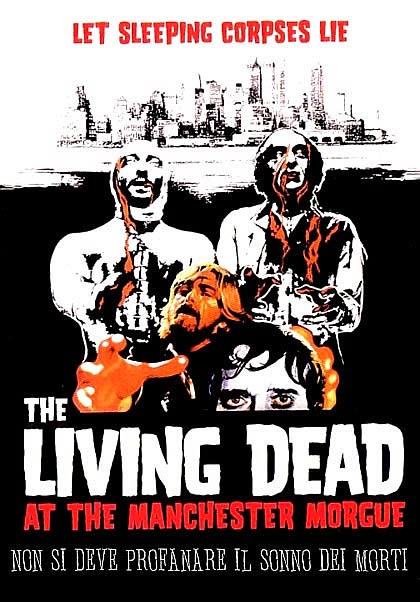
The Living Dead at Manchester Morgue (1974)
The Living Dead at Manchester Morgue may have
a Spanish director and largely Italian cast and crew, but the settings and
wonderfully creepy atmosphere put it closer to English horror films and TV
shows of the same time. In addition, buried in the slightly schlocky script are
some interesting themes about the abuse of power and abuse of the environment.
George (Ray Lovelock) is taking a break
from his Manchester antique shop to meet up with friends in the scenic beauty
of the Lake District. When Edna (Christina Galbo) accidentally trashes his
motorbike, she offers to drive him to his destination. After getting lost,
George comes across a remote farm where government scientists are trying a new
form of pest control, using ultrasonic radiation, while a lumbering mad man who
emerges from a river attacks Edna. Are the two things connected? Moreover, as
more and more residents of the local churchyard rise to attack them, can George
and Edna get to safety and stop the source of the zombies?
The story is in the realm of George Romero
zombie films, with its non-supernatural premise and contemporary setting, as
well as scenes of people being stalked in a cemetery and barricaded inside a
building. However, unlike Romero's zombie films, Grau makes the reason the dead
are coming back to life a central part of the story and the search for the
cause of the zombies, and the efforts to get that cause shut down do provide a
good “McGuffin”, making for a slightly more coherent and plot heavy film than
others of the era. However, this is unnecessarily muddied by throwing in
further plot points in order to bring in to get the requisite gore. We are told
that the ultrasonic machine excites primitive nervous systems, hence the dead
come back to life and attack anything that moves, but about half way through
the film, they start to eat the flesh and organs of their victims. Then we get
an unsatisfactory explanation about the zombies using the blood of the living
to bring others to life for some unspecified reason. There are also some
baffling lapses in logic at times (how does the fire in the church put itself
out? If the ultrasonic radiation has a range of 1 mile, why are the scientists
pointing a machine at a small spot on the ground?)
The main characters a little one
dimensional, as is often the case in these sorts of films, and George's “Gor
Blimey” accent soon gets a bit grating, while Edna seems to serve little
purpose other than screaming and being rescued. The police sergeant also seems
both clichéd, with his gruff and loud manner, Irish accent and trench coat, and
wildly out of place in the Lake District. Of more interest, are her sister,
Katie and Katie's husband Martin, with dark hints at the relationship they
have, a junkie being exploited and abused by a manipulative pervert. While it
might have been worth developing that story further, it may have proved to be
too much of a distraction from the core plotline.
However, these minor niggles are more than
made up for by the films strengths, such as the excellent gory make up, with
some nice details such as stitches on the chest of one walking corpse. This film first came to my attention as part
of the British Government's notorious "video nasty" list, and while
it does not skimp on the gore, the real success comes from the creepy
atmospherics. Director Jorge Grau shows genuine talent and imagination in
places, with some prowling, restless camerawork, giving a palpable sense of
unease at times. Setting the film not only in England, but, just as
importantly, far outside of London is a stroke of genius. The hills and valleys
of the countryside, along with tropes such as the 1970s haircuts, the cheap
looking ultrasonic machine, the pseudoscientific dialogue and white antiseptic
hospital make me think of British sci-fi and horror such as Dr Who, Quatermass,
Hammer House of Horror, and Doomwatch. Sound design plays a large part in this
sense of unease, with throbbing bleeping machine sounds throughout.
Despite some, at times, slightly silly plot
elements, Living Dead at Manchester Morgue has some interesting and intelligent
things going on thematically. I would not pretend for one minute that this film
is a preachy “message” film, but it was made not long after the rise of Greenpeace
and Friends of the Earth, so may have been the case of exploitation filmmakers
responding to what their audience would be seeing in the news. Nevertheless, the
environmental undertones are there within the opening credits montage, and as
George heads out of the city, we see industrial wasteland, dead wildlife, power
stations belching smoke into the sky, and a population who already look like
dead-eyed zombies.
Beyond that, rather than go for a
straightforward "progressive v reactionary" subtext, the scenario
presented is more complex. On the one hand, we have the aggressive and
high-handed side of science and on the other we have a reactionary almost
fascistic section of society, as represented by the police sergeant with his
disgust at "long hair and faggot clothes" and "permissive
rot", and his wish that the police could have "a free hand". The
former causes the problem through arrogance, the latter fails to solve it
through a blinkered and bigoted worldview, and caught in the middle, is George,
who, despite his hippy appearance, is seemingly not engaged with subversive
political or social activity. He carries pagan antiques that the police assume
are for satanic rituals, but are in fact purely for business. Nobody in
authority listens so nothing is learnt and the, perhaps unlikely, combination
of progressive and reactionary thinking actually prevents the problem being
solved.
Labels:
1974,
British,
Colour,
Horror,
Italian,
Manchester,
Spanish,
Video Nasty,
Zombies
Subscribe to:
Posts (Atom)