Horror and Sci-Fi films old and new, weirdo trash, arthouse, forgotten gems, well loved classics, and I'm watching the original Dr Who from the beginning.
The Plan 9 from Outer Space of 80s British slasher movies, Bloody New Year can be called many things, but it can never be called dull.
After fleeing a menacing gang of gypsy bikers at a funfair, a group of teenagers/ young adults find themselves trapped on an island. Taking refuge in a hotel, they find it seemingly abandoned, and untouched since the New Year’s celebrations of 1959. But is it abandoned? Why do the group start disappearing one by one? And what are people from the past doing in the present?
Clearly made on a low budget, with little time or money for retakes, special effects or discussions on character motivation, it would be all too easy to sneer at a film like this. I suspect it is likely that director Norman J Warren had to contend with interfering producers insisting on seeing "scenes where X happens, like in Y film", hence at times the film is obviously aping the likes of The Evil Dead, Lamerbero Bava's Demons or the likes of Lucio Fulci's more delirious and disjointed zombie films. Sure the acting is lousy, the situations the characters find themselves in baffling, and their lack of reaction doubly so, and the end result is never going to knock Citizen Kane off the BFI best film list. There is an interesting idea buried somewhere in the film, involving a government time travel experiment gone wrong, an idea that, properly developed, would have lifted the film beyond a standard slasher.
However, fortunately, what we get instead, while goofy and incoherent has enough energy to be always fun, and never boring, thanks to the sheer audacity of some of the twists and turns of the story. Do not attempt to make sense of things, just sit back and enjoy the ride. Bloody New Yearby FLIXUMovies
Despite the painfully lurid title, I Walked with a Zombie is not a horror film, but an unsettling melodrama with lashings of ambiguity and ambience.
Betsy Connell (Frances Dee) is a nurse, sent to Haiti to care for Jessica (Christine Gordon), the wife of sugar plantation manager Paul Holland (Tom Conway). Jessica, always seems to wandering around in a silent stupor, and the Voodoo practising natives think she is a zombie. But is there something more to it than that? Something that involves Paul's missionary mother and his jealous alcoholic half-brother Wesley?
This was the second collaboration between French director Jacques Tourneur and RKO producer Val Lewton, following their box office smash Cat People. Both films share a visual palette steeped in shadows, a plot steeped in ambiguity and uncertainty, and a shocking advertising campaign from the studio.
However, unlike Cat People there are no jumps or shocks, as Tourneur prefers a slow burning atmosphere of creeping dread. The world of this film is one of unresolved conflicts and contrasts - light and dark, Caribbean Voodoo and Western Christianity, science and superstition, slavery and freedom, none of which are ultimately resolved.
The script is the other strong point for this film, with characters that are not as straightforward as they first appear, and a refusal to provide any easy answers. It is also refreshing to see our zombies were originally presented on screen, a world away from the flesh eating, rotten corpses we are used to nowadays.
For many people, Plan 9 From Outer Space is the gateway drug to the world of bad movies, and it was certainly the case for me. Writer/Director Ed Wood Jr can be accused of many things in terms of deficiencies of plot, characterisation and special effects, but there is no way you can call his work boring. While on a routine flight airline pilot Jeff Trent (Gregory Walcott) and his co-pilot Danny are surprised by a bright light and loud sound, and are shocked to see a flying saucer. The saucer lands at a cemetery, where a number of suspicious deaths have taken place. It turns out aliens are hiding out there, carrying out their fiendish plan to take over the world: reanimating the dead, otherwise known as Plan 9 From Outer Space. The basic elements of the story, mad scientists, atomic power, alien invasions, zombies (albeit the pre-Romero, non contagious, non-flesheating kind) are not unfamiliar in the genre films of the time. In the hands of another film-maker, what could have resulted is the sort of pleasant but forgettable film that so many others were churning out at that time. Thankfully the job was turned over to Ed Wood, a man whose enthusiasm for movies was only matched by his enthusiasm for vodka. This meant that his scripts were bursting with ideas, and while he was not always the best at shaping these into a coherent whole, they have an anarchic energy and anything-can-happen atmosphere, coupled with dialogue that veers between the drearily banal and the outrageously surreal.
There are so many other points of interest along the way, from the health and safety loving police sergeant who insists on punctuating every line of dialogue by pointing at things with his gun, the Styrofoam Gravestones, the outrageously camp chief alien, and the heroic disregard for continuity, especially in terms of what time of day it is. The star of the film, Bela Lugosi died a few days into shooting, the sort of event that would have crushed a lesser man than Ed Wood. Instead, he simply carried on, getting his wife's chiropractor to play the Lugosi role with his cape over his face so that we can't see the difference, even though he is at least a foot taller than Lugosi. When I first saw this, back in the early 1990s the consensus was that this was something silly and terrible, something to be sneered at. Nowadays, I feel nothing but admiration for Wood. Granted his film-making skills are not up there with the best, but his enthusiasm and tenacity shines through in the movies, The surfeit of ideas means the film never gets dull and stands up to repeat viewings.
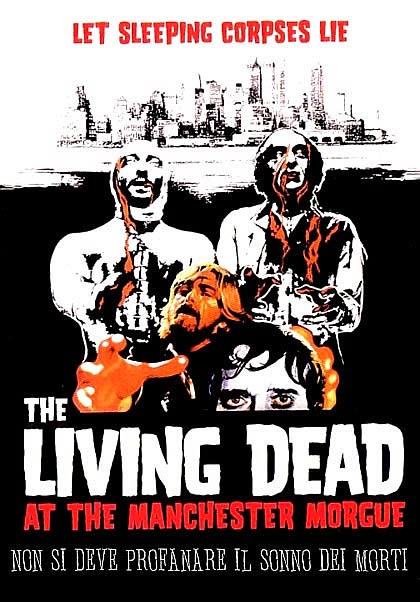
The Living Dead at Manchester Morgue may have
a Spanish director and largely Italian cast and crew, but the settings and
wonderfully creepy atmosphere put it closer to English horror films and TV
shows of the same time. In addition, buried in the slightly schlocky script are
some interesting themes about the abuse of power and abuse of the environment.
George (Ray Lovelock) is taking a break
from his Manchester antique shop to meet up with friends in the scenic beauty
of the Lake District. When Edna (Christina Galbo) accidentally trashes his
motorbike, she offers to drive him to his destination. After getting lost,
George comes across a remote farm where government scientists are trying a new
form of pest control, using ultrasonic radiation, while a lumbering mad man who
emerges from a river attacks Edna. Are the two things connected? Moreover, as
more and more residents of the local churchyard rise to attack them, can George
and Edna get to safety and stop the source of the zombies?
The story is in the realm of George Romero
zombie films, with its non-supernatural premise and contemporary setting, as
well as scenes of people being stalked in a cemetery and barricaded inside a
building. However, unlike Romero's zombie films, Grau makes the reason the dead
are coming back to life a central part of the story and the search for the
cause of the zombies, and the efforts to get that cause shut down do provide a
good “McGuffin”, making for a slightly more coherent and plot heavy film than
others of the era. However, this is unnecessarily muddied by throwing in
further plot points in order to bring in to get the requisite gore. We are told
that the ultrasonic machine excites primitive nervous systems, hence the dead
come back to life and attack anything that moves, but about half way through
the film, they start to eat the flesh and organs of their victims. Then we get
an unsatisfactory explanation about the zombies using the blood of the living
to bring others to life for some unspecified reason. There are also some
baffling lapses in logic at times (how does the fire in the church put itself
out? If the ultrasonic radiation has a range of 1 mile, why are the scientists
pointing a machine at a small spot on the ground?)
The main characters a little one
dimensional, as is often the case in these sorts of films, and George's “Gor
Blimey” accent soon gets a bit grating, while Edna seems to serve little
purpose other than screaming and being rescued. The police sergeant also seems
both clichéd, with his gruff and loud manner, Irish accent and trench coat, and
wildly out of place in the Lake District. Of more interest, are her sister,
Katie and Katie's husband Martin, with dark hints at the relationship they
have, a junkie being exploited and abused by a manipulative pervert. While it
might have been worth developing that story further, it may have proved to be
too much of a distraction from the core plotline.
However, these minor niggles are more than
made up for by the films strengths, such as the excellent gory make up, with
some nice details such as stitches on the chest of one walking corpse. This film first came to my attention as part
of the British Government's notorious "video nasty" list, and while
it does not skimp on the gore, the real success comes from the creepy
atmospherics. Director Jorge Grau shows genuine talent and imagination in
places, with some prowling, restless camerawork, giving a palpable sense of
unease at times. Setting the film not only in England, but, just as
importantly, far outside of London is a stroke of genius. The hills and valleys
of the countryside, along with tropes such as the 1970s haircuts, the cheap
looking ultrasonic machine, the pseudoscientific dialogue and white antiseptic
hospital make me think of British sci-fi and horror such as Dr Who, Quatermass,
Hammer House of Horror, and Doomwatch. Sound design plays a large part in this
sense of unease, with throbbing bleeping machine sounds throughout.
Despite some, at times, slightly silly plot
elements, Living Dead at Manchester Morgue has some interesting and intelligent
things going on thematically. I would not pretend for one minute that this film
is a preachy “message” film, but it was made not long after the rise of Greenpeace
and Friends of the Earth, so may have been the case of exploitation filmmakers
responding to what their audience would be seeing in the news. Nevertheless, the
environmental undertones are there within the opening credits montage, and as
George heads out of the city, we see industrial wasteland, dead wildlife, power
stations belching smoke into the sky, and a population who already look like
dead-eyed zombies.
Beyond that, rather than go for a
straightforward "progressive v reactionary" subtext, the scenario
presented is more complex. On the one hand, we have the aggressive and
high-handed side of science and on the other we have a reactionary almost
fascistic section of society, as represented by the police sergeant with his
disgust at "long hair and faggot clothes" and "permissive
rot", and his wish that the police could have "a free hand". The
former causes the problem through arrogance, the latter fails to solve it
through a blinkered and bigoted worldview, and caught in the middle, is George,
who, despite his hippy appearance, is seemingly not engaged with subversive
political or social activity. He carries pagan antiques that the police assume
are for satanic rituals, but are in fact purely for business. Nobody in
authority listens so nothing is learnt and the, perhaps unlikely, combination
of progressive and reactionary thinking actually prevents the problem being
solved.
With so many
zombie films hitting screens over the last few years, to stand out from the
crowd nowadays, you really need a gimmick. Rushed into production to cash in on
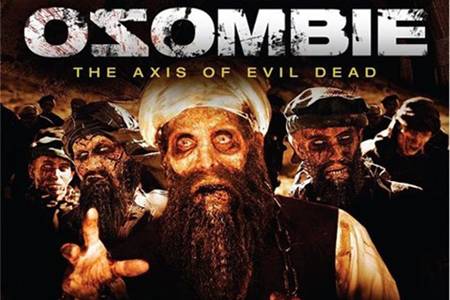
the death of Osama Bin Laden at the hands of the US Military, Osombie has an
intriguingly offbeat and poor taste premise, but the script, the actors and the
special effects are not up to fleshing this out into an entertaining full
length feature, and the end result is surprisingly boring.
The action kicks
off with US Special Forces storming Bin Laden's secret hideout in Pakistan to
capture or kill him, and coming up against a horde of walking corpses, a result
of Bin Laden’s experiments with weird chemicals that bring the deceased back to
life. He is shot dead, but one of the troops is bitten and starts to turn into
a zombie on the helicopter ride home and in a moment of panic Bin Laden’s
corpse falls in to the sea. Cut to another band of troops, a few months later, and
this time in Afghanistan, trying to find the source of a spate of zombies
springing up in the country. Can they stop the spread of the undead before it
threatens the whole world? Moreover, is Bin Laden not as dead as it was
thought?
The first major
fault lies with the script, which fails to back up a great film pitch with a
decent story or characters. The quest for somebody or something is one of the
classic storytelling archetypes, so you would think that the hunt for the
undead version of Osama Bin Laden surely has story telling potential, but the
film takes up too much time with repetitive and grating scenes of the soldiers
shooting zombies. These scenes are not scary or suspenseful, as a horde of
zombies is usually a dozen at the most, and with them being out in the middle
of the desert, the zombies can be seen from some distance, reducing the
potential for sudden scares. Not that this stops the dumb gung-ho troops, who
happily wade into close combat and then are amazed when they are bitten and
infected. Moreover, as if the film has to fill some kind of cliché quota, we
get a pointless training montage, and even a shot of somebody running in slow
motion shouting "NOOOOOOOOOOOOO"
When they are not
killing or being killed our heroes are badly delivering crappy jokes and dull
dialogue, and when the director tries to switch gears and go for some emotional
resonance, the lines are said in the same flat manner as the humour and
exposition, and make just as little impact. The villains are just as cartoonish
and two-dimensional as the soldiers are, all wearing the standard beard and
turban uniform, and every other line of (subtitled) dialogue contains the words
God, Allah or infidels.
Some poor quality
effects compound the script and acting problems. CGI has become a useful tool
for filmmakers to achieve results on screen that belie a low budget, such as in
the recent Iron Sky, but here it is used to generate both blood and bullet
squibs. Unfortunately, they are poorly rendered and rather obviously from a
computer, which makes the constant use of a blood splatter on the 'camera lens'
throughout the film, baffling and irritating.
The makeup is competent,
nothing particularly new or innovative, just the typical contemporary movie
zombie look. This seems to be in keeping with a wider desire by the makers to
keep everything very familiar for fans of the genre, and much of the standard
undead mythology is adhered to, such as a bite from a zombie causing infection,
and needing a bullet in the head being to kill one.
Considering the
title of the film, there is one character that is sorely underused, as the
Osombie only really appears in the closing few minutes and on-screen or off, he
presents nothing in the way of threat or menace. There is also a missed opportunity
with some interesting symbolism that is never explored (maybe religious
extremism is spreading like a virus?) and what could be a funny fake trailer or
a South Park episode is badly stretched out to leave a horror-comedy lacking in
scares or laughs.
The walking dead have long been used as a way for writers and directors
to make comments on contemporary society and culture, from Hammer's Plague of the Zombies (1966), with the exploited undead being forced to work the tin mines, to George A. Romero's Dawn of the Dead (1978), where people rise from their graves – and head straight for the shopping mall. Dead Set,
a five-episode television series that aired over consecutive nights on
British satellite channel E4, uses its zombies to explore the reality
television phenomenon. However, rather than doing this through clunky
heavy-handed dialogue, the satirical elements are contained in some
rather more subtle symbolism.
The
zombie film is a virus that has truly gone global, and joining recent efforts
from the likes of Spain (REC) and Africa (The Dead) is Juan of the Dead, the
first one ever to be made in Cuba. The basic plot may sound a little familiar,
but with a combination of some creative and brilliantly executed set pieces,
and a jet black sense of humour it is a fresh, funny and surprisingly poignant
addition to the genre.
Juan
is a 40-something layabout, whose days consist of petty crime, fishing, and
swigging rum, aided and abetted by his best friend Lazaro. But when a
mysterious virus sweeps across Cuba, turning the residents into flesh eating
zombies, Juan must turn into a hero, and lead his friends and estranged
daughter to safety - and make a few pesos at the same time.
The
most obvious influence for this film is, not surprisingly given the name, Edgar
Wright and Simon Pegg's Shaun of the Dead.Both films have as main characters a lazy but well meaning man and his
slob friend; both have a plot that revolves around a zombie apocalypse in their
home town; and both are blessed with a director who can deftly blend laughs,
shocks and gore - but there the similarities end. Juan is much more of an
anti-hero than Shaun, as illustrated by his response to the zombie outbreak:
after a lifetime of hustling, his first thought is "How can I profit from
this?". The answer - his own Ghostbusters style zombie-killing service,
Juan of the Dead (with it's refreshingly direct motto: "We kill your
beloved ones"), and he and his friends take to the streets of Havana,
armed to the teeth with clubs, machetes and throwing stars.
Despite
being extremely gory, "Juan of the Dead" is primarily a comedy, with
the humour coming from a mix of sources. Firstly the crude, scatological banter
between the characters, particularly between Juan and Lazaro. Secondly, the
gore itself, which comes from Monty Python style sight gags, juxtaposing blood
and guts with comic situations, and, in some cases, taking aspects of Zombie
mythology, (for example, having to damage their brains in order to properly
kill them) to their logical extreme, such as in an hilarious descent in a lift
with the dismembered top half of an elderly neighbour.Thirdly there are some pointed digs at the
Cuban government, a regime not usually noted for taking constructive criticism
from it's citizens. The powers-that-be are shown as being unable to deal with
the zombie outbreak, and their only answer is to use the state-run TV news to
blame the deaths on "American dissidents" and blithely proclaim that
everything is okay. In addition, the film-makers do not paint a very flattering
picture of Havana itself, with the air of inertia and decay shown in every
aspect of both the city and people before the zombies make an appearance.
Interestingly,
the script does not get bogged down in explaining a great deal of zombie
mythology, which maybe a sign that the undead are a large enough presence in
popular culture that sufficient numbers of people are familiar with the rules
of the genre. In addition, just like George Romero's classic Zombie trilogy
(and more recent efforts like "Shaun...") hardly any time is spent
discussing what is causing the zombie outbreak, the focus being pretty much
entirely on the characters and their fight for survival in the here and now.
Everyone manages to get themselves into increasingly hair-raising and ingenious
scrapes, and out of them in similarly ingenious manners, and even if some of
them seem a little too convenient in retrospect, at the time it's such an exhilarating
ride, you barely notice. Within that, there is still space for a certain amount
of characterisation, as Juan tries to make amends for the way he abandoned his
now grown up daughter, and is faced with a horrible choice regarding Lazaro.
Touches like this mean that, while the people on screen are by no means fully
rounded three dimensional characters, they are still people that you grow to
like, and, despite their flaws, to care about, making the final scene more
touching than might otherwise be expected.