Horror and Sci-Fi films old and new, weirdo trash, arthouse, forgotten gems, well loved classics, and I'm watching the original Dr Who from the beginning.
Excision is an intriguing and disturbing mix of teen angst, suburban tension, and Cronenberg style body horror. Pauline (Annalynne McCord) is a teenage outcast, obsessed with surgery and losing her virginity, a combination that leads to some erotic and gory dreams. The interest in medicine is not entirely morbid, as Pauline wants to cure her younger sister Grace, who has cystic fibrosis. This is an excellent, assured debut from writer/director Richard Bates, Jr, who keeps the pace restrained and the gore unhinged. Some scenes are reminiscent of David Lynch, with the juxtaposition of suburban banality and gross disturbing imagery. Pauline is a great character, a mix of unashamed assertiveness and manipulation, and an disturbing innocence. There's an first-class supporting cast with Traci Lords as Pauline's uptight religious mother, locked in a permanent power struggle with her wayward daughter and cameos from Malcolm McDowell and John Waters as Pauline's maths teacher and priest respectively.
As enjoyable as it is inconsequential, To Rome With Love could perhaps have done with a second draft of the script, but Woody Allen turns out a pleasant and enjoyable piece of fluff.
The script cuts between four unconnected stories; an office worker who suddenly becomes a celebrity for no discernible reason; an architecture student who finds himself attracted to his girlfriend's actress friend; a young couple whose honeymoon turns into a farce involving a burglar and a prostitute; and an American Opera director who thinks he may have found his next big star - although there is one small but potentially serious catch.
The script has some of the problems that Woody Allen films all seem to have to some extent nowadays. The characters are two dimensional, and half of them are the standard issue American middle class liberal intellectuals, while the script feels under thought out and overwritten at times. However, with the stories being so slight, Allen is probably right not to try and stretch any of them further than he does.
The segments do all have differing styles, from farce to surreal comedy to more standard Allen territory of neurotic white men worrying about relationships, the contrast helping to keep things fresh. The best story is the one starring Allen himself as an Opera director visiting his daughter and her fiancée in Rome. The fiancée's father has the sort of tenor voice that should be on the stage - but he seems to have trouble performing outside of the privacy of his shower. The payoff to this takes the film into the kind of magical realism that Allen touches on every now and then, and as long as you can buy into it, it is hilarious.
As usual Allen seems to be able to scare up A-List celebrities at will, with regulars such Alec Baldwin, Penelope Cruz and Judy Davis, as well as Jesse Eisenberg trying out his Woody Allen impression.
The film looks great too, with Allen taking great care to show Rome off in a very flattering light.
When
Monty Python’s Flying Circus took the stage in London earlier this year, they
were one member short. Graham Chapman, the hedonist, reformed alcoholic, pipe
smoking, qualified medical doctor had passed away from cancer in 1989. Three
years before that he had recorded himself readings extracts from his only
telling of his life story, “A Liar’s Autobiography”, and it is these that form
the basis of the film of the same name. However, the animated visuals that
accompany the soundtrack rarely do justice to the words, and the sloppy overall
tone soon becomes irritating.
Along
the way learn something of his life, growing up in the Midlands with a
no-nonsense policeman dad, studying medicine at Cambridge, meeting John Cleese,
breaking into the world of television, coming out as an openly gay man, fame
with Monty Python, 70s hedonism with rock star pals in LA, and a last few years
of sobriety. We also learn a little of his character, his interest in and
knowledge of science and medicine making a perfect contradictory counterpoint
to his surreal outlook on life and hedonistic, staggeringly unhealthy
lifestyle.
However,
it soon becomes apparent that we are learning all of this purely from listening
to Chapman talk, with the visuals at best adding nothing, and worst becoming
distracting and grating. This is not to say that individual bits are not
without merit, such as an astonishing sequence involving fighter pilots
becoming overwhelmed with lust for each other, which plays like something from
a William Burroughs novel. Far from being gratuitous, the scene links together
several strands of Chapman's character and past, such as growing up during,
World War Two, reading the stiff upper lip exploits of fictional hero fighter
pilot Biggles, his sexuality, and his rugged macho image and interests, such as
rugby, and mountain climbing. The credits list over a dozen different animation
studios and while this may have been an attempt to capture the anarchy and
randomness that Chapman brought to his work, the combined result feels like a
tiresome mess.
Sadly
having four of the five remaining Pythons (Eric Idle is the only one not involved) to voice the characters in the life
of Chapman adds little to the film. Instead of creating characters, they mostly
sound like they are halfheartedly reading lines of a piece of paper that has
just been handed to them, while the use of Cameron Diaz as the voice of Sigmund
Freud is just pointless stunt casting
So,
what is the point of this film? Fair enough, the directors did not want to do a
straightforward biography, and certainly, Chapman did not with his book. The
stories may be largely untrue, but you can still learn plenty about people from
tall tales. Beyond a brief mention of watching Peter Cook and Jonathan Miller
perform Beyond the Fringe on television, the film does not explore any of the
roots of Chapman's comedy, such as BBC Radio comedy like The Goon Show. There
is also little mention of his long-term partner David Sherlock, who stuck with
him through the darkest days of boozing, right through to the end of Chapman’s life.
Python fans will not learn anything new, and non-fans just will not learn
anything much.
The feature
length debut from writer/director Brandon Cronenberg, Antiviral is a cold,
creepy mix of satire and body horror, set in a world where people do not just
want to get under the skin of celebrities, they want to get the celebrities under
their skin.
Caleb Landry Jones plays Syd March, a worker at a clinic that takes live
viruses from ill celebrities and sells them to obsessed fans. He also has a
lucrative sideline selling pirate samples, smuggling them out in his own body.
When Syd becomes infected with a disease that kills super star Hannah Geist, he
must solve the mystery surrounding her death before he succumbs next.
Brandon Cronenberg is theson of "body horror" pioneer David, so comparisons are inevitable and perhaps unavoidable,
but given the subject matter and the execution, these would arise anyway, no
matter who was behind the camera. Some of the tropes, such as the morally
dubious corporation, body modification, and the lone man getting into a
situation way out of his depth, will be familiar from earlier films of
Cronenberg Sr., such as Videodrome and Shivers (as well as from the writings of
William Burroughs, a big influence on David). In addition, like those films,
the story moves at a slow, deliberate pace, with the emphasis is on the exploration
of ideas rather than characters, or heavy handed moralising.
However, Antiviral is by no means a slavish copy of any of these, with a style
and contemporary look of its own, which contrasts with the grungy feel and
slightly lurid, exploitation movie trappings of a film like Shivers. The sleek
white offices of the Lucas Clinic, with smiling receptionists and plasma screen
TVs pumping out a constant information dense stream of news, feel like the
headquarters of any large corporation anywhere in the world today, while the
recognisable contemporary urban landscapes help root the more outrageous ideas
in reality.
There are also
some recurring motifs in the camerawork, especially the handheld, over the
shoulder shot, which crops up repeatedly, and made me think of a paparazzi
stalking it’s prey.
The piracy
storyline gives the film a very contemporary feel, but also with an outrageous
twist, that sees the pirated cells used by a delicatessen to create the
ultimate in celebrity tie-in merchandise. Special mention must also go to the
soundtrack by E.C. Woodley, a mix of glacial cold glacial strings and throbbing
synths.
The lack of sympathetic, fully rounded characters and the detached,
intellectual approach to the subject matter will mean Antiviral is not for everyone, but it is a
fascinating debut, and leaves me intrigued as to where Cronenberg will go next
with his career.
All works of art
should be open to interpretation and debate, but how important is it to be able pin
down a definitive meaning? Moreover, to what extent do we have the right to say
what an artist’s intentions were? The fascinating and compelling documentary Room
237 explores these issues via some weird and wonderful theories about Stanley
Kubrick's The Shining, from supposed Holocaust symbolism to the seemingly
impossible geography of the Overlook Hotel.
Director Rodney Ascher takes the decision to let the people with the ideas
talk without interruption, and let the audience make up their own minds. Keeping
the interviewees all off camera, the screen is instead filled with a mix of
images, mostly from The Shining, (although there is miscellaneous stock
footage, and scenes of people sat in a cinema, taken from Lamberto Bava’s
Demons), which have been re-cut, played backwards and forward, with certain scenes looped, and
certain images emphasised. For anyone who has seen the film several times, this
makes for a slightly disorientating experience, watching familiar source
material in a completely new context.
Some of the speakers make interesting points regarding the layout of the hotel
or the blatant continuity errors, but seem happy to conclude that, if they are
deliberate errors, their primary function is to disorientate the viewer and add
to the feeling of the world of The Shining being an unreal one.
However, the words of those that claim to see a coherent and definitive layer
of symbolism in The Shining quickly start to sound like the kind of poorly
constructed arguments that float around things like the September 11th attacks.
The proponents often start by fixating on one element (A German typewriter/The
collapse of the Towers), blend elements of the real (footage from the film/footage
from news broadcasts) with the fictional or speculative (Kubrick wanted to
highlight the /the US Government demolished the Twin Towers, or maybe the Jews
did it), and the latter is used to as the context to interpret the former.
The "Moon Landings" theory is a classic example of this approach. Start by fixating
on one element
then take bits of dialogue from the film, particularly Jack's "Have you ever thought, for a single solitary moment about my responsibilities to my employers?" speech, mix with something completely baseless, in this case the idea that
Kubrick helped fake footage of the first moon landing, and interpret: The
Shining is Kubrick’s way of saying sorry to his family for getting involved
with the deceit of the US Government.
Where they lack imagination is being unable to believe that someone/something
as powerful and organised as Kubrick/The Government, could possibly NOT have
some overarching plan, or, even more unthinkable, could be capable of simple
human error. They also seem unable to accept that the primary function of The
Shining is simply to disorientate and disturb the audience, an opinion I am
inclined towards, based both on my viewings of the film, and a quote from Jan
Harlan, who was not only the Executive Producer on the film, but also
Stanley Kubrick's brother-in-law:
"The audience is deliberately made to not know where they're going.
People say The Shining doesn't make sense. Well spotted! It's a ghost
movie. It's not supposed to make sense."
Room 237 does raise an interesting question of to what extent the audience can
take control of the meaning of a work from an artist, especially one who is no
longer alive to confirm or deny the more outlandish theories. It certainly
sounds, at the very least, presumptuous to say definitively “well what Kubrick
meant was…”, but if you can see the story of the decline of the Native Americans in The
Shining, fine. Marvelling at how people join up the disparate dots of their
ideas is a fun game, and part of what makes the documentary so enjoyable. As
each absurdity was trumped by another, the audience I saw it with frequently
laughed aloud. However, it did not always feel they were doing so in a mocking
way, as sometimes it felt more like the laughter produced when you are shown a particularly
baffling magic trick.
Steeped in the sexual and violent films coming out of Italy in the 1970s, collectively known as Giallo, Berberian Sound Studio is a confused and frustrating mess, which sees writer/director Peter Strickland on one hand seem to want to celebrate the genre, while on the other, want to look down at it.
Toby Jones plays a character called Gilderoy, an English Sound Effects artist who flies out to Italy to work on the audio track of a fictional Giallo film, The Equestrian Vortex. Initially, uncertain about working on something so violent and disturbing, his mind starts to unravel as he gets sucked into the oppressive world of the studio, and the images and noises facing him every day; can he keep his sanity and make it back home in one piece?
A good chunk of Berberian Sound Studio is based around Gilderoy and his interactions with the film crew. The contrast between the outgoing, garrulous and tactile Italians and the shy, repressed and awkward Englishman are played for laughs, with polyester shirts, big moustaches and testosterone on one side, and meekness, hesitancy, and cardigans on the other. The differences are there to provide tension, via the dramatic staple of the fish out of water and this starts to build from awkward comedy into more sinister mind games, with Gilderoy trapped and penniless, forced to stay and finish the film. Frustratingly, these are never properly resolved, as the film breaks down into David Lynch style weirdness before fizzling out, as if Strickland had simply run out of ideas. A shame, as Toby Jones delivers a great performance, giving the dorky and awkward Gilderoy, a likeable vulnerability.
Aside from Jones, there are some things to enjoy, at least for genre fans and audiophiles. For the former, a host of in-jokes, from the opening credits of the fake film, The Equestrian Vortex, a perfect and believable parody with its lurid animated credits and prog-rock soundtrack, to the studio projectionist, who remains unseen apart from his black gloves, and the end credits which list Suzy Kendall as "special guest screamer".
For the latter, the other big star, apart from Jones, is the sound itself. Screams, gongs, squashed fruit and vegetables, and, eerie singing are recorded and then manipulated and distorted into a disorienting cacophony. Very cleverly, the origins of the sound are obscured or played around with, blurring the line between the soundtrack of the fake film, the soundtrack of the film that we are watching, and soundtrack going on in the head of Gilderoy.
Unfortunately, Berberian Sound Studio does not give us anything other than clever, and disappointingly, considering the genre the film is set in, we also get no real horror, of either the psychological or cheap shock kind. Instead, we get a lot of, at times, fascinating, disturbing and baffling sounds and images, that ultimately add up to nothing.
Ultimately, Strickland seems to want to have it both ways, celebrating the outre elements of the Giallo genre, but then suddenly seeming to remember that by contrast, Berberian Sound Studio is also a "proper" film, and that we are supposed to be tut-tutting at this trash for what it is doing to Gilderoy and his morality and mental state. By the way if you are not sure what it is doing, the repeated close ups of the rotting vegetables used as sound effects for the violent on-screen deaths MIGHT GIVE YOU A VERY SUBTLE CLUE.
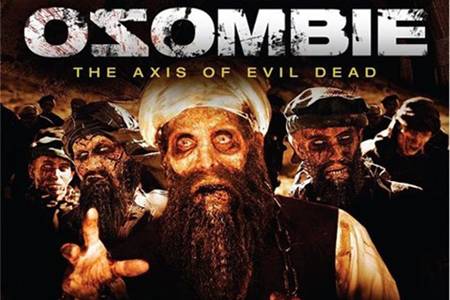
With so many
zombie films hitting screens over the last few years, to stand out from the
crowd nowadays, you really need a gimmick. Rushed into production to cash in on
the death of Osama Bin Laden at the hands of the US Military, Osombie has an
intriguingly offbeat and poor taste premise, but the script, the actors and the
special effects are not up to fleshing this out into an entertaining full
length feature, and the end result is surprisingly boring.
The action kicks
off with US Special Forces storming Bin Laden's secret hideout in Pakistan to
capture or kill him, and coming up against a horde of walking corpses, a result
of Bin Laden’s experiments with weird chemicals that bring the deceased back to
life. He is shot dead, but one of the troops is bitten and starts to turn into
a zombie on the helicopter ride home and in a moment of panic Bin Laden’s
corpse falls in to the sea. Cut to another band of troops, a few months later, and
this time in Afghanistan, trying to find the source of a spate of zombies
springing up in the country. Can they stop the spread of the undead before it
threatens the whole world? Moreover, is Bin Laden not as dead as it was
thought?
The first major
fault lies with the script, which fails to back up a great film pitch with a
decent story or characters. The quest for somebody or something is one of the
classic storytelling archetypes, so you would think that the hunt for the
undead version of Osama Bin Laden surely has story telling potential, but the
film takes up too much time with repetitive and grating scenes of the soldiers
shooting zombies. These scenes are not scary or suspenseful, as a horde of
zombies is usually a dozen at the most, and with them being out in the middle
of the desert, the zombies can be seen from some distance, reducing the
potential for sudden scares. Not that this stops the dumb gung-ho troops, who
happily wade into close combat and then are amazed when they are bitten and
infected. Moreover, as if the film has to fill some kind of cliché quota, we
get a pointless training montage, and even a shot of somebody running in slow
motion shouting "NOOOOOOOOOOOOO"
When they are not
killing or being killed our heroes are badly delivering crappy jokes and dull
dialogue, and when the director tries to switch gears and go for some emotional
resonance, the lines are said in the same flat manner as the humour and
exposition, and make just as little impact. The villains are just as cartoonish
and two-dimensional as the soldiers are, all wearing the standard beard and
turban uniform, and every other line of (subtitled) dialogue contains the words
God, Allah or infidels.
Some poor quality
effects compound the script and acting problems. CGI has become a useful tool
for filmmakers to achieve results on screen that belie a low budget, such as in
the recent Iron Sky, but here it is used to generate both blood and bullet
squibs. Unfortunately, they are poorly rendered and rather obviously from a
computer, which makes the constant use of a blood splatter on the 'camera lens'
throughout the film, baffling and irritating.
The makeup is competent,
nothing particularly new or innovative, just the typical contemporary movie
zombie look. This seems to be in keeping with a wider desire by the makers to
keep everything very familiar for fans of the genre, and much of the standard
undead mythology is adhered to, such as a bite from a zombie causing infection,
and needing a bullet in the head being to kill one.
Considering the
title of the film, there is one character that is sorely underused, as the
Osombie only really appears in the closing few minutes and on-screen or off, he
presents nothing in the way of threat or menace. There is also a missed opportunity
with some interesting symbolism that is never explored (maybe religious
extremism is spreading like a virus?) and what could be a funny fake trailer or
a South Park episode is badly stretched out to leave a horror-comedy lacking in
scares or laughs.