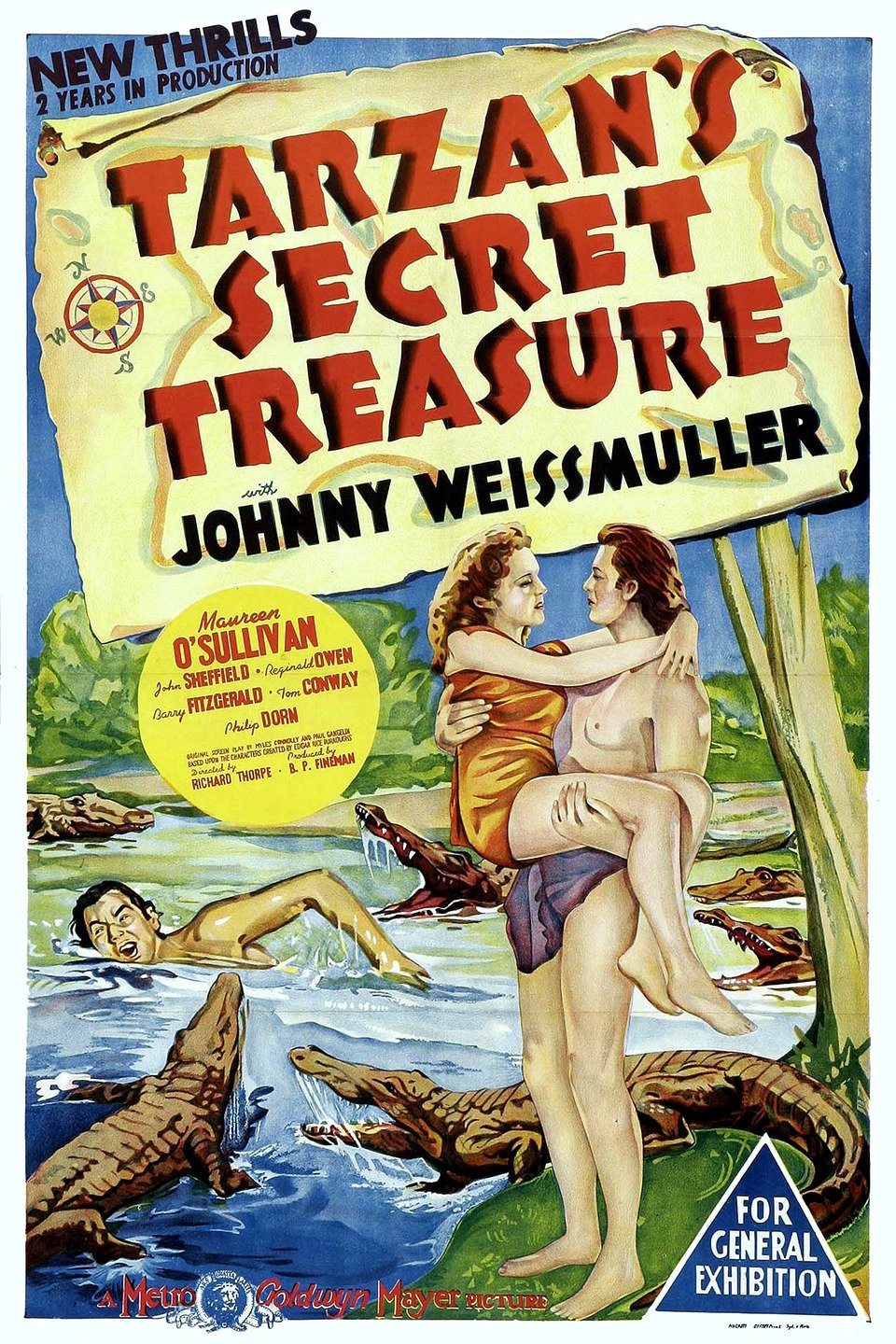
Tarzan's Secret Treasure is the fifth in the MGM series of films starring the Olympic Gold medal winning swimmer Johnny Weissmuller as the definitive depiction of the vine swinger. It has all the expected elements to be expected, both positive and negative, as well as some surprisingly physical love scenes, and an approach to racial themes that is not as straightforward as it may first appear.
Tarzan is enjoying a life of splendid isolation in the African jungle, with wife Jane, adopted son Boy, a pet chimp called Cheetah, and a menagerie of all creatures great and small. An expedition team arrives on the hunt for a lost tribe, but when Boy inadvertently reveals the presence of gold, two of the party get greedy and kidnap Boy and Jane.
The film moves at an unhurried pace to begin with and we get plenty of scenes showing the home life of the Tarzans, as well as some comedy relief bickering among the non-human inhabitants that would not pass animal welfare regulations today.
After about twenty minutes the actual plot kicks in when the expedition team appear, rescuing Boy from a crowd of angry natives. Head villain Medford is played in suitably oily fashion by Tom Conway, (the brother of George Sanders, from whom he took over the role of debonair detective The Falcon), while Barry Fitzgerald as his dogsbody O'Doul is such as broad Irish stereotype that his main purpose seems to be to distract from the stereotyping of the Africans. Also, look fast for a cameo from Johnny Eck of Freaks fame, here in full costume, playing a bizarre looking jungle bird.
The pace picks up once Tarzan leaps to the rescue, and from then on, the action doesn't let up, thanks largely to the astonishing physical presence of Weissmuller, particularly when he is in or under the water.
The first and most striking thing that occurred to me while watching this film was how, on one level, the Tarzan clan is very much you average nuclear family, with Dad going out to work (gather food) while Mom stays at home to cook, clean, and raise the child.
But the Tarzan family is also a little more unconventional than that. The love scene between Tarzan and Jane is surprisingly sensual and physical for the time, with little separating the husband and wife (who presumably did not marry in a Christian church) other than a skimpy dress and a loincloth. The depiction of the Africans as backwards, superstitious, and communicating in a gibberish language is unflattering, if standard for the time, but I think sufficient time has gone past that we can recognise it as no more realistic than the depiction of Indians in Western films. Moreover, the focus is on Tarzan, a man who has turned his back on his own society and culture, and refuses to integrate with those of the country he now calls home, putting him more in line with the ideals of the pioneer spirit. Lastly, don't forget, this is an idyllic situation that he has made, learning to live alongside the natives, and things only go wrong in this world when white people turn up.
Tarzan's Secret Treasure Trailer by trailerapi
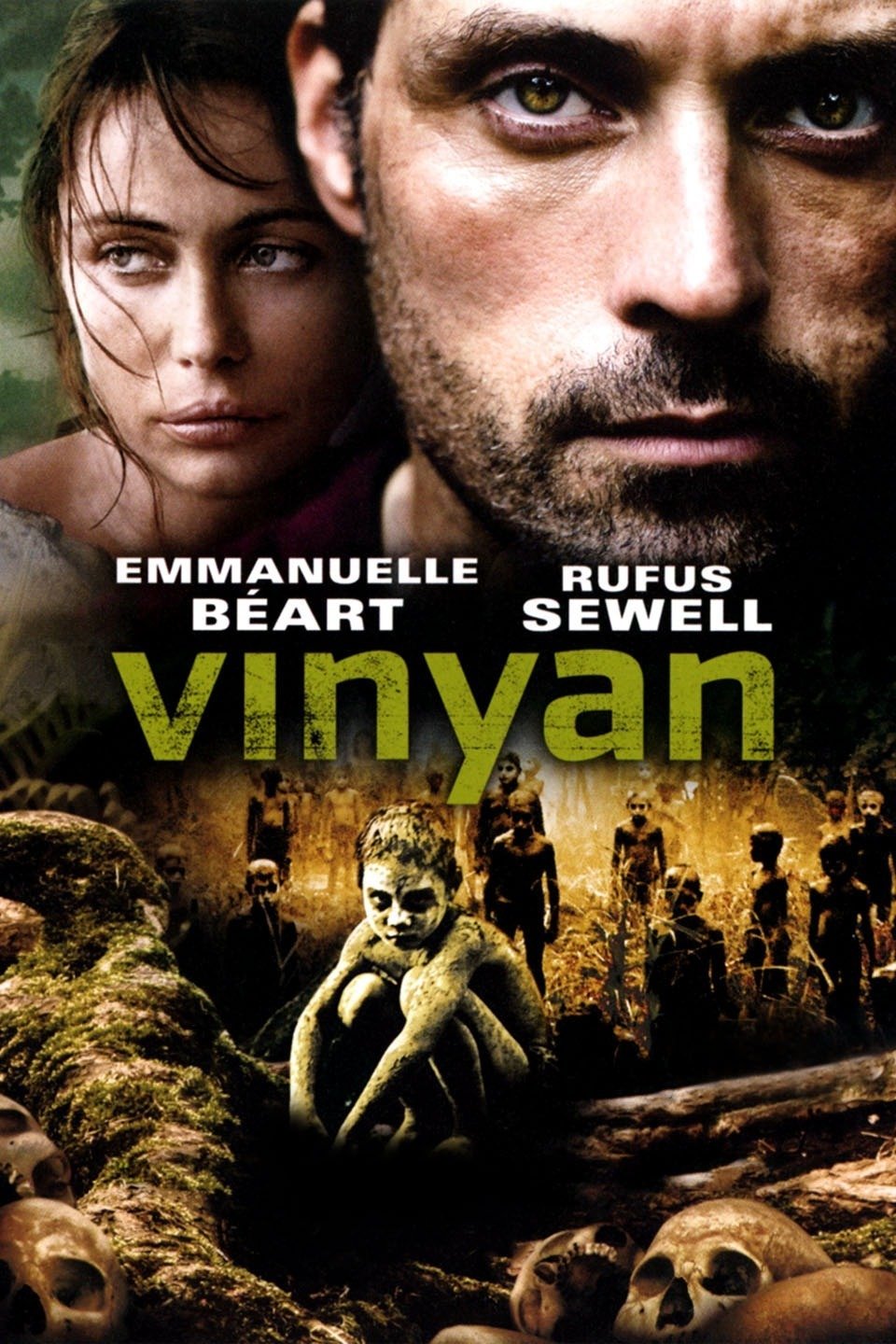
Vinyan is frustrating, with a harrowing and believable performance by Emmanuelle Beart wasted in a film where writer and director Fabrice du Welz hints at things but seems unable or unwilling to commit to them
The story centres around Paul (Rufus Sewell) and Janet Belhmer (Beart), a European couple living and working in Thailand, trying to get over the loss of their young son Joshua in a tsunami. After Janet becomes convinced Joshua is in a video of orphans in Burma, the pair head out there to investigate, along the way getting mixed up with con men, Triads, and other assorted local characters, all the time slipping further and further into madness.
Beart gives an intense performance, very convincing as a woman suffering every parent’s worst nightmare and being unable to cope with the loss. The only real problem with this is that she starts as already disturbed and has nowhere to go with the character. Sewell just does his best to keep up, playing as a man watching his dream life turning into a nightmare.
As with his previous film, Calvaire, Fabrice du Welz is long on stylish visuals and short on strong gripping narrative that makes a lot of sense. From the opening sequence set underwater, with just a few bubbles going past the camera (foreshadowing the tragedy that strikes of Joshua), to the dingy neon lit underworld of Thai bars and clubs, to the menacing Burmese jungles, the film always looks great.
The problem lies with the script, which is all over the place. It hints at many things, but never properly develops any of them, and the lack of character development makes the denouement somewhat puzzling. The film's title refers to the belief that when someone's death is particularly horrible their spirit becomes lost and confused, and they become Vinyan. Obviously, we are meant to link this to the death of Joshua, but then nothing further happens with this idea.
The trailer for Vinyan may have led you to think that this is a straight horror film, and the subject matter and spooky atmosphere suggests Don't Look Now, although it has none of that film's emotional impact.
The jungle setting and gory scenes also hint at another horror connection, that of the gut munching likes of Cannibal Holocaust or more recent efforts like The Green Inferno. Like many of those, in Vinyan, there is very much an "us and them" feel, the civilised white people versus the savages, with the latter never being humanised, and nearly always being shown as a dangerous swarm of insects.
Ultimately Vinyan feels like a film that could have been either a haunting meditation on loss, a disturbing horror film or even just a simple gore fest, but the lack of focus means it is none of these.
Vinyan - Bande-annonce (VOST) by Ecranlarge

The Green Inferno harks back to the Italian cannibal films of the 1970s but lacks the truly disturbing edge of the likes of Cannibal Holocaust, as well as their grimy underground feel. In addition the misjudged tone and annoying characters blunt any satirical edge.
Justine (Lorenza Izzo) is a college student and daughter of a UN lawyer. After going to a lecture on female genital mutilation, and meeting hunky rabble-rouser Alejandro, she agrees to sign up his protest trip to take a gang of do-gooders to halt a logging company and their paramilitary security in the Amazon rainforest. It looks like their protest is a success, but after their plane crashes on the return trip, the protesters soon realise that the people they are trying to save would rather have them for dinner.
To his credit, Roth has made a mostly well-structured film in terms of plot, and there are also some brilliant set pieces, not least the plane crash, which is every bit as stomach churning as any gut munching scene.
While the most of the characters exist in order to be bumped off, Roth takes time introduce some tension in the group, particularly through Justine, who finds to her disgust that the crusaders are happy to put her life at risk without asking, banking on her daddy's reputation to avoid her getting killed.
The film also brings the cannibal genre into the twenty first century. For a start, the idea of Westerners flying into a foreign country uninvited with good aims, only to have the natives turn on them still seems topical. The narcissistic campaigners seem as obsessed with getting their work noticed on the internet or planning their next tattoo as with any good they are doing. However Roth seems to lack any ideas as to where to go beyond this, and the constant sneering at the mostly unlikeable characters becomes tiresome, not helped by misjudged scenes about drugs and diarrhoea.
The lush photography is wonderful and is a throwback to more highbrow 70s films such as Herzog's Aguirre, Wrath of God. The cannibals, while portrayed by a real South American tribe, are never shown to be more than obviously outrageous caricatures so I found it hard to get as offended I might have done if I thought Roth was trying to portray anything realistic. But for all the nods to more lowbrow Grindhouse cinema of the same decade like this, The Green Inferno lacks two important elements from these films.
Firstly is unsimulated animal cruelty, something that makes the likes of Cannibal Holocaust uncomfortable viewing even in these jaded times. Incidentally, it is something that Holocaust director Ruggero Deodato seems to regret, having recently completed a special cut of the film that eliminates nearly all of the animal footage, while keeping, it should be noted, nearly all of the human cruelty. Similarly, the focus in The Green Inferno is on the grim and gory fates that befall the cast.
The second hinges on the viewing experience itself. I watched The Green Inferno on a plasma screen TV from a DVD I had bought in a supermarket. I first saw Cannibal Holocaust on a grimy, wonky, third generation dubbed VHS (on a double bill with Cannibal Ferox), borrowed from someone at school who had bought it from an ad in the back of a horror movie mag, with the sound turned down so my parents wouldn’t hear it. Every aspect of this reinforced the feeling that I was watching something truly underground and transgressive, (which also distracted from the problems with the film). Without being able to capture these elements The Green Inferno becomes ultimately, just another horror film.
Eli Roth's The Green Inferno - Official Trailer by FanReviews

