Horror and Sci-Fi films old and new, weirdo trash, arthouse, forgotten gems, well loved classics, and I'm watching the original Dr Who from the beginning.
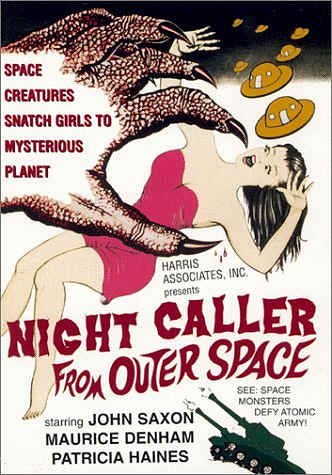
After a meteorite crashes into the English countryside, scientist Jack Costain (John Saxon) and his team set out to investigate. They discover it is actually an alien device from one of Jupiter's moons used to transfer matter to Earth. But what is the connection between the visitor from outer space, a mystery man placing ads in the back pages of bikini magazines and the disappearance of anyone who answers them.
At times this feels like two different films thrown together lurching between Quatermass style extra terrestrial mystery and sleazy Soho-based whodunnit. What should have been either a creepy atmospheric chiller or a campy piece of fun is sunk by the script, which is both confusing and relentlessly talky, and the finished product is teeth-grindingly dull.
John Saxon does his best, heroically managing to sustain an English accent for the duration, and there is some fun to be had watching for cameos from Warren Mitchell as a father of a missing girl, Aubrey Morris as a squalid bookstore owner, and Ballard Berkeley, best known as the Major in Fawlty Towers.
Hammer Horror is perhaps mostly closely associated with the Dracula and Frankenstein films, but the studio first explored the horror genre with The Quatermass Xperiment. Although somewhat hampered by the odd choice of leading man, director Val Guest gives both a tense, fast moving adaption of the hit BBC TV serial (the “Xperiment” was presumably changed by Hammer to sell it as an "X" rated film), while keeping the themes of the original intact. The film can also be counted as a very early example of the subgenre known as Body Horror.
Professor Bernard Quatermass, the head of the British Rocket Group, has just sent the country’s first manned rocket into space. However, disaster strikes as all contact with the three crew members is lost, and the rocket crashes back to earth. Two of the crew have disappeared, and the one remaining survivor, Victor Carroon, is in shock, unable to speak, only mouth the words “Help me”. While in hospital, Caroon starts to undergo horrifying changes, and finds he needs to absorb living things in order to survive. Quatermass soon realises that Caroon, or whatever it is that he has become, will not stop growing, and the next stage of his transformation will threaten the entire planet.
Like many low budget European films, The Quatermass Xperiment was given a Hollywood star whose career had hit a lull, brought in for cheap to help sell the film to the American market. This leaves The Quatermass Xperiment with it's only serious flaw, Irish born Brian Donlevy, who had made a name for himself playing tough guys and gangsters, particularly in groundbreaking examples of Film Noir such as Kiss of Death and The Big Combo. Given this background, it is perhaps not surprising that he seems a little bit out of place in an English Sci-Fi movie. That said, while he lacks credibility playing a man of science, his tough guy persona gives the movie Quatermass a headstrong decisiveness and a refusal to be bullied or brushed aside. This Quatermass is a leader, a man of action, coupled with an almost reckless arrogance, a character that is tough to like, not least because he seems unwilling to take responsibility for the consequences of his actions, but who is always unpredictable and interesting.
Far more sympathetic is Richard Wordsworth as the tragic surviving astronaut Carroon. The character stays mute throughout so the anger and despair we see him go through as he loses control of his mind and body is portrayed largely through facial expressions and inarticulate grunts, something that puts him in the same realm as the Boris Karloff’s heartrending take on Frankenstein’s monster. There is also a more overt echo of this, whether it is a conscious one or not, in the scene where Carroon encounters a small girl out playing by herself. Although there is a different outcome here, both scenes are symbolic of the monster's struggle with their intrinsic humanity, and like Frankenstein's monster, Carroon's anguish is not self inflicted, being the victim of a scientists, albeit well meaning, plans gone wrong. This sort of approach would come to be termed Body Horror, and explored many years later by the likes of David Cronenberg, with films such as Shivers, Rabid, and his reworking of The Fly.
The Quatermass Xperiment was the first attempt at a sci-fi / horror film by director Val Guest. He would go on to helm other genre classics such as this film's sequel, Quatermass 2, and The Day The Earth Caught Fire (as well as a long and eclectic career taking in everything from thrillers, comedies and numerous TV shows). If there is a common thread to his approach with these three films, it is to keep the fantastic story rooted in reality, helped by an unflashy, almost documentary approach to shooting scenes, as well as frequent use of actual locations rather than studio backdrops. The screenplay (co-written by Guest, based on Nigel Kneale's original TV scripts) also shows the effects of the events on ordinary people as much as the scientists, military men and government officials.
The film is also fascinating when placed into a historical context, being released at a time when Britain was still wrestling with the mix of World War Two euphoria, Cold War feelings of potential apocalyptic doom, and the realisation that with the collapse of the British Empire, the country was no longer the global colossus that it had been. This was coupled with the clash of the old and new, that Quatermass with his relentless charge to the future and insistence on blasting rockets into outer space represents the latter half of. This insistence is not dulled by the events of the film however, and in the final scenes, we see Quatermass walking off alone into the distance, followed, without any dramatic music, by the final shot of another rocket being launched. Progress, it seems, will not be stopped.
Although they
have their place as influential science fiction, ground breaking television,
and a vital part of the Hammer Film Studio story, to me the Quatermass stories
are also a kind of 20th century English mythology, an attempt to examine and
explore the post-World War Two English identity, politically and socially. The
first, the Quatermass Experiment showed a country trying to maintain its status
as a world superpower through space exploration. The third, Quatermass and the Pit, looked at issues of race and identity. Sandwiched between those is
Quatermass 2, a paranoid tale of Government cover-ups, colonisation, attitudes
to authority, and mob mentality. The end result is tense, fast paced, and even
more thought provoking than the original.
Professor Quatermass and his team of scientists have been tracing mysterious
objects that have been falling to earth from outer space. Tracking them to
their landing place, Quatermass finds a town that has been almost completely
destroyed, some rocks filled with a mysterious, ammonia-based gas that infects
his assistant, and a shadowy refinery that bears a striking resemblance to his
rejected plans for a Moon colony. Officially, it is producing a new synthetic
food, but it actually harbours a terrifying secret with deadly implications for
the future of humanity.
Like the other two Quatermass films made by the Hammer Studios, this started
life as a six part BBC TV serial, which was condensed into a 85 minute film,
and as with the other two, the original story stays largely the same, but moves
along at a much quicker pace. The only significant change is in the climax,
where instead of Quatermass piloting his experimental rocket to destroy the
invaders, an unmanned craft is sent up instead.
Director Val Guest had a long and varied career, and although he never settled
on a particular style or genre, when faced with subject matter of a fantastic
nature, such as here or The Day the Earth Caught Fire, he would often mix this
with a low key, more realistic filming style. Events are presented in a matter
of fact style, and many of the scenes set in everyday locations, such as pubs,
or out in the countryside. In addition, Guest employed cinema verite
techniques, such as hand-held cameras, to give something of a documentary feel
and by having the dialogue delivered at a rapid pace, sometimes overlapping, he
stops it feeling too staged and stilted
A standard practise in British films at the time was to cast an American actor
(usually one whose services could be obtained cheaply) in order to maximise box
office potential in the US. Hence, Brian Donlevy reprises his role as Professor
Quatermass from the first film, and, as before, he is both a liability and an
asset.The character was originally
conceived as a thoughtful, somewhat reserved scientist, a world away from Buck
Rogers-style action heroes, and Donlevy rarely seems convincing when having to
play that role. However, plenty of fictional characters, from Hamlet to Dr Who,
have been played in plenty of different ways, so why not Quatermass? His real
strength comes when events call for, if not aggressive, then at least assertive
action, as this Quatermass is no shrinking violet.
As a film, although not overly gory, Quatermass 2 manages to be gruesome and
quite shockingly violent at times. The brainwashed refinery guards
cold-bloodedly gun down their fellow citizens, who respond in kind when they
get chance, while at one point the aliens use pulped human corpses to block
pipes pumping out deadly (to them) oxygen. There are also more subtle nods to
the horror genre, particularly the sight of the townsfolk forming themselves
into that classic horror archetype, the lynch mob, to attack the
refinery.
It is fascinating to consider some of the historical context in which
Quatermass 2 would have been seen originally, and the picture of 1950s Britain
that it presents. Identity is one of the key themes of the film, both national
and personal, and the big influence on both would undoubtedly have been World
War 2. With Britain under threat of invasion, whether fighting overseas or
keeping the home fires burning, it was something that everyone was involved
with and affected by, and something that they would still be reminded of some
years after, in the landscape of bombed out buildings and craters, in the
continued rationing of food, and in the dead and injured soldiers and
civilians.
The Britain shown on screen is not a "green and pleasant land" but a
grey, frightened, paranoid country, coming back down to earth from the giddy
euphoria of victory over Hitler, to face the harsh and potentially apocalyptic
realities of the Cold War. Writer Nigel Kneale cleverly combines this with
drawing on contemporary fears and events such as the Chemical Warfare plant at
Porton Down, and the (nowadays, largely forgotten) state of emergency that the
British Government declared in 1955, and these are reflected in some of the
images and situations in the film.
Yet there is
still possible to see something relevant to modern life in Quatermass 2. The
idea of aliens infiltrating the government predates the X-Files by several
decades, along with the general air of paranoia, and cover-ups. That
infiltration could also be read as commentary on creeping corporate influence
on government, while fears over loss of identity, both national and personal,
are perennial.
Ultimately, what
I love about the Quatermass stories, and Quatermass 2 in particular is how it
almost sums up my love/hate relationship with both England and being English.
It has elements and themes that are everything I dislike about this country:
New towns, deference to authority (at one point, we see a sign behind a bar saying,
"Secrets mean sealed lips"), small-minded pettiness, Government
secrecy, and the lynch mob mentality.
However, Quatermass 2 also represent plenty of things I like about England: It
is a Hammer film; the script is full of a thoroughly English dry satirical wit
and a streak of paranoia, and understatement; and, in a sign of the obvious
influence on that other English sci-fi icon Dr Who, the calm logic of science
and the decency and heroism of the individual cools the raging heat of the mob
and saves the day.