Horror and Sci-Fi films old and new, weirdo trash, arthouse, forgotten gems, well loved classics, and I'm watching the original Dr Who from the beginning.
Showing posts with label vampires. Show all posts
Sunday, 22 March 2020
Dracula's Daughter (1936)
As a sequel, Dracula's Daughter is overlooked and overshadowed by the Bela Lugosi original. Today it feels like a brave attempt to bring something fresh to the vampire mythology. The pace of the story and editing is snappier than the sometimes sluggish original. It is also loaded with fascinating symbolism and a great performance from Gloria Holden as the title character.
With a quick recap, the plot picks up at the end of the first film. Professor Van Helsing has been arrested (by Yorkshire policemen talking with "gor blimey guvnor" accents) for murder after destroying Count Dracula. He enlists the help of a psychiatrist friend Dr Jeffrey Garth (Otto Kruger) to try and prove his innocence. Meanwhile, Dracula's daughter, Countess Marya Zaleska has stolen and burnt the Count's body hoping to break free of the curse of vampirism. After a chance meeting with Dr Garth, she enlists him in her efforts. But Zaleska seems unable to curb her blood cravings, and takes to kidnapping young girls from the streets of London
As much as I love the Universal monsters films, they are a boys club. (The obvious other exception is the Bride of Frankenstein, although the time the title character is on screen is minimal). So, to see a strong female protagonist who is the main focus of the film makes a refreshing change. Dracula's daughter has the same seductive power over both men and women as her father. Of course this raises the question, how did she become a vampire? Through her father? Is this child abuse?
This is very much a film of it's time, not least with it's fascination with psychoanalysis. Zaleska tries to enlist the help of Dr. Jeffrey Garth to cure what she thinks is a mental illness. This is a man who believes addicts should simply use their willpower, without examining the underlying causes. When new victims of the vampire appear the initial assumption is that is Dracula. I mean, God forbid that a woman should have the competence and initiative to stalk their own victims. This is, after all, a psychiatrist who spends his spare time shooting birds with his big gun. He also stumbles over tying a tie. Only Janet, his long suffering secretary, can finish him off.
Labels:
1936,
Bela Lugosi,
Black and White,
Dracula,
Freud,
Horror,
Universal,
vampires
Thursday, 27 February 2020
Dracula (1974)
1974 was a bumper year for vampire films in quantity, if not always quality. Andy Warhol was bring the sleaze and gore in Blood for Dracula. Hammer Studios were looking for new twists, with Captain Kronos, Vampire Hunter and the martial arts cash-in Legend of the Seven Golden Vampires. Meanwhile, David Niven was embarrassing himself in Old Dracula. Elsewhere, Dan Curtis, the producer of legendary Gothic soap opera Dark Shadows brought us a TV take on the tale.
The screenplay is by genre legend Richard Matheson, and the plot hits all the major beats of the source novel. But, like the Hammer and Universal versions, it pares back the sprawling plot and cast of characters. One original element it does introduce is the idea of Dracula being a tragic, lovesick character, doomed to spend eternity pining for a lost love. This is something that Francis Ford Coppola will use twenty years later by in his risible take on the story.
In the title role is Jack Palance, someone who has no problem being evil, menacing, and imposing. In fact he's almost like the Terminator, acting alone, breaking into houses, and refusing to lie down when shot, Palance also brings a secondary layer to the character. His Dracula is someone who is occasionally vulnerable to, and not quite in control of their lusts. This offers a reading of the character as a metaphor for addiction.
Opposing Dracula as his arch rival Dr Van Helsing is Nigel Davenport. He is best known, to me at least, as the cantankerous scientist Hubbs in the apocalyptic classic Phase IV. As Van Helsing he brings the necessary stolid reassurance of the character. But he lacks the eccentricity and energy that someone like Peter Cushing being to the role.
The cinematography makes it look like an episode of Hammer House of Horror. This is not a criticism, as a I am big of fan of this show, but it means it might be an acquired taste. Regardless, it's a pacy, creepy and often overlooked version of a familiar tale.
Thursday, 12 September 2019
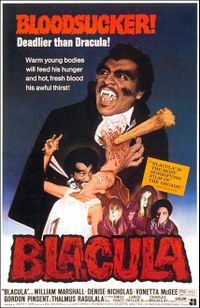
Blacula (1972)
Blacula is a fun and intriguing mash up of Blaxploitation and horror, with a dignified turn from William Marshall as the title character.
Marshall plays an 18th century African prince named Mamuwalde. He wants to bring his kingdom into the modern world, and, for some reason, turns to Count Dracula for help. Unsurprisingly, it does not go well, and instead of opening up global markets, Dracula opens up the veins in Mamuwalde's neck, seals him up in a coffin and leaves his wife Luva to die. Cut to the 1970s, and two interior decorators who are expanding their US property portfolio to include Transylvania. They unwittingly resurrect Mamuwalde after bringing him back to the US, leaving him free to pursue a woman he thinks is the reincarnation of his late wife.
This is cheap but cheesy fun and there has been some thought gone into the script.
The original Dracula story had the Van Helsing character to act as the counterpoint to Dracula (and exposition point for the audience). Wisely, Dr. Gordon Thomas (Thalmus Rasulala) plays that role here.
What is especially interesting is that all the main characters are black, and the producers made no attempt to introduce any kind of white saviour character.
The real star is William Marshall whose natural charisma manages to inject some dignity into the part of Mamuwalde, and make him a tragic rather than horrific character.
Labels:
1972,
AIP,
blaxploitation,
Colour,
Dracula,
Horror,
vampires,
William Marshall
Tuesday, 30 October 2018
Mother Riley Meets The Vampire (1952)
One for the Bela Lugosi (or Mother Riley) completists,
Mother Riley meets the Vampire is a strange hybrid of English Music Hall and
American low budget mad scientist movies.
Arthur Lucan had been playing Mother Riley, an Irish washer
woman who gets herself into assorted scrapes and adventures, on stage and
screen since the 1930s, but, possibly due to the parochial nature of the
character, the films had not really caught on internationally had much success
outside of the UK. Enter Bela Lugosi, who had travelled to the UK for a stage
version of Dracula that flopped, leaving him penniless and desperately needing
money to get back to the US. Producer George Minter must have seen him, even in
the twilight of his career, as a big enough name to drum up some business at
the American box office.
The sinister Von Housen (Lugosi) has two notable character
traits: he is hellbent on seeks dominating the world with an army of 50,000
radar-controlled nuclear-powered robots. He also reckons he's a vampire and has
several young women abducted, including one who has a map to a uranium mine
that he needs for his robot army. Granted, his army is currently 49,999 short,
and to make matters worse, his only functioning robot has been shipped to
Mother Riley's store by mistake.
The result is two different film styles that don't really
gel together, but it's more entertaining than not. Lugosi seems to be enjoying
himself, and, as always, is great fun to watch. Lucan brings a sense of
knockabout slapstick and some well delivered occasional salty quips ("May
the saints shower you with sailors on shore leave!"), but his constantly
shrill delivery means a little goes a long way. Modern audiences may mostly be
reminded of comedy character Arthur Atkinson from the Fast Show, with
comparable baffling catchphrases and contemporary references.
Wednesday, 8 April 2015
A Girl Walks Home Alone at Midnight (2014)
Equal parts brilliant and exasperating, A Girl Walks Home Alone at Midnight borrows liberally from lots of clichés and tropes in vampire and indie cinema, and puts them into a new context. Ultimately, though, it fails to develop them any further, and ultimately feels like a short film overstretched to feature length.
The emphasis is more on mood than plot, but what story there is revolves around a fictional Iranian town, where a female vampire is stalking the residents – the difference here is that the vampire wears a chador (a traditional Iranian cloak) and rides on a skateboard.
Director Ana Lily Amirpour has a great eye for visuals and the film looks and sound great, steeped in creepy and off beat atmosphre. It owes much to the eccentric and indie side of 80s American cinema, directors such as Lynch, and Jarmusch especially, and stylish vampire films like The Hunger. It is shot in black and white and looks, everybody smokes, characters meet at a run down power plant and the vampire lives in a bedsit festooned with posters, listening to vinyl.
However, the style overwhelms the substance too often and for too long and too many scenes drag on with people staring at themselves or each other while whole songs play, and it begins to feels at times like a music video or commercial.
The vampire is interesting, as she is not presented in the clichéd overtly sexual way. There is sexual imagery and a metaphorical castration involving a finger – but perhaps ultimately she represents something heterosexual men find threatening – a woman who is indifferent to and uninterested in them.
Labels:
2014,
Black and White,
Horror,
Iran,
Jim Jarmusch,
vampires
Saturday, 13 September 2014
Zoltan, Hound of Dracula (1978)
Zoltan, Hound of Dracula may have one of the goofiest premises for a vampire film, but it deserves credit on three points. Firstly, for trying something different with the mythology, secondly, for a couple of interesting cast choices, and thirdly, for being great trashy entertainment.
The story starts in 1970s Romania, where a group of Russian soldiers are carrying out excavation and demolition work. But despite their best efforts, they only succeed in unearthing and reviving two of Count Dracula's faithful and long dead servants, one two legged (Veidt Smith, played by the wonderfully sinister looking Reggie Nalder) and one four legged (Zoltan, the count's faithful mutt, played by, well, a dog). However, servants are no good without a master, so the pair set off to track down the only surviving member of the Dracula bloodline, a man living in Los Angeles, under the cleverly disguised name of Michael Drake. Can the enigmatic Inspector Branco (Jose Ferrer) get to him first? Moreover, can Drake trust his own four-legged friends to protect himself and his family?
The central premise, the idea of man’s best friend turning into man's worst enemy is actually a good one, and screenwriter Frank Ray Perrili, a veteran of low budget exploitation films has some fun with transferring human vampire behaviour to animals. Granted, the results, such as scenes of Zoltan biting other dogs to turn them into his vampire slaves are impossible to take seriously. However, there are two set pieces with Drake trapped in a house and a car respectively, under siege from the canines, desperately trying to hold out until sunrise, which are suspenseful.
The (human) star of the show is definitely Reggie Nalder, whose distinctive scarred face had helped him get work with the likes of Dario Argento (The Bird with the Crystal Plumage) and Hitchcock (The Man Who Knew Too Much). Despite often doing nothing more than staring at the camera, he still manages to imbue the role with an unsettling, creepy quality.
Kudos too for casting Jose Ferrer as Inspector Branco, the Van Helsing type character tasked with explaining the back-story to the audience and characters. In a similar way that Peter Cushing does, he manages to bring a bit of gravitas to patently stupid situations and dialogue.
The film only really flags during the frequent, unnecessary and interminable scenes of people driving, scenes that last beyond the time needed to establish that people are going somewhere and quickly feel like the padding that they are. However, they are usually accompanied by a distinctive musical theme, so at least when you hear it start, you can go to the fridge and get a beer.
The story starts in 1970s Romania, where a group of Russian soldiers are carrying out excavation and demolition work. But despite their best efforts, they only succeed in unearthing and reviving two of Count Dracula's faithful and long dead servants, one two legged (Veidt Smith, played by the wonderfully sinister looking Reggie Nalder) and one four legged (Zoltan, the count's faithful mutt, played by, well, a dog). However, servants are no good without a master, so the pair set off to track down the only surviving member of the Dracula bloodline, a man living in Los Angeles, under the cleverly disguised name of Michael Drake. Can the enigmatic Inspector Branco (Jose Ferrer) get to him first? Moreover, can Drake trust his own four-legged friends to protect himself and his family?
The central premise, the idea of man’s best friend turning into man's worst enemy is actually a good one, and screenwriter Frank Ray Perrili, a veteran of low budget exploitation films has some fun with transferring human vampire behaviour to animals. Granted, the results, such as scenes of Zoltan biting other dogs to turn them into his vampire slaves are impossible to take seriously. However, there are two set pieces with Drake trapped in a house and a car respectively, under siege from the canines, desperately trying to hold out until sunrise, which are suspenseful.
The (human) star of the show is definitely Reggie Nalder, whose distinctive scarred face had helped him get work with the likes of Dario Argento (The Bird with the Crystal Plumage) and Hitchcock (The Man Who Knew Too Much). Despite often doing nothing more than staring at the camera, he still manages to imbue the role with an unsettling, creepy quality.
Kudos too for casting Jose Ferrer as Inspector Branco, the Van Helsing type character tasked with explaining the back-story to the audience and characters. In a similar way that Peter Cushing does, he manages to bring a bit of gravitas to patently stupid situations and dialogue.
The film only really flags during the frequent, unnecessary and interminable scenes of people driving, scenes that last beyond the time needed to establish that people are going somewhere and quickly feel like the padding that they are. However, they are usually accompanied by a distinctive musical theme, so at least when you hear it start, you can go to the fridge and get a beer.
Subscribe to:
Posts (Atom)