Horror and Sci-Fi films old and new, weirdo trash, arthouse, forgotten gems, well loved classics, and I'm watching the original Dr Who from the beginning.
Showing posts with label Dracula. Show all posts
Sunday, 22 March 2020
Dracula's Daughter (1936)
As a sequel, Dracula's Daughter is overlooked and overshadowed by the Bela Lugosi original. Today it feels like a brave attempt to bring something fresh to the vampire mythology. The pace of the story and editing is snappier than the sometimes sluggish original. It is also loaded with fascinating symbolism and a great performance from Gloria Holden as the title character.
With a quick recap, the plot picks up at the end of the first film. Professor Van Helsing has been arrested (by Yorkshire policemen talking with "gor blimey guvnor" accents) for murder after destroying Count Dracula. He enlists the help of a psychiatrist friend Dr Jeffrey Garth (Otto Kruger) to try and prove his innocence. Meanwhile, Dracula's daughter, Countess Marya Zaleska has stolen and burnt the Count's body hoping to break free of the curse of vampirism. After a chance meeting with Dr Garth, she enlists him in her efforts. But Zaleska seems unable to curb her blood cravings, and takes to kidnapping young girls from the streets of London
As much as I love the Universal monsters films, they are a boys club. (The obvious other exception is the Bride of Frankenstein, although the time the title character is on screen is minimal). So, to see a strong female protagonist who is the main focus of the film makes a refreshing change. Dracula's daughter has the same seductive power over both men and women as her father. Of course this raises the question, how did she become a vampire? Through her father? Is this child abuse?
This is very much a film of it's time, not least with it's fascination with psychoanalysis. Zaleska tries to enlist the help of Dr. Jeffrey Garth to cure what she thinks is a mental illness. This is a man who believes addicts should simply use their willpower, without examining the underlying causes. When new victims of the vampire appear the initial assumption is that is Dracula. I mean, God forbid that a woman should have the competence and initiative to stalk their own victims. This is, after all, a psychiatrist who spends his spare time shooting birds with his big gun. He also stumbles over tying a tie. Only Janet, his long suffering secretary, can finish him off.
Labels:
1936,
Bela Lugosi,
Black and White,
Dracula,
Freud,
Horror,
Universal,
vampires
Thursday, 27 February 2020
Dracula (1974)
1974 was a bumper year for vampire films in quantity, if not always quality. Andy Warhol was bring the sleaze and gore in Blood for Dracula. Hammer Studios were looking for new twists, with Captain Kronos, Vampire Hunter and the martial arts cash-in Legend of the Seven Golden Vampires. Meanwhile, David Niven was embarrassing himself in Old Dracula. Elsewhere, Dan Curtis, the producer of legendary Gothic soap opera Dark Shadows brought us a TV take on the tale.
The screenplay is by genre legend Richard Matheson, and the plot hits all the major beats of the source novel. But, like the Hammer and Universal versions, it pares back the sprawling plot and cast of characters. One original element it does introduce is the idea of Dracula being a tragic, lovesick character, doomed to spend eternity pining for a lost love. This is something that Francis Ford Coppola will use twenty years later by in his risible take on the story.
In the title role is Jack Palance, someone who has no problem being evil, menacing, and imposing. In fact he's almost like the Terminator, acting alone, breaking into houses, and refusing to lie down when shot, Palance also brings a secondary layer to the character. His Dracula is someone who is occasionally vulnerable to, and not quite in control of their lusts. This offers a reading of the character as a metaphor for addiction.
Opposing Dracula as his arch rival Dr Van Helsing is Nigel Davenport. He is best known, to me at least, as the cantankerous scientist Hubbs in the apocalyptic classic Phase IV. As Van Helsing he brings the necessary stolid reassurance of the character. But he lacks the eccentricity and energy that someone like Peter Cushing being to the role.
The cinematography makes it look like an episode of Hammer House of Horror. This is not a criticism, as a I am big of fan of this show, but it means it might be an acquired taste. Regardless, it's a pacy, creepy and often overlooked version of a familiar tale.
Thursday, 12 September 2019
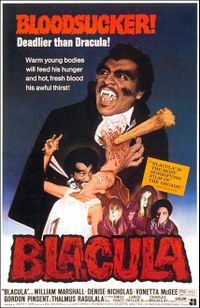
Blacula (1972)
Blacula is a fun and intriguing mash up of Blaxploitation and horror, with a dignified turn from William Marshall as the title character.
Marshall plays an 18th century African prince named Mamuwalde. He wants to bring his kingdom into the modern world, and, for some reason, turns to Count Dracula for help. Unsurprisingly, it does not go well, and instead of opening up global markets, Dracula opens up the veins in Mamuwalde's neck, seals him up in a coffin and leaves his wife Luva to die. Cut to the 1970s, and two interior decorators who are expanding their US property portfolio to include Transylvania. They unwittingly resurrect Mamuwalde after bringing him back to the US, leaving him free to pursue a woman he thinks is the reincarnation of his late wife.
This is cheap but cheesy fun and there has been some thought gone into the script.
The original Dracula story had the Van Helsing character to act as the counterpoint to Dracula (and exposition point for the audience). Wisely, Dr. Gordon Thomas (Thalmus Rasulala) plays that role here.
What is especially interesting is that all the main characters are black, and the producers made no attempt to introduce any kind of white saviour character.
The real star is William Marshall whose natural charisma manages to inject some dignity into the part of Mamuwalde, and make him a tragic rather than horrific character.
Labels:
1972,
AIP,
blaxploitation,
Colour,
Dracula,
Horror,
vampires,
William Marshall
Thursday, 30 October 2014
Dracula (1958)
It is always good to go back to an old film favourite and find something new, and a recent viewing of the Hammer Studios 1958 take on Dracula provided just such an opportunity.
Made nearly 30 years after Tod Browning's equally ground-breaking,iconic and financially successful Universal version starring Bela Lugosi, director Terence Fisher crafts something just as distinctive and unique, helped both by a first rate cast and a punchy script by Jimmy Sangster, one that never forgets that the audience wants to be entertained. Sangster takes the basic premise from the Bram Stoker novel but tinkers with the story quite significantly, stripping the plot to the bare essentials, moving the action from England to Germany, changing some characters (Jonathan Harker is upgraded to Van Helsing’s undercover sidekick, and is fully aware of the Count’s night-time activities), and playing down or eliminating others, such as Dr Seward.
The main theme of Good v Evil is left in place, along with the absolutist, black and white definitions of each, and this film taps into many of the tropes associated with vampires and Hammer films, such as the gloomy castles, frightened villagers and lush Gothic ambience. However, despite the changes from the source material, the underlying themes are still in place too, and as any media studies student knows, vampires are about two things - addiction and sex. The former is undisguised, with the vampires depicted as slaves to their craving for blood, and Van Helsing explicitly comparing it to narcotic dependence.
Sex is there too, in an overt rather than explicit manner. The main source of the sex is the Count himself, with Christopher Lee lighting up the screen as six feet five inches of charm, testosterone and magnetism. Of course, if you go with the "neck biting as intercourse" theory, he is not only seducing other men's wives, but other men too, (in the climax between Van Helsing and Dracula, after their initial skirmish, look quickly and you can see Van Helsing checking his neck to make sure he hasn’t been penetrated by the Count). This imagery gives a queasy undertone to the sight of Harker’s fiancĂ©e Lucy, turned into a vampire by Dracula, trying to abduct her niece and seduce her brother,.
The lurid sexual tone is backed by an equally violent one, albeit tamer than we see nowadays, with lashings of very red blood, and a new slightly extended gruesome sight of Dracula disintegrating, thanks to some recently rescued footage taken from a previously lost Japanese version of the film.
The other thing that I had not properly appreciated is the energy, intensity and swashbuckling demeanour of Peter Cushing. His version of Van Helsing is a world away from the elderly, more academic characterisation by Edward Van Sloan in the Browning film, and the final battle between him and the Count could almost have come right out of an Errol Flynn film.
Made nearly 30 years after Tod Browning's equally ground-breaking,iconic and financially successful Universal version starring Bela Lugosi, director Terence Fisher crafts something just as distinctive and unique, helped both by a first rate cast and a punchy script by Jimmy Sangster, one that never forgets that the audience wants to be entertained. Sangster takes the basic premise from the Bram Stoker novel but tinkers with the story quite significantly, stripping the plot to the bare essentials, moving the action from England to Germany, changing some characters (Jonathan Harker is upgraded to Van Helsing’s undercover sidekick, and is fully aware of the Count’s night-time activities), and playing down or eliminating others, such as Dr Seward.
The main theme of Good v Evil is left in place, along with the absolutist, black and white definitions of each, and this film taps into many of the tropes associated with vampires and Hammer films, such as the gloomy castles, frightened villagers and lush Gothic ambience. However, despite the changes from the source material, the underlying themes are still in place too, and as any media studies student knows, vampires are about two things - addiction and sex. The former is undisguised, with the vampires depicted as slaves to their craving for blood, and Van Helsing explicitly comparing it to narcotic dependence.
Sex is there too, in an overt rather than explicit manner. The main source of the sex is the Count himself, with Christopher Lee lighting up the screen as six feet five inches of charm, testosterone and magnetism. Of course, if you go with the "neck biting as intercourse" theory, he is not only seducing other men's wives, but other men too, (in the climax between Van Helsing and Dracula, after their initial skirmish, look quickly and you can see Van Helsing checking his neck to make sure he hasn’t been penetrated by the Count). This imagery gives a queasy undertone to the sight of Harker’s fiancĂ©e Lucy, turned into a vampire by Dracula, trying to abduct her niece and seduce her brother,.
The lurid sexual tone is backed by an equally violent one, albeit tamer than we see nowadays, with lashings of very red blood, and a new slightly extended gruesome sight of Dracula disintegrating, thanks to some recently rescued footage taken from a previously lost Japanese version of the film.
The other thing that I had not properly appreciated is the energy, intensity and swashbuckling demeanour of Peter Cushing. His version of Van Helsing is a world away from the elderly, more academic characterisation by Edward Van Sloan in the Browning film, and the final battle between him and the Count could almost have come right out of an Errol Flynn film.
Saturday, 13 September 2014
Zoltan, Hound of Dracula (1978)
Zoltan, Hound of Dracula may have one of the goofiest premises for a vampire film, but it deserves credit on three points. Firstly, for trying something different with the mythology, secondly, for a couple of interesting cast choices, and thirdly, for being great trashy entertainment.
The story starts in 1970s Romania, where a group of Russian soldiers are carrying out excavation and demolition work. But despite their best efforts, they only succeed in unearthing and reviving two of Count Dracula's faithful and long dead servants, one two legged (Veidt Smith, played by the wonderfully sinister looking Reggie Nalder) and one four legged (Zoltan, the count's faithful mutt, played by, well, a dog). However, servants are no good without a master, so the pair set off to track down the only surviving member of the Dracula bloodline, a man living in Los Angeles, under the cleverly disguised name of Michael Drake. Can the enigmatic Inspector Branco (Jose Ferrer) get to him first? Moreover, can Drake trust his own four-legged friends to protect himself and his family?
The central premise, the idea of man’s best friend turning into man's worst enemy is actually a good one, and screenwriter Frank Ray Perrili, a veteran of low budget exploitation films has some fun with transferring human vampire behaviour to animals. Granted, the results, such as scenes of Zoltan biting other dogs to turn them into his vampire slaves are impossible to take seriously. However, there are two set pieces with Drake trapped in a house and a car respectively, under siege from the canines, desperately trying to hold out until sunrise, which are suspenseful.
The (human) star of the show is definitely Reggie Nalder, whose distinctive scarred face had helped him get work with the likes of Dario Argento (The Bird with the Crystal Plumage) and Hitchcock (The Man Who Knew Too Much). Despite often doing nothing more than staring at the camera, he still manages to imbue the role with an unsettling, creepy quality.
Kudos too for casting Jose Ferrer as Inspector Branco, the Van Helsing type character tasked with explaining the back-story to the audience and characters. In a similar way that Peter Cushing does, he manages to bring a bit of gravitas to patently stupid situations and dialogue.
The film only really flags during the frequent, unnecessary and interminable scenes of people driving, scenes that last beyond the time needed to establish that people are going somewhere and quickly feel like the padding that they are. However, they are usually accompanied by a distinctive musical theme, so at least when you hear it start, you can go to the fridge and get a beer.
The story starts in 1970s Romania, where a group of Russian soldiers are carrying out excavation and demolition work. But despite their best efforts, they only succeed in unearthing and reviving two of Count Dracula's faithful and long dead servants, one two legged (Veidt Smith, played by the wonderfully sinister looking Reggie Nalder) and one four legged (Zoltan, the count's faithful mutt, played by, well, a dog). However, servants are no good without a master, so the pair set off to track down the only surviving member of the Dracula bloodline, a man living in Los Angeles, under the cleverly disguised name of Michael Drake. Can the enigmatic Inspector Branco (Jose Ferrer) get to him first? Moreover, can Drake trust his own four-legged friends to protect himself and his family?
The central premise, the idea of man’s best friend turning into man's worst enemy is actually a good one, and screenwriter Frank Ray Perrili, a veteran of low budget exploitation films has some fun with transferring human vampire behaviour to animals. Granted, the results, such as scenes of Zoltan biting other dogs to turn them into his vampire slaves are impossible to take seriously. However, there are two set pieces with Drake trapped in a house and a car respectively, under siege from the canines, desperately trying to hold out until sunrise, which are suspenseful.
The (human) star of the show is definitely Reggie Nalder, whose distinctive scarred face had helped him get work with the likes of Dario Argento (The Bird with the Crystal Plumage) and Hitchcock (The Man Who Knew Too Much). Despite often doing nothing more than staring at the camera, he still manages to imbue the role with an unsettling, creepy quality.
Kudos too for casting Jose Ferrer as Inspector Branco, the Van Helsing type character tasked with explaining the back-story to the audience and characters. In a similar way that Peter Cushing does, he manages to bring a bit of gravitas to patently stupid situations and dialogue.
The film only really flags during the frequent, unnecessary and interminable scenes of people driving, scenes that last beyond the time needed to establish that people are going somewhere and quickly feel like the padding that they are. However, they are usually accompanied by a distinctive musical theme, so at least when you hear it start, you can go to the fridge and get a beer.
Subscribe to:
Posts (Atom)