Showing posts with label 1930. Show all posts

Monday, 11 May 2020

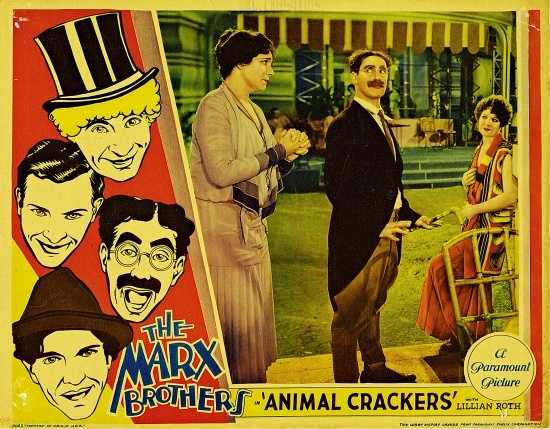
Animal Crackers (1930)


A straightforward adaptation of their hit stage play of the same name, Animal Crackers is flatly filmed but propelled along by the manic energy of the stars.


The slim plot revolves around society matron Mrs Rittenhouse (played by regular Marx brother foil Margaret Dumont) holding a lavish party to celebrate the return of Captain Spaulding (Groucho) and his secretary Horatio Jameson (Zeppo) from his latest jaunt to Africa. The Professor (Harpo) and Signor Emanuel Ravelli (Chico) have been hired to provide musical entertainment but spend most of the time wreaking havoc. There is a side plot involving Rittenhouse's daughter, her boyfriend, and a valuable work of art, but who cares?


Like many films of that era, the direction is a little flat with the camera barely moving. Luckily, the stars are on top form, with a mix of one liners and superb physical comedy, all shot through with surreal anarchy. Even Zeppo manages to keep pace, especially in a classic scene with Spaulding dictating a letter in gibberish legalese.


The film also gives us two songs that would go on to define Groucho. "Hooray for Captain Spaulding" became the theme of Groucho's radio and TV game show You Bet Your Life. "Hello I must be Going" was the opening number of his famous Carnegie Hall concert in 1972


There also a few topical jokes from the time that are fascinating to read about nowadays. The controversial Eugene O'Neill play Strange Interlude was still in the news in 1930. It sees characters regularly stopping what they are doing to give soliloquies to the audience. At several points Groucho spoofs this by turning to the camera and intoning a nonsense monologue in a deep sombre voice.


In addition, the character of Captain Spaulding shares a name with a real-life person, a US Army captain arrested for selling cocaine to movie stars of the day.


Monday, 27 July 2015

Brats (1930)


A great example of Laurel and Hardy at the height of their powers, Brats takes a single idea, some slapstick, destruction, word play and mixes the lot into some great laugh aloud moments. The film also has some interesting symbolism relating to both the characters and to how parents see their children, as the juniors are literally small versions of the seniors.

Being a short film there is not much in the way of plot, simply a premise. Stan and Olly have been left in charge of their respective sons for the evening, sons that look exactly like miniature versions of their fathers and have a similarly antagonistic relationship. All the grownups have to do is keep the little ones out of trouble - what could possibly go wrong?

The answer is, of course, plenty, but what makes Brats more than a series of gags is the insight it gives us into the relationship between Stan and Olly. In the absence of their partners, the duo form a parental duo, with Olly as the stern father figure and Stan as the more easygoing mother.

Brats is also a perfect example of Laurel and Hardy's approach to talkie comedy, taking a more deliberate and measured pace compared to the frantic style of their silent work. Many of the gags are telegraphed in advance, and the build up to the laughs comes not from an unexpected surprise but from looking at the skate at the top of the stairs, or the snooker cue in front of a glass cabinet and realising, it is just a question of when things are going to go wrong.

Fans will recognise many favourite motifs that recur throughout the duo's films, such as Olly's withering glances to camera (and plaintive cry, not for the first time of "why don't you do something to help me?"). There are also some surprisingly agile slapstick moves from Hardy, as well as Stan's surreal mangling of the English language ("You can lead a horse to water, but a pencil must be lead”).

Director James Parrot uses some cinematic tricks such oversized props and clever editing to create the illusion of the children and adults interacting. To me this shows that the films of Laurel and Hardy can be considered groundbreaking, not just for the comedy, but also for the way they, and the directors they worked with were willing to go beyond their theatrical roots and exploit the medium of cinema.


Sunday, 9 March 2014

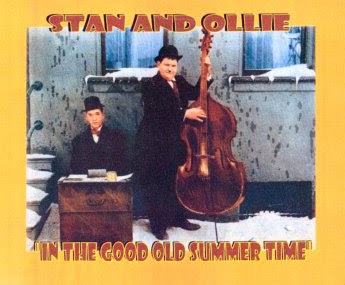
Below Zero (1930)


With Laurel and Hardy, the two main characters stay the same, but their circumstances and situations vary from film to film. Sometimes they have wives, sometimes they have jobs, and sometimes they have houses. In Below Zero, they have none of these, only a harmonium, a double bass, and their rather limited musical ability, with which to try to survive a harsh winter.

The humour comes from familiar sources, slapstick, misunderstandings (playing music outside a deaf centre is never going to be a success), bad luck and petty fighting with each other and the rest of the world, which invariably leads to destruction of property. The duo’s instruments do not survive the first half of the film, as they eventually push a woman too far. As in other Laurel and Hardy films such as Big Business, the destruction almost becomes a stylised ritual, and the duo make no attempt to stop it, seemingly almost resigned to their fate.

The direction is straightforward, largely consisting of pointing the camera at the stars and fixing it there. However, there is one scene, involving a bird laying an egg that uses editing to tell the joke by implying through the juxtaposition of shots, a sign that the language of film was getting more sophisticated as people began to explore the unique possibilities of the medium.

Below Zero also contains two elements of Laurel and Hardy that can sometimes be overlooked. First is the touching bond of friendship between the two, which is always there even if it is often buried beneath the bickering. When, after being beaten up and thrown out of a restaurant, Olly is calling out for Stan, he seems genuinely concerned that his partner is missing.

The second is the bizarre, cartoonish climax that sees Stan end up with a grotesquely distended belly after drinking the entire contents of the huge barrel of water in which he has been dumped, the sort of gag I would expect to find in a Tom and Jerry or Looney Tunes cartoon. However, such bizarre surrealism is something that crops up from time to time in their films, such as the ending of Dirty Work, where a mad scientist and his anti-aging serum turn Olly into a chimp.  

Below Zero was one of several films reshot in foreign languages, in this case Spanish, in order to cash in the popularity they had achieved as silent film stars in Europe. Instead of dubbing the film it was completely remade, with Stan and Olly saying their lines in broken Spanish (and Stan struggling to get past his Lancashire accent), and most of the other actors with speaking parts replaced by people who speak the language.

For financial reasons, these versions needed to be slightly longer than the usual 20 minutes, leading to extra or reworked scenes. These range from the opening scene introducing the policeman, and the back-story about his wallet and money that the duo inadvertently acquire, to extended version of the scene with a blind man, that lacks the short simplicity (and humour) of the English version. These feel exactly like the padding that they are, and interesting though it is to watch, this version adds nothing to the original, which favours quality over quantity.