Horror and Sci-Fi films old and new, weirdo trash, arthouse, forgotten gems, well loved classics, and I'm watching the original Dr Who from the beginning.
One of their best known and best loved Laurel and Hardy films, The Music Box is a perfect example of them taking a simple idea and getting the most from it.
The pair play deliverymen who have one job, which is to get a box containing a player piano to the house of its new owner. Unfortunately, the house in question is at the top of a very long flight of stairs indeed, and they also must contend with obstacles like a vengeful nanny, a bad-tempered policeman and their own blissful incompetence.
The film is perfectly structured with the repeating joke playing like variations on a theme, and, rather than being unconnected from each other, link together to set up a new hazard for the duo.
The box itself is as sometimes as much of a star as the Stan and Olly, seemingly possessing a sentience that gives their efforts an air of people trying to wrangle a difficult wild animal.
The Music Box went on to win the 1932 Oscar for Best Short and remains a brilliant example of Laurel and Hardy at the height of their powers.
Although starring the duo (along with their regular sparring partner, James Finlayson), this is not a Laurel and Hardy film featuring the familiar characters, but another early silent where the duo are still working out their roles. Despite the occasional blasts of crude energy, the end result is a little slow and sluggish.
There is no real story to speak of, just a selection of loosely strung together sketches featuring the misadventures of Home Guard Private Cuthbert Hope (a very effeminate looking Stan), Sergeant Banner (Olly) and Captain Bustle (Finlayson). What surprises is the earthy, coarse tone of some scenes - at one point, the sweaty, slobby soldiers are packed into a single train carriage, sticking their backsides in other people's faces, making revolting smelling food, while other gags involve skunks, swollen posteriors and (implied) nudity.
Some of the elements that would be staples of Laurel and Hardy are in place here, such as the perpetually splenetic Finlayson and the sparingly used caustic intertitles from HM Walker ("There were cheers and kisses as the Home Guards left for camp. The married men did the cheering"). Unsurprisingly, the most successful sections are the gags involving the duo working together to cause mayhem. Their combined carelessness leads to the destruction of the soldier's uniforms, and an elaborate and silly gag involving a conveniently placed and conveniently sized movie poster. They were perfectly talented on their own, but together, greater than the sum of their parts. With Love and Hisses(B&W) 1927 - Laurel & Hardyby herbert-hueller
From their sometimes underappreciated silent era, That's My Wife
is quintessential Laurel & Hardy, featuring the key ingredients of a
well-structured script, great chemistry between the stars and a scheme
that may be fool proof, but certainly isn't idiot-proof.
The script spends little time getting down to the action, and the gags
are not strung together at random, but are driven by the plot, as well
as driving it forward. Olly has a rich uncle who has promised him a
large sum of money, provided he is happily married. Unfortunately, this
is not the case, with Mrs Hardy having stormed out of the marital home
in disgust at their malingering houseguest, Mr Laurel, just minutes
before the arrival of said uncle. So, Stan is pressganged into putting
on a dress and posing as the love of Olly's life, even when Uncle
insists on a visit to a raucous nightclub.
Much mileage is got out of Stan’s poor attempts to pass as a woman, from
his fondness for cigars to his dumbbell cleavage enhancement, but there
is no shortage of slapstick, such as the recurring gag with a hapless
waiter and a cake. Far from becoming repetitive, jokes like this start
to take on a feeling of inevitability, that somehow when Laurel and
Hardy appear in people’s lives, chaos and misfortune inevitably follow.
But as well as their effect on other people, all the best Laurel and
Hardy films are also about the effect they have on each other, and the
way they seem inexorably stuck with each other. Indeed, by the end, Olly
has lost his wife and his chance of getting his hands on a big sum of
money, and all he has left is Stan.
For completists, a interesting companion piece to this film is a 1926 silent comedy called Along Came Auntie. Only Olly appears on appears on screen, Stan's contributions being purely on the writing side.
The plot has similar basis to That's My Wife, with a woman, played by Vivien Oakland, set to receive $100,000 and a truckload of diamonds from her aunt. Said Aunt is not a fan of divorce, which proves awkward as Vivian has, unbeknown to her current husband, taken in first husband Vincent Belcher (played by Olly, initially hard to recognise, being several pounds lighter than usual and hiding behind a big moustache) as a lodger in order to cover her mounting debts.
Much slightly strained farce ensues, with the film most noticeable for what it lacks compared to That's My Wife. Firstly the action all takes place in one house, often feeling like a filmed stage comedy, whereas the second part of That's My Wife moves out of the house and into the nightclub. Secondly the script does not have the same structure or pacing of That's My Wife, seeming both rushed and tiresome in places, and the characters bland and uninteresting. Thirdly, what is really lacks is the chemistry and partnership of Stan and Olly, again emphasising what a bright idea it was to pair them up together.
One Good Turn sees Stan and Olly down on their luck, jobless, penniless, with no more possessions than the shirts on their backs and the car they live in. They are, as they put it, “victims of the Depression”, but when a kindly lady offers them a meal, a misunderstanding leads to the pair trying to repay her kindness. However, this being a Laurel and Hardy film, things do not go to plan, and once again we see the truth of the old adage that “no good deed goes unpunished”.
One Good Turn has all of the elements of a solid Laurel and Hardy talkie film. We get Stan's well-meaning stupidity (setting fire to their tent and put it out one cup of water at a time), Olly turning on the Southern charm to get them fed, bickering and friendship between the two, their arch nemesis James Finlayson, escalating tit for tat slapstick (this time at the dinner table) and damage of other people's property.
It is this final element that gives One Good Turn a destructive and slightly jarring (albeit memorable) climax, as mild mannered Stan turns on Olly, after a barrage of wrong accusations as to his integrity. The red mist descends to the extent that Stan takes an axe to the woodshed of their hosts, while Olly cowers inside. One Good Turn(B&W) 1931 - Laurel & Hardyby herbert-hueller
The final short to star Laurel and Hardy together, Thicker than Water sees the usual formula of domestic bliss turning to domestic chaos, with brilliant slapstick, a dash of Stan’s wordplay (“Is Mr Hardy Home?” “Yes but he’s not in”) and surrealism.
The story opens at the home of Mr and Mrs Hardy, and their lodger, a certain Mr Laurel. The two men want to go out to watch the ball game – but the lady of the house (played by the diminutive Daphne Pollard) will not hear of it, at least until they have done the washing up. The sight of the under five feet tall Pollard browbeating the hapless duo is mined to great comic effect, and the washing up goes as smoothly as might be expected, especially for those who have seen Helpmates.
The rest of the story revolves around money and debt, in particular, the debt owed to furniture store owner James Finlayson, and the money that Olly gave to Stan to cover this month's payment, money that, needless to say, did not get to where it should have, leading to further ear bending and emasculation for Olly.
In an effort to regain some of his crushed male pride, he is persuaded by Stan to withdraw the couple’s remaining bank balance in order to buy furniture outright, so they are not in hock to Finlayson. As we seen time after time in the world of Laurel and Hardy, no good deed goes unpunished, and Olly’s chivalrous attempts to help a lady get a Grandfather clock at an auction leave him minus his cash and holding the timepiece. Mrs Hardy does not approve, and registers her disapproval, with the help of a frying pan, on Olly's head, requiring a trip to the hospital and a surreal twist ending.
Surrealism is perhaps one of the more underappreciated elements of Laurel and Hardy films, and it crops up here in two distinct ways. Firstly the body swap gag, where, after a blood transfusion required by Mrs Hardy taking a frying pan to Mr Hardy, Olly dresses, talks and acts like Stan, and vice versa. The voices are dubbed but the pair do an uncannily excellent job of mimicking each other’s body language and tics of each other. These sort of jarringly odd punchlines did crop up from time to time, such as Stan’s grotesquely distended belly at the end of Below Zero
Secondly is the recurring gag where by the pair change to the next scene by having one of them drag the frame in from off-camera, a clever way of getting quickly from one scene to another, seemingly quite innovative for the time.
While never rising to the heights of some of their other silent films, Should Married Men Go Home? is an enjoyable and amusing Laurel and Hardy short The story comes in two distinct halves, starting with a scene of domestic bliss at the home of Mr and Mrs Hardy, bliss that is soon destroyed by the appearance on the doorstep of Stan Laurel, intent on dragging his friend out for a game of golf. When attempts to avoid him fail, Stan is invited in (through gritted teeth) where he proceeds to cause destructive chaos. When Mrs Hardy packs them both off to the gold course, the pair meet up with a couple of lady golfers, as well as Stan’s oversized hat, a mud-bath, and a toupee that just will not stay in place. The film is an important milestone in the Laurel and Hardy story, as this is the first time they are billed together as a duo. The performers and film-makers are still finding their feet in terms of pacing and execution of the gags, although it is interesting to see that some of them use film editing, something that helped the pair develop from their theatrical roots to being movie comedians. The characters are still being formed, lacking their hats and tatty suits, and the dynamic of their relationship is subtly different, still being friends, but the idea of Olly wanting to avoid Stan and spend time with his wife would not last. A couple of the routines would crop up later in talkie films, with Olly's bungled attempts to avoid Stan at home getting a second outing in Come Clean, while Stan's constant undermining of Olly's attempts to preserve their meagre cash reserves at the drug store would be reworked in Men O'War. The latter in particular worked much better with dialogue. There's plenty of slapstick too, from a piece of turf mistaken for a wig to Olly's disastrous attempt to jump over his picket fence, to the messy anarchic ending, something that would crop up repeatedly in their films. In Battle of the Century it was pies, in You're Darn Tootin' it was pants, here the film ends in a mud bath, as once again Laurel and Hardy cause inadvertent but hilarious chaos wherever they go.
A great example of Laurel and Hardy at the height of their powers, Brats takes a single idea, some slapstick, destruction, word play and mixes the lot into some great laugh aloud moments. The film also has some interesting symbolism relating to both the characters and to how parents see their children, as the juniors are literally small versions of the seniors.
Being a short film there is not much in the way of plot, simply a premise. Stan and Olly have been left in charge of their respective sons for the evening, sons that look exactly like miniature versions of their fathers and have a similarly antagonistic relationship. All the grownups have to do is keep the little ones out of trouble - what could possibly go wrong?
The answer is, of course, plenty, but what makes Brats more than a series of gags is the insight it gives us into the relationship between Stan and Olly. In the absence of their partners, the duo form a parental duo, with Olly as the stern father figure and Stan as the more easygoing mother.
Brats is also a perfect example of Laurel and Hardy's approach to talkie comedy, taking a more deliberate and measured pace compared to the frantic style of their silent work. Many of the gags are telegraphed in advance, and the build up to the laughs comes not from an unexpected surprise but from looking at the skate at the top of the stairs, or the snooker cue in front of a glass cabinet and realising, it is just a question of when things are going to go wrong.
Fans will recognise many favourite motifs that recur throughout the duo's films, such as Olly's withering glances to camera (and plaintive cry, not for the first time of "why don't you do something to help me?"). There are also some surprisingly agile slapstick moves from Hardy, as well as Stan's surreal mangling of the English language ("You can lead a horse to water, but a pencil must be lead”).
Director James Parrot uses some cinematic tricks such oversized props and clever editing to create the illusion of the children and adults interacting. To me this shows that the films of Laurel and Hardy can be considered groundbreaking, not just for the comedy, but also for the way they, and the directors they worked with were willing to go beyond their theatrical roots and exploit the medium of cinema.
Although The
Bohemian Girl is somewhat innocuous and underwhelming compared to the best Laurel and Hardy films, it is still fun and enjoyable. The duo’s
sketches more than make up for the silly plot, and what it lacks in surreal
invention, or destructive slapstick, it makes up for in warmth and gentleness.
The film is based
on an opera written by Irish composer Michael William Balfe, but Stan and Olly
still play their familiar hen-pecked roles, albeit with the twist that this
time they are Gypsies living in 18th- century Austria. Olly's wife kidnaps
Arline, the young daughter of a nobleman who has been persecuting the Gypsies,
but soon runs off with another Gypsy, leaving our heroes holding the baby.
Of course, it
does not matter if they are Gypsies, Laurel and Hardy are still the same basic
characters, dim witted, hen pecked, bickering, and the best of friends. Olly
actually comes across as slightly more pathetic than usual, oblivious to, and
then in denial of his wife's cheating, and her ridiculous story of where the
child came from.
Foregoing the,
often destructive, slapstick that they do best, the humour is based around more
low key set pieces, with word play (when Olly asks for some of Stan’s banana,
Stan gives him the peel), clumsiness and stupidity. While these are very funny,
they do sometimes feel like they have come straight from a vaudeville stage.
The direction is largely flat and unimaginative, and apart from a few touches
such as Stan pointing directly into the camera close up to demonstrate his
hypnotism scam, the film does do not really make use of the medium.
Mae Busch,
reprises her regular role as the formidable Mrs Hardy, although her take on the
character here is less based on righteous indignation than a mean spirited
desire to humiliate Olly. Despite this her scenes are still great fun to watch.
Elsewhere, Julie Bishop, playing the grown up Arline has a genuinely touching
scene, singing, "I Dreamt I Dwelt in Marble Halls” to her adopted father,
and James “D’oh” Finlayson has an amusing cameo with an in-joke one-liner for
fans involving his eye.
The rest of the
cast are pleasant if forgettable, as is the chorus singing. The portrayal of
Gypsies as pickpockets and thieves may seem a bit dubious to some nowadays, but
it is such an obviously stylised Hollywood portrayal of them that it is hard to
take offence. In addition, it does allow for the vital plot point that drives
the story, as well as scenes with Stan and Olly attempting to be pickpockets
with mixed results. In a switch to the usual situations, Stan excels, while
Olly makes a hash of it.
In the closing
few minutes we get a jarring break from the mild fun and sentiment, as we see
Olly stretched on a rack and Stan squashed in a press – and, unlike when it happens
in a Roadrunner cartoon, as the final scene fades to credits, the pair are
still horribly deformed
This seems a
little hard to justify in the context of the story, as this fate is the thanks
that Stan and Olly get for looking after Arline for over a decade. According to
Laurel and Hardy biographer Simon Louvish, the idea came from Stan, and was
hated by producer Hal Roach, who was too distracted by studio business to get
it stopped. There are other examples of Stan’s morbid surreal streak, such as
his grossly swollen belly at the end of Below Zero, and while not to everyone’s
taste, I like that side of the duo, which gives them an extra depth beyond
slapstick, and gives them an unexpected dark undertone.
The Bohemian Girl
is also notable as part of a rather sad footnote in Hollywood history,
concerning actress Thelma Todd, who initially had a substantial role in the
film. Todd had starred in several Laurel and Hardy films, as well as working
with the Marx Brothers and Buster Keaton, among others. On 16th December 1935,
two months before the release of the Bohemian Girl, she was found deadin the garage of her home, poisoned by the
fumes from her own car. A jury returned a verdict of accidental death, due to
no evidence of a suicide, and (unproven) rumours of murder and Mafia links have
persisted ever since. As a result, all but one of her scenes were
re-shot and her character was renamed as the Gypsy Queen's Daughter, with
actress Zeffie Tilbury playing the Queen taking most of her lines.
One of a small number of missing or incomplete Laurel and Hardy films, enough of The Battle of the Century exists to watch and enjoy. What is left is a film of two very different parts, the second of which contains what may be one of the wildest custard pie fights ever filmed. There is no deep message here, just simple exuberant fun, brilliantly executed.
The story starts with Stan stepping into the boxing ring to face the terrifying Thunderclap Callahan “who will probably win” the caption card informs us. The laughs come from playing up the differences between puny thin Stan, who seems to know nothing about boxing, and his gargantuan opponent who seems to have the head of Max Schreck grafted onto the body of a pro wrestler. Standing behind him, powerless to do anything other than watch in mounting horror and exasperation, is his manager, Olly.
The familiar Stan and Olly characters are not yet properly formed, but a few of the basic ingredients are in place. Stan is weak, mentally and physically, as well as clumsy. Olly sees himself as the natural leader of the duo, and always has a get rich quick scheme on the go. What is missing, apart from the trademark hats, is any sense of intimacy and familiarity between the pair. This develops later in their career along with the feeling that whatever is happening is just the latest is an ongoing series of misfortunes to befall the duo.
The boxing sequence is not in itself side-splittingly funny, although it is interesting to see director Clyde Bruckman using varying camera angles and editing to give some sense of the energy of the fight, rather than just point the camera at the ring. Contemporary audiences may have got a hoot out of the references to the famous "Long Count Fight" of the same year where, after flooring his opponent Gene Tunny, Jack Dempsey ignored newly introduced rules requiring him to move to a neutral corner of the boxing ring during the ten second count. Here, Stan messes up in an identical fashion, costing Olly his match winnings, and leading on, albeit very tenuously, to the second part of the film.
Desperate for cash, Olly takes out a life insurance scheme on Stan, with the plan being to make sure he suffers a nasty accident. We do not get to see any of this bit, as the footage has been lost for many years, but it has been reconstructed with the help of a still photo and a title card. When the moving pictures start up again, we cut to Laurel and Hardy regular Charlie Hall performing one of the archetypal pratfalls of slapstick comedy, slipping up on a banana skin, one that was intended to cause Stan an insurance claimable injury. Of course, it's seems only right that Hall is carrying a large tray of custard pies, and what follows may well be one of the greatest examples of the pie fight ever filmed.
Although the sequence as it stands today is missing some footage, more than enough survived to appreciate what a well crafted piece of anarchy it is. It starts off slowly and deliberately, and, like all the best Laurel and Hardy fights, has an air of ritualised violence to it, as each person gets their turn while the others wait politely for them to throw. However, each time somebody ducks and a pie causes some collateral damage, another person gets drawn into the mayhem, and as more and more pies are flung, the pace winds up and up until it feels like the whole town is involved, until finally Stan is taking orders for pies from the back of a lorry.
Not for the last time, the pair cause mayhem without intending to, or without even seeming to try too hard.
Starting a fight in prison may be common enough in prison movies, but starting a rice pudding fight is something else entirely, something that requires a special level of idiocy. Step forward Laurel and Hardy, who achieve just that in The Hoose-Gow (the name derives from juzgado, the Spanish word for courtroom).
We get a brief intro, establishing that Stan and Olly have (unwittingly, they say) been caught up in an armed robbery. Beyond that, there is little in the way of story, which does leave the film feeling a little rambling and unfocussed, not helped by the flat uninspired direction, which leaves the performers to take up the slack.
Luckily, they are up to the task, with plenty of slapstick, kicking, punching, gouging with pick-axes, tearing of clothes, accidentally chopping down a watch tower, and other assorted self-sabotaging stupidity and childish antagonism (as well as a reworking of the salt shaker lid gag from You're Darn Tootin').
No matter where Stan and Olly are, they never fit in, and this is no exception, with Olly's naivety and genteel manners, and Stan's timidity clashing sharply with the wily, rough looking convicts.
Just when the film feels like it is running out of steam, along comes regular foil James Finlayson as the top hat and tailed prison governor, and the second half of the film kicks in. After inadvertently puncturing the radiator of his car, Stan and Olly ill-advisedly decide to plug the holes and absorb the water with rice, leading to the aforementioned bust up.
Like so many of the food fights or bouts of destruction in Laurel and Hardy films, the whole thing starts off feeling stylised, almost ritualised, with people waiting for the other person to have their turn, even though they must realise they are about to get something in their face, before the pace and intensity gradually picks up. The Hoose-Gow is not the best Laurel and Hardy short, not least because it feels like they (presumably along with the rest of Hollywood) are still trying to figure out how to make sound and dialogue work in films. However, it is still a very funny and thoroughly entertaining way to spend 20 minutes.
Helpmates is one of the best of Laurel and Hardy's short talkie films, a textbook example of them doing what they do best. The blueprint is a familiar one: a simple task for the pair to carry out, which means there is ample room for them to mess it up, in a permanently destructive manner.
In this case, while his wife is away, Olly has held a particularly raucous party. Next morning, it's panic stations, as a telegram arrives, informing him of the imminent return of the love of his life. Clearly not thinking straight, Olly, turns to the one person he thinks can help get his house back in order – Stan.
The direction is straightforward, apart from some cinematic touches at the beginning, with the camera panning around the post-party wreckage, and Olly giving a lecture on the evils of partying – which we pull back to reveal is being addressed to himself in the mirror. However, when the gags are this good, the performers this engaging and the running time so short, this lack of anything flashy is not a problem.
The humour comes from the classic Laurel and Hardy formula of slapstick and wordplay, with the pacing deliberate and calculated, compared to the sometimes frantic pace of their silent work. Gags are set up and allowed to work at a natural, unrushed pace, sometimes repeated and built up to an excruciating but hilarious climax.
It is interesting to note how much of the situation Olly brings on himself. Obviously, throwing the party was his idea in the first place, and expecting to involve Stan and not experience some complications is naïve at best. But, beyond that, along the way, there are also small lapses in concentration (tripping over a sweeper), oversights (leaving the gas on) or losses of temper (throwing a plant pot) that have wider consequences.
Nevertheless, he is not an unsympathetic character, largely because, thanks to one brief scene of dialogue, and a less than flattering photograph,
we are left with no doubt about what a truly awful human being his wife is. Different Laurel and Hardy films focus on different aspects of their personalities and lives, but when the focus is on domestic life it is rarely a blissful existence, although, again, this is usually their own fault.
When Olly finally gets out to the station to pick up his wife, he is wearing an ornate military uniform, complete with feathered hat and ceremonial sword, the duo having destroyed every other item of clothing he owns. When he returns, he has a black eye
but more significantly, the sword, the symbol of his manhood has been bent out of shape.
This is not the only time they have trashed a home, but unlike the work they did on James Finlayson in Big Business, this is entirely accidental. Nevertheless, here they are again desecrating that most sacred of middle class status symbols, the well-kept, well-decorated and well-furnished home, and while many of their fans, not just in the US, but around the world would be suffering from the effects of The Great Depression, maybe having lost homes of their own as a result. Joan Crawford is once reported to have said "I never go outside unless I look like Joan Crawford the movie star. If you want to see the girl next door, go next door", and it is probably true that the appeal of many celebrities is that they are so utterly different from us normal folk. This is not the case for Laurel and Hardy though, as their appeal feels more like something we can identify with, folk engaged with constant and sometimes futile struggles against everyday life and everyday people, struggles often entirely of our doing. Even if we cannot learn anything from Stan and Olly, we can take heart in knowing that it is not just us.
With Laurel and Hardy, the two main
characters stay the same, but their circumstances and situations vary from film
to film. Sometimes they have wives, sometimes they have jobs, and sometimes
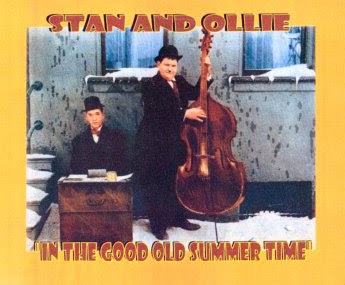
they have houses. In Below Zero, they
have none of these, only a harmonium, a double bass, and their rather limited
musical ability, with which to try to survive a harsh winter.
The humour comes from familiar sources,
slapstick, misunderstandings (playing music outside a deaf centre is never
going to be a success), bad luck and petty fighting with each other and the
rest of the world, which invariably leads to destruction of property. The duo’s
instruments do not survive the first half of the film, as they eventually push
a woman too far. As in other Laurel and Hardy films such as Big Business, the
destruction almost becomes a stylised ritual, and the duo make no attempt to
stop it, seemingly almost resigned to their fate.
The direction is straightforward, largely
consisting of pointing the camera at the stars and fixing it there. However,
there is one scene, involving a bird laying an egg that uses editing to tell
the joke by implying through the juxtaposition of shots, a sign that the
language of film was getting more sophisticated as people began to explore the
unique possibilities of the medium.
Below Zero also contains two elements of
Laurel and Hardy that can sometimes be overlooked. First is the touching bond
of friendship between the two, which is always there even if it is often buried
beneath the bickering. When, after being beaten up and thrown out of a
restaurant, Olly is calling out for Stan, he seems genuinely concerned that his
partner is missing.
The second is the bizarre, cartoonish
climax that sees Stan end up with a grotesquely distended belly after drinking
the entire contents of the huge barrel of water in which he has been dumped,
the sort of gag I would expect to find in a Tom and Jerry or Looney Tunes
cartoon. However, such bizarre surrealism is something that crops up from time
to time in their films, such as the ending of Dirty Work, where a mad scientist
and his anti-aging serum turn Olly into a chimp.
Below Zero was one of several films reshot
in foreign languages, in this case Spanish, in order to cash in the popularity
they had achieved as silent film stars in Europe. Instead of dubbing the film
it was completely remade, with Stan and Olly saying their lines in broken Spanish
(and Stan struggling to get past his Lancashire accent), and most of the other
actors with speaking parts replaced by people who speak the language.
For financial reasons, these versions
needed to be slightly longer than the usual 20 minutes, leading to extra or
reworked scenes. These range from the opening scene introducing the policeman,
and the back-story about his wallet and money that the duo inadvertently
acquire, to extended version of the scene with a blind man, that lacks the
short simplicity (and humour) of the English version. These feel exactly like
the padding that they are, and interesting though it is to watch, this version
adds nothing to the original, which favours quality over quantity.


.png)