Showing posts with label psychoanalysis. Show all posts

Thursday, 6 July 2017

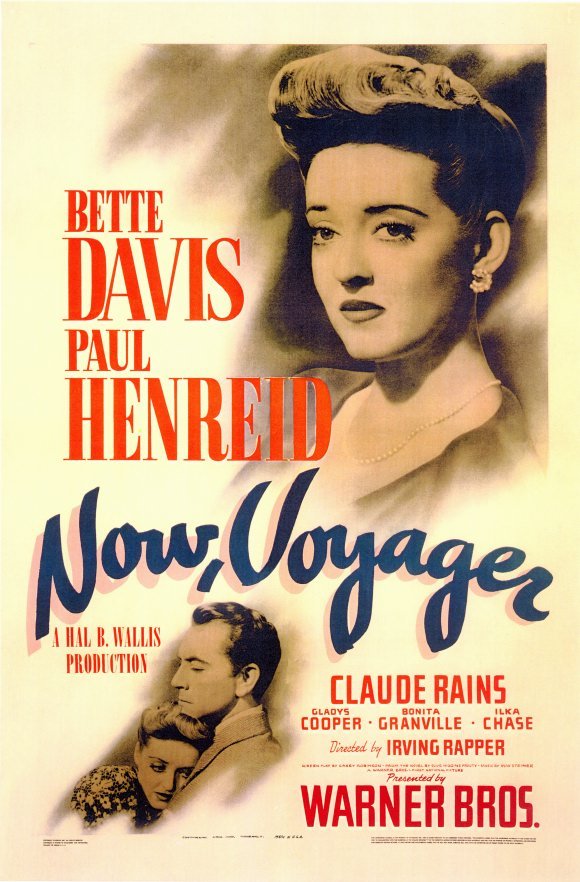
Now Voyager (1942)


Now Voyager appeared as part of the first wave of Hollywood's brief love affair with psychoanalysis, along with the likes of Hitchcock's Spellbound. This Freudian undertone sets it apart from standard Hollywood romantic melodramas, and the plot of a person forced to repress their true personality by an overbearing family figure seems to have struck a chord with gay film fans, amongst whom it has a fanbase to this day.

Bette Davis plays Boston heiress Charlotte Vale, a neurotic mess, largely due to her domineering mother (Gladys Cooper). After coming under the care of psychiatrist Dr. Jasquith (Claude Rains), Charlotte reinvents herself, going from frumpy introvert to glamorous woman about town. While on a cruise she meets and fall in love with a married man, Jerry (Paul Henreid). How will her mother react to the newly independent Charlotte? And can she ever find happiness with Jerry?

Drama is based around conflict and there is no shortage of that in this film, with Charlotte clashing with her mother, Charlotte's sister clashing with her mother, her mother clashing with Dr Jasquith, and Charlotte clashing with her feelings for Jerry. What makes the drama seem so fresh is the liberal attitude of Jasquith. He is more interested in Charlotte being happy, rather than have her conform to the stuffy morality of her background, or, indeed, of the wider society of the day, something that makes the appeal to the film's gay fanbase obvious. In addition, the script goes against the grain of contemporary romantic films by not going for an obvious path to true love, and seeming to accept that relationships are often complicated and happiness not always conventional.

There is plenty of fun to be had watching Bette Davis playing against type as the monobrowed dowdy Charlotte we see at the beginning of the film, emerging from her chrysalis into the polar opposite, glamorous, adventurous, and fun loving, not giving a damn for the stifling world of upper middle class Boston and the sense of duty and obligation that comes with it.

Film and psychoanalysis are the around the same age, as the Lumiere brothers started screenings of moving pictures in 1895, the same year that Freud published Studies in Hysteria, his first foray into what would become psychoanalysis. If anything it is the depiction of psychoanalysis itself, or at least the Hollywood version of Freud's work that dates Now Voyager. It portrays the mystery of the human psyche as being like a whodunnit, one that can be unravelled with the aid of the right clues, an approach that now seems a little unsophisticated.


Tuesday, 13 May 2014

The Dark Mirror (1946)


The Dark Mirror is an entertaining melodrama, fusing elements of film noir, psychoanalysis and an old cinematic trope about good twin vs bad twin. Although the psychology has dated badly, the film is more than lifted by clever direction, great lead performances, and some, for the time at least, astonishing special effects

Terry and Ruth Collins (both played by Olivia de Havilland) are identical twins, one kind and caring, the other a very disturbed individual. However, both are caught up in the murder of a doctor after witnesses place one of them with the victim just before his death. The police agree, but are stumped as to which, so they call in the help of psychiatrist Doctor Scott Elliott to see if he can shed any light on them. However, is Elliot putting his own life at risk, by falling in love?

Although the events in this film are triggered by crime, director Robert Siodmak favours mind over murder, with the focus on Elliot delving into the psyche of the sisters, rather than any police investigation. Olivia de Havilland wisely plays the pair as having distinctive characteristics, particularly in their attitudes to men, without being too dissimilar, or too extreme and theatrical.

Her performance is greatly helped by the extraordinary (for the time at least) optical effects used to place both twins in the same shot, which, when combined with clever editing and body doubles, means it is often possible to forget you are watching the same actress.


She gets able support from Thomas Mitchell as the baffled police detective, Lt. Stevenson, bringing the same sort of likeable enthusiasm he gave to the role of Uncle Billy in It's a Wonderful Life. Lew Ayres is less successful as Dr Elliot, although this may be down to the character being fundamentally unlikeable, a slightly pompous know-it-all, whose actions, particularly taking a patient out on a date, can seem a little unethical.

Siodmak is considered, in some circles, “the primary architect” of Film Noir, and there are enough elements of Noir, both in style and character, for it to be counted in that genre. The film is shot with plenty of stylised light and shade, which helps keep an air of suspense and unease, the plot revolves around crime, and, of course, if there is a woman who is aggressive confident, and intelligent, she has to be evil. Siodmak has also taken the time to put plenty of mirror themes into the imagery and characters, such as the symmetrical Rorschach inkblots in the opening and end credits, or the total opposite character pairing of the old-fashioned cop and the ultra-modern doctor.

What also makes this film so fascinating is the portrayal of psychoanalysis, something Hitchcock had started putting into his films with Spellbound, which was released a year before this. Perhaps it was the hope it seemed to offer in healing the minds shattered by the traumas of World War Two, but it is shown as something that can provide, quantifiable, empirical, definitive answers, and quickly, in the same way a treatment of drugs can for the body. At one point Elliot subjects the twins to a Rorschach inkblot test, showing them a series of pictures and noting their answers. He is then seen crosschecking these against some sort of textbook, before going on to tell Stevenson that from the results of this alone can he tell for certain that one of the twins is insane. This kind of thinking looks clunky and simplistic nowadays, although this film was not the only example. The idea that a psychological test or the uncovering of a single traumatic event can provide the key to unlocking a mystery would crop up in other Film Noir movies, throughout Hitchcock’s work, and in the giallo films that came out of Europe in the 1960s and 70s. This suggests a pattern of thinking in directors (maybe also in audiences) that, no matter how baffling a mystery may be, it cannot, under any circumstances, go unsolved.