Showing posts with label Hitchcock. Show all posts

Sunday, 3 May 2020

Strangers on a Train (1951)


Strangers on a Train kicked off a golden era of work that would go on to include Dial M for Murder, Rear Window, North by Northwest, and Psycho. The subject matter is perfect for Hitchcock's mix of suspense and jet-black humour. The director packs the film with imagery, themes and great set pieces.

Bruno Antony (Robert Walker) reckons he has devised the perfect crime. While traveling on a train, he meets tennis player Guy Haines (Farley Granger). Bruno suggests the two strangers each agree to kill someone the other person wants gone. For Bruno, this means his hated father, and for Guy his wife Miriam, who will not grant him the divorce he craves to marry Anne Morton (Ruth Roman), the beautiful daughter of a U.S. Senator. Guy balks, but Bruno goes ahead and bumps off Miriam anyway. When Guy refuses to carry out his half of the bargain anyway, Bruno decides to frame Guy for the murder.

Strangers on a Train had a bumpy conception. Hitchcock fell out with the original screenwriter Raymond Chandler after a clash over their working styles. Hitch liked brainstorming sessions; Chandler preferred to be left alone to get on with the writing. Also, Hitchcock was not happy with being forced to cast the rather staid Granger and Roman, which was the price he paid for getting Walker.

It was a price worth paying because Walker creates one of my favourite screen villains. Intense, manipulative, but also vulnerable. Bruno starts off seeming to be in total control of the relationship between Haines and himself. This focus on his target is summed up in one image. Bruno sits in a crowd of people watching Guy play tennis. The heads of the crowd move from left to right as they follow the ball, but Bruno stays locked onto his target.

But the cracks start to show in his facade, and events being to spiral out of his control. A lighter stolen from Haines forms part of a plot to frame the tennis star for murder. But when Bruno loses the lighter down a drain, it becomes symbolic of his increasing desperation. The lighter almost feels like a magical object. If Bruno has it, he has some form of control over Guy.

The main recurring theme throughout the film is that of mirror images. This occurs in the main characters, as Bruno can be read as a Jungian shadow of Guy. It is in the editing, with the opening montage showing the two main characters heading to the train. They walk in opposite directions, but are otherwise indistinguishable. And the final scene mirrors the opening one, with a stranger inquiring "Aren't you Guy Haynes"? In this case, it is a harmless vicar. There are many more which reveal themselves with repeated viewings.

There are also other standard Hitchcock tropes. The police are portrayed as pig headed, stupid and unhelpful. It is left for Anne to do the bulk of the legwork to try and prove Guy's innocence.

The film also has a streak of jet-black comedy running through it. There is the knowing easy banter between Guy and the cop sent to tail him. And Pat (daughter of Alfred) Hitchcock plays Anne's sister, a character hilariously obsessed with the gory details of crime. In yet another mirror image reference, she becomes the focus of Bruno's unsavoury attention, as she bears an uncanny resemblance to Guy's late wife.



Thursday, 6 July 2017

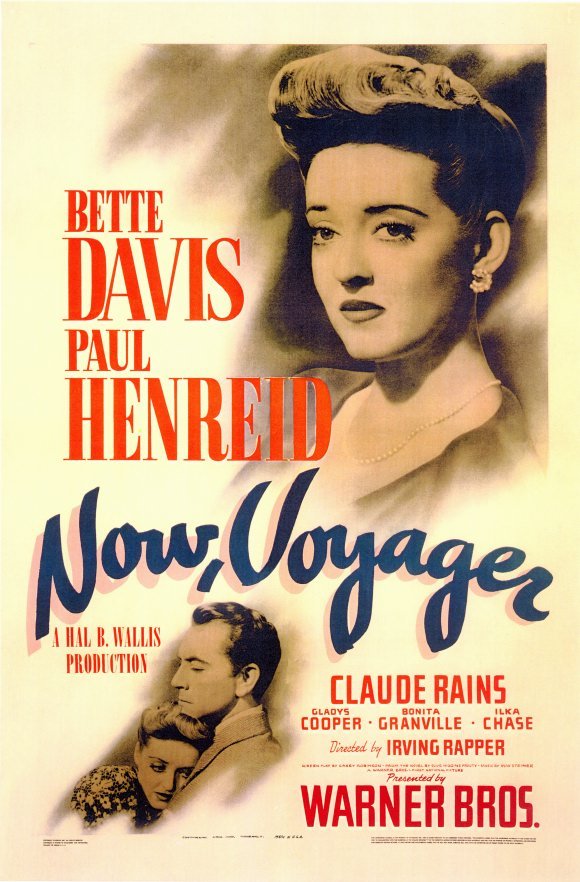
Now Voyager (1942)


Now Voyager appeared as part of the first wave of Hollywood's brief love affair with psychoanalysis, along with the likes of Hitchcock's Spellbound. This Freudian undertone sets it apart from standard Hollywood romantic melodramas, and the plot of a person forced to repress their true personality by an overbearing family figure seems to have struck a chord with gay film fans, amongst whom it has a fanbase to this day.

Bette Davis plays Boston heiress Charlotte Vale, a neurotic mess, largely due to her domineering mother (Gladys Cooper). After coming under the care of psychiatrist Dr. Jasquith (Claude Rains), Charlotte reinvents herself, going from frumpy introvert to glamorous woman about town. While on a cruise she meets and fall in love with a married man, Jerry (Paul Henreid). How will her mother react to the newly independent Charlotte? And can she ever find happiness with Jerry?

Drama is based around conflict and there is no shortage of that in this film, with Charlotte clashing with her mother, Charlotte's sister clashing with her mother, her mother clashing with Dr Jasquith, and Charlotte clashing with her feelings for Jerry. What makes the drama seem so fresh is the liberal attitude of Jasquith. He is more interested in Charlotte being happy, rather than have her conform to the stuffy morality of her background, or, indeed, of the wider society of the day, something that makes the appeal to the film's gay fanbase obvious. In addition, the script goes against the grain of contemporary romantic films by not going for an obvious path to true love, and seeming to accept that relationships are often complicated and happiness not always conventional.

There is plenty of fun to be had watching Bette Davis playing against type as the monobrowed dowdy Charlotte we see at the beginning of the film, emerging from her chrysalis into the polar opposite, glamorous, adventurous, and fun loving, not giving a damn for the stifling world of upper middle class Boston and the sense of duty and obligation that comes with it.

Film and psychoanalysis are the around the same age, as the Lumiere brothers started screenings of moving pictures in 1895, the same year that Freud published Studies in Hysteria, his first foray into what would become psychoanalysis. If anything it is the depiction of psychoanalysis itself, or at least the Hollywood version of Freud's work that dates Now Voyager. It portrays the mystery of the human psyche as being like a whodunnit, one that can be unravelled with the aid of the right clues, an approach that now seems a little unsophisticated.


Wednesday, 14 June 2017

Rear Window (1954)


One of Hitchcock greatest films, Rear Window is an ode to voyeurism that effortlessly combines mystery, wit, and romance, and has some interesting things to say about both the movies and moviegoers. Hitchcock is at the height of his powers, and his complete control of the film means there is not a wasted scene or line.

James Stewart plays L.B. Jeffries, a globe-trotting, thrill-seeking news photographer whose last assignment left him with a broken leg. Apart from visits from his socialite girlfriend Lisa (Grace Kelly), and his insurance company nurse Stella (Thelma Ritter), he is forced to spend the summer cooped up in his apartment, passing the time by taking an interest in the lives of his neighbours in the courtyard opposite. There is the beautiful ballet dancer, the newly married couple, Miss Lonely Hearts, a composer struggling with writer's block - and a salesman, Lars Thorwald (Raymond Burr) and his bedridden wife. When the wife mysteriously disappears, Jeffries begins to think there is something sinister going on.

The whole story takes place in one room, something Hitchcock had attempted before with the flawed but interesting Rope, but here there are two important differences. Firstly, while Rope was set in real time, Rear Window takes place over a week or so, giving more time to introduce the characters and build up the storyline. Secondly, in Rear Window, the location is used to provide a portal into a much larger world.

The window itself becomes a metaphor for the screen that we watch the film on. What he is seeing is just like a movie. The characters and story form, he gets gripped by this, but at tense heart stopping moments, he is almost always as powerless to intervene as we are, and like us, is reduced to the role of passive voyeur.

The theme even extends beyond the on screen characters, to take in our viewing of the relationship between the two leads. There is great chemistry between the leads, and several times Hitchcock shoots passionate scenes between Stewart and Kelly in such an extreme close manner that we begin to feel like voyeurs.

However, in a further twist, Jeffries goes beyond the role of passive voyeur, when he tries to intervene in the plot of the unfolding story. After antagonising his chief suspect, said suspect performs the equivalent of the movie monster coming out of the cinema screen and into his real life, threatening him physically.

Hitchcock's genius is to set all this within a tense, witty suspense thriller with two gorgeous likeable and charismatic stars, and a great supporting cast, particularly the sinister Burr, and Thelma Ritter as Jeffries' droll nurse Stella, whose disapproving attitude towards the sleuthing soon morphs into morbid fascination.


Friday, 17 March 2017

The Love Witch (2016)


The Love Witch is not just an intoxicating homage to both 1970s sexually charged exploitation films, and the dreamlike psychological thrillers of the Giallo genre, or Vertigo era Hitchcock. Beneath the lush colours, nudity and violence, writer / director Anna Biller has also crafted a thought provoking exploration of female identity.

Elaine (a breakthrough performance by Samantha Robinson) is a beautiful, self-absorbed witch who breezes into a Californian town to find a new husband to replace her previous murdered one. Her search leads to men falling at her feet - and then falling down dead. As Griff, the police officer investigating the deaths gets closer to the truth, will he be next to fall under her spell?

The heady intoxicating world in which all this takes place looks like a mix of classic Hollywood Technicolor and a perfect pastiche of the rich colours (and hairy characters) of sixties and seventies European exploitation cinema. This is all complemented by the sort of soundtrack of lush strings and female solo voice often found in those sorts of films.

Writer/director/editor/producer Anna Biller has Wes Anderson levels of detail in creating her completely self-contained cinematic universe, which, like Anderson's, feels both real and completely imagined. When late in the film, one character pulls out a mobile phone, the effect is jarring, making you wonder if the whole thing is set in contemporary times after all, albeit completely re-imagined in Elaine's mind. 

The story is pulpy, melodramatic and absurd but works better for taking place within this slightly artificial environment. The acting style ranges from (deliberately) am-dram to understated, all of which seems inexplicably chilling, as artificial and persuasive as a nightmare.

Beneath the masses of style is substance too, in the examination of some of the stereotypical roles men and ascribe to themselves and each other. Elaine in particular seems to have swallowed the idea of presenting herself as a sex object for men to take care of. This buys her some power over them, but when they crave an emotional connection, she seems to find the cognitive dissonance between fantasy and reality too much to take.


THE LOVE WITCH Trailer (Romantic Comedy, 2016) by hotmovietrailer

Sunday, 23 October 2016

The 39 Steps (1935)


Fast paced, sexy and brilliantly written and directed, The 39 Steps is a landmark in the career of Alfred Hitchcock that lays out his distinctive vision, both in terms of story and cinematic technique.

A simple evening at a London music hall turns into a nightmare for Richard Hannay (Robert Donat), when it ends in gunshots, a panicked crowd and a beautiful and mysterious woman who calls herself Annabella Smith (Lucie Mannheim). After a trip back to Hannay's flat, Smith reveals that not only is she a spy, but she is being pursued by enemy agents after uncovering a plot to steal British military secrets. When Smith is murdered in his flat, and Hannay framed for the crime, he has no choice but to go on the run, using the little information Smith and told him to find the secrets and clear his name. With this being a Hitchcock film, we also get a beautiful blond woman to join him for the ride.

The film starts off at a roaring pace and barely stops for breath. Within twenty minutes of screen time Hannay goes from rakish man about town to wanted man on the run. Hitchcock effectively deploys one of his trademark storytelling devices, The MacGuffin. This is an object or person that presents the motivation or goal for a character, in this case the stolen military secrets, and drives the story, without ever overwhelming it, so the audience can enjoy the digressions.

Hitchcock also shows an assured and developed cinematic technique, going far beyond the simple static framing and sluggish editing of some of his contemporaries. He uses the camera lens to manipulate the point of view and knowledge of the audience, mixing suspense and surprises, and throws in simple but effective methods such as quick transition shots showing changes of location help keep the breakneck pace.

All of this is aided by, as you would expect from Hitchcock, a well constructed script, with set ups and pay-offs. The "innocent man caught up in something dangerous" plot was something that Hitchcock had used before in the silent film The Lodger and the original version of The Man Who Knew Too Much and would use again, most notably in North by Northwest. But here is where we see him first trying other tropes and ideas that he would come back to, the sharp witty dialogue, such the icy cool blonde female sidekick, and the chemistry between the two lead actors. It is also a surprisingly, for the time it was released, sexy film, whether in the scene of the two stars handcuffed together on a bed, or the conversation between two ladies underwear salesman on a train.

The story itself does sound absurd, and at one point one character says that Hannay's tale "sounds like a spy story". This is the case with many of Hitchcock's films, but to use this is as a criticism is to miss the point of what a film like this is about. It does sound absurd, but, like somebody trapped in a dream, that is what he has to deal with, an ordinary man in an extraordinary situation.


Thursday, 11 June 2015

The Man Who Knew Too Much (1956)

A remake of a film that he first attempted 20 years earlier, the 1956 version of The Man Who Knew Too Much has a bigger budget, bigger stars and a much more experienced Alfred Hitchcock behind the camera. It also has some emotional depth to the characters, giving some substance to the style.

Dr Ben McKenna (James Stewart) is holidaying in Marrakesh with his wife Jo (Doris Day) and young son Hank. They have an accidental meeting on a bus with a mysterious Frenchman, Louis Bernard, who is later murdered in front of the family. With his dying words, he reveals details of an assassination attempt on a foreign statesman. This plunges the McKenna family into a nightmare that see Hank kidnapped, and Ben and Jo in a desperate race against time to save two lives.

In many ways, The Man Who Knew Too Much fits in well with much of Hitchcock’s work. The story is an unlikely one, but no more so than many of his other films which share the trope of the ordinary man thrown into an extraordinary situation. It also has Hitchcock regular James Stewart who, as always, brings a real likeability and vulnerability to the character of Ben, as well as the complexity and glimpses of a darker side that Hitchcock was so good at bringing out of him.

Hitchcock also indulges in his love of what call “Pure Cinema”, using techniques and tools unique to the medium, such as editing or juxtaposition of sound and images, to manipulate the viewer and tell the story. This works brilliantly in the climactic scene at the Albert Hall in London, a bravura sequence, nearly 10 minutes long with no dialogue, only the sound of the orchestra (conducted in person by legendary Hitchcock collaborator Bernard Hermann). The tension mounts as the gunman lines up his target in his sights and Ben frantically tries to convince the police that he is telling the truth – and the whole thing is told through images and editing.

However, in some ways this is an atypical Hitchcock film. The ordinary man is often accompanied by a blonde woman, and The Man Who Knew Too Much is no exception in that respect. However, instead of the usual sub-plot that sees them playing cat-and-mouse love games, here the couple are already in love, happily married with a child, which we see in the opening sequences of the McKenna's holiday (including some great physical comedy from Stewart as he tries to get his longs legs into the awkward seating at a Moroccan restaurant). This makes the dynamic different, making them equal partners, with an equal stake in the outcome, and, as things become more desperate, superb acting from Day and Stewart makes the film less arch and knowing and much more heartfelt than the Hitchcock reputation as a master manipulator might lead you to expect.

Friday, 5 June 2015

The Lodger (1927)


Coming before the droll British chase films of the 1930s, the glamorous Hollywood psychodramas of the 1940s and 50s and the controlled cruelty of his later work, the silent films of Alfred Hitchcock can get overlooked. Despite lacking the budget, resources and superstars of the later work, there is still much to enjoy as well as some pointers as to where the career of Mr Hitchcock was going to go, most particularly in The Lodger.

The plot sees a sinister Jack the Ripper style killer called The Avenger on the loose on the foggy streets of London, a killer who only targets blonde women. A mysterious man (Ivor Novello) arrives at the house of Mr. and Mrs. Bunting, looking for a room to rent. The Buntings have a daughter, Daisy, who is a fashion model, and has a police detective boyfriend, Joe  - and blonde hair. As Joe investigates the murders, he begins to suspect the Bunting's new lodger - just as Daisy starts to find herself attracted to him. Does Joe have the right man? Moreover, is he about to lose his woman to him?

The Lodger was Hitchcock's third completed film but already we can see many of the themes and tropes that would crop up time and time again in his work over the next 50 years. The plot revolves not just around murder, but the murder of women, and blonde women at that. There is also a man wrongly accused of a crime, a slightly buffoonish police officer, a streak of black humour, and a twist ending. We also see in Ivor Novello, a leading man cast in a different light to how the public were used to seeing him – think of James Stewart as a neurotic weirdo in Vertigo.

In addition, Hitchcock is already starting to not just hint at sex and violence in his films, but draw a link between the two. This is most explicitly shown here, not just by the killer, but by Joe the detective, who gleefully talks of putting a ring on Daisy's finger after he has put a rope around the neck of the Avenger, implying that the perfect climax to a violent death is consummating his marriage.

However, the Lodger is more than just a dry run for Hitchcock's career, and is a great thriller in its own right. The cinematic style is at wonderfully audacious, with some brilliantly designed shots and scenes that show Hitchcock had grasped the unique power of the medium, and was also paying attention to and learning from some of his contemporaries, particularly the German Expressionists, such as Robert Wiene and his silent classic The Cabinet of Dr. Caligari

As always with a silent film, the soundtrack that accompanies your screening will be a definite factor. While previous viewings have been on DVD with a soundtrack played by the London Symphony Orchestra, a recent watch on the big screen for me had music by drums/bass/guitar trio Minima. This was in itself an eclectic affair, moving seamlessly between jazzy noire, eerie atmosphere psychedelic noodling and loud, dramatic rhythm and may initially feel somewhat anachronistic, compared to the large ensemble or organ score of the time of the films release, However, it actually gives the film a completely different feel, one that is to my mind somewhat closer to the Giallo genre, and given that one of the progenitors of Giallo, Dario Argento, made his name with visually stunning films about sexually charged murder (with great soundtracks) this actually makes sense.


Sunday, 8 March 2015

Town on Trial (1957)


An entertaining whodunnit, Town on Trial is also a peek behind the curtains of middle class village life in 1950's England. While the crime aspect of the film is not entirely successful, the subject matter is surprisingly frank for the time that it was made, and the script takes some surprising turns with characterisation.

When a young woman is found strangled by a stocking in the English village of Oakley Park, there is no shortage of suspects, from Mark Roper, the married Lothario secretary of her tennis club, to the local doctor with a secret from his past, to a troubled young man with a history of blackouts. Superintendent Mike Halloran (John Mills) is brought in to solve the case, something he pursues with relentless zeal, but with the locals resenting the outsider and refusing to help, can Halloran succeed before the killer strikes again?

The detective aspects of the story do not always work, with the clues and police procedural work rarely rising above the sophistication of an episode of Midsomer Murders, while the killer's motives seem vague. Much more convincing is the claustrophobic and sometimes mean-spirited world of village life, where many residents seem more interested in sweeping the murder under the carpet rather than finding out who did it. Conformity and fitting in is the name of the game, a theme that drives or shapes many of the main characters. The murder victims both stray from the accepted social norms for women, giving their deaths an air of puritanical retribution akin to some horror films, accentuated by the by the Bible quotes left at the murder scenes. 

The detective is also an outsider, something underlined in the scene where, after a conversation about ties worn by former pupils of Harrow Public School, Halloran pointedly replies that he went to London Polytechnic. He is certainly a man who feels more at home with inner city life "a place you can see the dirt – here you have to dig for it".

The suspects, on the other hand, are doing their best to keep their heads down and out of trouble. Roper has spun an extraordinary web of deceit in order to keep his coveted position as secretary of the tennis club, a web that soon comes unraveled once the police start poking into his affairs, and his past.

The plot mixes sex, violence, and stockings in a way reminiscent of Hitchcock, with the story generally pacy, and the revelations and twists coming thick and fast. The Hitchcock influence is also felt in the climax, which sees Halloran clinging for dear life to the side of the church steeple. 


Wednesday, 26 March 2014

Plein Soleil (1960)


Sometimes the most disturbing films are not those that are obviously shocking but those that slowly creep under your skin and Plein Soleil (aka Purple Noon) is a classic example of this. The first on-screen appearance of Patricia Highsmith’s supremely cold-hearted villain Tom Ripley, director René Clément brilliantly mixes elements of Hitchcock with a decidedly French New Wave approach, and Alain Delon gives a charismatic, star-making performance as Ripley.
         
Based on Highsmith’s novel “The Talented Ripley” (filmed again in 1999 with Matt Damon as Ripley), the plot sees Tom Ripley in Italy, living it up on a boat with his wealthy friend, Philippe Greenleaf (Maurice Ronet). Greenleaf’s father has employed Ripley to persuade his son to return to the US. However, Greenleaf Jr., ensconced on a boat, travelling the Italian coast with his girlfriend Marge, has no such plans – and Ripley may have more sinister intentions than Philippe realises.

The relationship between Ripley and Greenleaf drives the first part of the story, but even that is never entirely straightforward. Ripley starts as a clumsy, slightly dim, subservient "little brother" to Greenleaf, going along with his behaviour, as Greenleaf throws his father's money away like confetti.  Eventually the whole film starts to revolve purely around Ripley, and he remains a fascinating, enigmatic character throughout. His motives are ambiguous, never as simply explainable as, for example, greed, envy, coveting Marge or even the need to "possess" or become Greenleaf, even though they may be all or none of those things.

Alain Delon is magnetic, looking a mixture of baby faced innocence and ridiculously handsome movie star. He is completely convincing as Ripley, and the switch in dynamic and behaviour, from charmer to amoral psychopath is creepy and chilling.

Plein Soleil has a number parallels with the work of Alfred Hitchcock. Most obviously is the fact that Hitch made a big screen version of another Highsmith novel, Strangers on a Train. There are other thematic similarities to the work of Hitchcock, such as murder, loss of identity, and relationships.

However, in some ways, in this film at least, Clement is the opposite of Hitchcock. He employs a number of techniques that are synonymous with the French New Wave of filmmaking, particularly the way the film is grounded very much in real life. Therefore, instead of filming the sequences on Greenleaf’s ship in a studio with an obviously projected backdrop, they are filmed out at sea, with a handheld camera, on an actual boat. This makes the actual scenes of them struggling to regain control of the ship in choppy waters, especially when being thrown overboard, seemingly in the middle of nowhere, almost unbearably tense, as there are clearly no special effects or stuntmen in use here.

The only real disappointment is the ending, which deviates from the novel. It feels like a needless concession to morality and jars noticeably with the amoral tone of the rest of the film. Nevertheless, there is still an air of ambiguity to the conclusion, and given the situations, Ripley has previously extricated himself from, maybe things are not as clear-cut as they might appear.


Monday, 30 December 2013

Phase IV (1974)


Although arguably best known for his work with other directors, particularly Alfred Hitchcock, Saul Bass had his one and only stab at making a feature film with this apocalyptic sci-fi oddity. Phase IV does mine some of the same territory as Hitchcock’s The Birds, with humans being challenged for their place at the top of the natural hierarchy, but instead of glamorous stars and taut, suspenseful set pieces, Bass goes for a mix of icy cold detachment, surreal and experimental montages, and a subtly unnerving design aesthetic.


An unexplained cosmic event has caused ants to evolve and seemingly develop an advanced "hive" mind, leading to some perplexing behaviour on their part. Two scientists set out to investigate strange towers that the ants have started building in the desert, but quickly find themselves outnumbered and outmanoeuvred, and soon, the future of the human race is under threat.

Bass started life as a graphic designer, making film posters, before moving into his memorable title sequences such as The Man with the Golden Arm, Vertigo and Psycho, so it is no surprise to see that his strengths as a director lie in the visual side of things.

Other ant themed films such as Them or Empire of the Ants, have the insects portrayed as equal or larger size as humans, using models or trick photography to establish this, but with Phase IV, Bass takes a different approach. He drafted in wildlife photographer Ken Middleham to shoot the amazing macro zoomed footage of ants that takes up a good chunk of the screen time. Any time the ants are shown physically adjacent to humans they are normal size, and rather than being physically overwhelming monsters, it is their ingenuity and overwhelming numbers that makes them seemingly unstoppable. By giving so much screen time to the magnified scenes, it does subtly imply a comparison and equality between the two species.

The story is more opaque than confusing, and there is extensive use of voiceover to provide the exposition, a trick sometimes used to cover over gaps or problems in the script or production. Here it works to the film's advantage, so that we are not bogged down in the narrative, and can focus on the visuals and the interplay between the two scientists, the excitable Hubbs and the more reticent Lesko.

Hubbs, (played by veteran British character actor Nigel Davenport), is the real human star of the show. Utterly devoted to his work, he is able to see the up close, micro level world of the ants, and their wider implications their behaviour has for the world. However, he seems utterly oblivious to the effects of his actions on the world between those two, that of individual human beings, especially when he starts wanting to provoke the ants.

Lesko, (Michael Murphy) is more quiet and reserved, preferring to use his analytical skills to try to understand and communicate with the ants, so makes less of an impact as a character, but still plays a pivotal role in the story. The weakest link in terms of characterisation is Kendra, played by the late Lynne Frederick, a young girl taken in by the scientists after the ants destroy her Grandparents farm, and Hubbs inadvertently kills her Grandparents. The role is underwritten, and the tensions caused by being trapped in the bunker with Hubbs are never really explored. This is not helped by Frederick being wooden and ineffectual, and having an accent that veers all over the Atlantic.

Things like this might have been picked up by a different director, but the impression I got, given the dominance of the visuals, is that that this is where Bass had the most talent and interest, and was perhaps quite happy to leave the actors to get on with things by themselves. This is fine when you have an actor of Davenport's calibre, but less so with one of Frederick's.

Although this is the only full length feature Bass ever directed, he had a rich body of work both in and out of the film world, and we can see some recurring themes from this in Phase IV. A glance at his film posters and opening titles, and even his corporate design work, shows a fondness for clear lines and geometric shapes


We see this in the designs of the ant nests, which incorporate clean, straight lines to give them a modernist look, unlike the rough and ready mounds of earth we are used to seeing, a neat way of underlining the mysterious change that the insects have undergone.


The rest of the film looks just as exquisite, especially the landscapes and homesteads, ravaged by the unstoppable insect army, adding to the feeling of inevitable defeat of mankind.

The only serious weak point is the way the film ends, not with a bang, but a whimper. However, this is not the fault of Bass, as somebody at Paramount studios decided that the final montage, which somehow manages to be even more disturbing and strange than anything that has gone on before, was too much, and cut it from the released version. Unseen for decades, thankfully, the footage has recently resurfaced, and it feels like the logical extension and conclusion of what has gone on before, both in terms of the style and content.

 
Although only about 3 minutes in length it distils everything that the film has been leading up to at this point, and is a master class in surreal cinematic montage. Commencing with our hero’s descent into a hole, to the underworld of the ant kingdom (Freud/Jung fans, read into that whatever you like), after that, without a single spoken word, it sums up the grim, seemingly inevitable vision the ants have for the future, with the inevitability of the end of humanity as the dominant species.
Aside from the apocalyptic elements, the hopeless irreversibility of the ending, the feeling that things will never be the same again, taps into the ideas of the human fear of impermanence, and the futility of fighting against it. This reading invites us to think of the ants representing death itself, something we can control only temporarily before succumbing to, something that will permanently change life and existence.


Sunday, 6 January 2013

Dial M for Murder (1954)


Although lacking the extravagant set pieces or psychological depth of some of his other work, Dial M for Murder is still classic Hitchcock, and a great example of a confident and assured director at the top of his game.

Former tennis pro Tony Wendice (Ray Milland) thinks he has devised the perfect way to get rid of his cheating wife Margot (Grace Kelly, in her first collaboration with Hitchcock) and get his hands on her money. Blackmailing an old college friend into murdering her, it looks like the plan has come unstuck when Margot manages to kill her attacker, but then the police charge her with murder. Can her boyfriend stop her being sent to the gallows?

Dial M for Murder (originally shot in 3D, but rarely seen in that format since) is based very closely on the stage play by Frederick Knott, and it is to Hitchcock’s credit that he resists the urge to expand the location or plot any further. The original story is elaborately but tightly plotted, with hardly an extraneous word or action, and the single location, the Wendice's London flat gives the film a claustrophobic feel.

Ray Milland gives an excellent performance as Tony, smooth, charming, confident and virtually unflappable. Grace Kelly plays Margot across as vulnerable and sympathetic, not easy to achieve, as she is the one cheating.

They are backed by an excellent supporting cast, especially John Williams as Chief Inspector Hubbard, who goes for the Columbo method of crime solving, by making out he hasn’t got a clue what is going on, while all the time playing cat and mouse games with Tony. Only Margot’s boyfriend Mark (Robert Cummings) comes across as stiff and unappealing, but this may be more to do with Hitchcock playing with the audience expectations, by making the evil schemer much more appealing than the clean cut good guy.

The other star is, of course, Hitchcock, who, with Dial M for Murder, is wise enough to realise that with the right cast and the right script, sometimes it is enough to just point the camera and let them talk.