Showing posts with label thriller. Show all posts

Sunday, 3 May 2020

Strangers on a Train (1951)


Strangers on a Train kicked off a golden era of work that would go on to include Dial M for Murder, Rear Window, North by Northwest, and Psycho. The subject matter is perfect for Hitchcock's mix of suspense and jet-black humour. The director packs the film with imagery, themes and great set pieces.

Bruno Antony (Robert Walker) reckons he has devised the perfect crime. While traveling on a train, he meets tennis player Guy Haines (Farley Granger). Bruno suggests the two strangers each agree to kill someone the other person wants gone. For Bruno, this means his hated father, and for Guy his wife Miriam, who will not grant him the divorce he craves to marry Anne Morton (Ruth Roman), the beautiful daughter of a U.S. Senator. Guy balks, but Bruno goes ahead and bumps off Miriam anyway. When Guy refuses to carry out his half of the bargain anyway, Bruno decides to frame Guy for the murder.

Strangers on a Train had a bumpy conception. Hitchcock fell out with the original screenwriter Raymond Chandler after a clash over their working styles. Hitch liked brainstorming sessions; Chandler preferred to be left alone to get on with the writing. Also, Hitchcock was not happy with being forced to cast the rather staid Granger and Roman, which was the price he paid for getting Walker.

It was a price worth paying because Walker creates one of my favourite screen villains. Intense, manipulative, but also vulnerable. Bruno starts off seeming to be in total control of the relationship between Haines and himself. This focus on his target is summed up in one image. Bruno sits in a crowd of people watching Guy play tennis. The heads of the crowd move from left to right as they follow the ball, but Bruno stays locked onto his target.

But the cracks start to show in his facade, and events being to spiral out of his control. A lighter stolen from Haines forms part of a plot to frame the tennis star for murder. But when Bruno loses the lighter down a drain, it becomes symbolic of his increasing desperation. The lighter almost feels like a magical object. If Bruno has it, he has some form of control over Guy.

The main recurring theme throughout the film is that of mirror images. This occurs in the main characters, as Bruno can be read as a Jungian shadow of Guy. It is in the editing, with the opening montage showing the two main characters heading to the train. They walk in opposite directions, but are otherwise indistinguishable. And the final scene mirrors the opening one, with a stranger inquiring "Aren't you Guy Haynes"? In this case, it is a harmless vicar. There are many more which reveal themselves with repeated viewings.

There are also other standard Hitchcock tropes. The police are portrayed as pig headed, stupid and unhelpful. It is left for Anne to do the bulk of the legwork to try and prove Guy's innocence.

The film also has a streak of jet-black comedy running through it. There is the knowing easy banter between Guy and the cop sent to tail him. And Pat (daughter of Alfred) Hitchcock plays Anne's sister, a character hilariously obsessed with the gory details of crime. In yet another mirror image reference, she becomes the focus of Bruno's unsavoury attention, as she bears an uncanny resemblance to Guy's late wife.




Tuesday, 11 February 2020

Parasite (2019)


For once the hype is justified and the Oscars got it right. Parasite is a brilliant, unsettling and completely unpredictable work.

Set in modern day Korea, the story revolves around two families, from polar opposite ends of the social spectrum, whose lives intertwine by chance. There is no point saying much else about the plot, as you should watch Parasite with as little prior knowledge as possible.

Director Bong Joon-ho effortlessly switches between gears and genres. He mixes unsettling horror, with black comedy and heartbreaking tragedy, wrong-footing the audience expectations. He backs it with characters that are complex, believable, and very sympathetic, even when this sympathy is challenged.

It is also, I suspect, a richly layered work with plenty of rewards for repeat viewing.


Tuesday, 26 December 2017

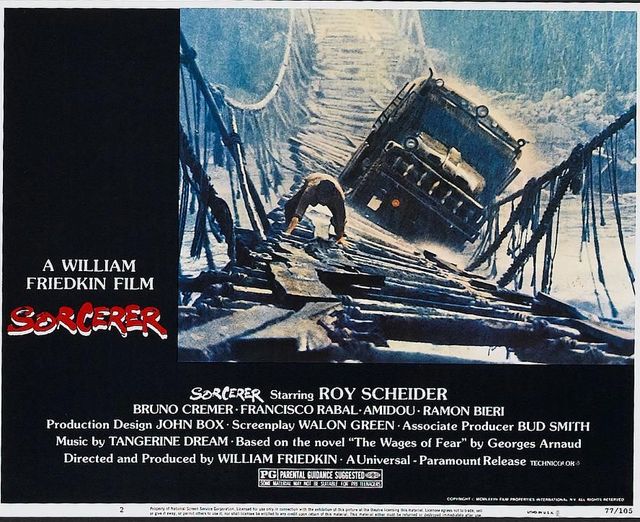
Sorcerer (1977)


Panned and largely ignored on its initial release (although it was up against Star Wars at the Box Office), Sorcerer is a beautiful, brutal and unbearably tense film.

The first half an hour or so is set up, where we learn something of the back story of Nilo (Francisco Rabal), a hitman who pulls off a killing in Mexico, Kassem (Amidou), an Arab terrorist who has just set off a bomb in the middle of Jerusalem, Serrano (Bruno Cremer), a crooked French banker, and gangster Scanlon (Roy Scheider) who has to flee after robbing a church and killing a priest whose brother is in the mob. All four find themselves in the South American town of Porvenir, a dismal place where, to quote Hunter S. Thompson, "men sweat 24 hours a day". With funds low and desperation high, their only way out is to drive trucks full of highly unstable Nitro-glycerine over treacherous mountain dirt roads to help put out a fire at an American owned oil well.

The film takes the same source (the novel Le salaire de la peur) as the 1953 French thriller The Wages of Fear. However, director William Friedkin, who denied this was a remake of the earlier film, stamps his own personal style on to the material with a mix of the documentary realism and stylised imagery seen in The Exorcist.

There is shaky handheld close-up camera work, which bring us right into the chaos and confusion, but Friedkin also seems to anthropomorphise objects. The jungle sometimes feels like a malevolent sentient being, with vines and branches leaping out from nowhere to attack the trucks, and, when viewed from the front with their headlamps glowing in the dark like eyes, the trucks almost have a life of their own, like beasts that the men are riding on an ancient mythical quest. Friedkin is also comfortable with regular passages of non-English dialogue, or even long passages of no dialogue whatsoever, using images to tell the story.

Visually the palette is rich, with blue skies and green jungle backdrops contrasted with fiery orange explosions and the ubiquitous brown mud. Sound also plays a big part in the film, from Tangerine Dream's creepy, gloomy score to the contrasting scenes of noisy chaotic action, and total silence.

The brilliant direction is backed up by a brilliant cast, headed by Roy Scheider, who, despite playing a mafia hitman, brings the same likeable and identifiable everyman quality to his role that he did in Jaws. From the rest of the cast Bruno Cremer makes the most impact, as the suave playboy thrown from a world of luxury and money into one of sweat, toil, desperation and poverty. These are people trapped by location and circumstance of their own making.


The other character is that of the landscape itself, which suffers as much as any of the people, both from the trucks ploughing through trees and churning up mud, and the fires and pollution of big business.


Wednesday, 14 June 2017

Rear Window (1954)


One of Hitchcock greatest films, Rear Window is an ode to voyeurism that effortlessly combines mystery, wit, and romance, and has some interesting things to say about both the movies and moviegoers. Hitchcock is at the height of his powers, and his complete control of the film means there is not a wasted scene or line.

James Stewart plays L.B. Jeffries, a globe-trotting, thrill-seeking news photographer whose last assignment left him with a broken leg. Apart from visits from his socialite girlfriend Lisa (Grace Kelly), and his insurance company nurse Stella (Thelma Ritter), he is forced to spend the summer cooped up in his apartment, passing the time by taking an interest in the lives of his neighbours in the courtyard opposite. There is the beautiful ballet dancer, the newly married couple, Miss Lonely Hearts, a composer struggling with writer's block - and a salesman, Lars Thorwald (Raymond Burr) and his bedridden wife. When the wife mysteriously disappears, Jeffries begins to think there is something sinister going on.

The whole story takes place in one room, something Hitchcock had attempted before with the flawed but interesting Rope, but here there are two important differences. Firstly, while Rope was set in real time, Rear Window takes place over a week or so, giving more time to introduce the characters and build up the storyline. Secondly, in Rear Window, the location is used to provide a portal into a much larger world.

The window itself becomes a metaphor for the screen that we watch the film on. What he is seeing is just like a movie. The characters and story form, he gets gripped by this, but at tense heart stopping moments, he is almost always as powerless to intervene as we are, and like us, is reduced to the role of passive voyeur.

The theme even extends beyond the on screen characters, to take in our viewing of the relationship between the two leads. There is great chemistry between the leads, and several times Hitchcock shoots passionate scenes between Stewart and Kelly in such an extreme close manner that we begin to feel like voyeurs.

However, in a further twist, Jeffries goes beyond the role of passive voyeur, when he tries to intervene in the plot of the unfolding story. After antagonising his chief suspect, said suspect performs the equivalent of the movie monster coming out of the cinema screen and into his real life, threatening him physically.

Hitchcock's genius is to set all this within a tense, witty suspense thriller with two gorgeous likeable and charismatic stars, and a great supporting cast, particularly the sinister Burr, and Thelma Ritter as Jeffries' droll nurse Stella, whose disapproving attitude towards the sleuthing soon morphs into morbid fascination.


Friday, 17 March 2017

The Love Witch (2016)


The Love Witch is not just an intoxicating homage to both 1970s sexually charged exploitation films, and the dreamlike psychological thrillers of the Giallo genre, or Vertigo era Hitchcock. Beneath the lush colours, nudity and violence, writer / director Anna Biller has also crafted a thought provoking exploration of female identity.

Elaine (a breakthrough performance by Samantha Robinson) is a beautiful, self-absorbed witch who breezes into a Californian town to find a new husband to replace her previous murdered one. Her search leads to men falling at her feet - and then falling down dead. As Griff, the police officer investigating the deaths gets closer to the truth, will he be next to fall under her spell?

The heady intoxicating world in which all this takes place looks like a mix of classic Hollywood Technicolor and a perfect pastiche of the rich colours (and hairy characters) of sixties and seventies European exploitation cinema. This is all complemented by the sort of soundtrack of lush strings and female solo voice often found in those sorts of films.

Writer/director/editor/producer Anna Biller has Wes Anderson levels of detail in creating her completely self-contained cinematic universe, which, like Anderson's, feels both real and completely imagined. When late in the film, one character pulls out a mobile phone, the effect is jarring, making you wonder if the whole thing is set in contemporary times after all, albeit completely re-imagined in Elaine's mind. 

The story is pulpy, melodramatic and absurd but works better for taking place within this slightly artificial environment. The acting style ranges from (deliberately) am-dram to understated, all of which seems inexplicably chilling, as artificial and persuasive as a nightmare.

Beneath the masses of style is substance too, in the examination of some of the stereotypical roles men and ascribe to themselves and each other. Elaine in particular seems to have swallowed the idea of presenting herself as a sex object for men to take care of. This buys her some power over them, but when they crave an emotional connection, she seems to find the cognitive dissonance between fantasy and reality too much to take.


THE LOVE WITCH Trailer (Romantic Comedy, 2016) by hotmovietrailer

Tuesday, 14 February 2017

The Hand (1960)


The Hand has a grisly premise and a seedy atmosphere but the film loses its way with a talky confused script, uninteresting characters, and poor acting.

Starting in 1940s Burma, the story sees three captured British soldiers being interrogated by the Japanese. When two of them each have a hand chopped off, the third agrees to talk. Cut to 1960s London and a policeman makes a gruesome discovery - a tramp who is missing a hand - is there a link back to the events in the Far East?

The majority of the film is taken up with the police investigation involving Inspector Munyard and his sidekick Sergeant Foster, two solid, characterless, permanently smoking detectives. The investigation mostly consists of the two of them talking, going to places, talking some more, and then smoking, which does not make for gripping cinema. It is not helped by the poorly written script, which feels like a great central premise that nobody knew how to write a pay-off for. The fractured, hard to follow storyline feels like certain key expositional scenes were either not written, not filmed, or cut out.

Having said that there is, for the time it was released, occasional brutal (if off screen) violence, and some surprisingly coarse language. The Hand also has a rather pleasing ambience of Trad Jazz, fog and Brylcream, so if those things appeal, come for the story, stay for the atmosphere.


Sunday, 23 October 2016

The 39 Steps (1935)


Fast paced, sexy and brilliantly written and directed, The 39 Steps is a landmark in the career of Alfred Hitchcock that lays out his distinctive vision, both in terms of story and cinematic technique.

A simple evening at a London music hall turns into a nightmare for Richard Hannay (Robert Donat), when it ends in gunshots, a panicked crowd and a beautiful and mysterious woman who calls herself Annabella Smith (Lucie Mannheim). After a trip back to Hannay's flat, Smith reveals that not only is she a spy, but she is being pursued by enemy agents after uncovering a plot to steal British military secrets. When Smith is murdered in his flat, and Hannay framed for the crime, he has no choice but to go on the run, using the little information Smith and told him to find the secrets and clear his name. With this being a Hitchcock film, we also get a beautiful blond woman to join him for the ride.

The film starts off at a roaring pace and barely stops for breath. Within twenty minutes of screen time Hannay goes from rakish man about town to wanted man on the run. Hitchcock effectively deploys one of his trademark storytelling devices, The MacGuffin. This is an object or person that presents the motivation or goal for a character, in this case the stolen military secrets, and drives the story, without ever overwhelming it, so the audience can enjoy the digressions.

Hitchcock also shows an assured and developed cinematic technique, going far beyond the simple static framing and sluggish editing of some of his contemporaries. He uses the camera lens to manipulate the point of view and knowledge of the audience, mixing suspense and surprises, and throws in simple but effective methods such as quick transition shots showing changes of location help keep the breakneck pace.

All of this is aided by, as you would expect from Hitchcock, a well constructed script, with set ups and pay-offs. The "innocent man caught up in something dangerous" plot was something that Hitchcock had used before in the silent film The Lodger and the original version of The Man Who Knew Too Much and would use again, most notably in North by Northwest. But here is where we see him first trying other tropes and ideas that he would come back to, the sharp witty dialogue, such the icy cool blonde female sidekick, and the chemistry between the two lead actors. It is also a surprisingly, for the time it was released, sexy film, whether in the scene of the two stars handcuffed together on a bed, or the conversation between two ladies underwear salesman on a train.

The story itself does sound absurd, and at one point one character says that Hannay's tale "sounds like a spy story". This is the case with many of Hitchcock's films, but to use this is as a criticism is to miss the point of what a film like this is about. It does sound absurd, but, like somebody trapped in a dream, that is what he has to deal with, an ordinary man in an extraordinary situation.