Horror and Sci-Fi films old and new, weirdo trash, arthouse, forgotten gems, well loved classics, and I'm watching the original Dr Who from the beginning.
Phantasm is a delirious mix of gore and laughs shot through with the claustrophobic lack of logic of a child's dream. Topped with a Goblin-esque synth based soundtrack, the end result is pitched somewhere between American suburban horror and baffling Euro weirdness, and is a unique and original effort in both subject matter and execution.
Still reeling from the death of his parents, Jody is a troubled teen who is being raised by his older brother in a small Oregon town. While spying on the local funeral home he begins to get suspicious of what is going on there, particularly the hooded dwarves who keep attacking him, and the mysterious Tall Man (played by the brilliantly chilling Angus Scrimm), who can lift a full coffin as though it were a surf board. Who is he and what are his plans for the funeral home residents? And will Jody end up joining them?
Phantasm is chaotic and not always entirely coherent, with some scenes seemingly cutting short or baring no relation to what has gone on before or since. Some of this may be down to time and money, as writer/director Don Coscarelli shot the film at weekends for a few hundred thousand dollars. But this lack of logic often works well, giving the feel of a child trapped in a nightmare, which contributes to the tension. With all the normal rules suspended, anything could happen, and you genuinely don't know what will crop up next.
This sense of being in a child's dream is heightened by the fact that Jody doesn't seem to go to school and during the course of the film gets to do the sorts of things that an adolescent boy would fantasise about, such as shoot guns, drive fast cars, and drink beer. The dream feeling is further enhanced by frequent scenes of characters being chased, something that Jungian therapists consider both common to the human experience and symbolic of someone avoiding confronting some painful emotion or feeling.
Phantasm has more than enough blood for the average gore hound, especially in scenes involving the iconic flying sphere. However, much of the horror comes from the discomfort and unpleasantness of the thought of the remains of the dead, especially those of loved ones being violated and exploited.
An Eastern Westerner is a breezy, no nonsense Harold Lloyd comedy, that makes up for a lack of big belly laughs with the charm, upbeat persona, and energy of its star
Lloyd plays a spoiled young New Yorker, living the high life at his increasingly frustrated parent's expense. After one party too many, they decide to send the boy to a relative’s ranch out west in the town of Piute Pass ("It's considered bad form to shoot the same man twice on the same day."), where he falls foul of every cowboy cliché and trope you can think of.
The plot is flimsy, and the gags take precedence, as often the case with short silent films of this era. Although he did not have the vaudeville background of Keaton or Chaplin, Lloyd was still incredibly agile and athletic, as showcased here with some hair-raising stunts and great chase sequences (even if one does involve a disconcertingly Klan-like hooded gang).
Obviously, it looks a little crude and underdeveloped compared to his later, more assured works such as Safety Last, An Eastern Westerner is still well worth a look, both for the laughs and to compare it to the later films and see how people like Lloyd helped shape the medium.
Horror and satire seem to make for a potent mix and Get Out is the latest entry in this sub-genre, joining the likes of The Stepford Wives and They Live. With genuine scares and a relevant social message, the film is a pitch perfect mix of excruciating satire and nerve shredding horror
Chris Washington (a star-making turn from British actor Daniel Kaluuya) is a young black man getting ready to visit the family of his white girlfriend, Rose Armitage at the upmarket country estate where they live. But no matter how friendly and welcoming everyone is, there is no denying something weird is going on. Why do the family's black housekeeper and grounds keeper, Walter and Georgina, seem so passive and mindless? What is going on with Mrs Armitage's hypnosis techniques? And why is one of the Armitage's guests warning Chris to "Get Out"?
This is a remarkably assured début from writer director Jordan Peele, who manages to get the balance between shocks and satire right, so that one does not overwhelm the other, and makes the shocks and satire genuinely shocking and funny respectively. The script is a master-class in discipline and structure, with hardly a wasted scene or line, clever set-ups that all pay off, and some great lines ("I would have voted for Obama a third time if I could"). Peele also throws in plenty of horror tropes that genre fans will instantly recognise, but does not rely on them to plug gaps in the story.
The cast is also uniformly excellent, led by Daniel Kaluuya as Chris, trying to retain his cool and dignity in the face of increasingly weird and uncomfortable events. As the Armitage parents, Catherine Keener and Bradley Whitford combine a welcoming charm with an unnerving forcefulness and underlying menace, and Caleb Landry Jones is memorably obnoxious as Rose's brother Jeremy.
Race is always in the news, but recent events have made this film feel even more relevant. However, what makes Get Out so different and successful is the unexpected way the topic is tackled. There are some scenes of Chris falling foul of authority figures, but the main focus of this theme is elsewhere. Equally hurtful is the patronising privileged condescension from the white liberals at the Armitage house. Despite their friendly attempts to ingratiate themselves, for them, black people are judged purely in terms of how useful they are.
The Love Witch is not just an intoxicating homage to both 1970s sexually charged exploitation films, and the dreamlike psychological thrillers of the Giallo genre, or Vertigo era Hitchcock. Beneath the lush colours, nudity and violence, writer / director Anna Biller has also crafted a thought provoking exploration of female identity. Elaine (a breakthrough performance by Samantha Robinson) is a beautiful, self-absorbed witch who breezes into a Californian town to find a new husband to replace her previous murdered one. Her search leads to men falling at her feet - and then falling down dead. As Griff, the police officer investigating the deaths gets closer to the truth, will he be next to fall under her spell? The heady intoxicating world in which all this takes place looks like a mix of classic Hollywood Technicolor and a perfect pastiche of the rich colours (and hairy characters) of sixties and seventies European exploitation cinema. This is all complemented by the sort of soundtrack of lush strings and female solo voice often found in those sorts of films. Writer/director/editor/producer Anna Biller has Wes Anderson levels of detail in creating her completely self-contained cinematic universe, which, like Anderson's, feels both real and completely imagined. When late in the film, one character pulls out a mobile phone, the effect is jarring, making you wonder if the whole thing is set in contemporary times after all, albeit completely re-imagined in Elaine's mind. The story is pulpy, melodramatic and absurd but works better for taking place within this slightly artificial environment. The acting style ranges from (deliberately) am-dram to understated, all of which seems inexplicably chilling, as artificial and persuasive as a nightmare. Beneath the masses of style is substance too, in the examination of some of the stereotypical roles men and ascribe to themselves and each other. Elaine in particular seems to have swallowed the idea of presenting herself as a sex object for men to take care of. This buys her some power over them, but when they crave an emotional connection, she seems to find the cognitive dissonance between fantasy and reality too much to take.
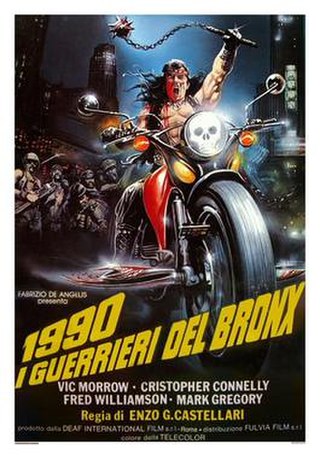
What it lacks in originality and coherence, 1990: The Bronx Warriors more than makes up for in energy, glorious cheese, and a pulsing soundtrack.
Like many of the film's contemporaries, there is much in common with other successful genre films, in this case Mad Max 2, The Warriors and especially Escape From New York.
The year is 1990 and the US government has given up trying to police the Bronx, instead sealing the area off and leaving it to the gangs and criminals still there. Meanwhile, Anne, the teenage heiress to a giant arms manufacturing corporation is having some moral questions about her upcoming inheritance, so she runs away to the Bronx to join a biker gang. But the Corporation isn't about to let her go that easily, so enter ruthless, psychopathic mercenary Hammer (played by Vic Morrow), who has orders to get her back by any means necessary.
Although the premise and characters may sound like a none too subtle imitation of Escape from New York, it is not quite as straightforward as that. Carpenter's film paints Snake Pliskin as an anti-authoritarian nihilist, while Hammer is simply a gun for hire, who, by the end, turns into a pantomime villain. Genre stalwarts Fred Williamson and Christopher Connelly (The Atlantis Interceptors) take on the Isaac Hayes and Ernest Borgnine roles as Ogre the gangster and Hot Dog the cabby, the former being more of a Robin Hood figure than an outright villain. Meanwhile the biker gangs are actually the easiest to cheer for, coming across as the little Davids taking on the Goliath that is the Corporation.
Some clever shooting and editing helps cover up the limited resources available to the filmmakers, and there are some nice goofy touches such as the supposedly menacing gang on roller skates (no match for guys on bikes) or the drum solo on the soundtrack that, as the camera pulls back reveals an actual drummer playing away in the middle of some wasteland for reasons best known to himself.
The script has a few head scratching moments but also an energy that stops it from ever getting dull. Essential trash viewing.
The Hand has a grisly premise and a seedy atmosphere but the film loses its way with a talky confused script, uninteresting characters, and poor acting.
Starting in 1940s Burma, the story sees three captured British soldiers being interrogated by the Japanese. When two of them each have a hand chopped off, the third agrees to talk. Cut to 1960s London and a policeman makes a gruesome discovery - a tramp who is missing a hand - is there a link back to the events in the Far East?
The majority of the film is taken up with the police investigation involving Inspector Munyard and his sidekick Sergeant Foster, two solid, characterless, permanently smoking detectives. The investigation mostly consists of the two of them talking, going to places, talking some more, and then smoking, which does not make for gripping cinema. It is not helped by the poorly written script, which feels like a great central premise that nobody knew how to write a pay-off for. The fractured, hard to follow storyline feels like certain key expositional scenes were either not written, not filmed, or cut out.
Having said that there is, for the time it was released, occasional brutal (if off screen) violence, and some surprisingly coarse language. The Hand also has a rather pleasing ambience of Trad Jazz, fog and Brylcream, so if those things appeal, come for the story, stay for the atmosphere.
Long before dark and moody superheroes were all the rage, 2000AD was presenting a bleak, funny and subversive take on the comic genre. Future Shock does an excellent job of gathering together many of the names who created and nurtured the magazine, and presenting their funny, astounding and, at times, contradictory stories of how it all happened.
We see the rise both artistically and commercially, as it strikes a chord with 70s readers through strips such as Strontium Dog, Halo Jones, and the legendary Judge Dredd. We also get the lows in the 90s when a dip in the quality of the writing, coupled with poor management and jaw-droppingly stupid marketing ("Women just don't get 2000AD") nearly saw the comic fold.
Watching the parade of faces, it's astonishing to think what a school of talent 2000AD has been, from the early days of Alan Grant, Alan Moore (absent in person, but instantly recognisable in photographs) and mainstay Pat Mills, through to the 80s and 90s eras of the likes of Neil Gaiman and Grant Morrison.
The main thing the documentary achieves is placing 2000AD into a historical and cultural context. The original group of writers and artists all say how the grim world of 1970s England, with strikes, food shortages and riots, along with the angry energy of punk, all fed into their stark vision of the future. In turn a generation of writers, film-makers and musicians have all had their lives and imaginations shaped by the comic. This ranges from modern writers such as Lauren Beukes, to musicians like Scott Ian from Anthrax (who wrote I am the Law about Judge Dredd) to filmmakers like Alex Garland (who wrote and produced the second and far superior Judge Dredd film) and Richard Stanley, whose 1990 film Hardware borrowed so liberally from a 2000AD strip called SHOK! that the lawyers had to get involved.