Horror and Sci-Fi films old and new, weirdo trash, arthouse, forgotten gems, well loved classics, and I'm watching the original Dr Who from the beginning.
Released just
months after King Kong, and using much of the same cast and crew, Son of Kong
is no match for the original. Despite some unique touches, and a likeable title
character, the rushed ending and talky script make this sequel sometimes
exciting, but, too often, dull.
The film opens
with Carl Denham, the man who bought King Kong to New York, penniless and up to
his neck in lawsuits from the death and destruction that caused by Kong.
Jumping at the chance to get out of the country, he takes a job on a cargo
ship, where he meets Nils Helstrom, the man who sold him the map to Kong Island
in the first place. Helstrom is now full of tales of buried treasure on the
island and says he wants to go back there - but is something much dangerous
waiting for them instead?
The screenplay
feels poorly thought out and put together in a rushed manner, which, given how
quickly the film was released after the original, surely must have been the
case. It assumes you have some knowledge of the first film, but given how fresh
it would have been in the minds of the movie going public (and the extent to
which the character of King Kong is still part of popular culture) this is
unlikely to be a problem.The first half
is relentlessly talky, with dull dialogue delivered in a wooden manner, and
while things pick up slightly when the characters reach Kong Island, there is
still no momentum to the search for the treasure, a wasted opportunity.
The film only
really comes to life during the action sequences, particularly the fights between
Kong Junior and the assorted beasts, such as giant bears and dinosaurs that
inhabit the island. While the special effects look dated, and not as carefully
constructed as in the first film, presumably due to lack of time and money they
are still elaborate and well done. Kong Junior comes across as more than just a
roaring beast, being quite charming at times, and even a bit goofy and
childlike, at one point doing a shrug of his shoulders to camera.
As is common in
many of the films of the time, the attitudes to race look very dated. However,
both the “Ooga Booga” tribesmen that the party encounter on the island, some of
who look obviously blacked up, and Charlie the Chinese cook and his broken
English are both too silly to cause any serious offence, being more insensitive
than intentionally offensive.
In the closing
few minutes, with an earthquake appearing from out of nowhere to destroy the
island, we finally see the characters in some real peril, with a chance they
might not all get out alive. Unfortunately, the rushed nature of the film means
that we have not had time to get to know any of them, and when one does make
the ultimate sacrifice, there is little emotional impact.
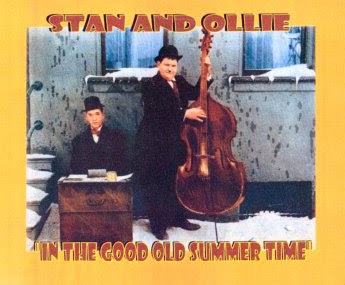
With Laurel and Hardy, the two main
characters stay the same, but their circumstances and situations vary from film
to film. Sometimes they have wives, sometimes they have jobs, and sometimes
they have houses. In Below Zero, they
have none of these, only a harmonium, a double bass, and their rather limited
musical ability, with which to try to survive a harsh winter.
The humour comes from familiar sources,
slapstick, misunderstandings (playing music outside a deaf centre is never
going to be a success), bad luck and petty fighting with each other and the
rest of the world, which invariably leads to destruction of property. The duo’s
instruments do not survive the first half of the film, as they eventually push
a woman too far. As in other Laurel and Hardy films such as Big Business, the
destruction almost becomes a stylised ritual, and the duo make no attempt to
stop it, seemingly almost resigned to their fate.
The direction is straightforward, largely
consisting of pointing the camera at the stars and fixing it there. However,
there is one scene, involving a bird laying an egg that uses editing to tell
the joke by implying through the juxtaposition of shots, a sign that the
language of film was getting more sophisticated as people began to explore the
unique possibilities of the medium.
Below Zero also contains two elements of
Laurel and Hardy that can sometimes be overlooked. First is the touching bond
of friendship between the two, which is always there even if it is often buried
beneath the bickering. When, after being beaten up and thrown out of a
restaurant, Olly is calling out for Stan, he seems genuinely concerned that his
partner is missing.
The second is the bizarre, cartoonish
climax that sees Stan end up with a grotesquely distended belly after drinking
the entire contents of the huge barrel of water in which he has been dumped,
the sort of gag I would expect to find in a Tom and Jerry or Looney Tunes
cartoon. However, such bizarre surrealism is something that crops up from time
to time in their films, such as the ending of Dirty Work, where a mad scientist
and his anti-aging serum turn Olly into a chimp.
Below Zero was one of several films reshot
in foreign languages, in this case Spanish, in order to cash in the popularity
they had achieved as silent film stars in Europe. Instead of dubbing the film
it was completely remade, with Stan and Olly saying their lines in broken Spanish
(and Stan struggling to get past his Lancashire accent), and most of the other
actors with speaking parts replaced by people who speak the language.
For financial reasons, these versions
needed to be slightly longer than the usual 20 minutes, leading to extra or
reworked scenes. These range from the opening scene introducing the policeman,
and the back-story about his wallet and money that the duo inadvertently
acquire, to extended version of the scene with a blind man, that lacks the
short simplicity (and humour) of the English version. These feel exactly like
the padding that they are, and interesting though it is to watch, this version
adds nothing to the original, which favours quality over quantity.
Sharing the same mentality (and hailing
from the same part of the world) as early Peter Jackson films like Bad Taste
and Brain Dead, Body Melt has some good ideas, but is derailed by an unfocussed
script. What is left is good looking, and sporadically extreme and gory, but
ultimately, slightly too dull to be a classic.
Residents in the quiet suburban Australian
street of Pebbles Court have started getting free vitamin pills in the mail,
pills designed to make them into the ultimate healthy human. Unfortunately they
also seem to have unexpected side effects such as hallucinations and grotesque
mutations. With the bodies piling up, can police find the source - and does it
have anything to do with the kindly local doctor with a mysterious past?
Body Melt is the brainchild of director
Phillip Brophy and he certainly gives the film a strong, consistent visual
style, particularly in the scenes set in Pebbles court, with the houses and
people alike shown in bright, almost nauseatingly lurid colours, reminiscent of
films like Parents or Blue Velvet.
However, as co-writer and composer, he also
has to shoulder some of the blame for the film's two major shortcomings, the rambling
script, and weak soundtrack. After a great opening that sets up plenty of
intrigue around the premise (as well as giving us a car crash victim with
tentacles crawling out of his neck wounds) things soon taper off, and the
energy dissipates as the script cuts between the different characters from the
street, in long and sometimes seemingly pointless scenes. The credits say the
script is based on a series of short stories by Brophy, and that might go some
way to explaining why none of the plot lines really gel together,
The tinny electronic soundtrack is also
largely down to Brophy, and adds nothing to the power or mood of any of the
scenes, as well as being monotonous enough to quickly become tiresome.
Thankfully, there is still enough to enjoy making
it worth a look. The comic book feel of the film invites some fun overacting,
and the cast are more than up to the challenge. Best of the bunch is Ian Smith
as the town doctor, and British viewers may remember him as Harold Bishop from
the Aussie TV soap Neighbours.
Although some of the ideas, such as mutant
cannibals and melting bodies, are obvious nods to films such as Street Trash,
or The Texas Chainsaw Massacre, placing them in new contexts such as housing
estates or the Australian outback gives them a fresh feel that avoids them
feeling stolen.
There are some wholly original touches too,
such as the musclebound hunks that make up the staff of the Health farm, and
all speak with squeaky high-pitched voices, and the scene involving a pregnant
woman and her husband being attacked by a mutant placenta is, unsurprisingly,
done in wonderfully poor taste, and injects some much needed, and all too rare
energy into the film.
When watching Shakespeare on the big screen I always look for how the director has adapted the play for the medium. Franco Zefferelli's Hamlet is an excellent example of someone willing to expand the text in such a manner, but despite a relentless pace, an epic feel, and an excellent supporting cast, the film is let down by the star.
Although largely faithful in story and setting to the play, Zefferelli has chopped and changed the text slightly. The changes make for an interesting, pacey film, that those not familiar with the text can follow, and shows he is not intimidated or overawed by the thought of taking on Shakespeare.
Even with the cuts the films still retains the themes of loyalty, betrayal, madness, life and death, and Zefferelli plays up the Oedipal sexual tension between Hamlet and Gertrude (played by Glenn Close), without it ever spilling over into being sleazy.
Much of the film was shot on location at Dover Castle in Kent, as well as several places in Scotland, and this helps to anchor the events in reality, as does a lack of any expressionistic flourishes.
Unfortunately, the main problem with this version of the story is the star, with Gibson trying too hard to be a serious actor, relying far too on raised eyebrows and bulging eyes to convey intensity and drama, leaving a performance that is ultimately earnest, but flat. In addition, Gibson looks too old to convince as a troubled youth, something only accentuated when he is next to Glenn Close (in real life there is only 10 years between them).
Thankfully there is an excellent supporting cast, led by particularly the experienced Shakespearian types such as Paul Scofield, Alan Bates, and Ian Holm, who effortlessly breathe life into the text.
Judged as Shakespeare, this is not a classic Hamlet, lacking the depth and gravitas of other stage and screen versions (particularly Olivier's 1948 film, and Kenneth Branagh's 1996 version). However, it is certainly a good introduction to the play for the uninitiated, and judged purely as a stand-alone film, it makes for entertaining, and, at times, thought provoking cinema.
The swashbuckler
is a film genre almost as old as cinema, and while not one of the best
examples, Captain Horatio Hornblower RN is still an entertaining film. A
meandering and occasionally sluggish script is compensated for with great
special effects, exciting battle sequences, lush Technicolor, and an endearing
performance from Gregory Peck as the stern but fair title character. It is also
easy to see the influence of Hornblower on one famous sci-fi saga.
Combining
elements of three of C S Foresters Hornblower novels, the plot sees the
Captain, his ship and crew on a secret mission to Central America during the
Napoleonic wars at the turn of the 19th century. Hornblower find himself
battling not just the Kings enemies, who change according to the whims of
politics, but tragedies at home, and the unwelcome appearance of a woman on his
ship
By using three
books, seemingly unconnected, it does mean the plot often lacks a single
driving force, with the main focus being on the character of Hornblower himself,
who comes across as a man of integrity and intelligence, a stoical man who
always does his duty, but certainly not a martinet, or a macho show off.
However, his stiff upper lip becomes a barrier, meaning we never really get
inside the mind of Hornblower.
Director Raoul
Walsh usually made more contemporary, and more land based films, which might
explain why it never feels like he gets totally to grips with the genre and the
setting. However, when the action does kick off it is first rate, with exciting
battle sequences, backed up with excellent special effects, a stirring musical
score from Robert Farnon and lovely rich looking Technicolor.
Gregory Peck plays
Hornblower with a relatively understated authority, rather than the brash
machismo of someone like Errol Flynn, and his charisma help keep your attention
through the slower parts of the film. The main stand out in the supporting cast
is James Robertson Justice as Quist, the seaman who helps Hornblower escape
capture by the French. Although better known to me as the demanding surgeon Sir
Lancelot Spratt in the "Doctor" films with Dirk Bogarde, he certainly
brings a more down-to-earth quality to the character of Quist, and would go on
to head out to sea with Peck in Moby Dick and The Guns of Navarone. Also, look
fast for a cameo from a young and just about recognisable Christopher Lee, as a
Spanish naval captain.
As a footnote, I
had not realised the extent of the influence of Hornblower on the creation of
Star Trek. The basic premise of a ship, its captain and crew, far from home, being
plunged into dramatic situations (often with a military or diplomatic background)
is easily transposed into outer space. While Kirk is perhaps more macho (and more
of a ladies man) than Hornblower, both are bold, decisive men of action, and
both have loyal first officers, and, in this film at least, cantankerous ship’s
doctors.
Although
arguably best known for his work with other directors, particularly Alfred
Hitchcock, Saul Bass had his one and only stab at making a feature film with
this apocalyptic sci-fi oddity. Phase IV
does mine some of the same territory as Hitchcock’s The Birds, with humans being challenged for their place at the top
of the natural hierarchy, but instead of glamorous stars and taut, suspenseful
set pieces, Bass goes for a mix of icy cold detachment, surreal and
experimental montages, and a subtly unnerving design aesthetic.
An
unexplained cosmic event has caused ants to evolve and seemingly develop an
advanced "hive" mind, leading to some perplexing behaviour on their
part. Two scientists set out to investigate strange towers that the ants have
started building in the desert, but quickly find themselves outnumbered and
outmanoeuvred, and soon, the future of the human race is under threat.
Bass
started life as a graphic designer, making film posters, before moving into his
memorable title sequences such as The Man
with the Golden Arm, Vertigo and Psycho, so it is no surprise to see that
his strengths as a director lie in the visual side of things.
Other
ant themed films such as Them or Empire of the Ants, have the insects
portrayed as equal or larger size as humans, using models or trick photography
to establish this, but with Phase IV,
Bass takes a different approach. He drafted in wildlife photographer Ken
Middleham to shoot the amazing macro zoomed footage of ants that takes up a
good chunk of the screen time. Any time the ants are shown physically adjacent
to humans they are normal size, and rather than being physically overwhelming
monsters, it is their ingenuity and overwhelming numbers that makes them
seemingly unstoppable. By giving so much screen time to the magnified scenes,
it does subtly imply a comparison and equality between the two species.
The
story is more opaque than confusing, and there is extensive use of voiceover to
provide the exposition, a trick sometimes used to cover over gaps or problems
in the script or production. Here it works to the film's advantage, so that we
are not bogged down in the narrative, and can focus on the visuals and the
interplay between the two scientists, the excitable Hubbs and the more reticent
Lesko.
Hubbs,
(played by veteran British character actor Nigel Davenport), is the real human
star of the show. Utterly devoted to his work, he is able to see the up
close, micro level world of the ants, and their wider implications their
behaviour has for the world. However, he seems utterly oblivious to the effects
of his actions on the world between those two, that of individual human beings,
especially when he starts wanting to provoke the ants.
Lesko,
(Michael Murphy) is more quiet and reserved, preferring to use his analytical
skills to try to understand and communicate with the ants, so makes less of an
impact as a character, but still plays a pivotal role in the story. The weakest
link in terms of characterisation is Kendra, played by the late Lynne Frederick,
a young girl taken in by the scientists after the ants destroy her Grandparents
farm, and Hubbs inadvertently kills her Grandparents. The role is underwritten,
and the tensions caused by being trapped in the bunker with Hubbs are never
really explored. This is not helped by Frederick being wooden and ineffectual,
and having an accent that veers all over the Atlantic.
Things
like this might have been picked up by a different director, but the impression
I got, given the dominance of the visuals, is that that this is where Bass had
the most talent and interest, and was perhaps quite happy to leave the actors
to get on with things by themselves. This is fine when you have an actor of
Davenport's calibre, but less so with one of Frederick's.
Although
this is the only full length feature Bass ever directed, he had a rich body of
work both in and out of the film world, and we can see some recurring themes
from this in Phase IV. A glance at
his film posters and opening titles, and even his corporate design work, shows
a fondness for clear lines and geometric shapes
We
see this in the designs of the ant nests, which incorporate clean, straight
lines to give them a modernist look, unlike the rough and ready mounds of earth
we are used to seeing, a neat way of underlining the mysterious change that the
insects have undergone.
The
rest of the film looks just as exquisite, especially the landscapes and
homesteads, ravaged by the unstoppable insect army, adding to the feeling of
inevitable defeat of mankind.
The
only serious weak point is the way the film ends, not with a bang, but a
whimper. However, this is not the fault of Bass, as somebody at Paramount
studios decided that the final montage, which somehow manages to be even more
disturbing and strange than anything that has gone on before, was too much, and
cut it from the released version. Unseen for decades, thankfully, the footage
has recently resurfaced, and it feels like the logical extension and conclusion
of what has gone on before, both in terms of the style and content.
Although
only about 3 minutes in length it distils everything that the film has been
leading up to at this point, and is a master class in surreal cinematic
montage. Commencing with our hero’s descent into a hole, to the underworld of
the ant kingdom (Freud/Jung fans, read into that whatever you like), after
that, without a single spoken word, it sums up the grim, seemingly inevitable
vision the ants have for the future, with the inevitability of the end of
humanity as the dominant species.
Aside
from the apocalyptic elements, the hopeless irreversibility of the ending, the
feeling that things will never be the same again, taps into the ideas of the
human fear of impermanence, and the futility of fighting against it. This
reading invites us to think of the ants representing death itself, something we
can control only temporarily before succumbing to, something that will
permanently change life and existence.