Thursday, 5 January 2017

Django (1966)


Despite being fifty years old, Django remains a brutal and disconcerting entry in the spaghetti western sub-genre.

Across a bleak muddy landscape, a lone figure in a Union Army uniform drags a coffin behind him. The man is Django, a former soldier with a secret from his past and a secret in his coffin. These secrets will soon drag him into the paths of a prostitute named Maria, a racist confederate ex-soldier and his hood wearing henchmen, and an excitable gang of Mexican revolutionaries.

All Westerns are slightly surreal and somewhat stylised, especially with the excess or lack of blood, given the amount of bullets fired, but Spaghetti Westerns, the uniquely European appropriation of a uniquely American genre are even more so. Whereas the US versions may celebrate or explore both the light and dark sides of the modern history of the country, the continental equivalents are shorn of that cultural context, and seem to take place in a strange alien world, but the world of Django goes a step further.

The bleak, isolated muddy town looks like a post-apocalyptic war zone, a place where human life has lost all value, where unlucky men are used as sporting prey, the unlucky women used for pleasure, and the "lucky" women get to feel like "real" women and be loved by a man.

The script is offbeat, unpredictable, and shocking. Plot wise, barely more than half an hour and the big twist about the contents of the coffin is revealed, turning the focus of the story elsewhere, with the links between Django and the other characters becoming apparent.

Clearly modelled on the two criminal sides of A Fistful of Dollars, the two gangs in Django are both equally despicable, but director Sergio Corbucci takes things a disturbing step further. The confederate gang dress in in red Ku Klux Klan style hoods, and treat their Mexican prisoners like animals, to be hunted for sport.

Django himself is no angel, repaying the hospitality of Nathaniel the saloon owner by shooting up the bar to demonstrate a weapon to the Mexicans, then later cajoling Nathaniel into driving him to a massacre. It's a testament to Franco Nero that he can make a character like that likeable enough to keep us rooting for him.

What makes Django so compelling is the extremity of so many of the elements, even by the standards of the Spaghetti Western. The dialogue veers between the cringingly cheesy (“I felt like I was a real woman. Someone to protect, and to be loved), and the portentous (“His time hasn't come yet”). The violence is still shocking today, the tone being set in the opening scene of Maria being mercilessly whipped by the Mexicans, after which we get everything from an ear that gets cut off and fed to its owner, to the comical, almost sexual pleasure General Rodríguez takes from watching Django having his hands crushed. Not surprisingly the film suffered with the censors, especially in the UK, with the BBFC refusing a certificate for the film until 1993.

There are also two things in Django that are surprising for this sort of film. Firstly is a modicum of character development. As the end theme music swells, Django walks off into the distance, but in the foreground we see that he has left his gun behind, which throughout the film has been the main way for Django to define himself as a man. Secondly, as he walks off, he has Maria with him, signifying another change in how he defines himself, this time with the love of a good woman. Both of these thing point to a changed man, and a happy ending of sorts, for an audacious and forgettable classic.


Tuesday, 3 January 2017

To Rome With Love (2012)


As enjoyable as it is inconsequential, To Rome With Love could perhaps have done with a second draft of the script, but Woody Allen turns out a pleasant and enjoyable piece of fluff.

The script cuts between four unconnected stories; an office worker who suddenly becomes a celebrity for no discernible reason; an architecture student who finds himself attracted to his girlfriend's actress friend; a young couple whose honeymoon turns into a farce involving a burglar and a prostitute; and an American Opera director who thinks he may have found his next big star - although there is one small but potentially serious catch.

The script has some of the problems that Woody Allen films all seem to have to some extent nowadays. The characters are two dimensional, and half of them are the standard issue American middle class liberal intellectuals, while the script feels under thought out and overwritten at times. However, with the stories being so slight, Allen is probably right not to try and stretch any of them further than he does.

The segments do all have differing styles, from farce to surreal comedy to more standard Allen territory of neurotic white men worrying about relationships, the contrast helping to keep things fresh. The best story is the one starring Allen himself as an Opera director visiting his daughter and her fiancée in Rome. The fiancée's father has the sort of tenor voice that should be on the stage - but he seems to have trouble performing outside of the privacy of his shower. The payoff to this takes the film into the kind of magical realism that Allen touches on every now and then, and as long as you can buy into it, it is hilarious.

As usual Allen seems to be able to scare up A-List celebrities at will, with regulars such Alec Baldwin, Penelope Cruz and Judy Davis, as well as Jesse Eisenberg trying out his Woody Allen impression.

The film looks great too, with Allen taking great care to show Rome off in a very flattering light.


Monday, 2 January 2017

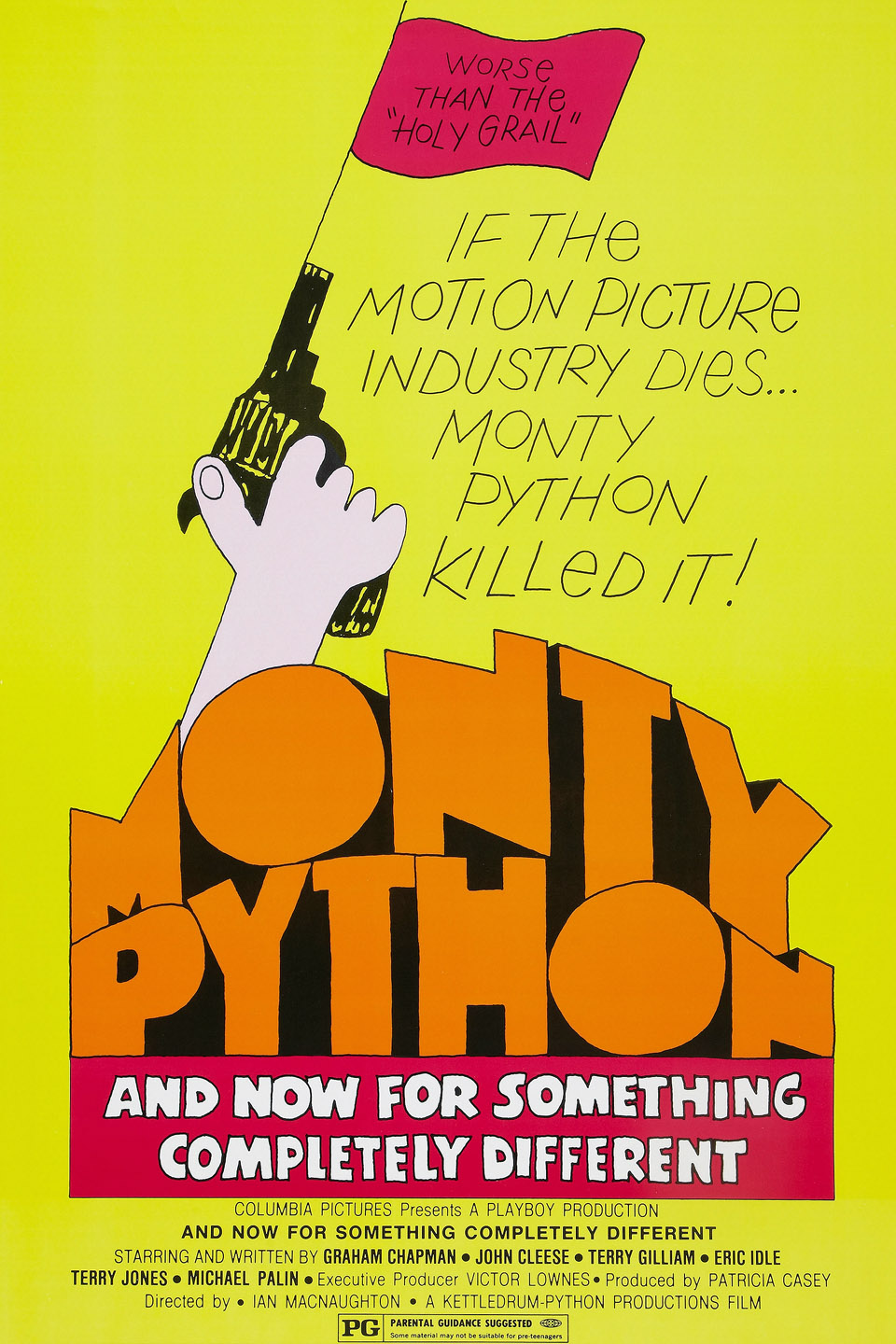
And Now For Something Completely Different


A rather ironic title considering that this is simply a big screen rehash of some of the best and best known sketches from the TV incarnation of Monty Python's Flying Circus. The end result is sometimes frustrating but it is saved by the quality of a lot of the material.

As it is simply a Greatest Hits, there is no plot or unifying theme to speak of, although, as on the TV show, sketches sometimes run into each other, and there are occasional running gags, and Terry Gilliam's jaw-dropping animations.

The film is directed in a workmanlike fashion by Ian McNaughton, who was behind the camera for most the TV show. No attempt is made to expand on the writing or shooting of the original material, although this may have been down to the minuscule budget and schedule. The whole thing was financed by Playboy as a way to try and break Monty Python in the US, but with less money for the whole thing than Heff spends in a week on pipe cleaners. In addition, and it may be a subjective thing on my part, but some of the sketches felt a little flat without the laughter track that I was used to hearing on the TV show.

A nice introduction to Monty Python for the uninitiated, but no match for the later efforts such as Holy Grail and Life of Brian, where, unlike here, the team would have the chance to engage with and take advantage of the medium.


Friday, 30 December 2016

Bloody New Year (1987)


The Plan 9 from Outer Space of 80s British slasher movies, Bloody New Year can be called many things, but it can never be called dull.

After fleeing a menacing gang of gypsy bikers at a funfair, a group of teenagers/ young adults find themselves trapped on an island. Taking refuge in a hotel, they find it seemingly abandoned, and untouched since the New Year’s celebrations of 1959. But is it abandoned? Why do the group start disappearing one by one? And what are people from the past doing in the present?

Clearly made on a low budget, with little time or money for retakes, special effects or discussions on character motivation, it would be all too easy to sneer at a film like this. I suspect it is likely that director Norman J Warren had to contend with interfering producers insisting on seeing "scenes where X happens, like in Y film", hence at times the film is obviously aping the likes of The Evil Dead, Lamerbero Bava's Demons or the likes of Lucio Fulci's more delirious and disjointed zombie films. Sure the acting is lousy, the situations the characters find themselves in baffling, and their lack of reaction doubly so, and the end result is never going to knock Citizen Kane off the BFI best film list. There is an interesting idea buried somewhere in the film, involving a government time travel experiment gone wrong, an idea that, properly developed, would have lifted the film beyond a standard slasher.

However, fortunately, what we get instead, while goofy and incoherent has enough energy to be always fun, and never boring, thanks to the sheer audacity of some of the twists and turns of the story. Do not attempt to make sense of things, just sit back and enjoy the ride.


Bloody New Year by FLIXUMovies

Thursday, 29 December 2016

One Armed Swordsman (1967)


Possessing many of the virtues and faults of the genre, One Armed Swordsman is a success, despite uneven pacing and overlength, largely due to it’s charismatic star and some well-directed gory fight scenes.

Fang Kang (played by Jimmy Wang), has been raised as a disciple of master swordsman Qi Ru Er, after Fang's father died saving Qi's life. A violent fight with a group of fellow disciples leaves Fang minus an arm and left for dead. After being found and nursed back to health by the peace-loving Xiao Man, he lives out a tranquil existence of farming and fishing, until the day he finds out that his former master’s old enemies, Smiling Tiger and Long Armed Devil are planning to attack and murder Qi on his 55th birthday. Kang is forced back to his warrior ways but can he adapt his two armed fighting style to his one armed circumstances?

Like many films in the martial arts genre, when the action is in full swing, it is an exhilarating ride, with stylishly choreographed and bloody (even if it is bright red paint like blood typical if the era) fight sequences. It might be one thing accidentally getting a fist or a foot in your face, a sword could do something more permanent, as it did to Fang. However, once the fighting stop, things get too talky, and any momentum is soon dissipated. Jimmy Wang is an excellent leading man, who gets tp showcase his fighting skills and a sense of menace and danger.

The script does have some intriguing and loopy ideas, such as the half burnt instruction manual, useless to most fighters, but perfect for a man with only half the number of arms of most people. Wang would reprise a similar role in two films that he both wrote and directed, One Armed Boxer and Master of the Flying Guillotine, where this dreamlike lack of logic would be taken to even more satisfying extremes.

Many of the tropes that I always associate with martial arts films are here throughout the film, such as melodrama, crash zooms, and loud bombastic music. However, one cliché that was noticeable by its absence during my last viewing of this film was bad dubbing. This had always been an essential part of the viewing experience for Westerners, but now it seems the pendulum has swung the other way and many of these films have been reissued with original dialogue soundtracks and subtitles. This certainly makes One Armed Swordsman feel a little less goofy and a bit closer to being a straight action and drama film.


There are also some interesting themes in the script as illustrated by the two important lessons that Fang learns. The other warriors, both good and bad, are locked into their own rigid systems of fighting, unable or unwilling to change, which will ultimately lead to defeat for them. By being forced to adapt his style, Fang finds a third way, that allows him to become victorious. However, he also realises that ultimately revenge only leads to more revenge and eventually someone needs to walk away in order for the cycle to be broken, or as the Buddha himself said "Hatred is never appeased by hatred in this world, only by non-hatred."


** ONE ARMED SWORDSMAN ** (TRAILER * ENGLISH... by filmow

Saturday, 24 December 2016

Rogue One: A Star Wars Story (2016)


Rogue One: A Star Wars Story, a prequel to the Star Wars: Episode IV - A New Hope manages to accomplish the difficult task of being acceptable viewing for fans without alienating those who have never seen a Star Wars film in their lives. It also brings something new to the franchise, a moral complexity, where there are not just good guys and bad guys, but bad good guys, and good guys who have to do bad things.

The plot is set just before the events of Episode IV, and covers the building of the iconic planet destroying monstrosity that is the Death Star. To help with their plans the Empire kidnaps scientist Galen Erso leaving his wife dead and daughter Jyn in hiding, being raised by rebellion fighter Saw Gerrera. Many years later Jyn (played by Felicity Jones) finds herself caught up in a plot to sabotage the Death Star which would also give her an opportunity to find her father. But with splits and factions within the rebellion and conflicting emotions for Jyn over both Gerrera and her father, can she trust her new allies - and can they trust her?

The film's main strengths lie in the story, which is fast paced, and has clear goals for the protagonists. It does not get bogged down in the Star Wars mythology, and without too much rewriting could have worked well as a sci-fi action film completely divorced from the Star Wars universe. However, the filmmakers are smart enough to include enough in-jokes for the nerds, whether it is cameos from characters both well-known and not, or the production design of the Death Star which flawlessly matches the clunky brightly lit seventies design of the original.

Where it differs from the original is by introducing a sense of moral complexity. The rebel who takes Jyn under his wing is later branded an extremist, and throughout we are shown examples of supposedly good people having to do bad things.

The characters are a mix of the new and the old; Jones does an excellent job of making Jyn likeable and believable, a tough female character to rival Princess Leia. It wouldn't be a Star Wars film without a droid, and here we get K-2SO, whose reprogramming has left with him with a seeming inability to be tactful (especially with statistics), leading to some great comic and dramatic moments. Donnie Yen brings his formidable Martial Arts skills to the role of blind warrior-monk Chirrut Imwe.

The action sequences are also a mix of the old and new; the aerial fight sequences, as much a part of a Star Wars film as droids and lightsabers, are done in the traditional dog-fight style, but the ground based action often utilises the chaotic handheld camera work of a war film such Saving Private Ryan.

The only big flaw revolves around the CGI work. At its best, it is barely noticeable, whether in sweeping planetary vistas or K-2SO. However, when two characters from Episode IV make their (dramatically important) appearances, the limits of the technology to properly capture the movement and complexity of the human face become apparent and distracting.

Overall though, a good film in its own right, as well being a worthy addition to the Star Wars universe, and a positive indicator for the future of the series.


Wednesday, 7 December 2016

Arrival (2016)


Arrival (2016)

Mankind's first encounter with extra-terrestrial life has long been a fascination of sci-fi filmmakers, with the emphasis often on the effect this has both on individuals and the planet as a whole. Arrival does have these elements but the emphasis is as much on the process of communication itself, and despite having a fascinating premise, and some good performances, the script flounders with a disappointing payoff.

When gigantic spaceships touch down in a dozen locations around the world.  Linguistics professor Louise Banks (Amy Adams) is called in by the US government to discover a way to communicate with them. But with panic on the streets, and nations on the verge of war, will she find a way before the aliens turn sinister - or before humanity destroys itself?

Adams does her best with the clunky dialogue that sounds deeper than it is ("We are so bound by time. By its order.”), managing to create some sympathy and emotional depth with her character. Forest Whitaker also does good work as Colonel Weber, the middle man between the scientists, the politicians, and the more gung-ho elements of the military.

The CGI is a mixed bag, with the huge spacecraft flawlessly blended into the Montana countryside setting, making it even more disconcerting. However, too much of what we see of the alien creatures feels like, well, it was created in a computer, which, granted, is the problem I have with most CGI.

However, the real problems lie with the script. Some of the plot twists rely on the highly unlikely, such as soldiers having unfettered internet in a locked down high security military base.  The underlying theme of a planet whose population is about to tear each other apart because of a failure to communicate is interesting and drives much of the tension, giving a ticking clock countdown to the work of Professor Banks. But the Deus Ex Machina pay off to this feels lazy, as if the writers have scripted themselves into a corner.

In addition, too much of the script is talky, resorting to the cliché of boffins standing around pointing at whiteboards, a pitfall perhaps of trying to explore the concept of language in a visual medium.