Monday, 11 May 2020

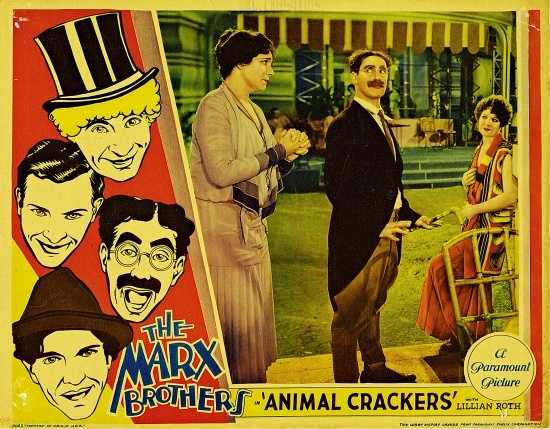
Animal Crackers (1930)


A straightforward adaptation of their hit stage play of the same name, Animal Crackers is flatly filmed but propelled along by the manic energy of the stars.


The slim plot revolves around society matron Mrs Rittenhouse (played by regular Marx brother foil Margaret Dumont) holding a lavish party to celebrate the return of Captain Spaulding (Groucho) and his secretary Horatio Jameson (Zeppo) from his latest jaunt to Africa. The Professor (Harpo) and Signor Emanuel Ravelli (Chico) have been hired to provide musical entertainment but spend most of the time wreaking havoc. There is a side plot involving Rittenhouse's daughter, her boyfriend, and a valuable work of art, but who cares?


Like many films of that era, the direction is a little flat with the camera barely moving. Luckily, the stars are on top form, with a mix of one liners and superb physical comedy, all shot through with surreal anarchy. Even Zeppo manages to keep pace, especially in a classic scene with Spaulding dictating a letter in gibberish legalese.


The film also gives us two songs that would go on to define Groucho. "Hooray for Captain Spaulding" became the theme of Groucho's radio and TV game show You Bet Your Life. "Hello I must be Going" was the opening number of his famous Carnegie Hall concert in 1972


There also a few topical jokes from the time that are fascinating to read about nowadays. The controversial Eugene O'Neill play Strange Interlude was still in the news in 1930. It sees characters regularly stopping what they are doing to give soliloquies to the audience. At several points Groucho spoofs this by turning to the camera and intoning a nonsense monologue in a deep sombre voice.


In addition, the character of Captain Spaulding shares a name with a real-life person, a US Army captain arrested for selling cocaine to movie stars of the day.


Sunday, 3 May 2020

Strangers on a Train (1951)


Strangers on a Train kicked off a golden era of work that would go on to include Dial M for Murder, Rear Window, North by Northwest, and Psycho. The subject matter is perfect for Hitchcock's mix of suspense and jet-black humour. The director packs the film with imagery, themes and great set pieces.

Bruno Antony (Robert Walker) reckons he has devised the perfect crime. While traveling on a train, he meets tennis player Guy Haines (Farley Granger). Bruno suggests the two strangers each agree to kill someone the other person wants gone. For Bruno, this means his hated father, and for Guy his wife Miriam, who will not grant him the divorce he craves to marry Anne Morton (Ruth Roman), the beautiful daughter of a U.S. Senator. Guy balks, but Bruno goes ahead and bumps off Miriam anyway. When Guy refuses to carry out his half of the bargain anyway, Bruno decides to frame Guy for the murder.

Strangers on a Train had a bumpy conception. Hitchcock fell out with the original screenwriter Raymond Chandler after a clash over their working styles. Hitch liked brainstorming sessions; Chandler preferred to be left alone to get on with the writing. Also, Hitchcock was not happy with being forced to cast the rather staid Granger and Roman, which was the price he paid for getting Walker.

It was a price worth paying because Walker creates one of my favourite screen villains. Intense, manipulative, but also vulnerable. Bruno starts off seeming to be in total control of the relationship between Haines and himself. This focus on his target is summed up in one image. Bruno sits in a crowd of people watching Guy play tennis. The heads of the crowd move from left to right as they follow the ball, but Bruno stays locked onto his target.

But the cracks start to show in his facade, and events being to spiral out of his control. A lighter stolen from Haines forms part of a plot to frame the tennis star for murder. But when Bruno loses the lighter down a drain, it becomes symbolic of his increasing desperation. The lighter almost feels like a magical object. If Bruno has it, he has some form of control over Guy.

The main recurring theme throughout the film is that of mirror images. This occurs in the main characters, as Bruno can be read as a Jungian shadow of Guy. It is in the editing, with the opening montage showing the two main characters heading to the train. They walk in opposite directions, but are otherwise indistinguishable. And the final scene mirrors the opening one, with a stranger inquiring "Aren't you Guy Haynes"? In this case, it is a harmless vicar. There are many more which reveal themselves with repeated viewings.

There are also other standard Hitchcock tropes. The police are portrayed as pig headed, stupid and unhelpful. It is left for Anne to do the bulk of the legwork to try and prove Guy's innocence.

The film also has a streak of jet-black comedy running through it. There is the knowing easy banter between Guy and the cop sent to tail him. And Pat (daughter of Alfred) Hitchcock plays Anne's sister, a character hilariously obsessed with the gory details of crime. In yet another mirror image reference, she becomes the focus of Bruno's unsavoury attention, as she bears an uncanny resemblance to Guy's late wife.


Tuesday, 28 April 2020

Doctor Who #5 The Keys of Marinus


The fourth story, Marco Polo, is missing in its entirety so it is straight onto the fifth. Writer Terry Nation makes a return after his triumph with the Daleks. It is a disjointed but enjoyable affair, even if the patchwork nature of the story is both a blessing and a curse.

The TARDIS arrive on a small island on the planet Marinus. The Doctor, his granddaughter Susan, and her former teachers Ian and Barbara meet Arbitan. He is the keeper of the Conscience of Marinus, a computer designed to keep law and order across the entire planet. It is under attack by humanoid beings called the Voord, who want to control the conscience. As a security device, the Conscience requires five keys. By blocking their access to the TARDIS, Arbitan forces the Doctor and his friends to go and look for them.

The first episode sets up an intriguing mystery. Creepy beings in diving suits and spiked helmets prowl around, while the cast disappear one by one. It feels like an Agatha Christie story.

After a quick bit of exposition, the story is up and away. A quest is set up, giving us one key per episode. The question of "why don't you just leave?" is also settled by having an invisible force field thrown around the TARDIS.

There is a mix of the established story format (they are separated from the TARDIS) with a new one (different worlds in each episode). This gives us a new world to explore each time, which means that while there is always something fresh, there is no chance to explore or develop the worlds or characters we meet. Which is a shame, as there are some interesting ideas here. I liked the decadent, Roman style planet. This is a place where life is devoted to leisure and people can have anything they want. Barbara can see that there is something sinister going on under the surface. There is a creepy atmosphere to that episode, with POV camera shots, and brains with eye stalks in a jar giving it the feel of a horror film. 

Later episodes are not as successful. One that sees everybody trapped in a mountainous region of the planet has a bewildering array of characters jammed into twenty minutes. The Doctor disappears for two of these episodes without a decent on-screen explanation. Off screen, there was no great drama, William Hartnell took a fortnight's holiday.

We also see them land in the middle of a classic locked room mystery. This turns into a courtroom drama, with Ian accused of murder.

The character development is a mixed bag, highlighting the problem that having too many companions poses to the story format. The Doctor continues to be more assertive despite being absent for two thirds of the story. Ian is still an unlikely but willing action man. Barbara also takes a more proactive role. This leaves poor Susan who just seems to scream and scream again. I am starting to understand Carole Anne Ford's frustrations with the role.


Monday, 27 April 2020

Doctor Who #3 - The Edge of Destruction


The Edge of Destruction is a two part story, conjured up at the last minute due to an episode shortfall. It is an unsettling, claustrophobic tale that also provides important character development.

The story sees the TARDIS seeming taken over by an alien force. The Doctor, his granddaughter Susan, and her teachers Ian Chesterton and Barbara Wright start acting strangely and even turn on each other.

The main character in this is the TARDIS itself. By presenting the ship as an enigmatic, seemingly conscious entity make the epsiodes feel like a haunted house story. It's definitely unsettling to see characters at each others throats. In particular the sight of Susan trying to attack people with a pair of Scissors, or the Doctor drugging Ian and Barbara after he suspects them of sabotage.

Compared to The Daleks there is less action, which means that the Doctor can take a bigger role. We also start to see a thaw in his icy character at the end. He even apologises to the others for not trusting them. This sees an end to the adversarial relationships the character enjoyed, and the start of them working together as a team.


Monday, 13 April 2020

The Giant Claw (1957)


Standard issue 1950s Sci-fi, with little to recommend beyond the hilariously goofy godawful puppet used for the titular character.

The plot is about a giant bird attacking cities around the world. There's no point trying to describe it, so I'll just show you a picture:


As usual with this genre, there is far too much talking and padding out the running time with stock footage. There's some gobbledygook about antimatter to explain the creature, but trying to understand it is a waste of time.

There is a doom laden apocalyptic tone at the end as the bird smashes up New York, but by then it's too little too late.


Doctor Who #2 - The Daleks


The Daleks is as important and ground-breaking as the previous serial An Unearthly Child. It also has some of the same issues with pacing.

The story starts with the Doctor, his granddaughter Susan, and their two fellow travellers Ian Chesterton and Barbara Wright landing the TARDIS in a petrified jungle. From there, they get caught up in a war between the Daleks, unseen creatures encased in distinctive mechanical shells and the Thals, an Aryan-like race of humanoids.

This incarnation of the Doctor has yet to settle down into the proactive heroic do-gooder we know and love. In the Daleks he sabotages the TARDIS to force everyone to explore the Dalek city. Ian remarks that the Doctor "has a knack for getting himself into trouble". Of course, that means it's not himself, but also his companions, two of whom are there against their will. Of course, if he had not, the Thals would have been eliminated by the Daleks. The Doctor remains a passive character in this story, with Ian leading the attempts to escape from the Daleks, and the later attack on their city.

There is some silly and frustrating padding, such as the scene with a Food making machine, and the pace of the story is at times glacial. It also soon becomes clear that too much inter-Dalek dialogue is grating and unlistenable. And why are the female Thals dressed like they're trying to be Playboy bunnies?

These minor quibbles aside, it is still a fantastic story. There is tension and a weird creepy atmosphere that runs throughout. The script has some undertones of racial intolerance and Nazis that would be explored further in later stories.

It's also fascinating to two things about both the Doctor and the Daleks. Firstly, at this stage, neither are encumbered by their own mythology. Secondly, how both have a very analogue 1960s version of advanced technology, with everything working from dials and printouts. And of course, the MacGuffin for the story is the mercury filled fluid link that, without which, the TARDIS is rendered completely immobile.


The Thing from Another World (1951)


The Thing from Another World is an entertaining mix of Cold War paranoia and Howard Hawks machismo.

The plot is based on "Who Goes There?", a short story by John W. Campbell. A group of scientists and US Air Force crew unearth a frozen flying saucer and its pilot near to their Arctic base. Unfortunately for them, the pilot has thawed out, is on the hunt for blood, and is impervious to their bullets.

There has been some confusion over who directed this film. Christian Nyby is the man on the credits, but. Howard Hawks, whose production company made the film, has often been mentioned as being the real talent behind the lens. Regardless of how true any claim is, there are some Hawks-like tropes, most noticeably in the rapid and overlapping dialogue.

In the original short story, the alien is a shape-shifter, imitating the characters, and causing tension and paranoia. In this version, it becomes a vegetable-based humanoid (memorably described as "an intellectual carrot"), immune to bullets and needing blood to regenerate. But there is still tension in the conflict between scientists and the military. The character of Dr Carrington in particular is shown as, if not an enemy, then at least a threat by wanting to reason with the creature rather than set it on fire. This makes a change from other sci-fi films of the era. Scientists are usually portrayed as the only people with the answers, working with or trying to keep the military in check.