Tuesday, 17 September 2019

The Body Snatcher (1945)


The Body Snatcher is a classic example of a film that has all the ingredients on paper, but which never comes to life.

The screenplay is based on a short story by Robert Louis Stevenson. The film stars no less than Boris Karloff as the title character, John Gray, a shifty cab driver who has a sideline sourcing and delivering dead bodies for top surgeon Wolfe "Toddy" MacFarlane (Henry Daniell, best known as Goebbels parody Garbitsch in Charlie Chaplin's The Great Dictator). Bela Lugosi has a small role as MacFarlane's other cadaver consultant, but the fact that he barely registers should be an alarm bell for the rest of the film.

Producer Val Lewton had previously given us Cat People, The Curse of the Cat People and I Walked with a Zombie. These films, despite their lurid titles, have an unsettling mix of atmosphere and ambiguity. This kept the viewer intrigued and on edge. Director Robert Wise would go on to have an eclectic career, from editing montages for Citizen Kane, to directing everything from low key noir classics like The Set Up to big budget epics like The Sound of Music and Star Trek: The Motion Picture
 
There are some interesting ideas in The Body Snatcher, particularly with regard to class, and how those at MacFarlane's level feel like they can get away with flouting the law. But, largely it is talk, endless talk, with little or nothing left to the imagination of the viewer, the central strength of Lewton's former work. One for the Karloff / Lewton / Lugosi completists only.


Thursday, 12 September 2019

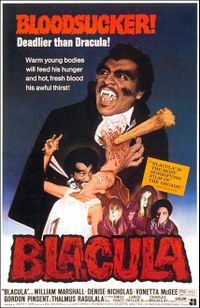
Blacula (1972)


Blacula is a fun and intriguing mash up of Blaxploitation and horror, with a dignified turn from William Marshall as the title character.

Marshall plays an 18th century African prince named Mamuwalde. He wants to bring his kingdom into the modern world, and, for some reason, turns to Count Dracula for help. Unsurprisingly, it does not go well, and instead of opening up global markets, Dracula opens up the veins in Mamuwalde's neck, seals him up in a coffin and leaves his wife Luva to die. Cut to the 1970s, and two interior decorators who are expanding their US property portfolio to include Transylvania. They unwittingly resurrect Mamuwalde after bringing him back to the US, leaving him free to pursue a woman he thinks is the reincarnation of his late wife.

This is cheap but cheesy fun and there has been some thought gone into the script.
 
The original Dracula story had the Van Helsing character to act as the counterpoint to Dracula (and exposition point for the audience). Wisely, Dr. Gordon Thomas (Thalmus Rasulala) plays that role here.

What is especially interesting is that all the main characters are black, and the producers made no attempt to introduce any kind of white saviour character.

The real star is William Marshall whose natural charisma manages to inject some dignity into the part of Mamuwalde, and make him a tragic rather than horrific character.


Sunday, 18 August 2019

Bruce Lee against Supermen (1975)


Any film with a title that great is only going to be a disappointment, and in this respect, Bruce Lee against Superman does not disappoint. It's part of an odd and crass sub genre of martial arts films cashing in on Lee's death with a similarly named star and little in the way of talent or story.

There's a half-hearted attempt at a plot, something involving a scientist who has worked out how to make food from petrol, but it feels more like a cheese induced fever dream. Bruce Li, aka Ho Tsung-Tao starts off playing a version of Cato from The Green Hornet, then seems to turn into somebody called Carter, who occasionally wears red pyjamas along with a bearded man who seems to be his boss or something. The Supermen wear black with little napkins for capes. One of them is the leader and the other two fall out with him for some reason.

While there are brief flashes of entertainingly unhinged nuttiness akin to Ed Wood or Ray Dennis Steckler (especially Rat Fink a Boo Boo) the real sin of this movie is to be mostly dull and boring.


Sunday, 11 August 2019

A Cat in the Brain (1990)


Lucio Fulci had a long career as a director, one that covered many styles. But he is best remembered for the gore splattered horror films he made from the late 70s onwards. A Cat in the Brain presents itself as a horror version of 8 1/2, a meta reflection on this particular genre, as well as Fulci's career, and his audience.

Fulci plays a fictional version of himself, a director in the middle of shooting his latest gory effort. Not only that but "Fulci" is also convinced he is going mad, sent over the edge by years of making horror films, and that he may be responsible for a series of slayings near his house.

For such an intriguing wacky premise with so much promise, the end result is surprisingly dreary and plodding.

Much of the footage in A Cat in the Brain is culled from half a dozen films Fulci was involved in a year or two previously, although none of them have anything to do with each other.

The mismatched incoherent tone is sometimes the perfect representation of a fractured disintegrating psyche, but often makes the film look cheap and poorly thought out.


Monday, 15 July 2019

Duck You Sucker (1971)


In Revolution-era Mexico, Juan (Rod Steiger) is a bandit with dreams of knocking over the country's biggest bank. When he meets wanted IRA terrorist John (James Coburn), Juan blackmails the Irishman into helping him. But the bank is as empty of money as it is full of political prisoners. After freeing them, Juan finds himself hailed as a revolutionary hero, but that means betrayal and tragedy are around the corner.

Director Sergio Leone kick-started the Spaghetti Western Genre with his ground-breaking 1964 film A Fistful of Dollars, and expanded on the template of amoral heroes, violent gun-play and eerie sun-baked apocalyptic atmosphere with For a Few Dollars More, The Good The Bad and The Ugly, and Once upon a Time in the West.

But, Duck You Sucker (aka A Fistful of Dynamite) feels like a step backwards, lacking some of the elements that made the other films work, particularly Clint Eastwood's Man with No Name character. In the Dollars Trilogy he's a tight lipped stoical man, who sets a tone of ambiguity and understatement. This provides a much needed contrast to the more outre characters. Here, Steiger and Coburn go for the thick cartoon brand of Mexican and Irish accents which soon become grating. Luckily, their natural presence and charisma stop the characters from being unwatchable. Also, the script is heavy handed with too much talk and exposition, while the soft focus flashbacks to John's back story become ludicrous.

Aside from occasional casual misogyny, Duck You Sucker has some more positive, familiar Sergio Leone traits. The Ennio Morricone soundtrack is as quirky, bombastic and haunting as his earlier work with the director. The action sequences, particularly the raid on the bank by Juan and his gang are brilliantly executed. The massacre of a large group of peasants by Mexican government troops is disturbing, and makes a contrast from the dismissive attitude to death often seen in this genre.


Sunday, 26 May 2019

Behemoth the Sea Monster (1959)


Cheap and cheerful, Behemoth the Sea Monster borrows from the American giant monster films of the 1950s, especially director Eugène Lourié's earlier influential classic The Beast from 20,000 Fathoms. It's worth a look for the novelty of the London setting, the appearance of Hammer Horror regular André Morell, and the final FX work by King Kong legend Willis O'Brien.

American scientist Steve Karnes (Gene Evans) is giving a speech to British scientists about marine life and the dangers by nuclear testing. Later, he learns of thousands of lifeless fish washed ashore on the Cornish coast and the death of a fisherman from radiation burns. Teaming up with Professor James Bickford (Morell) to investigate, the pair find a passenger ship destroyed, with the loss of all on board, while tests show the dead fish were full of radioactive contamination. Karnes begins to suspect the creature the fisherman described seeing is a beast mutated by nuclear testing, with a desire to come back to London.

In the first ten minutes we get all the tropes you expect from this genre. 1) A conference of scientists with ominous warnings. 2) A bureaucrat who dismisses said warnings. 3) A pretty girl, and a hunky love interest. 4) somebody having a deadly encounter with something, linked to the opening scene, and shot from the point of view of the something. 5) The dying man muttering portentous semi coherent warnings with his dying breath. Following this comes lots of padding, occasional exposition, further deaths and possible monster sightings. Finally, the full reveal of the monster and a trail of destruction. In this respect, Behemoth the Sea Monster is no different, but it is still entertaining for the most part. There is some hokey Dr Who level rubber glove puppet special FX, some atmospheric scenes in Cornwall, and the always watchable Morell.

In fairness, the stop motion monster in the final scenes is not too bad considering the low budget, and this was the final credited work of Willis O'Brien. While he did not invent the technique, he refined and brought it to popular attention through King Kong, inspiring the likes of Ray Harryhausen.

Lourie would go on to give the monster smashing up London in the more colourful and fun Gorgo. This took the action from destroying anonymous docks and houses, to smashing London landmarks like Tower Bridge.


Sunday, 17 February 2019

Sherlock Holmes and the Secret Weapon (1942)


Taking the master detective out of Victorian London into World War Two, Sherlock Holmes and the Secret Weapon has little in common with anything penned by Conan Doyle, but it is a hokey, entertaining spy thriller.

Holmes (Basil Rathbone) is up against his old nemesis Professor Moriarty (Lionel Attwill who had played Dr Mortimer in the earlier Rathbone version of The Hound of the Baskervilles), with both on the trail of a missing scientist and his invention, a revolutionary bomb sight that could change the course of the war.

The screenplay take it's cue from the Conan Doyle short story The Adventure of the Dancing Men, but there is little left of the original, beyond the plot device of an alphabet substitution code. The character of Holmes is a world away from the dispassionate Victorian gentleman, only taking cases that tickled his intellectual fancy. Here is a paid up patriotic Brit, doing his bit against the Nazis. As such there are no baffling, impossible murder mysteries to solve, just standard spy stuff like disguises and code breaking. Nevertheless, Rathbone brings the sort of energy and focus needed for the part, and Nigel Bruce as Watson is dimwitted but so charming and affable it is impossible not to like him.

In keeping with the secret agent feel of the film, Lionel Atwill plays Moriarty like a James Bond villain, and even has a secret lair with trapdoors and an entrance hidden by a moving bookcase.

The propaganda is kept to a minimum for most of the film, with the war being the McGuffin to drive a standard espionage plot. It only takes over in the closing minutes, with Holmes gazing wistfully into the distance reciting the "Fortress built by nature" speech from Richard II.