Thursday, 6 February 2020

Machine-Gun Kelly (1958)


Machine Gun Kelly is a change of pace from Roger Corman's more common 1950s output of cheap monster movies. It has an intelligent script, lean muscular direction from Roger Corman, and a brooding early performance from Charles Bronson.

Bronson plays George "Machine Gun" Kelly, a bank robber with two major obsessions - death, and a particular type of firearm. After a particularly successful job, Kelly is now Public Enemy Number One. Tensions grow in his gang, especially his partner in crime Flo Becker (Susan Cabot), who starts to question if he is a real man.

The screenplay uses Freudian elements to create a title character who is more than one dimensional. Kelly is infantilised by everyone around him. He has a fear of death that is repeatedly triggered by symbols that he sees. And he is a snivelling coward once deprived of his phallic machine gun. As well as making for interesting characterisation, this approach allows Corman to refute accusations that he is glorifying criminals.

Corman's directorial stylistic high point would come later, with his rich and surreal adaptions of several Edgar Allan Poe stories. Here, he shows the versatility and good taste to know that what he needs to do is to keep things focussed and moving. However, there are some great stylistic choices, such as the wordless opening sequence, showing a violent bank robbery that ends in the death of a security guard.




Sunday, 2 February 2020

Road to Morocco (1942)


The third of seven films Bob Hope and Bing Crosby made together during the 40s and 50s, Road to Morocco is pure entertainment that feels fresh and funny today.

The plot is never too important in these sorts of things, acting as a way of dumping the pair in the middle of nowhere so that they can wisecrack their way back home. In this case, the pair are shipwrecked after Hope blows up the vessel they were stowing away on, before drifting into Morocco.

Of course, being 1940s Hollywood, this is the 1940s Hollywood version of Morocco. Everybody is white and speaks either heavily accented English or gibberish. But, the series was always intended as a spoof of the hit film genres of the day, so it feels more like a parody of those tropes rather than a celebration.

The non stop wisecracking from Hope is broken up with an occasional musical interlude from Crosby, and Dorothy Lamour provides the love interest. There is also a charming and refreshing sense of self awareness. Hope regularly breaks the fourth wall to talk to the audience or complain about Crosby sabotaging his Oscar hopes. Even a Camel stops to comment on how this is the screwiest picture he's was ever been in.

Sunday, 19 January 2020

Wheels of Fire (1985)


Wheels of Fire is a competent action packed Mad Max knock-off, marred only by some dated 80s sexism.

The film is set in a post-apocalyptic (the reasons for this aren't clear, but don't matter) world. A permanently stubbled hero, Trace, spends his days riding around in his turbo boosted, flame throwing Ford Mustang, fighting marauding gangs.

There's a plot involving   a commune of people who want to fly to Mars in a homemade rocket, and an evil villain trying to wipe them out. Along the way Trace runs into a dwarf, a girl who has a hawk for a pet, a girl with telepathic powers, and a band of cave dwelling albino cannibals.

But, we're here for the car chases, gun battles and explosions, and Wheels of Fire does not disappoint. Nothing fancy or groundbreaking, but nothing unwatchably awful, just solid trashy entertainment. Plus, you have to admire any film with characters credited as Scum Woman 1 and Scum Woman 2.


Saturday, 2 November 2019

The Black Sleep (1956)


The Black Sleep is an intriguing and little seen low budget horror film, with a dream cast of genre veterans.

In Victorian England, a brilliant surgeon, Sir Joel Cadman (Basil Rathbone) is trying to find a way to revive his beloved wife from a coma caused by a brain tumor. But, his methods are a little unscrupulous, as Cadman employs a powerful anesthetic from India to induce a death like state in his test subjects. He uses it to snatch a fellow Doctor, Gordon Ramsey, from Death Row, where Ramsey is awaiting execution for a murder he denies carrying out. Cadman wants Ramsay's help, but as Ramsey soon discovers, not all Cadman's previous experiments have been so successful.

Rathbone is on fine form, making Cadman initially seem charming and even sympathetic, but slowly revealing him to be cruel and insane.

His co-stars are not always as lucky. Lon Chaney Jr hams it up as Mungo, a former scientific genius who has been turned into a crazed madman by the good doctor's experiments. But poor Bela Lugosi, in his final filmed role, is left without a word to say. The underwritten character of Cadman's butler feels like it was written to put Lugosi's name on the posters.

Tor Johnson, Lugosi's co-star in the Ed Wood films Plan 9 from Outer Space and Bride of the Monster, has some fun as the sort of lurking bulk of a monster he excelled at.

The highlight comes in the form of John Carradine, playing another of Cadman's victims. Carradine does not hold back, even by his usual standards, as the climax sees the inmates taking over the asylum.


Tuesday, 29 October 2019

Dolemite Is My Name (2019)


It's a testament to the charm of
Eddie Murphy that he makes the lead character of Dolemite Is My Name warm and sympathetic, despite that person's crude and sexist comedy. Along with a strong supporting cast, a lush period production design, and a well-structured script, this makes for a thoroughly entertaining film.

Murphy plays Rudy Ray Moore, a real life nightclub comic whose act was an early form of rapping. Wanting to break into the movies, he used his own money and a group of friends and volunteers to make outrageous cult Blaxploitation comedy Dolemite.

Moore offstage is often shown as a world away from his onstage persona, particularly through the character of Lady Reed. After meeting her in a bar following a show and hearing about her life of single motherhood, Moore encourages Reed to get on stage and tell her stories. When she becomes part of his show, she is always treated as an equal. Murphy effortlessly switches between the brash showman, and warm human being who understands and empathises with those who going through tough times. There are references to Moore's childhood, particularly an abusive stepfather who told him he would never amount to anything, but this is never turned into a simplistic single driving force behind Moore's ambition.

I know nothing about the real life Moore, and as it's a biopic I assume some liberties are taken with events and people. But, as a drama it's well constructed, taking time to establish the characters and their goals, and giving them plenty of obstacles to overcome along the way. 

One of the best scenes is Ray and his friends sitting in a packed cinema watching Jack Lemmon and Walter Matthau in The Front Page. They are baffled at how the white folks in the audience are falling about laughing at something they find unfunny. Looking behind him, Moore becomes transfixed on the light from the projector, until it becomes like a divine luminance from above, giving him an epiphany about the next stage of his career. 

Dolemite Is My Name made me think of two other films about filmmaking. Firstly, Ed Wood, Tim Burton's biopic about the cult 50s director. Like Moore, Wood is always optimistic, and will not take no for an answer. Both believe a person can reinvent themselves through sheer force of will.

The other is Sullivan’s Travels, Preston Sturges 1941 comedy. In it, John Sullivan, is a filmmaker who wants to leave behind the world of "mere" entertainment and make highbrow, socially conscious films. Eventually Sullivan has a change of heart and comes to the conclusion that "... there's a lot to be said for making people laugh". My Name is Dolemite has a similar conflict, through the character of Jerry Jones. The writer of the Dolemite screenplay, he wants to make a gritty thriller showing the realities of urban black life. Moore's instincts are towards entertainment, giving the audience a laugh and a few hours relief from their daily lives.


Tuesday, 17 September 2019

The Body Snatcher (1945)


The Body Snatcher is a classic example of a film that has all the ingredients on paper, but which never comes to life.

The screenplay is based on a short story by Robert Louis Stevenson. The film stars no less than Boris Karloff as the title character, John Gray, a shifty cab driver who has a sideline sourcing and delivering dead bodies for top surgeon Wolfe "Toddy" MacFarlane (Henry Daniell, best known as Goebbels parody Garbitsch in Charlie Chaplin's The Great Dictator). Bela Lugosi has a small role as MacFarlane's other cadaver consultant, but the fact that he barely registers should be an alarm bell for the rest of the film.

Producer Val Lewton had previously given us Cat People, The Curse of the Cat People and I Walked with a Zombie. These films, despite their lurid titles, have an unsettling mix of atmosphere and ambiguity. This kept the viewer intrigued and on edge. Director Robert Wise would go on to have an eclectic career, from editing montages for Citizen Kane, to directing everything from low key noir classics like The Set Up to big budget epics like The Sound of Music and Star Trek: The Motion Picture
 
There are some interesting ideas in The Body Snatcher, particularly with regard to class, and how those at MacFarlane's level feel like they can get away with flouting the law. But, largely it is talk, endless talk, with little or nothing left to the imagination of the viewer, the central strength of Lewton's former work. One for the Karloff / Lewton / Lugosi completists only.


Thursday, 12 September 2019

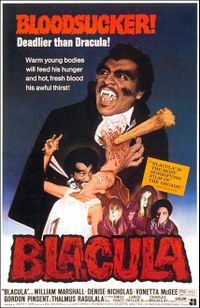
Blacula (1972)


Blacula is a fun and intriguing mash up of Blaxploitation and horror, with a dignified turn from William Marshall as the title character.

Marshall plays an 18th century African prince named Mamuwalde. He wants to bring his kingdom into the modern world, and, for some reason, turns to Count Dracula for help. Unsurprisingly, it does not go well, and instead of opening up global markets, Dracula opens up the veins in Mamuwalde's neck, seals him up in a coffin and leaves his wife Luva to die. Cut to the 1970s, and two interior decorators who are expanding their US property portfolio to include Transylvania. They unwittingly resurrect Mamuwalde after bringing him back to the US, leaving him free to pursue a woman he thinks is the reincarnation of his late wife.

This is cheap but cheesy fun and there has been some thought gone into the script.
 
The original Dracula story had the Van Helsing character to act as the counterpoint to Dracula (and exposition point for the audience). Wisely, Dr. Gordon Thomas (Thalmus Rasulala) plays that role here.

What is especially interesting is that all the main characters are black, and the producers made no attempt to introduce any kind of white saviour character.

The real star is William Marshall whose natural charisma manages to inject some dignity into the part of Mamuwalde, and make him a tragic rather than horrific character.