Showing posts with label Marx Brothers. Show all posts

Monday, 11 May 2020

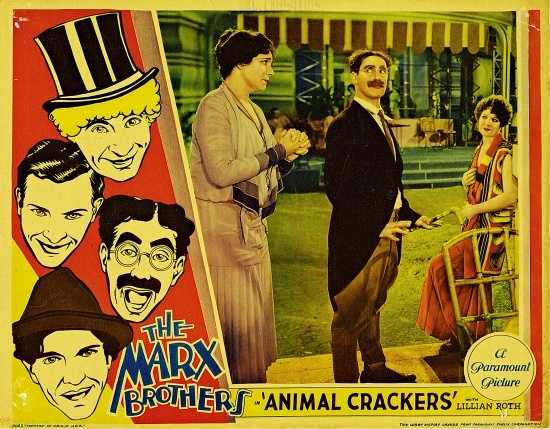
Animal Crackers (1930)


A straightforward adaptation of their hit stage play of the same name, Animal Crackers is flatly filmed but propelled along by the manic energy of the stars.


The slim plot revolves around society matron Mrs Rittenhouse (played by regular Marx brother foil Margaret Dumont) holding a lavish party to celebrate the return of Captain Spaulding (Groucho) and his secretary Horatio Jameson (Zeppo) from his latest jaunt to Africa. The Professor (Harpo) and Signor Emanuel Ravelli (Chico) have been hired to provide musical entertainment but spend most of the time wreaking havoc. There is a side plot involving Rittenhouse's daughter, her boyfriend, and a valuable work of art, but who cares?


Like many films of that era, the direction is a little flat with the camera barely moving. Luckily, the stars are on top form, with a mix of one liners and superb physical comedy, all shot through with surreal anarchy. Even Zeppo manages to keep pace, especially in a classic scene with Spaulding dictating a letter in gibberish legalese.


The film also gives us two songs that would go on to define Groucho. "Hooray for Captain Spaulding" became the theme of Groucho's radio and TV game show You Bet Your Life. "Hello I must be Going" was the opening number of his famous Carnegie Hall concert in 1972


There also a few topical jokes from the time that are fascinating to read about nowadays. The controversial Eugene O'Neill play Strange Interlude was still in the news in 1930. It sees characters regularly stopping what they are doing to give soliloquies to the audience. At several points Groucho spoofs this by turning to the camera and intoning a nonsense monologue in a deep sombre voice.


In addition, the character of Captain Spaulding shares a name with a real-life person, a US Army captain arrested for selling cocaine to movie stars of the day.


Saturday, 28 March 2015

Duck Soup (1933)


While not a hit on release, Duck Soup is now rightly regarded as a comedy classic and for my money it is definitely the most consistently laugh out loud funny of all of the Marx Brothers films.

The tiny fictional state of Freedonia is at the brink of war with neighbouring Sylvania, as well as being nearly bankrupt, with the leaders resorting to borrowing huge sums of money from a wealthy widow, Mrs. Teasdale (Margaret Dumont).  The catch is that she insists on replacing the current president with her friend, Rufus T. Firefly (Groucho Marx), despite his seeming lack of qualifications for the job. Within no time he has insulted her friend the Sylvanian ambassador and the two countries are on the brink of war. Time for Sylvania to send in their finest spies, Chicolini (Chico Marx) and Pinky (Harpo Marx).

Although often thought of as a satirical piece, Duck Soup is not the sort of focussed dissection that Chaplin would attempt a few years later with The Great Dictator. Instead, the key word is anarchy. Most Marx Brothers films revolve around them taking down pompous University Professors or Opera directors and the same applies here, the difference being that the context is political rather than the content. Just like their other classic films, we are introduced to a staid, controlled, highly ordered world before the human fireworks are thrown in.

The rest of the humour comes from the relentless barrage of puns and wordplay, Harpo's insane visual gags and the kind of physical comedy the brothers had been perfecting since their vaudeville days. The most famous is the mirror sequence, impossible to describe as the magic of it is in the flawless timing.


Although the Marx Brothers roots were on the stage, there are some signs here of them embracing the medium of cinema in their own way. For example, during the final battle sequence, there is a bizarre montage of everything from stampeding elephants, to fire engines responding to Groucho's call for reinforcements. 

The influence of Duck Soup can be seen in a number of artists from Woody Allen (especially his film Bananas, with it's surreal tangents and a plot based around tinpot potentates) to Sacha Baron Cohen's recent movie The Dictator. Duck Soup may be over 80 years old but the biting cynicism still helps it feel surprisingly fresh and modern too. “...while you're out there risking life and limb through shot and shell, we'll be in here thinking what a sucker you are”.